
You are currently browsing the tag archive for the ‘teachers’ tag.
The attack on Bill 25 has settled into a familiar script. Critics say it will make schools less welcoming, by which they mean that restricting ideological flag displays, limiting board activism, and requiring neutrality in certain forms of programming will make some students feel unseen or unwanted. It is an effective line because it hides a political claim inside the language of care. Nobody wants an unwelcoming school. The trick is that welcoming is being made to mean more than safety, decency, and respect.
A school should be safe, orderly, and humane. It should protect students from bullying, enforce standards of conduct, and make it possible for children to learn without fear or humiliation. What does not follow is the larger claim now being pushed by Bill 25’s opponents: that a public school must also visibly signal allegiance to a particular moral framework, and that if it stops doing so it has somehow become hostile.
“Protection is not the same as endorsement.”
That is the switch.
On the actual text, Bill 25 does not erase students, ban disagreement, or outlaw difficult topics. What it does is narrower, and more defensible, than its critics pretend. It pushes Alberta’s education law back toward institutional restraint. The bill revises parts of the Education Act’s language around school climate, requires courses and instructional materials to encourage a wide range of perspectives and foster critical thinking, says boards must refrain from taking political, social, or ideological positions unrelated to their duties, and requires certain non-approved programming to be impartial, fair, neutral, and free of personal bias. It also restricts school flags by default to the Canadian and Alberta flags, subject to later regulatory exceptions.
That is not a purge. It is a correction.
Now, the strongest version of the other side’s case is not hard to state. Some vulnerable students really do experience explicit symbols of affirmation as reassuring. Some will feel more at ease in an environment where support is made visible rather than merely promised in policy language. And because Bill 25 uses broad terms like “political, social or ideological” and refers to “common values and beliefs of Albertans,” it is fair to ask how those phrases will be applied in practice. A sloppy implementation could create confusion where schools need clarity.
Those are real concerns. They still do not settle the argument.
A public institution cannot make emotional reassurance the test for what it is allowed to endorse. The fact that some students feel comforted by visible institutional alignment does not mean the institution should align itself with a contested worldview. In a pluralistic public school, there will always be students who feel affirmed by one framework and alienated by another. The institution cannot solve that problem by choosing a side and calling the choice kindness. Its job is to protect students, maintain order, teach well, and show restraint in the use of its authority.
A public school is not a campaign office, a therapeutic identity space, or an activist workshop with a literacy block attached. It is a public institution. It belongs to families who do not agree with one another about politics, morality, religion, sex, identity, or the kind of society they want their children to inherit. Such an institution cannot remain trustworthy for long if it begins signaling that one contested framework has acquired official moral status.
This is why so much of the criticism of Bill 25 feels dishonest. It starts from a true premise and then quietly expands it. Some students are vulnerable. Fine. They deserve protection, dignity, and ordinary decency. But from that narrow duty of care, critics jump to a much broader demand: that the institution must visibly ratify a particular set of assumptions and display them as part of the school’s moral atmosphere. Protection becomes affirmation, affirmation becomes endorsement, and endorsement begins to drift into instruction.
“A school can protect a student without acting as a billboard for a worldview.”
That is the real dispute.
A teacher can treat every child with dignity without using classroom authority to suggest that contested beliefs about sex, identity, and society have already been settled beyond argument. A board can meet its legal obligations without issuing statements on every political controversy fashionable adults feel obliged to perform opinions about. Bill 25 does not solve all of this, but it does attempt to restore some institutional discipline where that discipline had plainly weakened.
As a teacher, that part is hard to ignore. I am not in the classroom to advertise my politics, recruit students into a moral sensibility, or drape school authority over my own preferred social vision and call the result compassion. I am there to teach. That means helping students read carefully, write clearly, listen seriously, and argue without slogans doing all the work for them. It also means knowing where my job ends.
That professional boundary now seems strangely difficult for some people to defend. They talk as though asking an institution to remain neutral is the same thing as demanding that individual students disappear. It is not. Bill 25 does not say students cannot exist as they are, think as they do, or discuss difficult questions. What it says, in substance, is that the institution itself should exercise more restraint in the positions it takes, the programming it allows outside the approved curriculum, and the symbolic alignment it displays as a public body.
That is a long way from the apocalyptic language being used against it.
None of this means the bill is perfect. It is not. The practical details will matter, and future regulations will matter even more. But arguing over those details is not the same as falsifying the centre.
And the centre is simple. A public school should not behave like an ideological camp that happens to issue report cards. It should teach students from many backgrounds under rules that are serious, fair, and publicly defensible. It should protect the vulnerable without demanding institutional allegiance to one faction’s beliefs. It should cultivate thought rather than posture, and trust rather than theatre.
The most dishonest move Bill 25’s opponents have made is to present neutrality as though it were hostility. That only works if one has already confused institutional discipline with emotional abandonment. Once every limit on symbolic activism is recast as an attack on children, no boundary remains. The institution becomes available for endless moral capture by whichever faction is best at translating its politics into therapeutic language.
That is not a school anyone should trust.
Bill 25 does not solve every problem in education. What it does do is move, however imperfectly, in the right direction. It treats the school as a public institution rather than a stage for institutional self-display. It reminds boards and educators that restraint is part of professionalism. It suggests, at long last, that children can be protected without making ideology the atmosphere everyone is expected to breathe.
That is not cruelty. It is maturity.

References
Bill 25 (official PDF):
Click to access 20251023_bill-025.pdf
Government of Alberta overview:
https://www.alberta.ca/removing-politics-and-ideology-from-alberta-classrooms
If “process legitimacy” is the immune system of pluralist democracy, then institutional behaviour on gender policy is a stress test. The question isn’t whether an organization “supports trans kids.” Most Canadians want distressed kids treated with compassion. The real question is whether a major institution preserves the rules that let citizens disagree without declaring each other enemies: transparent standards, viewpoint tolerance, due process, and consistent safeguarding norms.
On gender issues in Alberta schools, the Alberta Teachers’ Association (ATA) has repeatedly positioned itself against provincial policies that increase parental consent/notification requirements (for under-16 name/pronoun changes) and opt-in consent for certain explicit instruction around gender identity and sexuality. (Reuters) (Those positions are not obscure; they are central to ATA’s public posture around the province’s direction of travel.)
More important than the slogans is the procedural stance that shows up in teacher guidance: ATA-affiliated materials have explicitly cautioned educators against disclosing a student’s sexual orientation or gender identity to parents or colleagues without the student’s consent. (Office of Population Affairs) That is a high-stakes choice about where authority sits—between child, family, and school. You can argue for it. You can argue against it. But you can’t pretend it’s neutral. It quietly rewrites safeguarding defaults: the family becomes, at minimum, a conditional partner rather than the presumption.
Now add the evidence environment. Over the last two years the confidence level around pediatric medical interventions has become more openly disputed—not only in Europe but in the Anglosphere generally. A major American federal review published under HHS/OPA in late 2025 frames the evidence base for pediatric gender-dysphoria treatments as weak/low-certainty and calls for greater caution and higher standards of evidence. (Office of Population Affairs) Separately, a 2025 systematic review and meta-analysis focused on puberty blockers for youth with gender dysphoria rated the certainty of evidence as very low for many outcomes and called for higher-quality studies. (PMC)
None of that automatically tells Alberta what to do. But it does tell you what institutions shouldn’t do: treat a contested landscape as settled; treat caution as moral failure; treat parental involvement as presumptive danger; or treat dissent as “misinformation” rather than as disagreement about evidence thresholds and child-protection tradeoffs.
Because once an institution behaves that way, it teaches a poisonous lesson: the process is legitimate only when it produces the “right” outcomes. That’s outcome legitimacy wearing a procedural costume. And it’s exactly how you get an arms race in which every faction concludes it must “capture” the institution before the other faction does.
To be clear: there are serious researchers and clinicians who report short-term mental-health improvements in cohorts receiving gender-affirming medical interventions, and there are studies reporting low regret among youth who accessed puberty blockers/hormones in particular samples. (PubMed) That’s precisely why process legitimacy matters: when evidence is mixed, partial, or uncertain, the only adult stance is procedural humility—clear standards, honest uncertainty, room for argument, and policies that can survive being applied by your opponents next year.
Verdict (process-first, not tribe-first)
If an institution wants to avoid the “friend/enemy” trap on this file, it should stop acting like moral certainty is a substitute for good procedure. In practice that means:
- publish the evidence threshold being used (and why),
- separate student support from ideological doctrine,
- adopt viewpoint-neutral professional norms (no loyalty tests),
- and set safeguarding rules that can be defended symmetrically—not only when your side holds the pen.
That’s how you reduce ideological capture risk without replacing it with counter-capture. 🧯
Glossary 📌
Process legitimacy — Accepting an institution’s decision as binding even when you dislike the outcome, because rules were lawful, fair, transparent, and consistently applied.
Outcome legitimacy — Treating a process as legitimate mainly when it produces your preferred outcome.
Ideological capture — A condition where a contested worldview becomes so dominant in an institution’s norms and incentives that dissent is chilled and policy becomes insulated from evidence contestation and pluralism. (Best treated as an inference from mechanisms, not a slogan.)
Safeguarding — Child-protection norms and practices: role clarity, duty of care, appropriate parental involvement, documentation, escalation pathways, and risk management.
Low certainty evidence — A systematic-review judgment (often using GRADE) indicating limited confidence that an observed effect is real and durable; future studies may change the conclusion materially.
Puberty blockers (in this context) — Medications used to pause pubertal development; the debate concerns indications, outcomes, and risk–benefit in youth with gender dysphoria.
Citations 🧾
ATA / Alberta schooling context
- ATA-affiliated guidance on confidentiality around students’ sexual orientation/gender identity (GSA/QSA guide). (Office of Population Affairs)
American evidence review
- HHS/OPA report PDF: Treatment for Pediatric Gender Dysphoria: Review of Evidence and Best Practices (Nov 19, 2025). (Office of Population Affairs)
- HHS press release summarizing the report (Nov 19, 2025). (HHS.gov)
- Scholarly critique/response to the HHS report (J Adolesc Health, 2025). (JAH Online)
Systematic review on puberty blockers
- Miroshnychenko et al. 2025 systematic review/meta-analysis (PubMed + full text). (PubMed)
Evidence suggesting benefit / satisfaction in some cohorts (for balance and accuracy)
- Tordoff et al. 2022 (JAMA Network Open): association with lower depression/suicidality over 12 months. (JAMA Network)
- Olson et al. 2024 (JAMA Pediatrics): satisfaction/regret findings in youth accessing blockers/hormones (regret rare in that sample). (JAMA Network)
See Jonathan Kay’s X thread on the queering of outdoor education.
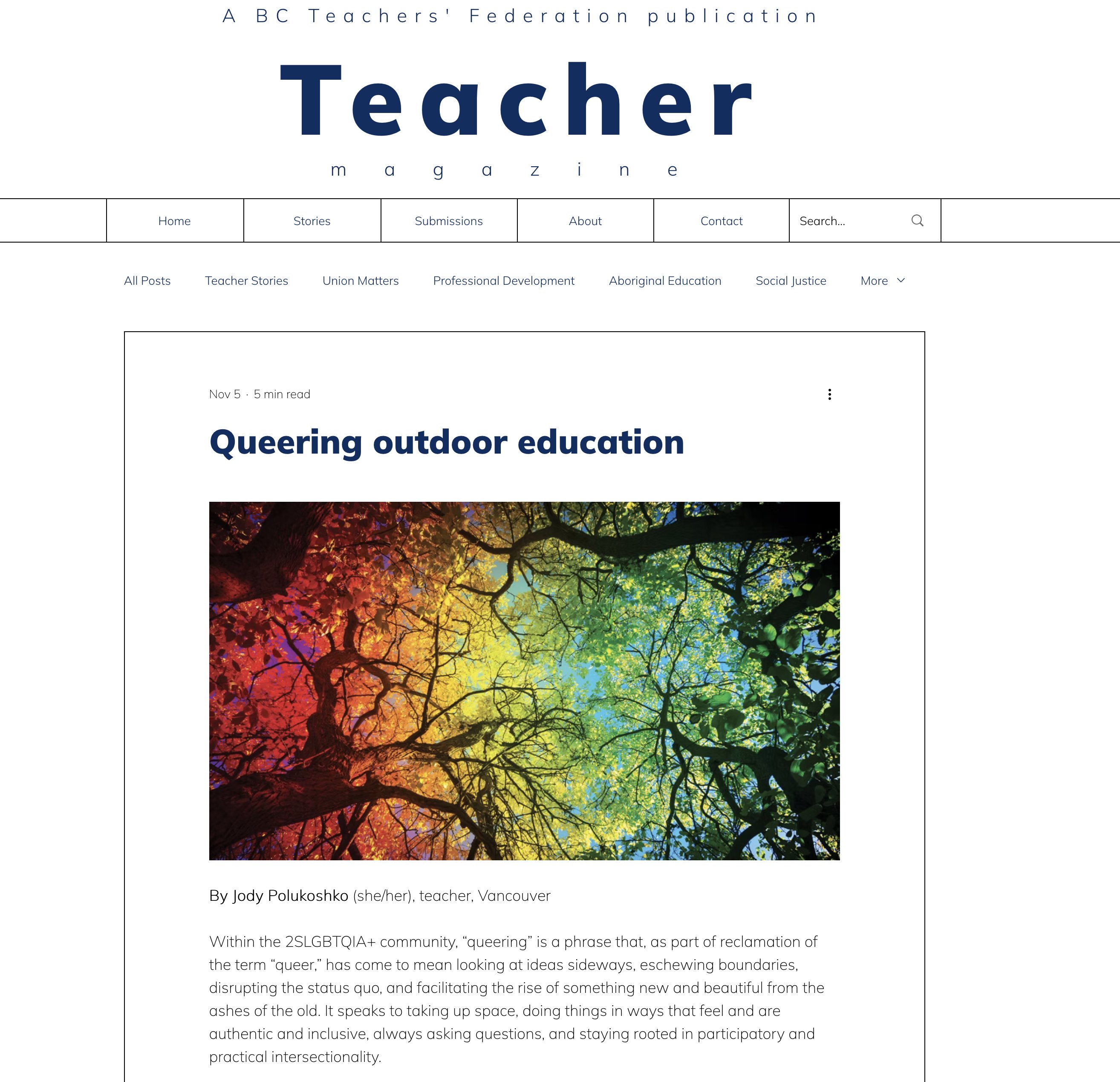
The British Columbia Teachers’ Federation (BCTF) has introduced a framework termed “Queering Outdoor Education,” which integrates queer theory, drag pedagogy, and decolonial approaches into environmental learning. This curriculum comprises lessons that encourage students to interpret natural phenomena through the lens of fluid identities, anti-normative critique, and social justice. While the framework is promoted as fostering inclusivity and challenging colonial and heteronormative assumptions, it raises substantive concerns regarding developmental appropriateness, educational clarity, and the potential for early ideological enculturation.
Metaphor and Conceptual Instability
The initial lessons employ metaphor as a primary pedagogical tool. Students are encouraged to draw analogies between natural elements—such as clouds, logs, or plants—and human identities, emphasizing fluidity and anti-essentialist perspectives. While metaphor can be valuable in education, these lessons risk overextending conceptual abstraction, replacing concrete environmental observation with ideological instruction. For children, particularly in early or middle childhood, excessive abstraction can hinder cognitive development by conflating empirical phenomena with normative social and political constructs.
Additionally, the curriculum critiques conventional linguistic frames, including metaphors like “birds and the bees,” positioning them as instruments of colonial and heteronormative power. Such framing may introduce complex sociopolitical interpretations into contexts traditionally reserved for foundational biological and ecological learning, potentially overwhelming young learners.
Moralizing Nature and Identity
Subsequent lessons extend these metaphorical frameworks into moral and social instruction. Students are asked to emulate the perceived allyship of natural objects and to conceptualize human identities in terms of ecological hierarchies, categorizing queer identities as “native” and others as “invasive.” While intended to promote reflection on inclusion and belonging, these exercises risk essentializing human worth according to ideologically charged criteria, substituting experiential learning with prescriptive social norms. By conflating ecological systems with social hierarchies, the curriculum may foster confusion rather than ethical understanding, undermining both environmental literacy and social cohesion.
Sexualization and Performative Instruction
The later lessons introduce overtly sexualized and performative elements, including the celebration of non-reproductive animal behaviors and the incorporation of drag-based exercises into outdoor activities. While drag pedagogy emphasizes self-invention and challenges normative binaries, its application to children’s environmental education raises questions of age-appropriateness. Embedding explicit discussions of sexuality and performative gender in contexts intended to cultivate observation, curiosity, and engagement with nature may distract from core learning objectives and impose adult conceptual frameworks onto immature cognitive and moral development.
Implications for Pedagogy
The queering of outdoor education exemplifies a broader pedagogical tension between radical inclusivity and the developmental needs of children. Integrating complex adult theoretical frameworks into early environmental education risks destabilizing students’ conceptual understanding, substituting guided inquiry with ideological instruction. While well-intentioned, such approaches may inadvertently limit children’s capacity for independent exploration, critical reasoning, and unmediated interaction with the natural world. Educational practice promote the idea of equality, not equity, along with the preservation of developmental appropriateness and cognitive accessibility.
Glossary
- Queer Pedagogy: An educational approach that incorporates queer theory to challenge traditional assumptions about gender, sexuality, and identity.
- Drag Pedagogy: A subset of queer pedagogy emphasizing performance, self-invention, and the destabilization of normative social roles.
- Decolonial Education: Curriculum frameworks aimed at addressing and countering the legacies of colonialism, often by centering Indigenous perspectives.
- Anti-Normative Critique: A critical approach that questions conventional social, cultural, or gender norms.
- Cognitive Development: The mental growth and acquisition of knowledge, reasoning, and understanding in children.
- Ideological Enculturation: The process of instilling a particular worldview or set of political beliefs, often through education.
References
- British Columbia Teachers’ Federation. Queering Outdoor Education Newsletter. 2025.
- Lacandona, Gaia. Drag Pedagogy: Performance and Learning. 2018.
- Polukoshko, Jody. Queer and Decolonial Approaches to Outdoor Learning. BCTF publication, 2024.
- Sumara, Dennis. Alternative Pedagogies and Cognitive Development: A Critical Review. 2017.
Suggested Readings Critiquing Queer Pedagogy
- Lindsay, James & McEwen, Bob. Critical Pedagogy and the Limits of Ideological Education. 2021.
- Wood, Peter. The Manipulation of Youth: How Ideology Enters the Classroom. 2019.
- Scholes, Robert. Childhood, Ideology, and the Limits of Social Theory. 2018.
- Davies, Belinda. Rethinking Radical Curricula: Balancing Innovation with Developmental Appropriateness. 2020.
 I’ve been around the mulberry bush a couple of times about teachers and unions. It’s nice when someone puts a piece together that concisely answers the usual bally-hoo about how bad unions are and how things would be fixed if there was just more free market, because more competition always fixes everything all the time no matter what how dare you even question that assumption you commie pinko-intellectual socialist!!!1!
Lie #1: Unions are undermining the quality of education in America.
Teachers unions have gotten a bad rap in recent years, but as education professor Paul Thomas of Furman University tells AlterNet, “The anti-union message…has no basis in evidence.” In fact, Furman points out, “Union states tend to correlate with higher test scores.” As a 2010 study conducted by Albert Shanker Fellow Matthew Di Carlo found, “[T]he states in which there are no teachers covered under binding agreements score lower [on standardized assessment tests] than the states that have them… If anything, it seems that the presence of teacher contracts in a state has a positive effect on achievement” – by as much as three to five points in reading and math at varying grade levels.
Even so, Thomas doesn’t believe that high test-scores should be taken as the primary indication that union teachers are good for kids, noting that “union states tend to be less burdened by poverty while ‘right-to-work’ (non-union) states are disproportionately high-poverty” – and poverty, as we well know , has its own, profound impact on student performance.
For these reasons among others, union presence can never be isolated as the sole relevant factor in producing higher student achievement. But teachers unions are still important to student success. Why? Most importantly, perhaps, because they fight for equality of opportunity in education by, for example, opposing attempts to resegregate American schools . One of the reasons the CTU so resolutely opposed the school closures Rahm Emanuel and the Chicago Board of Education threatened was because closures have proven to have disastrous consequences for displaced students in Chicago, who are generally forced to move from one underfunded, low-performing school to another. Teachers unions oppose such injustices because they support the rights of all children to have access to high-quality education — not just the kids whose parents can afford high property taxes. That’s a good thing for America’s education system, not a bad one.
The debacle that is going on down in Wisconsin is enough to make a person ill. The Daily Show comes through to show how tainted the corporate media actually is and how egregiously the population is affected by corporate propaganda.
In Canada watch the clip here.
In the US and possible elsewhere go here.
How do you fix the budget? Attack the poor and middle class. It is a message that never loses traction.











 bleatmop
 Mystro


 Dead Wild Roses
Your opinions…