
You are currently browsing the tag archive for the ‘Education Policy’ tag.
The attack on Bill 25 has settled into a familiar script. Critics say it will make schools less welcoming, by which they mean that restricting ideological flag displays, limiting board activism, and requiring neutrality in certain forms of programming will make some students feel unseen or unwanted. It is an effective line because it hides a political claim inside the language of care. Nobody wants an unwelcoming school. The trick is that welcoming is being made to mean more than safety, decency, and respect.
A school should be safe, orderly, and humane. It should protect students from bullying, enforce standards of conduct, and make it possible for children to learn without fear or humiliation. What does not follow is the larger claim now being pushed by Bill 25’s opponents: that a public school must also visibly signal allegiance to a particular moral framework, and that if it stops doing so it has somehow become hostile.
“Protection is not the same as endorsement.”
That is the switch.
On the actual text, Bill 25 does not erase students, ban disagreement, or outlaw difficult topics. What it does is narrower, and more defensible, than its critics pretend. It pushes Alberta’s education law back toward institutional restraint. The bill revises parts of the Education Act’s language around school climate, requires courses and instructional materials to encourage a wide range of perspectives and foster critical thinking, says boards must refrain from taking political, social, or ideological positions unrelated to their duties, and requires certain non-approved programming to be impartial, fair, neutral, and free of personal bias. It also restricts school flags by default to the Canadian and Alberta flags, subject to later regulatory exceptions.
That is not a purge. It is a correction.
Now, the strongest version of the other side’s case is not hard to state. Some vulnerable students really do experience explicit symbols of affirmation as reassuring. Some will feel more at ease in an environment where support is made visible rather than merely promised in policy language. And because Bill 25 uses broad terms like “political, social or ideological” and refers to “common values and beliefs of Albertans,” it is fair to ask how those phrases will be applied in practice. A sloppy implementation could create confusion where schools need clarity.
Those are real concerns. They still do not settle the argument.
A public institution cannot make emotional reassurance the test for what it is allowed to endorse. The fact that some students feel comforted by visible institutional alignment does not mean the institution should align itself with a contested worldview. In a pluralistic public school, there will always be students who feel affirmed by one framework and alienated by another. The institution cannot solve that problem by choosing a side and calling the choice kindness. Its job is to protect students, maintain order, teach well, and show restraint in the use of its authority.
A public school is not a campaign office, a therapeutic identity space, or an activist workshop with a literacy block attached. It is a public institution. It belongs to families who do not agree with one another about politics, morality, religion, sex, identity, or the kind of society they want their children to inherit. Such an institution cannot remain trustworthy for long if it begins signaling that one contested framework has acquired official moral status.
This is why so much of the criticism of Bill 25 feels dishonest. It starts from a true premise and then quietly expands it. Some students are vulnerable. Fine. They deserve protection, dignity, and ordinary decency. But from that narrow duty of care, critics jump to a much broader demand: that the institution must visibly ratify a particular set of assumptions and display them as part of the school’s moral atmosphere. Protection becomes affirmation, affirmation becomes endorsement, and endorsement begins to drift into instruction.
“A school can protect a student without acting as a billboard for a worldview.”
That is the real dispute.
A teacher can treat every child with dignity without using classroom authority to suggest that contested beliefs about sex, identity, and society have already been settled beyond argument. A board can meet its legal obligations without issuing statements on every political controversy fashionable adults feel obliged to perform opinions about. Bill 25 does not solve all of this, but it does attempt to restore some institutional discipline where that discipline had plainly weakened.
As a teacher, that part is hard to ignore. I am not in the classroom to advertise my politics, recruit students into a moral sensibility, or drape school authority over my own preferred social vision and call the result compassion. I am there to teach. That means helping students read carefully, write clearly, listen seriously, and argue without slogans doing all the work for them. It also means knowing where my job ends.
That professional boundary now seems strangely difficult for some people to defend. They talk as though asking an institution to remain neutral is the same thing as demanding that individual students disappear. It is not. Bill 25 does not say students cannot exist as they are, think as they do, or discuss difficult questions. What it says, in substance, is that the institution itself should exercise more restraint in the positions it takes, the programming it allows outside the approved curriculum, and the symbolic alignment it displays as a public body.
That is a long way from the apocalyptic language being used against it.
None of this means the bill is perfect. It is not. The practical details will matter, and future regulations will matter even more. But arguing over those details is not the same as falsifying the centre.
And the centre is simple. A public school should not behave like an ideological camp that happens to issue report cards. It should teach students from many backgrounds under rules that are serious, fair, and publicly defensible. It should protect the vulnerable without demanding institutional allegiance to one faction’s beliefs. It should cultivate thought rather than posture, and trust rather than theatre.
The most dishonest move Bill 25’s opponents have made is to present neutrality as though it were hostility. That only works if one has already confused institutional discipline with emotional abandonment. Once every limit on symbolic activism is recast as an attack on children, no boundary remains. The institution becomes available for endless moral capture by whichever faction is best at translating its politics into therapeutic language.
That is not a school anyone should trust.
Bill 25 does not solve every problem in education. What it does do is move, however imperfectly, in the right direction. It treats the school as a public institution rather than a stage for institutional self-display. It reminds boards and educators that restraint is part of professionalism. It suggests, at long last, that children can be protected without making ideology the atmosphere everyone is expected to breathe.
That is not cruelty. It is maturity.

References
Bill 25 (official PDF):
Click to access 20251023_bill-025.pdf
Government of Alberta overview:
https://www.alberta.ca/removing-politics-and-ideology-from-alberta-classrooms
One of the most corrosive habits in current political discourse is the way plain factual claims get assigned a partisan label. Not arguments. Not policies. Facts. Or, more precisely, statements that point back to material reality, institutional limits, or ordinary human constraints. In theory, facts are supposed to discipline ideology. In practice, they are often treated as ideological aggression when they obstruct a preferred moral script.
That is what people are reaching for when they say facts are now treated as right-wing. The phrase is blunt, but it points to something real. In a growing number of disputes, especially around sex, gender, speech, and institutional policy, a person can say something materially true and be treated not as a participant in debate but as a moral suspect. The point is not answered on its merits. It is recoded as a signal of contamination. The speaker is no longer heard as describing reality. He is heard as choosing a tribe.
That shift matters because it changes the structure of argument. Once a factual claim is socially coded as “right-wing,” the burden quietly moves. The question is no longer whether the claim is true. The question becomes why you said it, what kind of person says such things, and who might feel endangered by hearing it. Motive replaces mechanism. Stigma replaces rebuttal. The claim is not refuted so much as quarantined.
You can see this clearly in disputes over sex and pronouns. For many people, saying that sex is real, binary in the ordinary human sense, and not altered by self-declaration is not an act of hostility. It is a claim about reality and a claim about language. “He” and “she” historically track male and female persons. Refusing to detach those words from sex is not, on its face, a partisan performance. It is an attempt to keep public language tethered to the material world rather than to inward identity claims.
“The disagreement is not mainly about politeness. It is about which reality gets public authority.”
That is exactly why the issue generates so much heat. The disagreement is not mainly about politeness. It is about which reality gets public authority. Does language track bodies, or does it track self-declared identity? Does a school treat sex as a stable feature of the world, or does it treat identity assertion as the governing fact? Those are not small etiquette disputes inflated by the internet. They are conflicts about ontology, law, and institutional power.
Canada now offers several live examples. Alberta’s Education Amendment Act requires parental notification when a student requests a gender identity-related preferred name or pronouns, and parental consent for students under 16 before staff may use them. The province says these changes are part of supporting families and setting clear school rules, with the remaining education amendments anticipated to take effect on September 1, 2025. Then, in late 2025, Alberta escalated further. Bill 9 invoked the notwithstanding clause to shield not only this school policy but other contested sex-and-gender measures from being struck down by the courts. That bundling matters. It shows this is no longer being treated as a narrow administrative disagreement, but as a foundational conflict over parental authority, child development, and the public meaning of sex.
Quebec presents the same fracture from the opposite direction, and it is ongoing now. Current reporting says a Montreal teacher is challenging the provincial policy that allows students 14 and older to change the name and pronouns used at school without parental consent. The teacher alleges she was required to use male pronouns at school while using female pronouns with the student’s parents. A preliminary hearing on anonymity and confidentiality was held on March 6, 2026, with the broader merits challenge still to come. Strip away the activist packaging and the conflict becomes plain: can institutional professionals be required to maintain two vocabularies of reality depending on the audience, and if they object, are they making an ethical argument or committing a moral offense?
The Barry Neufeld case in British Columbia shows the institutional end point of this logic. On February 18, 2026, the B.C. Human Rights Tribunal issued its decision and ordered substantial damages after finding that multiple publications were discriminatory, while some crossed the threshold into hate speech. That does not prove that every factual objection to gender ideology is punishable. It does show how readily dissent can be processed through systems that move from moral condemnation to formal classification. Once that line is crossed, everyone watching understands the lesson. The risk is no longer simply that you will be called wrong. The risk is that you will be treated as a public contaminant.
This is why the familiar “both sides are just choosing different facts” formula goes soft in exactly the wrong place. The conflict is not symmetrical. One side is generally making claims about bodies, language, legal authority, and institutional procedure. The other is often demanding that those things yield to identity-based recognition norms. Dignity is real and relevant. But dignity does not erase biological category, dissolve observable sex, or transmute factual disagreement into literal violence.
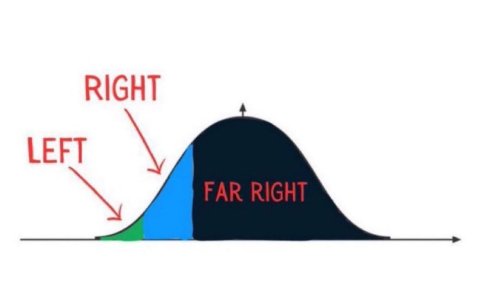
So when people say facts are treated as right-wing, the point is not that truth literally belongs to one side of the spectrum. The point is that in a culture saturated with moral performance, inconvenient facts are often recoded as partisan because it is easier to stigmatize them than to answer them. A factual claim that disrupts the script is no longer processed as description. It is processed as dissent. And dissent, under current conditions, is increasingly treated as a character defect.
Facts do not have a party. But when facts obstruct an ideological narrative, that narrative will often brand them right-wing and move straight to motive-policing. That is not a sign that the facts have changed. It is a sign that too much of public discourse has become allergic to reality when reality refuses to flatter the creed.
References
Government of Alberta. “Supporting Alberta students and families.”
https://www.alberta.ca/supporting-alberta-students-and-families
Government of Alberta. “Protecting youth, supporting parents, and safeguarding female sport.”
https://www.alberta.ca/protecting-youth-supporting-parents-and-safeguarding-female-sport
Global News. “Montreal teacher challenges policy for trans students to hide identity from parents.” March 6, 2026.
https://globalnews.ca/news/11719392/montreal-teacher-trans-students-challenge/
British Columbia Human Rights Tribunal. Chilliwack Teachers’ Association v. Neufeld (No. 10), 2026 BCHRT 49. February 18, 2026.
https://www.bctf.ca/docs/default-source/for-news-and-stories/49_chilliwack_teachers-_association_v_neufeld_no_10_2026_bchrt_49.pdf?sfvrsn=2d847803_1











 bleatmop
 Mystro
 The Arbourist


 Dead Wild Roses
Your opinions…