
You are currently browsing the tag archive for the ‘Sex and Gender’ tag.
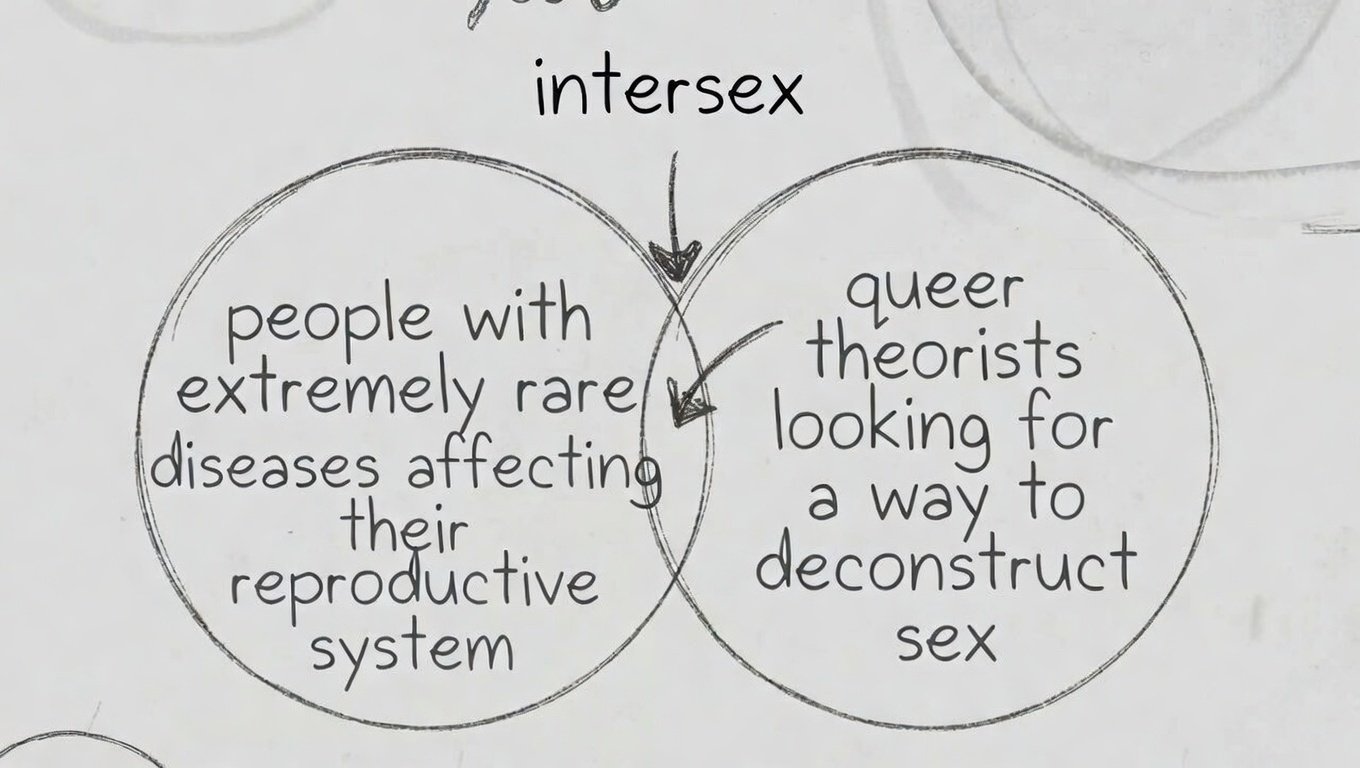
This image makes a simple point: “intersex” does not mean a third sex. It refers to rare medical disorders affecting sexual development. The criticism here is that queer theorists often use those rare exceptions rhetorically to blur or deconstruct the basic reality that sex is male or female.
Some political movements seek to reform institutions. Gender ideology asks for something larger and stranger. It asks society to treat subjective identity as more authoritative than sexed embodiment, and then to reorganize language, law, education, medicine, and intimate social norms around that priority. The promise is liberation from constraint. The reality is collision. When the self is treated as sovereign over the body, every boundary that still reflects sex begins to look like an injustice in need of correction.
That point has to be stated carefully. This essay is not a denial that some people experience genuine dysphoria, distress, or alienation from their bodies. Nor is it a claim that every trans-identifying person arrives at that identity through the same motives, pathways, or degree of ideological commitment. The target here is narrower and more political: an activist doctrine that turns subjective identification into a public demand, treats resistance as harm, and insists that the rest of society ratify its claims even where doing so dissolves clarity, boundaries, and truth.
At its most ambitious, gender ideology offers a redemptive promise. The conflict between self and body can be resolved. Alienation can be overcome. The old constraints of sex can be socially, medically, and linguistically superseded. The person need not reconcile himself to reality. Reality can be revised until it reflects the inner claim. But that promise carries a built-in instability. The body does not cease to be sexed because the surrounding vocabulary changes. Social reality does not become infinitely plastic because institutions adopt new rules. Other people continue to perceive bodies as they are, not merely as they are declared to be. Where the doctrine expects resolution, it encounters friction.
“Women are told to absorb the contradiction and treat it as progress.”
That friction matters because it does not remain abstract for long. Women’s boundaries are among the first places where sex remains socially visible and morally non-negotiable. Changing rooms, shelters, prisons, sports, hospital wards, quotas, maternity language, and the ordinary right to name male bodies as male all become targets once identity is treated as sovereign. The demand is not merely for courtesy. It is for override. Women are told to absorb the contradiction and treat it as progress. If they object, their objection is rarely treated as a competing rights claim grounded in privacy, vulnerability, fairness, dignity, or safety. It is moralized as exclusion, cruelty, or hatred.
This is where the negative-idealist mechanism, already traced in earlier essays, sharpens into focus. In a visible subset of male transition pathways, the conflict is intensified by a contested but persistent pattern: autogynephilia, the eroticization of the self as female. The concept is disputed and does not explain every case. Even so, it accounts for observable features in some trajectories: fantasy-driven identification, idealized femininity, online reinforcement, and a demand that others ratify the internal image as socially real. Where that pattern is present, sexed reality appears not as a limit to be reckoned with, but as an insult to be overcome. What cannot be secured inwardly is demanded outwardly through language, ritual affirmation, institutional policy, and the erosion of boundaries once thought too basic to require defense.
Institutions then inherit the contradiction. They are asked to affirm that sex is real enough to matter in medicine, reproduction, and anatomy, but unreal or irrelevant wherever women seek exclusion, protection, or clear naming. They are asked to treat words as both descriptive and compulsory, as if language were a branch of ethics rather than a tool for tracking reality. They are asked to uphold fairness while denying the relevance of the sex differences that made female categories necessary in the first place. The result is not ordinary accommodation. It is organized unreality, maintained by euphemism, fear, and social pressure.
Once the doctrine reaches this stage, dissent can no longer be treated as ordinary disagreement. Neutral refusal leaves sex standing. Clear language leaves the body visible. Female boundaries leave the claim of total override incomplete. So resistance must be moralized. Women defending sex-based spaces become aggressors. Parents asking for caution become extremists. Professionals who refuse to lie become threats. The contradiction is externalized so the doctrine can remain innocent. What it cannot resolve, it accuses.
“The result is not ordinary accommodation. It is organized unreality, maintained by euphemism, fear, and social pressure.”
At that point the familiar mechanism returns. The promised reconciliation between self and world fails to arrive in full. The body remains sexed. Other people keep noticing. Boundaries persist. Tradeoffs refuse to disappear. Rather than treating this as evidence that the doctrine asks too much of reality, the movement interprets the friction as proof that enemies remain active. A purified horizon is announced. Reality fails to comply. The gap is moralized. The search for the guilty begins.
The cost is now visible everywhere. Women lose the confidence to defend boundaries without being cast as moral offenders. Institutions lose the ability to speak plainly about sex without fear of sanction. Children are taught contested metaphysical claims as though they were settled truths. And a doctrine too unstable to secure assent through evidence alone increasingly relies on compulsion, euphemism, intimidation, and institutional pressure. What begins as a politics of identity becomes a politics of override.
The problem, then, is not simply that gender ideology is confused, though it often is. It is that confusion has been translated into policy, pedagogy, and compulsion. A doctrine built on unstable metaphysics now presses against some of the most basic social distinctions human beings have long relied on: male and female, mother and father, privacy and exposure, fairness and force, truth and courtesy. Because the doctrine cannot secure its claims through evidence or peaceful coexistence alone, it increasingly seeks protection through euphemism, intimidation, and institutional pressure. That is why the breakdown of female boundaries is not a side issue. It is one of the clearest signs that the ideology has moved from private belief to coercive social power.
When a movement cannot make reality yield, it begins by demanding silence and ends by punishing those who still name what they can see.

When an ideology cannot make reality yield, women are often told to bear the cost in silence.
When people say “trans rights,” they often smuggle in the conclusion before the argument has even begun. The phrase suggests a class of basic liberties being withheld from a minority population. In most liberal democracies, that is not the real dispute. Trans-identifying people already possess the same ordinary civil rights as everyone else: to vote, work, speak, worship, associate, and live free from assault or arbitrary exclusion. The real conflict begins when contested demands are framed as rights claims in order to place them beyond criticism.
That distinction matters. A right is not the same thing as a demand for access, validation, or institutional compliance. Female sports were not created out of prejudice, but out of recognition that sex differences matter in strength, speed, endurance, and physical risk. Female shelters, prisons, and changing rooms were built on the same logic. They exist because privacy, safety, fairness, and dignity are not imaginary goods. They are concrete protections, won through long struggle, and they do not cease to matter because a new vocabulary has been imposed on the debate.
Once this is seen clearly, much of the rhetoric falls apart. If a male-bodied person demands entry into a female space, the objection is not that he lacks human worth. It is that women have sex-based boundaries, and those boundaries exist for reasons. If a parent objects to gender ideology in schools, that is not the denial of anyone’s basic rights. It is the defense of parental authority in an area of profound moral and developmental consequence. If a citizen resists compelled pronouns or refuses to treat metaphysical claims about sex as binding fact, that is not violence. It is a refusal to surrender conscience and language to activist pressure.
“When one group’s ‘rights’ require another group to surrender privacy, fairness, or conscience, the conflict is no longer about equality. It is about power.”
This is where the phrase “trans rights” does its real work. It pre-loads the moral verdict. It makes disagreement sound like oppression before the argument has even begun. Once that framing is accepted, women’s boundaries become cruelty, parental caution becomes hatred, and democratic disagreement becomes abuse. But this is not a serious use of rights language. It is a way of insulating contested claims from scrutiny by wrapping them in the prestige of civil rights.
None of this means every accommodation is unreasonable, or that every dispute is zero-sum. Ordinary civility and equal treatment in public life are not difficult standards to defend. But when one group’s claimed “rights” require another group to surrender privacy, fairness, language, or the right to maintain sex-based boundaries, the conflict has moved beyond equal citizenship. It has become a struggle over whose moral framework will rule, and whose objections will be permitted to count.
That is why the language matters. “Trans rights” sounds like a plea for equal liberty. In many of the most contentious cases, it is something else: a demand that others yield, affirm, and rearrange long-standing social boundaries on command. When women refuse that erasure, or parents refuse that indoctrination, or citizens refuse that compelled speech, they are not violating rights. They are defending their own.

One of the most corrosive habits in current political discourse is the way plain factual claims get assigned a partisan label. Not arguments. Not policies. Facts. Or, more precisely, statements that point back to material reality, institutional limits, or ordinary human constraints. In theory, facts are supposed to discipline ideology. In practice, they are often treated as ideological aggression when they obstruct a preferred moral script.
That is what people are reaching for when they say facts are now treated as right-wing. The phrase is blunt, but it points to something real. In a growing number of disputes, especially around sex, gender, speech, and institutional policy, a person can say something materially true and be treated not as a participant in debate but as a moral suspect. The point is not answered on its merits. It is recoded as a signal of contamination. The speaker is no longer heard as describing reality. He is heard as choosing a tribe.
That shift matters because it changes the structure of argument. Once a factual claim is socially coded as “right-wing,” the burden quietly moves. The question is no longer whether the claim is true. The question becomes why you said it, what kind of person says such things, and who might feel endangered by hearing it. Motive replaces mechanism. Stigma replaces rebuttal. The claim is not refuted so much as quarantined.
You can see this clearly in disputes over sex and pronouns. For many people, saying that sex is real, binary in the ordinary human sense, and not altered by self-declaration is not an act of hostility. It is a claim about reality and a claim about language. “He” and “she” historically track male and female persons. Refusing to detach those words from sex is not, on its face, a partisan performance. It is an attempt to keep public language tethered to the material world rather than to inward identity claims.
“The disagreement is not mainly about politeness. It is about which reality gets public authority.”
That is exactly why the issue generates so much heat. The disagreement is not mainly about politeness. It is about which reality gets public authority. Does language track bodies, or does it track self-declared identity? Does a school treat sex as a stable feature of the world, or does it treat identity assertion as the governing fact? Those are not small etiquette disputes inflated by the internet. They are conflicts about ontology, law, and institutional power.
Canada now offers several live examples. Alberta’s Education Amendment Act requires parental notification when a student requests a gender identity-related preferred name or pronouns, and parental consent for students under 16 before staff may use them. The province says these changes are part of supporting families and setting clear school rules, with the remaining education amendments anticipated to take effect on September 1, 2025. Then, in late 2025, Alberta escalated further. Bill 9 invoked the notwithstanding clause to shield not only this school policy but other contested sex-and-gender measures from being struck down by the courts. That bundling matters. It shows this is no longer being treated as a narrow administrative disagreement, but as a foundational conflict over parental authority, child development, and the public meaning of sex.
Quebec presents the same fracture from the opposite direction, and it is ongoing now. Current reporting says a Montreal teacher is challenging the provincial policy that allows students 14 and older to change the name and pronouns used at school without parental consent. The teacher alleges she was required to use male pronouns at school while using female pronouns with the student’s parents. A preliminary hearing on anonymity and confidentiality was held on March 6, 2026, with the broader merits challenge still to come. Strip away the activist packaging and the conflict becomes plain: can institutional professionals be required to maintain two vocabularies of reality depending on the audience, and if they object, are they making an ethical argument or committing a moral offense?
The Barry Neufeld case in British Columbia shows the institutional end point of this logic. On February 18, 2026, the B.C. Human Rights Tribunal issued its decision and ordered substantial damages after finding that multiple publications were discriminatory, while some crossed the threshold into hate speech. That does not prove that every factual objection to gender ideology is punishable. It does show how readily dissent can be processed through systems that move from moral condemnation to formal classification. Once that line is crossed, everyone watching understands the lesson. The risk is no longer simply that you will be called wrong. The risk is that you will be treated as a public contaminant.
This is why the familiar “both sides are just choosing different facts” formula goes soft in exactly the wrong place. The conflict is not symmetrical. One side is generally making claims about bodies, language, legal authority, and institutional procedure. The other is often demanding that those things yield to identity-based recognition norms. Dignity is real and relevant. But dignity does not erase biological category, dissolve observable sex, or transmute factual disagreement into literal violence.
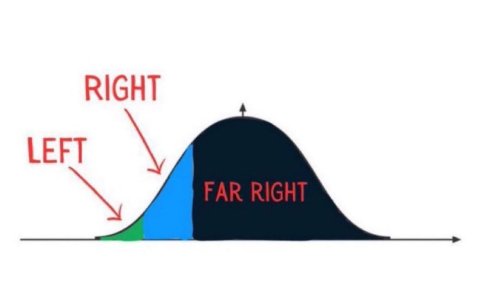
So when people say facts are treated as right-wing, the point is not that truth literally belongs to one side of the spectrum. The point is that in a culture saturated with moral performance, inconvenient facts are often recoded as partisan because it is easier to stigmatize them than to answer them. A factual claim that disrupts the script is no longer processed as description. It is processed as dissent. And dissent, under current conditions, is increasingly treated as a character defect.
Facts do not have a party. But when facts obstruct an ideological narrative, that narrative will often brand them right-wing and move straight to motive-policing. That is not a sign that the facts have changed. It is a sign that too much of public discourse has become allergic to reality when reality refuses to flatter the creed.
References
Government of Alberta. “Supporting Alberta students and families.”
https://www.alberta.ca/supporting-alberta-students-and-families
Government of Alberta. “Protecting youth, supporting parents, and safeguarding female sport.”
https://www.alberta.ca/protecting-youth-supporting-parents-and-safeguarding-female-sport
Global News. “Montreal teacher challenges policy for trans students to hide identity from parents.” March 6, 2026.
https://globalnews.ca/news/11719392/montreal-teacher-trans-students-challenge/
British Columbia Human Rights Tribunal. Chilliwack Teachers’ Association v. Neufeld (No. 10), 2026 BCHRT 49. February 18, 2026.
https://www.bctf.ca/docs/default-source/for-news-and-stories/49_chilliwack_teachers-_association_v_neufeld_no_10_2026_bchrt_49.pdf?sfvrsn=2d847803_1











 bleatmop
 Mystro


 Dead Wild Roses
Your opinions…