
You are currently browsing the tag archive for the ‘public discourse’ tag.
One key idea behind activist-left identity politics is the ladder of oppression: the more marginalized identity categories a person can claim, the more moral and political weight their speech is assumed to carry.
 The theory has an old philosophical root. In the master/slave dialectic, the subordinate person is said to understand both worlds: his own condition and the world of the master who rules over him. The master, by contrast, often knows only his own comfort, his own assumptions, and the social order that flatters him. From this comes the later activist claim that oppressed people possess a clearer or “truer” insight into reality because they see power from below.
There is a partial truth here. People who live under a system often notice things the comfortable miss. A disabled person may see barriers others walk past. A woman may notice male behaviour men excuse or ignore. A racial minority may recognize social patterns the majority experiences only as normal background noise. Lived experience can expose blind spots.
The problem comes when this insight hardens into hierarchy.
Instead of treating experience as evidence to consider, activist politics often treats identity as authority. The more oppression factors a person can claim — race, sex, gender identity, sexuality, disability, poverty, colonial history — the higher they stand on the moral ladder. Their narrative is then “centred,” while those lower on the ladder are expected to listen, defer, apologize, or stay quiet.
At that point, argument has been replaced by ranking. A weak claim from the approved identity can be protected from criticism, while a strong claim from the wrong identity can be dismissed as privilege, fragility, or harm.
Lived experience matters, but it does not make someone automatically right. Suffering can reveal truths, but it can also narrow vision, sharpen resentment, or turn personal pain into bad policy.
A serious society listens to experience without making identity a substitute for reason. The question still has to be: is the claim true?
“Human beings are very good at noticing the stupidity of outsiders and very bad at noticing when our own side has started laundering emotion through principle.”
It is easy to pick apart other people’s bad arguments. Too easy, sometimes. When the subject is gender ideology, the temptation is worse because so much of the public argument really does arrive as slogans, emotional coercion, category confusion, and moral theatre wearing institutional shoes.
But ease is a warning sign.
If an opponent’s weakest argument is the only one I can bear to examine, then I am not truth-seeking. I am harvesting reassurance. That may feel satisfying in the moment, especially when the home team applauds, but it is not the same thing as thinking.
The discipline I keep returning to is simple and unpleasant: prosecute your own argument in the harshest light you can tolerate. Ask what would weaken it. Ask which evidence you are avoiding. Ask whether your conclusion has become part of your identity, because once that happens, correction starts to feel like humiliation.
That is not easy. It cuts against our tribal wiring. Human beings are very good at noticing the stupidity of outsiders and very bad at noticing when our own side has started laundering emotion through principle. The people who agree with us can become dangerous in exactly this way. They reward the sharp line, the fast dunk, the satisfying contempt. They rarely reward the moment when you say, “This part of my own argument may need work.”
 I have had to revise some of my own instincts here. It is too easy to treat the whole phenomenon as ideology, cowardice, and social contagion. Those are real forces, but they do not explain every person caught inside the debate. Some people experience severe and persistent distress around sexed embodiment, and social recognition may reduce suffering in ways that are not trivial. That does not settle women’s spaces, children’s medicine, sports, prisons, or compelled speech. It does mean I have to resist the temptation to collapse every person into the worst activist slogan spoken on their behalf.
The trans debate remains a useful stress test because the public claims are so unstable. If strong evidence showed that cross-sex identification reflected a stable, measurable condition that reliably benefited from social or medical transition under careful safeguards, I would have to revise parts of my view. At present, I do not think that case has been made strongly enough, especially where children, safeguarding, and sex-based boundaries are concerned. Much of what is offered instead is moral pressure: affirmation presented as care, skepticism presented as harm, boundaries presented as hatred.
Still, that cannot become an excuse to write off every person on the other side. The strongest version of their argument is not that slogans are true because activists shout them. It is that some people experience suffering serious enough to deserve humane attention, even if the metaphysics built around that suffering are confused or overstated.
This is where charity matters. Not sentimental charity. Not the kind that asks you to pretend bad arguments are good. Real charity means refusing to make your opponent smaller than they are so you can defeat them more easily.
I do not want to become the mirror image of what I criticize: someone who begins with moral certainty, chooses the facts that flatter it, and treats disagreement as evidence of corruption. If reality matters, then it has to matter when it inconveniences me too.
That is the standard. Not perfection, because nobody gets that. But a willingness to remain revisable. To notice when contempt is doing the work of argument. To ask whether a cherished belief has survived scrutiny or merely avoided it.
A truth-first posture is only worth having if it still applies when the correction costs you something.
The double-slit experiment is one of those scientific ideas people love to borrow badly. It is strange, genuinely humbling, and easy to misuse. That makes it perfect material for people who want reality to be less stubborn than it is.
The basic version is simple enough. Fire particles through two slits without measuring which slit they pass through, and over time they produce an interference pattern, the kind of pattern we associate with waves. Try to measure which slit they go through, and that pattern changes. The system no longer behaves the same way.
That is the part people remember. Unfortunately, they often remember it badly.
The experiment does not show that human consciousness creates reality. It does not show that the universe waits around for a person to notice it before deciding what it is. “Observation” in this context does not mean vibes, attention, social agreement, or someone staring meaningfully at an electron. It means measurement. It means physical interaction with the system. The apparatus matters because the apparatus is part of the situation being tested.
That is weird enough. We do not need to add incense.
There are still serious debates in the foundations of quantum mechanics about how best to interpret what is happening. That is worth admitting. But those debates do not rescue the popular abuse of the experiment. Consciousness is not required, politics does not select the result, and social approval does not decide whether the interference pattern appears.
The real lesson is more disciplined and more interesting. Reality is not always available to common sense. How we investigate can affect what we are able to detect. At quantum scales, measurement is not a passive act, like glancing at a chair from across the room. It changes the conditions under which the result appears.
That should make people humble about truth-finding. It should not make them casual about reality.
This is where social constructivist thinking often slips in through the side door. It does not usually announce itself by saying, “Nothing is real.” That would be too crude, and too easy to reject. Instead, it emphasizes language, framing, power, interpretation, categories, and social meaning until the reader quietly stops treating reality as a constraint and starts treating it as a negotiation.
Reality is real, but not always simple. Because it is not simple, we need better methods, not ideological shortcuts.
Some things really are socially constructed. Money depends on shared agreement. Borders depend on law, force, recognition, and maps. Job titles, academic credentials, citizenship categories, and institutional rituals all rely on human systems to maintain them. That is not a trivial point. Human beings create layers of social meaning that shape how we live, distribute status, enforce rules, and decide what counts inside institutions.
But the fact that some realities are socially maintained does not mean all realities are socially produced. The category “doctor” is socially regulated. The body on the operating table is not. A passport is a legal object. A kidney is not. A government can change language around inflation, housing, crime, or sex, but the material world does not become more cooperative because the terminology became more fashionable.
This is the tell to watch for. A valid insight about interpretation gets stretched until it weakens contact with reality. “Categories have social meaning” becomes “categories are merely imposed.” “Observation matters” becomes “truth depends on standpoint.” “Language shapes perception” becomes “language can rearrange the world.” Each step sounds sophisticated enough in isolation. Put them together, and ordinary reality gets escorted out of the room by people who insist they are only asking questions.
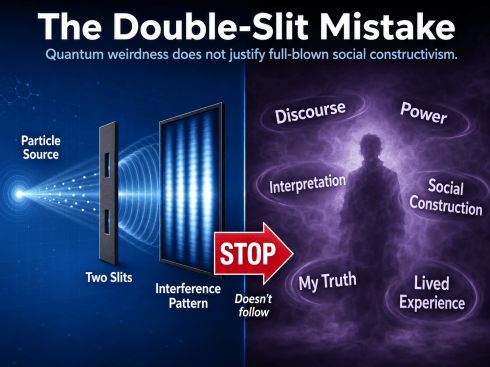
The double-slit experiment does not support that move. If anything, it rebukes it. The experiment is repeatable. The results are disciplined. The mathematics is unforgiving. You do not get a different interference pattern because your politics require one. You do not get to vote on the apparatus. The whole point of the experiment is that reality answers back, though not always in the form our intuitions expected.
That distinction matters far beyond physics. Bad theories of reality do not stay in seminar rooms. They eventually show up in schools, medicine, law, media, and public policy, often wearing the language of compassion or sophistication. If institutions lose the ability to distinguish between social meaning and material constraint, they do not become more humane. They become easier to fool.
Quantum weirdness should not become a permission slip for intellectual fog. It should remind us that careful methods are necessary precisely because reality can be subtle. The world is not always obvious, but it is also not waiting for our preferred theory to grant it permission to exist.
The better response to mystery is not social construction all the way down. It is patience, precision, and less eagerness to turn every difficulty in knowing into an excuse for pretending the thing known has disappeared.
Good intentions are not enough. That should be obvious, but much of our public life now behaves as if noble language can rescue bad thinking.
Before people declare what is compassionate, just, inclusive, hateful, dangerous, or necessary, they need some reliable way of knowing whether their factual claims are true. That order matters. If the tools used to find truth are broken, captured, or designed to protect a preferred belief from contradiction, then the moral conclusions built on top of those tools will inherit the damage.
This is not a left-wing or right-wing problem, though each side prefers noticing it in the other. The progressive version often begins with moral urgency. A policy is called compassionate, inclusive, or protective, and once that moral label is attached, factual objections start to look suspicious. Questions about consequences become “harm.” Questions about definitions become “erasure.” Questions about evidence become proof that the questioner is unsafe.
The conservative version has its own habits. A bad social trend gets folded too quickly into civilizational decline. One ugly example becomes proof of total collapse. A complicated institutional failure becomes evidence that the enemy planned the whole thing. The moral conclusion may contain some truth, but it arrives too early and then starts recruiting facts to serve it.
That is the trap. Once moral certainty arrives first, the mind stops investigating and starts defending.
You can see the pattern wherever institutions are rewarded for sounding virtuous before they are required to be accurate. A school board adopts fashionable language before asking whether the policy helps children. A medical system treats hesitation as cruelty before the long-term evidence is settled. A government describes economic pain in careful managerial terms while households are trying to make rent, groceries, debt, and wages fit inside the same month. The details differ, but the sequence is familiar: the moral frame arrives first, and the facts are invited in later as supporting cast.
A healthier public culture would ask plainer questions before the slogans begin. What is the claim? What evidence would show it is true? What evidence would weaken it? Who pays the cost if we are wrong? Are we counting those costs honestly, including the costs to people we do not like? Are we applying the same standard when the facts embarrass our own side?
Those questions are not glamorous. They do not fit neatly on a protest sign or a campaign graphic. They also do not offer the emotional satisfaction of instant righteousness. But they are the difference between thinking and performing.
This matters because moral language is powerful. It can move people to protect the vulnerable, correct injustice, and resist cruelty. But the same language can also be used to smuggle weak claims past scrutiny. Institutions have incentives to do this. Activists gain status from certainty. Bureaucracies protect themselves with approved vocabulary. Media outlets reward emotional clarity over careful qualification. Ordinary people learn, quickly enough, which questions are safe to ask in public and which ones are better saved for the parking lot.
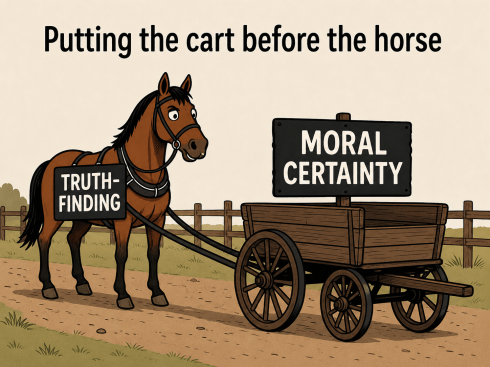
So they accept the conclusion first and hope the facts will catch up later.
They often do not.
Reality has a way of collecting unpaid debts. Bad premises eventually produce visible damage: failed policies, institutional distrust, medical scandals, economic denial, public cowardice, and citizens who no longer believe official language because they have watched it bend too many times.
The answer is not cynicism. Cynicism is often just laziness wearing a smarter jacket. The answer is better truth-finding: slower claims, clearer definitions, stronger evidence, real costs counted on both sides, and a willingness to notice when our preferred story stops matching the world.
That includes me. That includes you. That includes the people whose politics we find irritating, fashionable, smug, or deranged. Nobody gets a permanent exemption from reality because their intentions are good or their enemies are worse.
A decent society needs moral seriousness, but moral seriousness cannot mean protecting our favourite conclusions from examination. It has to mean caring enough about justice to ask whether our account of the world is actually true.
I do not especially care whether someone voted Liberal, Conservative, NDP, or something stranger from the pamphlet table. A democratic country still needs citizens who can look at reality without first asking whether the facts are useful to their team.
Canada is not in a healthy place. The economy has posted two straight quarters of contraction on an annualized basis, which is why the phrase “technical recession” has entered the conversation, even if analysts can argue over how much weight to give that label. Statistics Canada reported unemployment at 6.9% in April 2026, with youth unemployment at 14.3%. Food insecurity is harder to soften: PROOF reported that in 2024, 25.5% of people in the ten provinces lived in food-insecure households, about 10 million people, including 2.5 million children. These are not fringe complaints or partisan vibes. They are indicators of stress in the lives of ordinary people.
The point is not that every bad number belongs neatly to one party. Serious people should avoid that reflex. Some problems are inherited. Some are global. Some are structural. Some are provincial. Some are made worse by federal policy, and some are made worse by years of institutional delay, denial, or misplaced priorities. Canada’s productivity weakness, housing shortage, debt burden, immigration pressures, and affordability crisis did not arrive in one tidy partisan package. That is precisely why citizens need better habits of attention, not better excuses.
This is where media hygiene matters.

A lot of political coverage trains people to process public life through narrative before evidence. The right leader appears calm, credentialed, and respectable, so economic stress becomes “headwinds.” Stagnation becomes “uncertainty.” Failure becomes “transition.” Aggregate growth gets reported without enough attention to per-person decline. A press conference sounds adult and measured, while the household math keeps getting worse.
This problem is not confined to one side. Liberal-friendly media can soften failure when the right institutional language is being used. Conservative-friendly media can turn every bad number into proof that the apocalypse has already been scheduled. Social media rewards panic, resentment, and team loyalty. Legacy media rewards access, tone, and respectable framing. The result is a public conversation where facts often arrive already dressed for the argument someone wanted to make.
Voters participate in this too. Partisans learn to defend their side before checking the claim. Comfortable people mistake their own insulation for national health. Professionals who live inside institutional language can forget that ordinary Canadians live inside rent, groceries, wages, taxes, debt, and renewal notices, none of which become easier because the country’s managerial class found a more reassuring adjective.
A country needs some measure of optimism to function, so the answer is not theatrical despair. But optimism that cannot survive contact with the facts is closer to mood management than civic seriousness. Canadians should be able to say two things at once: yes, a leader may seem more competent than the alternative, and yes, the material indicators are still ugly. One does not cancel the other.
Political maturity begins when people stop treating bad news as betrayal. Reality does not care which party benefits from noticing it, which is precisely why noticing it remains one of the basic duties of citizenship.
“Diversity is our strength” is one of those phrases that now passes for settled truth. It appears in policy documents, school mandates, and corporate statements, rarely argued and almost never examined. Though it presents itself as an empirical observation, most of the time it functions as moral reassurance.
Since I am not a sociologist, I am not pretending to offer original research here. What I am doing is more modest: reading the best-known work in this area, noting the later reviews, and asking whether the slogan is actually supported by the evidence usually invoked in its defence.
On those terms, the answer is less flattering than the slogan suggests.
When people reach for the empirical case, the best-known starting point is Robert Putnam. In 2007, he published a major study on social capital in American communities built on the Social Capital Community Benchmark Survey, drawing on roughly 30,000 respondents through a national sample and smaller samples from 41 communities across the United States. In the pooled 41-site sample, the estimated effect of diversity on trust was negative in 39 of the 41 communities.
For present purposes, two things matter: the scale was serious, and the pattern was not some one-off local oddity.
Although Putnam is often invoked as if he were a critic of diversity as such, that is not what he was doing. In the same paper, he argued that increased diversity may, in the long run, bring important cultural, economic, fiscal, and developmental benefits, and that successful immigrant societies can build broader identities that overcome fragmentation. Even so, he also concluded that, in the short to medium run, immigration and ethnic diversity “tend to reduce social solidarity and social capital.”
That is the part the slogan politely steps around.
What Putnam found, moreover, was not a simple story of ethnic conflict. His summary remains the clearest: in ethnically diverse neighborhoods, residents of all races tend to “hunker down”; trust, including trust in one’s own race, is lower; altruism and community cooperation are rarer; and people have fewer friends. Contemporary reporting on the study described the pattern less as intergroup hostility than as a general civic malaise.
“The effect isn’t conflict. It’s withdrawal.”
While Putnam’s study is not the last word, neither is it some isolated embarrassment later research quietly buried. A 2020 narrative and meta-analytical review by Peter Thisted Dinesen, Merlin Schaeffer, and Kim Mannemar Sønderskov examined 1,001 estimates from 87 studies and found a statistically significant negative relationship between ethnic diversity and social trust across the literature as a whole. The association was stronger for trust in neighbours and stronger when diversity was measured locally. Adding covariates changed the relationship only slightly.
None of this means every study says the same thing, or that every context behaves the same way. It does mean the slogan cannot honestly be treated as a simple social-scientific fact. At best, the literature points to a more conditional and less comforting conclusion: diversity may bring benefits in some domains while also imposing real costs in trust, cohesion, and civic reciprocity, especially in the short to medium term.
Had public argument stopped there, the conversation would be easier. It does not. One reason progressive arguments on diversity can be so maddening to answer cleanly is that the problem is not just the evidence. It is the rhetorical structure built around it.
What you often get is a classic motte-and-bailey.
In its bailey form, the claim is large and ambitious: diversity makes societies stronger. It enriches institutions, strengthens communities, and should be treated as an obvious good. That is the version used in slogans, public messaging, and moral posturing.
The motte, by contrast, is smaller and safer: people from different backgrounds have equal dignity; plural societies can function; exposure to different people can be valuable; racism is wrong. All true. All defensible. All much easier to protect.
The trick, of course, is that these are not the same argument.
One is a broad empirical claim about what diversity does to trust, cohesion, and institutional life. The other is a narrow moral claim about how people ought to be treated. But when the broader claim comes under pressure, when someone points to evidence of lower trust, weaker civic engagement, or social withdrawal, the argument retreats into the motte. Suddenly the response is not “let’s examine the evidence.” It is “What, are you against diversity? Are you some kind of racist?”
That is the coercive move.
“The harder claim retreats. The safer claim takes its place.”
Once that happens, the moral core is used as a shield for a much larger empirical claim that has not earned that protection.
To say this is not to deny the moral core. It is to point out that it is being made to do dishonest work.
Equal dignity under the law is not the same claim as “diversity strengthens communities.” Opposition to racism is not the same claim as “more heterogeneity reliably produces more trust.” The first set of claims may be moral bedrock. The second set are empirical propositions, and empirical propositions do not become true because disagreement with them is made socially costly.
Nor is the underlying mechanism difficult to imagine. Social trust depends on shared expectations: language, norms, behaviour, obligation. As those expectations become less predictable, the cost of ordinary interaction rises. People become more cautious. Fewer interactions clear the threshold of “worth it.” The result is often not hostility, but distance. That basic picture fits both Putnam’s “hunkering down” formulation and the later finding that the negative association is strongest in neighbour trust and local contexts.
Less talking. Less joining. Less trusting.
None of that requires malice. It requires friction.
“The long run is not the short run.”
As Putnam himself argued, successful immigrant societies can, over time, construct broader identities and new forms of solidarity. Fine. Maybe. But that long-run possibility does not erase the short-run trade-off he reported, and the later review literature does not erase it either.
Here, “may” is doing a lot of work.
That outcome is conditional. It depends on institutions, norms, shared language, and successful integration over time. It is not an automatic by-product of demographic change, still less a magic formula that turns heterogeneity into cohesion by moral declaration. Putnam’s own formulation was that the central challenge for diversifying societies is to create a new, broader sense of “we.”
Possibility is not inevitability.
What raises the stakes is that the costs of lower trust do not fall evenly. They hit hardest where social capital is already thin: poorer neighborhoods, fragile communities, institutions with less slack, places where informal cooperation matters most. When trust declines there, the result is weaker networks, less mutual aid, and more pressure on systems already under strain. Social capital is not a decorative extra. It is part of what makes communities safer, healthier, and more governable.
Ignoring that does not make a society humane. It makes it less prepared.
“A slogan that cannot admit costs cannot guide policy.”
A serious discussion of diversity would start there. It would admit trade-offs. It would separate moral claims from empirical ones. It would stop pretending every objection is a moral stain and start asking the harder question: under what conditions can diversity be made compatible with trust, reciprocity, and shared civic life?
That is the real task. Not chanting the slogan more loudly. Not treating doubt as heresy. Not hiding a contested empirical claim inside a morally untouchable one.
In the end, societies that do that are not being honest. They are buying social peace on credit and hoping the bill never comes due.
References
- Robert D. Putnam, “E Pluribus Unum: Diversity and Community in the Twenty-first Century,” Scandinavian Political Studies 30, no. 2 (2007).
- Peter Thisted Dinesen, Merlin Schaeffer, and Kim Mannemar Sønderskov, “Ethnic Diversity and Social Trust: A Narrative and Meta-Analytical Review,” Annual Review of Political Science 23 (2020).
- Michael Jonas, “The Downside of Diversity,” Boston Globe, August 5, 2007.
One of the most corrosive habits in current political discourse is the way plain factual claims get assigned a partisan label. Not arguments. Not policies. Facts. Or, more precisely, statements that point back to material reality, institutional limits, or ordinary human constraints. In theory, facts are supposed to discipline ideology. In practice, they are often treated as ideological aggression when they obstruct a preferred moral script.
That is what people are reaching for when they say facts are now treated as right-wing. The phrase is blunt, but it points to something real. In a growing number of disputes, especially around sex, gender, speech, and institutional policy, a person can say something materially true and be treated not as a participant in debate but as a moral suspect. The point is not answered on its merits. It is recoded as a signal of contamination. The speaker is no longer heard as describing reality. He is heard as choosing a tribe.
That shift matters because it changes the structure of argument. Once a factual claim is socially coded as “right-wing,” the burden quietly moves. The question is no longer whether the claim is true. The question becomes why you said it, what kind of person says such things, and who might feel endangered by hearing it. Motive replaces mechanism. Stigma replaces rebuttal. The claim is not refuted so much as quarantined.
You can see this clearly in disputes over sex and pronouns. For many people, saying that sex is real, binary in the ordinary human sense, and not altered by self-declaration is not an act of hostility. It is a claim about reality and a claim about language. “He” and “she” historically track male and female persons. Refusing to detach those words from sex is not, on its face, a partisan performance. It is an attempt to keep public language tethered to the material world rather than to inward identity claims.
“The disagreement is not mainly about politeness. It is about which reality gets public authority.”
That is exactly why the issue generates so much heat. The disagreement is not mainly about politeness. It is about which reality gets public authority. Does language track bodies, or does it track self-declared identity? Does a school treat sex as a stable feature of the world, or does it treat identity assertion as the governing fact? Those are not small etiquette disputes inflated by the internet. They are conflicts about ontology, law, and institutional power.
Canada now offers several live examples. Alberta’s Education Amendment Act requires parental notification when a student requests a gender identity-related preferred name or pronouns, and parental consent for students under 16 before staff may use them. The province says these changes are part of supporting families and setting clear school rules, with the remaining education amendments anticipated to take effect on September 1, 2025. Then, in late 2025, Alberta escalated further. Bill 9 invoked the notwithstanding clause to shield not only this school policy but other contested sex-and-gender measures from being struck down by the courts. That bundling matters. It shows this is no longer being treated as a narrow administrative disagreement, but as a foundational conflict over parental authority, child development, and the public meaning of sex.
Quebec presents the same fracture from the opposite direction, and it is ongoing now. Current reporting says a Montreal teacher is challenging the provincial policy that allows students 14 and older to change the name and pronouns used at school without parental consent. The teacher alleges she was required to use male pronouns at school while using female pronouns with the student’s parents. A preliminary hearing on anonymity and confidentiality was held on March 6, 2026, with the broader merits challenge still to come. Strip away the activist packaging and the conflict becomes plain: can institutional professionals be required to maintain two vocabularies of reality depending on the audience, and if they object, are they making an ethical argument or committing a moral offense?
The Barry Neufeld case in British Columbia shows the institutional end point of this logic. On February 18, 2026, the B.C. Human Rights Tribunal issued its decision and ordered substantial damages after finding that multiple publications were discriminatory, while some crossed the threshold into hate speech. That does not prove that every factual objection to gender ideology is punishable. It does show how readily dissent can be processed through systems that move from moral condemnation to formal classification. Once that line is crossed, everyone watching understands the lesson. The risk is no longer simply that you will be called wrong. The risk is that you will be treated as a public contaminant.
This is why the familiar “both sides are just choosing different facts” formula goes soft in exactly the wrong place. The conflict is not symmetrical. One side is generally making claims about bodies, language, legal authority, and institutional procedure. The other is often demanding that those things yield to identity-based recognition norms. Dignity is real and relevant. But dignity does not erase biological category, dissolve observable sex, or transmute factual disagreement into literal violence.
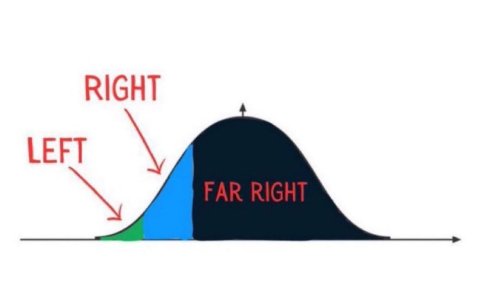
So when people say facts are treated as right-wing, the point is not that truth literally belongs to one side of the spectrum. The point is that in a culture saturated with moral performance, inconvenient facts are often recoded as partisan because it is easier to stigmatize them than to answer them. A factual claim that disrupts the script is no longer processed as description. It is processed as dissent. And dissent, under current conditions, is increasingly treated as a character defect.
Facts do not have a party. But when facts obstruct an ideological narrative, that narrative will often brand them right-wing and move straight to motive-policing. That is not a sign that the facts have changed. It is a sign that too much of public discourse has become allergic to reality when reality refuses to flatter the creed.
References
Government of Alberta. “Supporting Alberta students and families.”
https://www.alberta.ca/supporting-alberta-students-and-families
Government of Alberta. “Protecting youth, supporting parents, and safeguarding female sport.”
https://www.alberta.ca/protecting-youth-supporting-parents-and-safeguarding-female-sport
Global News. “Montreal teacher challenges policy for trans students to hide identity from parents.” March 6, 2026.
https://globalnews.ca/news/11719392/montreal-teacher-trans-students-challenge/
British Columbia Human Rights Tribunal. Chilliwack Teachers’ Association v. Neufeld (No. 10), 2026 BCHRT 49. February 18, 2026.
https://www.bctf.ca/docs/default-source/for-news-and-stories/49_chilliwack_teachers-_association_v_neufeld_no_10_2026_bchrt_49.pdf?sfvrsn=2d847803_1











 bleatmop
 Mystro


 Dead Wild Roses
Your opinions…