
You are currently browsing the tag archive for the ‘Western Civilization’ tag.
Culture wars are easy to dismiss when your side is winning one.
The phrase suggests an artificial conflict manufactured by activists who cannot leave ordinary life alone. Yet every society teaches its members what is admirable, shameful, natural and just. The dispute begins when we ask who is doing the teaching—and what vision of society their institutions are working to produce.
Ideas hostile to the classical liberal principles upon which Western societies were founded have gained commanding influence across many of the institutions that produce and transmit culture. Schools, universities, publishers, arts organizations, media outlets and professional associations increasingly interpret society through categories of power, identity, oppression and liberation, while individual responsibility, equality before the law and freedom of conscience are treated with suspicion.
This did not happen because a secret committee issued instructions from a hidden room. Cultural change rarely works that neatly. People enter institutions carrying particular assumptions, hire and promote others who share them, reward work that conforms to the emerging consensus and gradually redefine what respectable people are permitted to believe. The framework also offers something many post-religious institutions lack: moral purpose, a vocabulary of sin and redemption, and a hierarchy of virtue in which conformity can be experienced as courage.
Over time, ideology becomes professional common sense.
To understand how this occurred, we need to return to a problem that confronted Marxists in the early twentieth century. Classical Marxism predicted that the working class in advanced capitalist societies would eventually rise against the bourgeois order. That revolution did not materialize in the industrial democracies of the West, where workers frequently remained attached to their countries, churches, families and inherited ways of life.
Antonio Gramsci, an Italian Marxist writing from a Fascist prison, attempted to explain why.
Gramsci argued that Western societies were not maintained by economic coercion or state violence alone. Their stability also depended upon what he called cultural hegemony: the network of institutions, customs and moral assumptions through which people came to regard the existing order as legitimate. Government possessed force, but civil society produced consent.
Churches, schools, universities, newspapers, unions, voluntary associations and intellectual institutions all helped form the common sense of the population. Together they created a protective structure around the political order, making a direct revolutionary assault far more difficult than Marxist theory had anticipated.
Gramsci did not leave behind a five-point infiltration manual. What he provided was more important: an explanation of why political revolution in the West required a prior struggle over culture. Before a movement could capture the state, it would have to establish intellectual and moral authority within civil society by cultivating its own educators, organizers, artists and “organic intellectuals.”
Gramsci called this prolonged cultural contest a “war of position.” Decades later, Rudi Dutschke gave a related strategy its memorable name: the “long march through the institutions.” The phrase was Dutschke’s, and direct intellectual transmission from Gramsci is disputed, but both recognized the same strategic reality: durable political transformation required sustained work within the institutions that formed public consciousness.
That contest has travelled a considerable distance. The economic categories of classical Marxism did not disappear, but they were joined by cultural categories drawn from race, sex, sexuality and identity. Society was increasingly interpreted as a struggle between oppressors and oppressed, while inherited norms and institutions were treated as mechanisms through which dominant groups preserved their power.
This is what I mean by cultural Marxism. Critics object that this is not orthodox Marxism, and they are correct in the narrow sense. It is Marxism adapted to a cultural register, retaining the moral architecture of oppressor and oppressed while changing the principal categories through which that conflict is understood.
This does not require an omnipotent conspiracy in which every progressive activist takes orders from a central authority. It describes the migration of Marxist habits of thought into the wider culture: the elevation of group identity over individual responsibility, the reduction of social relationships to power, the assumption that unequal outcomes demonstrate oppression and the belief that liberation requires the transformation of inherited institutions.
The institutional consequences are no longer theoretical. The Canada Council for the Arts explicitly applies equity principles across its funding programs and provides targeted support to designated priority groups. Its stated purpose is to correct persistent barriers, not to advance Marxism, but the policy illustrates how cultural resources are increasingly allocated through group-based concepts of equity rather than formally equal treatment. The Council describes that policy in its own terms.
Universities provide another measure of the emerging consensus. In a 2024 survey by the Foundation for Individual Rights and Expression, more than half of conservative faculty respondents reported at least occasionally concealing their political beliefs from colleagues to protect their careers. That does not prove that every campus has become ideologically uniform, but it does show that institutional culture can impose professional costs without requiring formal censorship. FIRE’s faculty report documents the wider pattern.
Politics lies downstream of this cultural formation. People arrive at elections with moral intuitions already shaped by the stories they have encountered, the history they have been taught and the institutions they have learned to trust. If children encounter Western civilization primarily through slavery, colonialism, racism and exclusion, they should not surprise us by concluding that their inheritance is uniquely shameful.
Those failures belong in the historical record and must not be concealed. Progressives can reasonably argue that many institutional changes corrected genuine exclusions, and they are right. Western societies did not always honour their own principles, while appeals to tradition sometimes protected injustice.
The dividing line is not whether institutions may change. It is whether reform extends liberal principles to people previously denied them or replaces those principles with group entitlement, inherited guilt and political tests. A civilization taught only through its crimes does not produce citizens equipped to improve it; it produces citizens emotionally prepared to repudiate it.
Classical liberals and conservatives have too often responded downstream. They pour money into elections, policy organizations, advertising and social media campaigns while giving comparatively little attention to the institutions that form political instincts before a campaign begins. They criticize ideological films without supporting better filmmakers, mock politicized novels without helping dissenting writers reach readers and complain about educational capture without cultivating teachers capable of presenting a richer account of Western history.
They are searching beneath the political streetlamp because that is where the light is better, even though the cultural keys were lost somewhere else.
Winning a culture war therefore requires more than defeating a candidate or exposing the latest ideological absurdity. Writers, filmmakers, musicians, teachers, publishers and artists who value freedom need patrons, professional networks, durable institutions and routes to an audience. Expecting every dissenting creator to finance, market and distribute his own work while established institutions subsidize the prevailing orthodoxy is not a serious cultural strategy.
This does not mean manufacturing classical liberal propaganda. Ideological art remains ideological art regardless of which side produces it, while characters who exist only to recite correct opinions are no more compelling when those opinions happen to be ours. The alternative culture must succeed as culture: truthful about human nature, alive to tragedy, unafraid of beauty and capable of showing why freedom is both valuable and demanding.
It must also teach Western history honestly enough to acknowledge cruelty and failure while explaining the development of individual rights, constitutional government, scientific inquiry, religious toleration and equality before the law. Positive cultural confidence does not require collective innocence, because a mature society can admit what its ancestors got wrong without pretending they built nothing worth inheriting.
Nor does national pride require hostility toward other peoples. It means recognizing that a country and civilization can possess a distinctive inheritance worthy of gratitude, stewardship and improvement. We can criticize our institutions while remaining committed to them, correct injustice without abandoning individual responsibility and reform society without teaching people to hate it.
The alternative offered by revolutionary politics is not merely reform at a faster pace. A movement that treats individual rights, procedural neutrality and freedom of conscience as instruments of oppression cannot be trusted to preserve those protections after acquiring power. Activists who regard institutions principally as weapons against their enemies may discover that revolutionary institutions have little tolerance for activists once the revolution is complete.
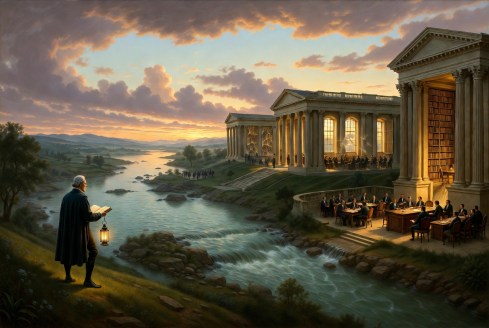
The proper response is not to imitate that illiberalism from the Right, but to contest the culture while remaining faithful to the classical liberal order we are trying to defend. That requires recovering the confidence to say that Western civilization, although imperfect, has produced achievements worth preserving; that freedom is more than camouflage for power; and that individuals cannot be reduced to racial, sexual or economic categories.
Politics still matters, but it cannot permanently defend principles that the culture has taught people to despise. If we want different political outcomes, we must begin further upstream, in the institutions and stories that teach each generation what is true, what is admirable and what kind of society deserves to survive.
The phrase “Judeo-Christian values” is often used loosely, so it is worth defining what it means in its strongest form.
Judaism and Christianity are not identical. They differ profoundly on theology, covenant, salvation, scripture, and the person of Jesus. The term “Judeo-Christian” can also flatten real historical tensions, including centuries of Christian anti-Judaism.
Nor did the West emerge from religion alone. Western civilization is a synthesis: Hebrew religion, Christian theology, Greek philosophy, Roman law, English common law, Germanic custom, Enlightenment liberalism, and centuries of political struggle all helped shape it.
Still, the Judeo-Christian inheritance gave the West several core moral claims that remain foundational. They are not the whole story, but they are a decisive part of the story.
1. Human beings possess inherent dignity
Human worth is not granted by the state, the tribe, the ruler, the market, the collective, or the majority.
In the biblical tradition, man is made in the image of God. That idea helped ground the belief that each person has moral worth beyond usefulness, status, race, sex, class, strength, or productivity.
This does not mean the West always honoured that claim. It often failed it catastrophically. But the claim itself became one of the standards by which those failures could be judged.
2. Moral law stands above human law
Kings, courts, governments, and majorities are not the highest moral authority.
A law can be legal and still be wicked. A ruler can hold power and still be morally wrong. The prophets rebuked kings. Christian natural law later joined biblical morality to Greek and Roman philosophy. Out of that synthesis came a powerful Western intuition: political power is answerable to a higher standard of justice.
This is one root of the rule of law, constitutional government, and the right to resist tyranny.
3. Each person is morally responsible
Human beings are not merely products of tribe, class, history, oppression, biology, or circumstance.
People can choose. People can do right or wrong. Guilt and innocence matter. Conscience matters. Repentance, judgment, forgiveness, and accountability all depend on the belief that human beings are moral agents.
Greek philosophy also emphasized moral formation and self-examination, but the Judeo-Christian tradition gave personal responsibility a particularly intense moral and spiritual weight.
4. Justice must be joined to mercy
Wrongdoing matters. Evil should not be excused, ignored, or sentimentalized.
But justice must not become mere vengeance. The Judeo-Christian tradition also emphasizes mercy, repentance, forgiveness, charity, care for the poor, protection of the vulnerable, and restraint against cruelty.
This helped form some of the West’s most important charitable and reforming institutions: hospitals, schools, poor relief, abolitionist movements, prison reform, and the idea that the weak are not disposable.
5. Power must be morally limited
Human beings are fallen, proud, corruptible, and tempted by domination.
Therefore rulers are not gods. The state is not sacred. The majority is not automatically righteous. Authority must be restrained by law, conscience, duty, and moral limits.
This idea did not come from religion alone. Greek political thought, Roman republicanism, common law, and Enlightenment constitutionalism all mattered. But the Judeo-Christian suspicion of human pride and idolatrous power gave the West a deep moral reason to distrust unchecked authority.
The short version
So when people speak seriously about Judeo-Christian values, the strongest list is this:
- Human dignity
- Moral law above human law
- Personal moral responsibility
- Justice tempered by mercy
- Power limited by law and conscience
These values are not uniquely owned by Judaism or Christianity. They have parallels elsewhere, and they can be defended in secular language.
But in the West, they were deeply shaped, transmitted, institutionalized, and morally charged by the Judeo-Christian inheritance.
That is the strongest version of the claim. Not that the West was purely Judeo-Christian. Not that every Western failure can be excused by appealing to religion. Not that secular reason contributed nothing.
The better claim is this: the West became what it became through a moral synthesis, and the Judeo-Christian tradition supplied several of its most important claims about dignity, conscience, justice, mercy, and the limits of power.

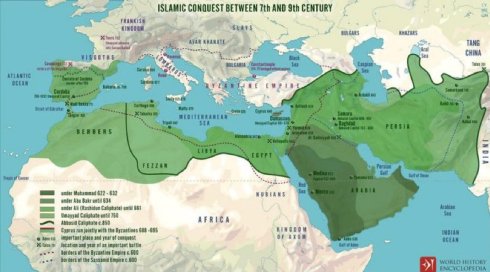
Maps like this disturb a comfortable habit in Western public life: colonialism is often discussed as though Europeans invented it, monopolized it, and uniquely embodied it.
They did not.
That does not make Western colonialism imaginary, minor, or excusable. European empires conquered, extracted, enslaved, displaced, racialized, governed, converted, and reordered huge parts of the world. The moral seriousness of that history remains. But if colonialism is part of the larger family of empire, conquest, domination, hierarchy, and the subordination of one people by another, then Western colonialism is not the whole category. It is one chapter in a much older human pattern.
The early Islamic conquests were not merely a spiritual awakening spreading through gentle persuasion. They were also military and imperial events. Arab Muslim armies and later Islamic-ruled polities expanded across the Levant, Egypt, North Africa, Persia, parts of Central Asia, and Iberia. These conquests changed political loyalties, tax systems, religious hierarchies, legal status, languages, and civilizational boundaries.
This does not reduce Islamic civilization to conquest. It would be foolish to ignore its achievements in philosophy, mathematics, architecture, medicine, poetry, trade, law, and scholarship. Many conquered peoples also helped build those achievements. Greeks, Persians, Jews, Christians, Indians, Arabs, Berbers, and others all contributed to what later gets remembered as Islamic civilization.
But that is exactly why the moral accounting should be honest. Conquest can produce synthesis. It can also produce subordination. Empire can preserve knowledge. It can also reorder peoples against their will. Complexity is real, but it cannot be used as a shield only for some civilizations.
The same selective memory appears around slavery and other imperial systems, but even staying with conquest alone, the pattern is clear: Western empire is treated as the moral template, while non-Western empire is often softened into “expansion,” “civilization,” “trade,” or “complexity.”
So why the imbalance?
Partly because Western colonialism is closer to us. Its archives, borders, museums, laws, churches, universities, racial categories, and economic consequences are still visible inside Western societies. Canadians, Americans, Britons, French, Belgians, Australians, and others are arguing inside institutional houses their own histories helped build. That proximity matters.
Partly because Western civilization developed powerful habits of self-criticism. Christianity, liberalism, socialism, abolitionism, human rights language, and modern academia all helped create tools by which the West could put itself on trial. That is not a weakness. In many ways, it is one of the West’s better inheritances.
But a virtue can decay into a ritual. Self-criticism can become selective prosecution. Once “colonialism” becomes a moral drama with fixed roles — guilty West, innocent rest — history gives way to theatre. The question stops being “Who conquered whom, and at what cost?” and becomes “Which story serves the approved politics?”
There is another reason for the imbalance. In contemporary Western politics, criticizing European empire is safe, rewarded, and institutionally familiar. Criticizing Islamic empire, Ottoman domination, Arabization, or other non-Western conquests is more dangerous. It risks being heard not as historical analysis, but as bigotry. So the subject is softened, avoided, or buried under the word “complexity.”
But all empire is complex. That cannot be a permission slip handed out selectively.
A serious anti-colonialism would not ask first whether the conqueror was European. It would ask: Who ruled? Who paid? Who was displaced? Who was taxed differently? Who was converted under pressure? Who lost language, land, status, sovereignty, or memory? Who was later told to be grateful for the civilization that absorbed them?
By that standard, Western colonialism remains morally serious. But it is not uniquely Western. It belongs to the larger human history of empire, conquest, slavery, hierarchy, and domination.
The point is not to excuse Europe. The point is to stop pretending that conquest only becomes colonialism when Europeans do it.
The most revealing thing about modern slavery is not only that it exists. It is that so many people who invoke slavery as a moral category seem oddly uninterested in it when it is happening now.
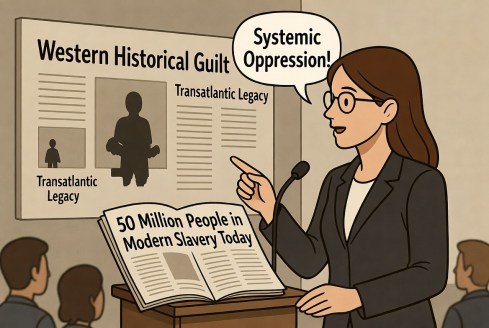
In contemporary activist politics, slavery is often treated as a permanent indictment of the West. It is invoked to explain present inequality, assign inherited guilt, rewrite institutional language, justify symbolic rituals, and discipline dissent. Some of that history matters. The transatlantic slave trade was real, brutal, and morally indefensible. A serious civilization should be able to tell the truth about its crimes.
But truth has a tense. If slavery matters morally, then slavery matters now.
According to the latest Global Estimates from the International Labour Organization, Walk Free, and the International Organization for Migration, roughly 50 million people were living in modern slavery on any given day in 2021: 27.6 million in forced labour and 22 million in forced marriage. Walk Free estimates that about 7 million people in Africa were living in modern slavery.
If slavery is invoked as a living moral category when it indicts the West, then slavery should also matter when people are being coerced, trafficked, forced into marriage, or trapped in labour today.
These are not metaphors. Modern slavery includes forced labour, forced marriage, trafficking, sexual exploitation, debt bondage, and other forms of coercion that people cannot freely refuse or leave.
Many human-rights groups do serious work on these abuses. That should be acknowledged. But the cultural volume is not the same. Western institutions pour energy into land acknowledgements, reparations debates, decolonization seminars, symbolic renamings, privilege workshops, and inherited-guilt rituals. Meanwhile, present-tense slavery struggles to command anything like the same moral attention.
Mauritania, for example, formally abolished slavery, yet descent-based slavery and slavery-like practices remain serious concerns. That should disturb anyone who claims to care about domination and human dignity. It should not be a niche humanitarian footnote.
The strongest activist reply is not ridiculous. Historical slavery did not vanish without consequence. The transatlantic slave trade, colonial rule, segregation, and legal exclusion shaped wealth, institutions, geography, and inherited disadvantage. A society does not become innocent simply because the worst laws are repealed.
That is a serious point. But it does not answer the problem of moral selectivity. If slavery is invoked as a living moral category when it indicts the West, then slavery should also matter when people are being coerced, trafficked, forced into marriage, or trapped in labour today.
This is where much contemporary anti-racism becomes revealing. In theory, it opposes domination and exploitation. In practice, it often functions as a selective solvent. It dissolves confidence in Western institutions, Western history, Western moral achievement, and Western civic inheritance, while offering little concrete help to people being dominated right now.
The predictable reply is that this is whataboutism. It is not. Whataboutism says, “Ignore this evil because that evil also exists.” The argument here is the opposite: if slavery is evil, then concern should become more urgent when slavery is happening now. Historical truth matters, but it cannot become a substitute for present-tense moral attention.
Nor is this answered by saying critics do not understand critical theory properly. If a theory constantly produces institutional rituals of guilt, suspicion, deconstruction, and accusation, ordinary citizens are allowed to judge it by its public effects. A politics that requires specialist initiation before anyone may notice its consequences has already left democratic argument behind.
The issue is not whether the West has sins in its history. It does. The issue is whether anti-racism is actually against domination, exploitation, and slavery as human evils, or whether those evils are useful mainly when they can be arranged into an indictment of Western society.
If slavery matters only when it can be used to shame the West, then slavery is not the real object of concern. The West is.
References
International Labour Organization, Walk Free, and International Organization for Migration. Global Estimates of Modern Slavery: Forced Labour and Forced Marriage.
https://www.ilo.org/publications/major-publications/global-estimates-modern-slavery-forced-labour-and-forced-marriage
Walk Free. Global Slavery Index 2023 — Global Findings.
https://www.walkfree.org/global-slavery-index/findings/global-findings/
Walk Free. Global Slavery Index 2023 — Modern Slavery in Africa.
https://www.walkfree.org/global-slavery-index/findings/regional-findings/africa/
Anti-Slavery International. What is Descent-Based Slavery?
https://www.antislavery.org/slavery-today/descent-based-slavery/
Anti-Slavery International. Mauritania: Descent-Based Slavery.
https://www.antislavery.org/what-we-do/mauritania/
Arab Reform Initiative. Racialized Hereditary Slavery in Mauritania: Interview with Activist Abidine Maettalla.
https://www.arab-reform.net/publication/racialized-hereditary-slavery-in-mauritania-interview-with-activist-abidine-maettalla/
There are few modern spectacles more interesting than Richard Dawkins speaking warmly about Christianity.
Not converting. Not recanting The God Delusion. Not wandering into Evensong with a softened heart and a sudden interest in incense. But speaking warmly, nevertheless.
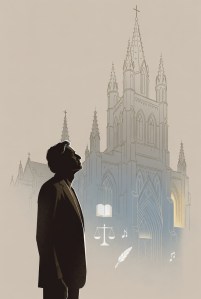 Dawkins has called himself a “cultural Christian.” He remains an atheist, which is what makes the admission interesting. He is not saying Christianity is true. He is noticing that Christianity helped form a civilization in which he could become Richard Dawkins: skeptical, eloquent, publicly irreverent, protected enough to criticize sacred things, and still culturally at home among the ruins and residues of the faith he rejects.
For a long time, many secular Westerners treated Christianity as something they had outgrown. It was old, morally complicated, often hypocritical, and associated with repression, scolding, and bad Sunday mornings. Keep the music, perhaps. Keep the architecture. Keep Christmas, provided no one gets doctrinal about it. The rest could be packed away.
There were reasons for that impatience. Churches persecuted, censored, lied, protected abusers, cozied up to power, and sometimes confused institutional self-interest with the will of God. No honest appreciation of Christian civilization can skip that part. But there is a difference between remembering the failures of an inheritance and forgetting that we inherited anything worth having.
The West was not built from one source. It is a quarrelsome inheritance: Greek reason, Roman law, Jewish moral seriousness, Christian theology, Germanic custom, common law, Reformation fracture, Enlightenment skepticism, scientific inquiry, and the long institutional habit of limiting power. Christianity did not invent every virtue from nothing, but it became one of the great furnaces in which those virtues were universalized, moralized, preached, contradicted, betrayed, and recovered.
Modern liberalism did not merely inherit Christian assumptions and put them in nicer clothes. It built institutions Christianity often resisted: robust free speech, religious disestablishment, broader suffrage, empirical science protected from clerical authority, and legal equality that went well beyond what most Christian societies were willing to grant. Some of the freedoms Dawkins enjoys were made possible by Christian moral inheritance. Others required sharp breaks from dominant Christian practice.
That tension is the point. The West is the product of argument, correction, rebellion, restraint, and institutional memory.
This is what modern secular people often miss. We imagine ourselves as freestanding moral adults. We believe in human dignity, equality before the law, freedom of conscience, care for the vulnerable, suspicion of tyranny, and the right to criticize authority. Fine. Keep all of that. But those commitments have a history. They were not produced by vibes, nor assembled last Tuesday by a committee with a land acknowledgement and a catering budget.
They came through centuries of conflict, doctrine, reform, law, blood, repentance, philosophy, institutional restraint, and exhaustion after too many people had killed each other over ultimate things.
To appreciate that inheritance is not to baptize every part of it. Christendom was not gentle. Christianity often had to be forced into better conduct by dissidents, reformers, scientists, heretics, abolitionists, and Christians reading their own scriptures more honestly than their institutions did. The West’s moral inheritance was not a clean gift. It was an argument, often conducted under pressure.
“The West is the product of argument, correction, rebellion, restraint, and institutional memory.”
But the argument happened inside a civilization shaped deeply by Christianity.
The freedom to doubt, mock religion, publish irreverent books, leave a faith, criticize clerics, and live without being ruled by priests was not inevitable. Nor was the expectation that women may walk unveiled, educated, employed, politically equal, and legally protected. These are achievements produced by particular histories, institutions, and moral restraints.
That is where Dawkins’ comparison with Islam enters the discussion, though it needs care.
The issue is not Muslim neighbours. Millions of Muslims live peacefully, work hard, raise families, keep faith privately, and want the ordinary goods everyone else wants: safety, dignity, friendship, decent schools, and a stable life. A serious argument begins by refusing collective suspicion.
The harder question is what happens when Islamic doctrine becomes politically confident and expects the wider society to accommodate its rules around blasphemy, apostasy, religious offence, sex roles, homosexuality, and public criticism. Outcomes differ by interpretation, education, migration patterns, and host-society confidence, but liberal societies still cannot survive by pretending every moral and legal order is equally compatible with liberal freedom.
Dawkins seems to understand that cultural Christianity has learned to live with disbelief in a way many religious systems have not. The Anglican church may annoy you. It may bore you. It may produce beige sermons, awkward committees, and hymns sung by twelve people spread across a nave built for three hundred. But it is unlikely to demand the state punish you for mocking it, which is not a small thing.
“But criticism without gratitude curdles into contempt, and contempt is a poor steward of anything worth preserving.”
The Sunday lesson, then, is not “become Christian or die,” nor “atheists secretly know God is real,” nor “all Muslims are enemies.” It is more modest and more useful: know where you are standing.
If you live in the West, you live inside an inheritance. You may criticize it. You should criticize it. The tradition itself contains the tools for doing so. But criticism without gratitude curdles into contempt, and contempt is a poor steward of anything worth preserving.
Secular liberalism has been living partly off inherited moral capital for a long time, even while adding real achievements of its own. Compassion, rights, conscience, equality, dissent, human dignity, forgiveness, reform, and care for the weak remained available, but the story of how they arrived became unfashionable.
A culture can run on inherited habits for a while. Maybe longer than its critics expect. But inheritance is not self-renewing, and gratitude alone is not repayment. If people are taught only to sneer at what formed them, they will not know what to keep, what to reform, what to defend, or what to pass on. If they merely admire the ruins, they become tourists in their own civilization.
Dawkins has not found God. He has noticed a debt.
The harder question is whether a civilization can repay that debt without pretending to believe what many of its citizens no longer believe.
The Age of Discovery was not a morality play. It was a capability leap. Between the late 1400s and the 1600s, Europeans built a durable system of oceanic navigation, mapping, and logistics that connected continents at scale. That system reshaped trade, ecology, science, and eventually politics across the world.
None of this requires sanitizing what came with it. Disease shocks, conquest, extraction, and slavery were not side notes. They were part of the story. The problem is what happens when modern retellings keep only one side of the ledger. When “discovery” is taught as a synonym for “oppression,” history stops being inquiry and becomes a single moral script.
What the era achieved
The Age of Discovery solved practical problems that had limited long-range sea travel: how to travel farther from coasts, how to fix position reliably, and how to represent the world in a form that could be used again by the next crew.
Routes mattered first. In 1488, Bartolomeu Dias rounded the Cape of Good Hope and helped establish the sea-route logic that linked the Atlantic to the Indian Ocean world. That made long voyages less like stunts and more like repeatable corridors.
Maps made it scalable. In 1507, Martin Waldseemüller’s map labeled “America” and presented the newly charted lands as a distinct hemisphere in European cartography. In 1569, Mercator’s projection made course-setting more practical by letting navigators plot constant bearings as straight lines. These were not aesthetic achievements. They were infrastructure for a global system.
Instruments and technique followed. Mariners relied on celestial measurement, and Europeans benefited from earlier work in the Islamic world and medieval transmission routes that carried astronomical knowledge and instrument development into Europe. This is worth stating plainly because it strengthens the real point: the Age of Discovery was not magic. It was the synthesis and scaling of knowledge into a logistical machine.
Finally, there was proof of global integration. Magellan’s expedition, completed after his death by Juan Sebastián del Cano, achieved the first circumnavigation. Whatever moral judgments one makes about the broader era, this was a genuine expansion of what humans could do and know.
What it cost
The same system that connected worlds also carried catastrophe.
Indigenous depopulation after 1492 was enormous. Scholars debate the causal mix across regions, but the scale is not seriously in dispute. One influential synthesis reports a fall from just over 50 million in 1492 to just over 5 million by 1650, with Eurasian diseases playing a central role alongside violence, displacement, and social disruption.
The transatlantic slave trade likewise expanded into a vast engine of forced migration and brutal labor. Best estimates place roughly 12.5 million people embarked, with about 10.7 million surviving the Middle Passage and arriving in the Americas. These are not “complications.” They are central moral facts.
And the Columbian Exchange, often simplified into “new foods,” was a sweeping biological and cultural transfer that included crops and animals, but also pathogens and ecological disruption. It permanently altered diets, landscapes, and power.
A reader can acknowledge all of that and still resist a common conclusion: that the entire era should be treated as a civilizational stain rather than a mixed human episode with world-changing outputs.
The Exchange is the model case for a full ledger
A fact-based account has to hold two truths at once.
First, the biological transfer had large, measurable benefits. Economic historians have argued that a single crop, the potato, can plausibly explain about one-quarter of the growth in Old World population and urbanization between 1700 and 1900. That is a civilizational consequence, not an opinion.
Second, the same transoceanic link that moved calories also moved coercion and disease. That is not a footnote. It is part of the mechanism.
The adult position is not denial and not self-flagellation. It is proportionality.
Where “critical theory” helps, and where it can deform
Critical theory is not one thing. In the broad sense, it names a family of approaches aimed at critique and transformation of society, often by making power, incentives, and hidden assumptions visible. In that role, it can correct older triumphalist histories that ignored victims and treated conquest as background noise.
The failure mode appears when the lens becomes total. When domination becomes the only explanatory variable, achievement becomes suspect simply because it is achievement, and complexity is treated as apology. The story turns into prosecution.
One can see the tension in popular history writing. Howard Zinn’s project, for example, explicitly recasts familiar episodes through the eyes of the conquered and the marginalized. That corrective impulse can be valuable. But critics such as Sam Wineburg have argued that the method often trades multi-causal history for moral certainty, producing a “single right answer” style of interpretation rather than a discipline of competing explanations. The risk is that students learn a posture instead of learning judgment.
A parallel point is worth making for Indigenous-centered accounts. Works like Roxanne Dunbar-Ortiz’s are explicit that “discovery” is often better described as invasion and settler expansion. Even when one disagrees with some emphases, the existence of that challenge is healthy. It forces the older story to grow up.
But there is a difference between correction and replacement. Corrective history adds missing facts and voices. Replacement history insists there is only one permissible meaning.

Verdict: defend the full ledger
Western civilization does not need to be imagined as flawless to be defended as consequential and often beneficial. The Age of Discovery expanded human capabilities in navigation, cartography, and global integration. It also produced immense suffering through disease collapse, coercion, and slavery.
A healthy civic memory holds both sides of that ledger. It teaches the costs without denying the achievements, and it refuses any ideology that demands a single moral story as the price of belonging.
References
Bartolomeu Dias (1488) — Encyclopaedia Britannica
https://www.britannica.com/biography/Bartolomeu-Dias
Recognizing and Naming America (Waldseemüller 1507) — Library of Congress
https://www.loc.gov/collections/discovery-and-exploration/articles-and-essays/recognizing-and-naming-america/
Mercator projection — Encyclopaedia Britannica
https://www.britannica.com/science/Mercator-projection
Magellan and the first circumnavigation; del Cano — Encyclopaedia Britannica
https://www.britannica.com/biography/Ferdinand-Magellan
https://www.britannica.com/biography/Juan-Sebastian-del-Cano
Mariner’s astrolabe and transmission via al-Andalus — Mariners’ Museum
European mariners owed much to Arab astronomers — U.S. Naval Institute (Proceedings)
https://www.usni.org/magazines/proceedings/1992/december/navigators-1490s
Indian Ocean trade routes as a pre-existing global network — OER Project
https://www.oerproject.com/OER-Materials/OER-Media/HTML-Articles/Origins/Unit5/Indian-Ocean-Routes
Indigenous demographic collapse (1492–1650) — British Academy (Newson)
Transatlantic slave trade estimates — SlaveVoyages overview; NEH database project
https://legacy.slavevoyages.org/blog/brief-overview-trans-atlantic-slave-trade
https://www.neh.gov/project/transatlantic-slave-trade-database
Potato and Old World population/urbanization growth — Nunn & Qian (QJE paper/PDF)
Click to access NunnQian2011.pdf
Critical theory (as a family of theories; Frankfurt School in the narrow sense) — Stanford Encyclopedia of Philosophy
https://plato.stanford.edu/entries/critical-theory/
Zinn critique: “Undue Certainty” — Sam Wineburg, American Educator (PDF)
https://www.aft.org/ae/winter2012-2013
Indigenous-centered framing (as a counter-story) — Beacon Press (Dunbar-Ortiz)
https://www.beacon.org/An-Indigenous-Peoples-History-of-the-United-States-P1164.aspx











 bleatmop
 Mystro
 The Arbourist


 Dead Wild Roses
Your opinions…