
You are currently browsing the tag archive for the ‘Richard Dawkins’ tag.
There are few modern spectacles more interesting than Richard Dawkins speaking warmly about Christianity.
Not converting. Not recanting The God Delusion. Not wandering into Evensong with a softened heart and a sudden interest in incense. But speaking warmly, nevertheless.
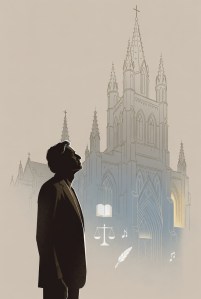 Dawkins has called himself a “cultural Christian.” He remains an atheist, which is what makes the admission interesting. He is not saying Christianity is true. He is noticing that Christianity helped form a civilization in which he could become Richard Dawkins: skeptical, eloquent, publicly irreverent, protected enough to criticize sacred things, and still culturally at home among the ruins and residues of the faith he rejects.
For a long time, many secular Westerners treated Christianity as something they had outgrown. It was old, morally complicated, often hypocritical, and associated with repression, scolding, and bad Sunday mornings. Keep the music, perhaps. Keep the architecture. Keep Christmas, provided no one gets doctrinal about it. The rest could be packed away.
There were reasons for that impatience. Churches persecuted, censored, lied, protected abusers, cozied up to power, and sometimes confused institutional self-interest with the will of God. No honest appreciation of Christian civilization can skip that part. But there is a difference between remembering the failures of an inheritance and forgetting that we inherited anything worth having.
The West was not built from one source. It is a quarrelsome inheritance: Greek reason, Roman law, Jewish moral seriousness, Christian theology, Germanic custom, common law, Reformation fracture, Enlightenment skepticism, scientific inquiry, and the long institutional habit of limiting power. Christianity did not invent every virtue from nothing, but it became one of the great furnaces in which those virtues were universalized, moralized, preached, contradicted, betrayed, and recovered.
Modern liberalism did not merely inherit Christian assumptions and put them in nicer clothes. It built institutions Christianity often resisted: robust free speech, religious disestablishment, broader suffrage, empirical science protected from clerical authority, and legal equality that went well beyond what most Christian societies were willing to grant. Some of the freedoms Dawkins enjoys were made possible by Christian moral inheritance. Others required sharp breaks from dominant Christian practice.
That tension is the point. The West is the product of argument, correction, rebellion, restraint, and institutional memory.
This is what modern secular people often miss. We imagine ourselves as freestanding moral adults. We believe in human dignity, equality before the law, freedom of conscience, care for the vulnerable, suspicion of tyranny, and the right to criticize authority. Fine. Keep all of that. But those commitments have a history. They were not produced by vibes, nor assembled last Tuesday by a committee with a land acknowledgement and a catering budget.
They came through centuries of conflict, doctrine, reform, law, blood, repentance, philosophy, institutional restraint, and exhaustion after too many people had killed each other over ultimate things.
To appreciate that inheritance is not to baptize every part of it. Christendom was not gentle. Christianity often had to be forced into better conduct by dissidents, reformers, scientists, heretics, abolitionists, and Christians reading their own scriptures more honestly than their institutions did. The West’s moral inheritance was not a clean gift. It was an argument, often conducted under pressure.
“The West is the product of argument, correction, rebellion, restraint, and institutional memory.”
But the argument happened inside a civilization shaped deeply by Christianity.
The freedom to doubt, mock religion, publish irreverent books, leave a faith, criticize clerics, and live without being ruled by priests was not inevitable. Nor was the expectation that women may walk unveiled, educated, employed, politically equal, and legally protected. These are achievements produced by particular histories, institutions, and moral restraints.
That is where Dawkins’ comparison with Islam enters the discussion, though it needs care.
The issue is not Muslim neighbours. Millions of Muslims live peacefully, work hard, raise families, keep faith privately, and want the ordinary goods everyone else wants: safety, dignity, friendship, decent schools, and a stable life. A serious argument begins by refusing collective suspicion.
The harder question is what happens when Islamic doctrine becomes politically confident and expects the wider society to accommodate its rules around blasphemy, apostasy, religious offence, sex roles, homosexuality, and public criticism. Outcomes differ by interpretation, education, migration patterns, and host-society confidence, but liberal societies still cannot survive by pretending every moral and legal order is equally compatible with liberal freedom.
Dawkins seems to understand that cultural Christianity has learned to live with disbelief in a way many religious systems have not. The Anglican church may annoy you. It may bore you. It may produce beige sermons, awkward committees, and hymns sung by twelve people spread across a nave built for three hundred. But it is unlikely to demand the state punish you for mocking it, which is not a small thing.
“But criticism without gratitude curdles into contempt, and contempt is a poor steward of anything worth preserving.”
The Sunday lesson, then, is not “become Christian or die,” nor “atheists secretly know God is real,” nor “all Muslims are enemies.” It is more modest and more useful: know where you are standing.
If you live in the West, you live inside an inheritance. You may criticize it. You should criticize it. The tradition itself contains the tools for doing so. But criticism without gratitude curdles into contempt, and contempt is a poor steward of anything worth preserving.
Secular liberalism has been living partly off inherited moral capital for a long time, even while adding real achievements of its own. Compassion, rights, conscience, equality, dissent, human dignity, forgiveness, reform, and care for the weak remained available, but the story of how they arrived became unfashionable.
A culture can run on inherited habits for a while. Maybe longer than its critics expect. But inheritance is not self-renewing, and gratitude alone is not repayment. If people are taught only to sneer at what formed them, they will not know what to keep, what to reform, what to defend, or what to pass on. If they merely admire the ruins, they become tourists in their own civilization.
Dawkins has not found God. He has noticed a debt.
The harder question is whether a civilization can repay that debt without pretending to believe what many of its citizens no longer believe.
No so gentle reminder of the reality of the situation.
We are moving toward this sort of frank discussion when it comes to the religion of gender identity. The days when we have a gender atheist the caliber of Richard Dawkins will not be here too soon.
Catch up with the full article found here on The Critic.
This is the situation we are up against. Speaking out against or even wanting to discuss the gender religion can be hazardous to you and your livelihood. Isn’t it darkly fascinating that defining women as adult human females is considered, in some ‘progressive circles’ the pinnacle of heresy?
“You tweeted in May 2015:
- Words are our servants not masters. But reality masterfully demands words to respect objective distinctions. “Social constructs” have limits
- Thus, it is polite & praiseworthy to refer to trans people by pronoun of choice. But not when talking of, say, chromosomes or anatomy
- No matter how neutral, objective, disinterested, or just plain true your statement, someone will be deeply (& offensively) offended.
- Anthropologists respect a culture by, say, synonymising “brother” & “cousin”. But we must acknowledge scientific distinction as more real.
This is pretty much the position for which I lost my job at an international development think tank, and which was deemed by a judge to be “not worthy of respect in a democratic society”. It is the position for which JK Rowling has been deemed a terrible transphobe, and disavowed by the Robert F Kennedy Foundation, who also revoked an award.
Meaning matters when words are used to make, or break, the rules by which society operates
I imagine you got some pushback at the time, but not of the ferociousness that women face when they say this. And maybe not enough to spark a recognition that this is an authoritarian faith that has taken hold of our enlightenment institutions; complete with a catechism (“trans women are women, trans men are men, non-binary people are non-binary”), heresy laws and an inquisition. It has corrupted and corroded the systems for data collection, sense making and rule formation, for safety, cooperation, and collective endeavour.
In October 2015 you tweeted: “Is trans woman a woman? Purely semantic. If you define by chromosomes, no. If by self-identification, yes. I call her “she” out of courtesy.”
Courtesy is nice, but meaning matters when words are used to make, or break, the rules by which society operates. Is a “trans woman” a woman when it comes to women’s prisons, women’s refuges, women’s rugby, women’s athletics, the request by a woman to be seen by a female doctor, the rules around being searched by a police officer or a prison guard of a particular sex? Should statistics and medical risk assessment defer to courtesy or stick to facts?
I think you see it now. What is being asked is not just day-to-day courtesy, but replacing sex with self-identified gender in every situation and punishing those who refuse to comply (or who even ask to discuss).
Thank you for speaking up. Please keep doing it.”
Do speak up everyone and push back against this profoundly misogynistic anti-reality ideology, but stay safe while doing so. Every voice, even anonymous voices on social media are important in spreading the word about this deeply regressive tide we are facing.
The good cardinal is out gunned, out classed and out argued on this episode of Q&A. He ends up calling Jesus and ignorant sheep-herder. A great debate, well worth your time.
 Richard Dawkins has a new new book out called the Magic of Reality. Doing the promotional rounds in the UK and the US must promote a certain amount of cognitive dissonance for Dawkins as the calibre of the questions he faces varies a great deal depending on which side of the Atlantic he’s on. Compare and contrast, my faithful readership, the two interviews conducted with Dawkins, one by the BBC and the other by Fox News.
As a North American, the second interview makes me ashamed to share the same continent with ‘commentators’ that espouse the merits of bronze age wisdom in the 21st century.
Two talk shows, two very different levels of discourse.
The Late Late Show from Ireland.
Bill Mahr on HBO.
Draw your own conclusions, but one can see why one should be worried about the state of affairs on this side of the pond.











 bleatmop
 Mystro
 The Arbourist


 Dead Wild Roses
Your opinions…