
You are currently browsing the category archive for the ‘Public Policy’ category.
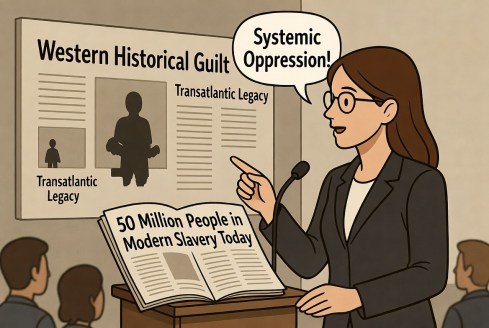
The most revealing thing about modern slavery is not only that it exists. It is that so many people who invoke slavery as a moral category seem oddly uninterested in it when it is happening now.
In contemporary activist politics, slavery is often treated as a permanent indictment of the West. It is invoked to explain present inequality, assign inherited guilt, rewrite institutional language, justify symbolic rituals, and discipline dissent. Some of that history matters. The transatlantic slave trade was real, brutal, and morally indefensible. A serious civilization should be able to tell the truth about its crimes.
But truth has a tense. If slavery matters morally, then slavery matters now.
According to the latest Global Estimates from the International Labour Organization, Walk Free, and the International Organization for Migration, roughly 50 million people were living in modern slavery on any given day in 2021: 27.6 million in forced labour and 22 million in forced marriage. Walk Free estimates that about 7 million people in Africa were living in modern slavery.
If slavery is invoked as a living moral category when it indicts the West, then slavery should also matter when people are being coerced, trafficked, forced into marriage, or trapped in labour today.
These are not metaphors. Modern slavery includes forced labour, forced marriage, trafficking, sexual exploitation, debt bondage, and other forms of coercion that people cannot freely refuse or leave.
Many human-rights groups do serious work on these abuses. That should be acknowledged. But the cultural volume is not the same. Western institutions pour energy into land acknowledgements, reparations debates, decolonization seminars, symbolic renamings, privilege workshops, and inherited-guilt rituals. Meanwhile, present-tense slavery struggles to command anything like the same moral attention.
Mauritania, for example, formally abolished slavery, yet descent-based slavery and slavery-like practices remain serious concerns. That should disturb anyone who claims to care about domination and human dignity. It should not be a niche humanitarian footnote.
The strongest activist reply is not ridiculous. Historical slavery did not vanish without consequence. The transatlantic slave trade, colonial rule, segregation, and legal exclusion shaped wealth, institutions, geography, and inherited disadvantage. A society does not become innocent simply because the worst laws are repealed.
That is a serious point. But it does not answer the problem of moral selectivity. If slavery is invoked as a living moral category when it indicts the West, then slavery should also matter when people are being coerced, trafficked, forced into marriage, or trapped in labour today.
This is where much contemporary anti-racism becomes revealing. In theory, it opposes domination and exploitation. In practice, it often functions as a selective solvent. It dissolves confidence in Western institutions, Western history, Western moral achievement, and Western civic inheritance, while offering little concrete help to people being dominated right now.
The predictable reply is that this is whataboutism. It is not. Whataboutism says, “Ignore this evil because that evil also exists.” The argument here is the opposite: if slavery is evil, then concern should become more urgent when slavery is happening now. Historical truth matters, but it cannot become a substitute for present-tense moral attention.
Nor is this answered by saying critics do not understand critical theory properly. If a theory constantly produces institutional rituals of guilt, suspicion, deconstruction, and accusation, ordinary citizens are allowed to judge it by its public effects. A politics that requires specialist initiation before anyone may notice its consequences has already left democratic argument behind.
The issue is not whether the West has sins in its history. It does. The issue is whether anti-racism is actually against domination, exploitation, and slavery as human evils, or whether those evils are useful mainly when they can be arranged into an indictment of Western society.
If slavery matters only when it can be used to shame the West, then slavery is not the real object of concern. The West is.
References
International Labour Organization, Walk Free, and International Organization for Migration. Global Estimates of Modern Slavery: Forced Labour and Forced Marriage.
https://www.ilo.org/publications/major-publications/global-estimates-modern-slavery-forced-labour-and-forced-marriage
Walk Free. Global Slavery Index 2023 — Global Findings.
https://www.walkfree.org/global-slavery-index/findings/global-findings/
Walk Free. Global Slavery Index 2023 — Modern Slavery in Africa.
https://www.walkfree.org/global-slavery-index/findings/regional-findings/africa/
Anti-Slavery International. What is Descent-Based Slavery?
https://www.antislavery.org/slavery-today/descent-based-slavery/
Anti-Slavery International. Mauritania: Descent-Based Slavery.
https://www.antislavery.org/what-we-do/mauritania/
Arab Reform Initiative. Racialized Hereditary Slavery in Mauritania: Interview with Activist Abidine Maettalla.
https://www.arab-reform.net/publication/racialized-hereditary-slavery-in-mauritania-interview-with-activist-abidine-maettalla/
Good intentions are not enough. That should be obvious, but much of our public life now behaves as if noble language can rescue bad thinking.
Before people declare what is compassionate, just, inclusive, hateful, dangerous, or necessary, they need some reliable way of knowing whether their factual claims are true. That order matters. If the tools used to find truth are broken, captured, or designed to protect a preferred belief from contradiction, then the moral conclusions built on top of those tools will inherit the damage.
This is not a left-wing or right-wing problem, though each side prefers noticing it in the other. The progressive version often begins with moral urgency. A policy is called compassionate, inclusive, or protective, and once that moral label is attached, factual objections start to look suspicious. Questions about consequences become “harm.” Questions about definitions become “erasure.” Questions about evidence become proof that the questioner is unsafe.
The conservative version has its own habits. A bad social trend gets folded too quickly into civilizational decline. One ugly example becomes proof of total collapse. A complicated institutional failure becomes evidence that the enemy planned the whole thing. The moral conclusion may contain some truth, but it arrives too early and then starts recruiting facts to serve it.
That is the trap. Once moral certainty arrives first, the mind stops investigating and starts defending.
You can see the pattern wherever institutions are rewarded for sounding virtuous before they are required to be accurate. A school board adopts fashionable language before asking whether the policy helps children. A medical system treats hesitation as cruelty before the long-term evidence is settled. A government describes economic pain in careful managerial terms while households are trying to make rent, groceries, debt, and wages fit inside the same month. The details differ, but the sequence is familiar: the moral frame arrives first, and the facts are invited in later as supporting cast.
A healthier public culture would ask plainer questions before the slogans begin. What is the claim? What evidence would show it is true? What evidence would weaken it? Who pays the cost if we are wrong? Are we counting those costs honestly, including the costs to people we do not like? Are we applying the same standard when the facts embarrass our own side?
Those questions are not glamorous. They do not fit neatly on a protest sign or a campaign graphic. They also do not offer the emotional satisfaction of instant righteousness. But they are the difference between thinking and performing.
This matters because moral language is powerful. It can move people to protect the vulnerable, correct injustice, and resist cruelty. But the same language can also be used to smuggle weak claims past scrutiny. Institutions have incentives to do this. Activists gain status from certainty. Bureaucracies protect themselves with approved vocabulary. Media outlets reward emotional clarity over careful qualification. Ordinary people learn, quickly enough, which questions are safe to ask in public and which ones are better saved for the parking lot.
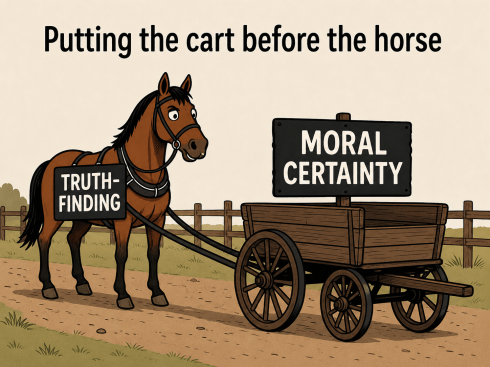
So they accept the conclusion first and hope the facts will catch up later.
They often do not.
Reality has a way of collecting unpaid debts. Bad premises eventually produce visible damage: failed policies, institutional distrust, medical scandals, economic denial, public cowardice, and citizens who no longer believe official language because they have watched it bend too many times.
The answer is not cynicism. Cynicism is often just laziness wearing a smarter jacket. The answer is better truth-finding: slower claims, clearer definitions, stronger evidence, real costs counted on both sides, and a willingness to notice when our preferred story stops matching the world.
That includes me. That includes you. That includes the people whose politics we find irritating, fashionable, smug, or deranged. Nobody gets a permanent exemption from reality because their intentions are good or their enemies are worse.
A decent society needs moral seriousness, but moral seriousness cannot mean protecting our favourite conclusions from examination. It has to mean caring enough about justice to ask whether our account of the world is actually true.
A recent post from a Women’s Liberation Front activist should be read less as a complaint than as a warning about how institutions train dissenters to accept contempt as normal.
She describes years of opposing gender-identity legislation in California: travelling to Sacramento, meeting legislative offices, testifying at hearings, and trying to explain to ordinary people what the policies actually mean. Female locker rooms become mixed-sex spaces by administrative decree. Girls’ sports and girls’ boundaries become conditional. Distressed young women are placed on medical pathways that can permanently alter healthy bodies.
The remarkable part is not merely that lawmakers disagree with her. Disagreement is expected in politics. What stands out is the air of pre-judgment around the process. She writes that legislators’ offices treat these women with “barely contained disdain.” Public hearings fill with activists who regard any defence of female boundaries as proof of bigotry. The women objecting are not received as citizens raising serious concerns about privacy, safeguarding, fairness, or medical ethics. They are treated as a nuisance class: managed, endured, and socially disqualified before the argument begins.
A functioning democracy does not require lawmakers to agree with every citizen. It does require them to hear citizens as citizens. When women raise concerns about intimate spaces, parental knowledge, fair competition, or irreversible interventions on minors, the answer cannot simply be a sneer and a label. “Bigot” is not an argument. “Hate” is not a policy analysis. “Inclusion” does not magically settle every conflict between competing rights.
Institutional capture often works this way. It does not begin by winning every argument in public. It begins by deciding which arguments are permitted to count. After that, the ordinary political process becomes strangely theatrical. Hearings still happen. Citizens still line up to speak. Legislators still nod along with the solemn expressions of people performing democratic patience. But the conclusion has already been filed away. These women are not constituents with claims on representation. They are obstacles to be routed around.
“A functioning democracy does not require lawmakers to agree with every citizen. It does require them to hear citizens as citizens.”
California is an especially sharp example because its political culture is so one-sided on this issue. The institutions are not neutral referees; they have chosen a side, and women who object are expected to absorb that fact politely. Over time, this wears people down. The WoLF activist’s most revealing line is not the one about crazy legislation. It is the moment of recognition: going to Washington, D.C. reminded her how badly she had become accustomed to being treated in California.
That is what contempt does over time. It lowers your expectations. It trains you to think basic respect is a luxury. It teaches you that being ignored is normal, that being caricatured is normal, that being called hateful for stating sex-based concerns is the price of admission.
This is especially perverse when the dissenters are women defending women’s boundaries. Feminism once insisted that female privacy, bodily integrity, and protection from male entitlement mattered. Now women who make those arguments are often treated as embarrassing relics, reactionaries, or moral contaminants. The old feminist vocabulary survives, but the sex class it was built to defend has been quietly replaced by a more fashionable abstraction.
The inversion should be obvious by now. Women are told they must be compassionate while their own concerns are dismissed. Girls are told inclusion matters while fairness and privacy are negotiated away on their behalf. Parents are told to trust institutions that increasingly treat hesitation as a threat. Citizens are told democracy is sacred while lawmakers learn to ignore the public on issues where the public is far less progressive than the activist class.
“The hearings still happen. Citizens still line up to speak. But the conclusion has already been filed away.”
This is why the fight matters even when a particular bill is lost. Public opposition creates a record. It denies consensus. It tells other women they are not alone. It forces legislators to own what they are doing rather than hiding behind bureaucratic language and moral fog.
Eventually, legislators need to pay a political price for treating women this way. Not because disagreement is forbidden. Not because every feminist objection should automatically prevail. But because a political class that can dismiss women’s sex-based concerns with contempt has learned something dangerous about power: the right moral vocabulary can make ordinary citizens disappear.
Women cannot win a fight they are shamed out of entering. They cannot defend boundaries they are not allowed to name. They cannot rely on institutions that have already decided their objections are evidence of guilt.
The point is not that every battle will be won in Sacramento. Some will be lost. Maybe many. But silence is how capture becomes permanent. Visibility is how it starts to crack.

Institutional capture rarely arrives breathing fire. More often, it brings a binder, a microphone, and a schedule.
The previous essay argued that we have stopped teaching self-control. The next question is what replaced it.
Too often, the answer is fragility.
Not deliberately. No parent sets out to make a child brittle. No teacher wants students less capable at the end of the year than they were at the beginning. The shift came wrapped in kind language: safety, validation, accommodation, trauma-awareness, student voice. Some of that language was needed. Cruelty has often hidden behind discipline, and adults have not always known the difference between formation and control. But there is another mistake now, quieter and more respectable: treating ordinary discomfort as harm.
In The Coddling of the American Mind: How Good Intentions and Bad Ideas Are Setting Up a Generation for Failure, Greg Lukianoff and Jonathan Haidt call this the “untruth of fragility”: the assumption that young people are easily damaged by adversity, frustration, disappointment, or disagreement. The intention is protection. The result is often training, though not the kind adults think they are providing.
 Children are not porcelain. They are more like muscles, immune systems, or voices in training. They develop through manageable strain, not through trauma or neglect, and not through well-intentioned overprotection. They need difficulty that can be borne, repeated, and mastered.
A child who never has to wait does not become patient. A child who never loses does not become gracious. A child who never hears “no” does not become free. He becomes dependent on the world bending quickly enough to keep him comfortable, and that dependence is one of the quiet curricula of modern fragility.
You can see it in ordinary school and home life. A student receives a low mark and treats it as injury rather than feedback. A child finds a task boring and is rescued by entertainment before endurance has a chance to form. A playground conflict begins, and adults rush in so quickly that no apology, embarrassment, repair, or social learning can happen. A deadline becomes flexible before the child has had to face the cost of poor planning.
None of this looks dramatic at the time. That is why it spreads. Each adult decision seems merciful in isolation: soften the consequence, remove the frustration, shorten the task, mediate the conflict, raise the grade, excuse the outburst, avoid the tears. Sometimes mercy is exactly what is required. Children are not all carrying the same burdens. A child being bullied needs protection. A child in genuine distress needs care. A child with a disability may need accommodation. A child in crisis may need the demand reduced.
But difficulty is not automatically damage, and that distinction is where too much modern child-rearing loses its nerve. A child being corrected is not necessarily being harmed. A child being disappointed is not necessarily being wounded. A child being asked to persist through boredom is not necessarily being oppressed. These are ordinary parts of formation. Remove them too consistently and the child does not become safer; he becomes less practised at living.
This is where Lukianoff and Haidt’s use of cognitive behavioural therapy matters. CBT does not teach people to obey every anxious thought. It teaches them to notice the thought, test it, reframe it, and move forward. A healthy adult response to childhood distress works in a similar direction. It does not sneer at the feeling, but neither does it make the feeling sovereign.
When a child says, “I can’t handle this,” the answer cannot always be, “Then you do not have to.” Sometimes the answer has to be, “I know this feels hard. We are going to do a smaller version, and you are going to discover that you can survive it.” That kind of answer is not cruelty. It is formation with an adult still in the room.
The older language of character understood this more plainly, even when it was sometimes misused. Patience, courage, temperance, perseverance, humility: these were not decorative virtues. They were survival equipment. Children learned them by doing unpleasant things under adult guidance — waiting, losing, apologizing, practising, revising, sitting still, trying again after embarrassment.
Modern childhood often wants the fruit without the cultivation. It wants confidence without correction, resilience without frustration, emotional health without disappointment, and independence without delayed gratification. The bargain looks generous in the moment, especially to adults who hate seeing children unhappy, but it does not hold.
This is where the link to self-control becomes direct. Self-control is one expression of antifragility. A child becomes stronger by meeting manageable resistance and discovering that impulse, fear, boredom, and frustration do not have to rule him. The Dunedin findings pointed in the same direction from the other side: children with poorer self-control were more likely to stumble into adolescent “snares” that narrowed their later options. The practical lesson is not that children should be hardened by neglect. It is that they need repeated practice meeting difficulty before difficulty becomes decisive.
This is the part our institutions need to relearn. Compassion and expectation are not enemies. Support and standards can coexist. A child’s distress may explain why something is difficult; it does not automatically prove the demand is wrong. If adults forget that, they may still sound compassionate while steadily reducing the child’s world to the size of his most avoidant impulse.
A wiser culture would prepare children for the road rather than trying to smooth every inch of it before they arrive. It would let small failures do their teaching while the stakes are still low. It would allow boredom, correction, awkwardness, and disappointment to resume their proper place as ordinary features of growth.
We wanted children to feel safe. Fair enough. But somewhere along the way, too many adults began treating safety as the absence of discomfort rather than the growth of capacity. That is how we stopped teaching self-control, and how we started teaching fragility.
One of the most effective moves in contemporary progressive argumentation, especially inside institutions that trade in moral prestige, is also one of the least truth-seeking: take an ordinary policy dispute, attach a moral charge to one side of it, and then treat resistance as evidence of personal defect.
The argument does not proceed by persuasion. It proceeds by contamination.
You are not merely skeptical of a DEI policy. You are hostile to inclusion. You are not asking whether a school lesson is age-appropriate. You are endangering vulnerable children. You are not questioning whether a land acknowledgement has become empty ritual. You are denying history. You are not concerned about due process, compelled speech, medical evidence, or institutional overreach. You are “unsafe.”
“The moral valence trap raises the social cost of dissent until silence looks like prudence.”
The mechanism is simple. First, the issue is moved from the realm of judgment into the realm of moral identity. Then the person asking questions is dragged with it. The disputed policy becomes kindness, justice, safety, inclusion, or harm reduction. Opposition becomes cruelty, hatred, danger, exclusion, or complicity. Once that happens, the argument is no longer about the thing itself. It is about whether you are the sort of person decent people should listen to.
This is dirty pool, but it works because most people do not want to be seen as cruel. They also do not want a meeting, classroom, workplace, choir rehearsal, staff room, or family dinner to become a tribunal. So they soften, retreat, or say nothing. The moral valence does its job. It raises the social cost of dissent until silence looks like prudence.
The tactic is not unique to progressives. Conservatives have used their own versions: dissent from a war becomes hatred of the troops; concern about state power becomes softness on crime; criticism of national myth becomes contempt for the country. The mechanism is the same. Policy disagreement is converted into a character flaw. The reason the progressive version deserves special attention now is not that it is uniquely wicked, but that it has become unusually powerful inside the institutions that shape respectable opinion: schools, universities, HR departments, media, charities, public agencies, and professional regulators.
The first defence is definitional clarity.
Do not accept suitcase words without unpacking them. Harm, safety, inclusion, dignity, equity, violence, erasure, and belonging are often used as if everyone already knows what they mean. Usually they do not. These words carry emotional force precisely because they remain blurry. A claim like “this policy protects safety” sounds serious, but it may mean physical safety, emotional comfort, reputational protection, ideological conformity, bureaucratic risk management, or the absence of disagreement.
Those are not the same thing.
The useful question is not “Do you care about safety?” That question has already been rigged. The useful question is: what kind of safety, for whom, from what, by what mechanism, and at what cost to others?
That last clause matters. Every moral claim has tradeoffs. A school policy that makes one child feel affirmed may require another child to lie. A workplace policy designed to create inclusion may create compelled speech. A public ritual meant to acknowledge one group may quietly pressure others into participation. A speech code meant to prevent harm may give administrators broad discretion to punish unpopular views.
Definitions bring the argument back to earth. They force slogans to become claims. Once a slogan becomes a claim, it can be examined.
The second defence is fairness in a liberal democratic society.
Progressive moral framing often assumes that once a group is described as vulnerable, its preferred policy should win by default. But liberal democracy cannot work that way. Vulnerability matters, but it does not abolish fairness. A decent society does not settle conflict by asking which side has the most emotionally powerful identity claim and then handing that side the institutional lever.
Fairness requires reciprocal rules. If one group may decline participation in a ritual that violates its conscience, others must be allowed the same freedom. If one group may describe its experience honestly, others must be allowed to describe theirs. If dignity matters for minorities, it also matters for dissenters. If safety matters for the anxious student, it also matters for the girl in the changing room, the employee pressured to say words he does not believe, the parent cut out of a consequential decision, or the teacher expected to enforce doctrine while pretending it is merely kindness.
The point is not that all claims are equal. Some are stronger than others. Some deserve accommodation. Some deserve rejection. But in a liberal society, moral concern cannot become a one-way ratchet where one side receives rights and the other receives obligations.
A fair question cuts through the fog: would this rule be acceptable if used by people you distrust?
If the answer is no, then the principle is not a principle. It is a weapon waiting for a friendly hand.

The third defence is free speech.
Not free speech as a bumper sticker. Not free speech as “I should be able to say anything without consequence.” Free speech as the basic operating condition of a truth-seeking society.
The moral valence trap depends on making certain questions unsayable. It does not always censor directly. Often it works through etiquette, professional risk, peer pressure, institutional language, and the quiet fear of being labelled. That is enough. You do not need formal censorship when people learn to pre-edit themselves before the room turns cold.
Free speech is not merely a personal liberty. It is a safeguard against institutional self-deception. Bad policies survive when people cannot question the assumptions underneath them. Medical scandals survive that way. Educational fads survive that way. Bureaucratic rituals survive that way. Ideologies survive that way. The organization tells itself that dissent is harm, then congratulates itself on the absence of dissent. An institution can call that consensus if it wants, but what it has really produced is managed silence.
This is also where the dissenter has to resist the forced confession. The moral valence trap often tries to make you prove your innocence before you are allowed to discuss the issue: “Do you support inclusion?” “Do you understand how harmful that is?” “Why are you uncomfortable with marginalized people being seen?” Sometimes these are sincere questions. Often they are attempts to move the conversation from the policy to your character. A useful response is calm redirection: I’m happy to discuss the rule. I’m not going to litigate my soul as a precondition for speaking.
The point is not to become rude or combative; it is to keep the discussion on the rule, the evidence, and the tradeoffs instead of letting it drift into a trial of your character.
Progressive argumentation wins when it turns politics into moral theatre. The trick is to refuse the theatre without refusing morality. There are real harms, real injustices, and real people who deserve protection, accommodation, and dignity. But moral language should clarify reality, not smother it. Once moral vocabulary becomes a substitute for evidence, mechanism, fairness, and speech, it stops being ethics and becomes discipline.
The answer is not counter-shaming, which only reproduces the same bad habit with different slogans, but steadiness: define the terms, ask who pays the cost, test the rule for reciprocity, and defend the right to question. A liberal society does not need citizens who agree about everything. It needs citizens who can disagree without turning every dispute into a loyalty test.
June is coming, which means the machinery will start again.
The flags. The emails. The school bulletin boards. The corporate logos. The municipal proclamations. The HR language. The social media badges. The rainbow email signatures. The familiar little suggestion that anyone who declines the ritual must be hiding some moral defect.
That is exactly why Pride needs civic proportion.
Not abolition. Not cruelty. Not some bitter campaign to drive gay and lesbian citizens back into silence. That would be wrong, and it would also miss the point. The question is not whether gay people should be treated with dignity. Of course they should. The question is whether equal citizenship requires a month of institutional performance, followed in Canada by what the federal government now openly calls Pride Season, running from June to September.
At some point, recognition became saturation.
That distinction matters. Visibility can have value. There are still young people who feel isolated, families that struggle to accept them, and countries where homosexuality remains criminalized. None of that is trivial. But a liberal society still has to distinguish between civic recognition and compulsory enthusiasm. It can protect minorities without turning public institutions into ideological billboards. It can permit parades, private celebration, voluntary corporate sponsorship, and public respect without making every workplace, school, and government office participate in a rolling moral pageant.
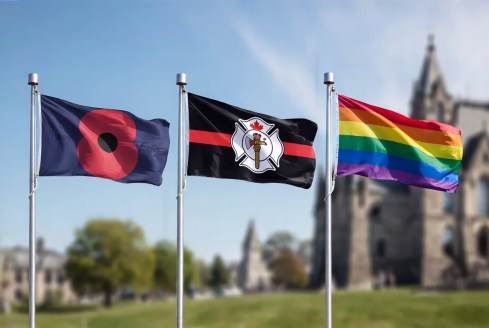
Veterans have Remembrance Day, with Veterans’ Week as a focused period of solemn national memory. Fallen firefighters are honoured through Firefighters’ National Memorial Day. Canadian peacekeepers are recognized on National Peacekeepers’ Day. These are not minor observances. They include people who served in wars, ran toward fire, responded to disaster, watched friends die, and carried burdens most citizens will never see.
Yet their recognition is bounded and it is not disrespect, but rather it is a demonstration of civic restraint.
Pride has not been restrained. It has expanded from a protest, to a celebration, to a month, to a season, to a branding cycle, to a school-calendar fixture, to a test of institutional obedience. The expansion is now so familiar that many people barely notice it. They only notice the consequences of objecting.
Decline the flag, and suspicion arrives. Question the school display, and someone starts measuring your moral temperature. Object to compelled language, and the labels come quickly: hateful, unsafe, bigoted, backward, not fit for polite company. This is how a movement that once asked for tolerance drifts into reputational discipline. Not by sending police to your door, but by making ordinary dissent socially expensive enough that most people decide silence is easier.
Surprisingly(?)this isn’t healthy pluralism or even good advocacy on a societal scale.
Every cause eventually faces a choice. It can keep expanding its demands forever, or it can settle into the ordinary dignity of citizenship. The first option keeps activists, consultants, committees, and bureaucracies busy. The second allows citizens to live together without every institution becoming a stage for moral performance.
And this critique does not apply only to one letter in the ever-expanding acronym. The problem is the machinery itself: the institutional expectation that citizens must affirm not only dignity and legal equality, but the whole ideological package attached to the celebration. That is where reasonable accommodation gives way to soft coercion.
The smarter move would be if the Pride organizations themselves stepped up and acknowledged their overreach.
“The better settlement is simple enough: one day of recognition, freely observed, and then the ordinary dignity of living together without a seasonal loyalty test.”
They could say: we have made our point. Gay and lesbian Canadians are not going anywhere. We are neighbours, friends, co-workers, artists, teachers, soldiers, parents, and citizens. We do not need four months of official reinforcement to prove we belong. Let Pride return to civic scale: a bounded public recognition, private celebration for those who want it, and no expectation that every institution must join the ritual.
That would be a sign of confidence, not retreat. A movement secure in its place does not need every bank logo recoloured, every school hallway decorated, or every employee nudged into public agreement. If the goal is equal citizenship, then the endgame cannot be permanent mobilization. It has to be ordinary civic life, with room for celebration, indifference, criticism, and refusal.
Let communities hold parades. Let businesses support Pride if they choose. Let citizens attend, ignore, criticize, or enjoy the day as free people. But public institutions should stop behaving as though full civic membership requires annual submission to a political liturgy.
The better settlement is simple enough: one day of recognition, freely observed, and then the ordinary dignity of living together without a seasonal loyalty test.
Manitoba Premier Wab Kinew wants children under 16 kept off social media and AI chatbots.
Good.
Not because the policy is automatically workable. Kids are talented little smugglers, and the internet has more holes than any government net. But the premise is sound enough: children are not miniature adults. Their judgment is still forming. Their resilience is still forming. Their sense of self is still being built under pressure from machines designed to harvest attention, anxiety, loneliness, status hunger, and imitation.
Anyone who has spent time in a school already knows this. The phone does not stay in the phone. It follows children into classrooms, friendships, sleep, family life, and self-understanding, dragging the emotional weather of the internet behind it.
So Kinew is not wrong to worry about the infinite scroll.
But now comes the circle no one should be asked to square.
If children under 16 are too developmentally immature to responsibly use TikTok, Instagram, Snapchat, or AI chatbots, how are they mature enough to consent to medical interventions that can alter puberty, sexual development, fertility, and future bodily integrity?
That is not a cheap gotcha. It is the question.
The same adult world cannot say a 15-year-old is too vulnerable for algorithmic identity machines, then turn around and treat that same 15-year-old as a sovereign authority on an identity framework often first encountered, rehearsed, and socially reinforced online. The developmental premise cannot change just because the political subject changes.
This is where the phrase “gender-affirming care” does too much work.
It bundles together counselling, social transition, names, pronouns, puberty blockers, cross-sex hormones, surgeries, legal changes, and an institutional framework that treats affirmation as the default moral response. Once the label is accepted, scrutiny begins to sound cruel. Caution becomes “denial of care.” Questions become “hate.”
That is how a medical culture loses discipline.
None of this requires pretending that gender dysphoria is fake. It is not. Some young people are genuinely distressed, and they deserve compassion, seriousness, and protection from bullying or humiliation.
But compassion is not the same thing as medical acceleration.
The evidence base for pediatric gender medicine is not as settled as activists and professional bodies spent years pretending. The Cass Review in England found serious weaknesses in the evidence behind youth gender services and pushed the NHS toward a more cautious model. NHS England stopped routine prescribing of puberty blockers for minors in 2024, and the U.K. government later made restrictions on puberty blockers indefinite, citing expert advice about safety risks. (NHS England)
That was not an American culture-war panic. It was a major health system responding to an evidentiary rupture.
NHS England has also moved toward greater caution around masculinising and feminising hormones for minors, including a 2026 consultation on whether those treatments should remain a routine option for under-18s. (The Guardian)
Meanwhile, Manitoba’s own Gender Diversity and Affirming Action for Youth program says hormone blockers may be discussed for some youth early in puberty, while gender-affirming hormones may be discussed for youth who have completed puberty. Shared Health Manitoba has also described puberty blockers as delaying physical and sexual maturity for youth who have not yet entered or completed puberty. (Shared Health)
So the contradiction is not imaginary.
Kinew’s child-safety argument depends on one claim: children under 16 are developmentally vulnerable. They are susceptible to manipulation, emotional contagion, social pressure, adult incentives, and systems they do not fully understand.
Exactly.
Now apply that consistently.
Protect children from addictive apps. Protect them from algorithmic sexualization. Protect them from online mobs and chatbot intimacy. But also protect them from adults who treat adolescent distress as proof of an inner essence that must be medically affirmed before the child has finished becoming herself.
A sane society can hold two thoughts at once.
First, distressed children deserve care.
Second, because they are children, adults owe them caution.
Patience is not cruelty. Hesitation is not hatred. Preserving a child’s future options is not oppression.
Kinew has stumbled into the right premise. Children are not miniature adults. If that is true when the subject is social media, it does not magically become false when the subject changes to puberty blockers, cross-sex hormones, fertility, and future sexual development.
The standard cannot be: fragile when scrolling, sovereign when affirming.
That is not child protection. That is politics choosing which vulnerabilities count.
Kinew has been hoisted by his own petard. The only question is whether anyone in his political world is willing to notice.

References
Wab Kinew / Manitoba youth social media and AI chatbot ban coverage: (650 CKOM)
NHS England, Clinical policy: puberty suppressing hormones: (NHS England)
U.K. government, Ban on puberty blockers to be made indefinite on experts’ advice: (GOV.UK)
U.K. government explainer, Puberty blockers: what you need to know: (healthmedia.blog.gov.uk)
NHS England / U.K. parliamentary briefing on hormone treatment policy for children and young people: (House of Commons Library)
Shared Health Manitoba, GDAAY program description: (Shared Health)
Shared Health Manitoba, Supporting Trans Youth to “Live Their Best Life”: (Shared Health)











 bleatmop
 Mystro


 Dead Wild Roses
Your opinions…