
You are currently browsing the tag archive for the ‘liberal democracy’ tag.
One of the most effective moves in contemporary progressive argumentation, especially inside institutions that trade in moral prestige, is also one of the least truth-seeking: take an ordinary policy dispute, attach a moral charge to one side of it, and then treat resistance as evidence of personal defect.
The argument does not proceed by persuasion. It proceeds by contamination.
You are not merely skeptical of a DEI policy. You are hostile to inclusion. You are not asking whether a school lesson is age-appropriate. You are endangering vulnerable children. You are not questioning whether a land acknowledgement has become empty ritual. You are denying history. You are not concerned about due process, compelled speech, medical evidence, or institutional overreach. You are “unsafe.”
“The moral valence trap raises the social cost of dissent until silence looks like prudence.”
The mechanism is simple. First, the issue is moved from the realm of judgment into the realm of moral identity. Then the person asking questions is dragged with it. The disputed policy becomes kindness, justice, safety, inclusion, or harm reduction. Opposition becomes cruelty, hatred, danger, exclusion, or complicity. Once that happens, the argument is no longer about the thing itself. It is about whether you are the sort of person decent people should listen to.
This is dirty pool, but it works because most people do not want to be seen as cruel. They also do not want a meeting, classroom, workplace, choir rehearsal, staff room, or family dinner to become a tribunal. So they soften, retreat, or say nothing. The moral valence does its job. It raises the social cost of dissent until silence looks like prudence.
The tactic is not unique to progressives. Conservatives have used their own versions: dissent from a war becomes hatred of the troops; concern about state power becomes softness on crime; criticism of national myth becomes contempt for the country. The mechanism is the same. Policy disagreement is converted into a character flaw. The reason the progressive version deserves special attention now is not that it is uniquely wicked, but that it has become unusually powerful inside the institutions that shape respectable opinion: schools, universities, HR departments, media, charities, public agencies, and professional regulators.
The first defence is definitional clarity.
Do not accept suitcase words without unpacking them. Harm, safety, inclusion, dignity, equity, violence, erasure, and belonging are often used as if everyone already knows what they mean. Usually they do not. These words carry emotional force precisely because they remain blurry. A claim like “this policy protects safety” sounds serious, but it may mean physical safety, emotional comfort, reputational protection, ideological conformity, bureaucratic risk management, or the absence of disagreement.
Those are not the same thing.
The useful question is not “Do you care about safety?” That question has already been rigged. The useful question is: what kind of safety, for whom, from what, by what mechanism, and at what cost to others?
That last clause matters. Every moral claim has tradeoffs. A school policy that makes one child feel affirmed may require another child to lie. A workplace policy designed to create inclusion may create compelled speech. A public ritual meant to acknowledge one group may quietly pressure others into participation. A speech code meant to prevent harm may give administrators broad discretion to punish unpopular views.
Definitions bring the argument back to earth. They force slogans to become claims. Once a slogan becomes a claim, it can be examined.
The second defence is fairness in a liberal democratic society.
Progressive moral framing often assumes that once a group is described as vulnerable, its preferred policy should win by default. But liberal democracy cannot work that way. Vulnerability matters, but it does not abolish fairness. A decent society does not settle conflict by asking which side has the most emotionally powerful identity claim and then handing that side the institutional lever.
Fairness requires reciprocal rules. If one group may decline participation in a ritual that violates its conscience, others must be allowed the same freedom. If one group may describe its experience honestly, others must be allowed to describe theirs. If dignity matters for minorities, it also matters for dissenters. If safety matters for the anxious student, it also matters for the girl in the changing room, the employee pressured to say words he does not believe, the parent cut out of a consequential decision, or the teacher expected to enforce doctrine while pretending it is merely kindness.
The point is not that all claims are equal. Some are stronger than others. Some deserve accommodation. Some deserve rejection. But in a liberal society, moral concern cannot become a one-way ratchet where one side receives rights and the other receives obligations.
A fair question cuts through the fog: would this rule be acceptable if used by people you distrust?
If the answer is no, then the principle is not a principle. It is a weapon waiting for a friendly hand.

The third defence is free speech.
Not free speech as a bumper sticker. Not free speech as “I should be able to say anything without consequence.” Free speech as the basic operating condition of a truth-seeking society.
The moral valence trap depends on making certain questions unsayable. It does not always censor directly. Often it works through etiquette, professional risk, peer pressure, institutional language, and the quiet fear of being labelled. That is enough. You do not need formal censorship when people learn to pre-edit themselves before the room turns cold.
Free speech is not merely a personal liberty. It is a safeguard against institutional self-deception. Bad policies survive when people cannot question the assumptions underneath them. Medical scandals survive that way. Educational fads survive that way. Bureaucratic rituals survive that way. Ideologies survive that way. The organization tells itself that dissent is harm, then congratulates itself on the absence of dissent. An institution can call that consensus if it wants, but what it has really produced is managed silence.
This is also where the dissenter has to resist the forced confession. The moral valence trap often tries to make you prove your innocence before you are allowed to discuss the issue: “Do you support inclusion?” “Do you understand how harmful that is?” “Why are you uncomfortable with marginalized people being seen?” Sometimes these are sincere questions. Often they are attempts to move the conversation from the policy to your character. A useful response is calm redirection: I’m happy to discuss the rule. I’m not going to litigate my soul as a precondition for speaking.
The point is not to become rude or combative; it is to keep the discussion on the rule, the evidence, and the tradeoffs instead of letting it drift into a trial of your character.
Progressive argumentation wins when it turns politics into moral theatre. The trick is to refuse the theatre without refusing morality. There are real harms, real injustices, and real people who deserve protection, accommodation, and dignity. But moral language should clarify reality, not smother it. Once moral vocabulary becomes a substitute for evidence, mechanism, fairness, and speech, it stops being ethics and becomes discipline.
The answer is not counter-shaming, which only reproduces the same bad habit with different slogans, but steadiness: define the terms, ask who pays the cost, test the rule for reciprocity, and defend the right to question. A liberal society does not need citizens who agree about everything. It needs citizens who can disagree without turning every dispute into a loyalty test.
By now the pattern should be familiar. A movement begins with a grievance, often a real one. It then defines the good chiefly by what must be abolished: oppression, domination, impurity, exclusion, hierarchy, stigma. The ideal remains vague, but the stain is vividly named. Reality resists. Limits persist. Tradeoffs do not disappear. At that point the movement faces a choice. It can revise its ambitions in light of the world as it is, or it can moralize the gap between promise and outcome. When it chooses the second path, disappointment hardens into blame, blame hardens into sorting, and sorting prepares the way for coercion.
That is the political logic this series has traced. The danger does not lie in idealism as such. A society without ideals becomes cynical, managerial, and spiritually thin. The danger begins when an ideal cannot survive contact with limits. Then every obstacle looks illegitimate. Every compromise looks corrupt. Every dissenter looks stained. The world is no longer a difficult place to govern. It becomes a field of obstruction to be purified.
The question, then, is what politics looks like once that temptation is recognized. The answer is not indifference. It is not quietism. It is not a shrug in the face of genuine injustice. The answer is a recovery of political adulthood. That recovery begins with three recognitions that negative idealism resists at every stage: limits, tradeoffs, and tragedy.
First, politics must recover the category of limits. Human beings are finite. Institutions are blunt. Knowledge is partial. Incentives matter. Scarcity does not vanish because a cause is morally urgent. Conflict does not disappear because a slogan sounds redemptive. Not every social friction is evidence of oppression. Not every persistence of imperfection is proof of sabotage. A mature politics begins by asking what kind of order flawed people can actually sustain, not what kind of redeemed world can be imagined at emotional full stretch.
“The refusal to admit tradeoffs does not abolish them. It merely disguises them until one side is forced to absorb the cost in silence.”
Second, politics must recover the reality of tradeoffs. Goods collide. Inclusion can conflict with standards. Freedom can conflict with equality. Privacy can conflict with recognition. Safety can conflict with access. Truth can conflict with the social desire to avoid offense. This is not a defect in politics. It is politics. The refusal to admit tradeoffs does not abolish them. It merely disguises them until one side is forced to absorb the cost in silence.
That point matters especially where female boundaries are concerned. One of the clearest signs of political infantilism in our time is the demand that women treat sex-based boundaries as optional whenever they obstruct a moral narrative someone else wishes to impose. Privacy, fairness, vulnerability, and safety are not relics of prejudice. They are goods. They sometimes conflict with other claims. That conflict cannot be solved by euphemism or moral intimidation. It must be faced as a tradeoff and judged accordingly. A politics that cannot say this plainly has already surrendered reality to abstraction.
Third, politics must recover the category of tragedy. Some conflicts do not admit a clean moral victory. Some losses cannot be fully repaired. Some goods cannot be simultaneously maximized. There are wounds in social life that can be mitigated but not abolished, tensions that can be managed but not transcended. Tragedy is not a counsel of despair. It is a protection against fanaticism. Once tragedy is denied, every unhealed wound becomes someone’s crime.
These three recognitions do not solve politics. They civilize it. They narrow the space in which utopian movements can turn ordinary disappointment into moral accusation. They remind us that not every unresolved problem is evidence of bad faith, and not every limit is a betrayal. Most importantly, they restore the possibility of settlement.
Settlement is not a glamorous word. It lacks the heat of liberation, the purity of justice, the romance of revolution. But settlement is what makes free societies livable. It is the hard-won agreement to live together under conditions of disagreement, conflict, and imperfection without constantly converting those conditions into moral war. It asks less of politics than redemption does, but it asks more of citizens. It requires restraint, proportion, compromise, and the discipline to distinguish between what must be opposed and what must simply be endured.
This is why the alternative to negative idealism is not cynicism. It is constructive seriousness. A constructive politics still names injustice. It still seeks reform. It still protects the vulnerable and disciplines abuse. But it does so without pretending that every problem has a pure solution or that every failure must be the work of enemies. It seeks correction before purification. It prefers workable arrangements to emotionally satisfying absolutes.
That preference may sound modest, but modesty is one of the great political virtues. The most dangerous movements are rarely modest. They are animated by total explanations and final promises. Once that certainty hardens, coercion begins to feel less like a failure of politics than its highest expression.
This is how moral sorting becomes institutional force. First come the categories of suspicion. Then the rituals of denunciation. Then the pressure to conform in language, thought, and association. Then the administrative rules that punish refusal. Before the knock on the door comes the explanation for why someone deserves it. Before force comes the story that makes force feel righteous.
“We can recover a harder, less intoxicating, and more humane standard: a politics that accepts limits, faces tradeoffs, admits tragedy, and prefers settlement to redemption.”
The task, then, is not to abolish ideals, but to discipline them. Ideals must be forced to pass through reality before they are allowed to govern it. They must answer questions about costs, institutions, enforcement, boundaries, and competing goods. An ideal that cannot endure that test is not a guide to politics. It is a danger to it.
That is the real choice at the end of this series. We can continue to treat politics as a theater of purification in which every unresolved tension demands a culprit and every limit must be denounced as oppression. Or we can recover a harder, less intoxicating, and more humane standard: a politics that accepts limits, faces tradeoffs, admits tragedy, and prefers settlement to redemption.
One path offers permanent moral excitement and permanent social war. The other offers no final victory, only the difficult dignity of living truthfully with one another in an unfinished world. That is not a small thing. It is civilization.

No redemption. No final victory. Only the difficult dignity of living in an unfinished world.
Over the next week, I will be publishing a five-part essay series on a pattern that has become increasingly visible across contemporary politics.
The pattern is not confined to any one ideology. It appears in different forms, with different moral vocabularies, and at different levels of intensity. But the structure is often recognizable.
A movement begins with a grievance, often a real one. It defines the good chiefly by what must be abolished. The ideal remains vague, but the stain is vividly named. Reality resists. Limits persist. Tradeoffs do not disappear.
At that point, a choice presents itself. The movement can revise its ambitions in light of the world as it is, or it can moralize the gap between promise and outcome. When it chooses the second path, disappointment hardens into blame. Blame hardens into sorting. Sorting prepares the way for coercion.
That is the mechanism this series examines.
The aim is not to collapse different movements into one another, nor to deny that many of the grievances in question are real. The aim is to describe a recurring political logic that can emerge across very different doctrines once ideals are treated as immune to revision.
The essays proceed in sequence:
- Essay 1: The structure of negative idealism
- Essay 2: The turn to scapegoating
- Essay 3: Gender ideology and the breakdown of boundaries
- Essay 4: Family resemblances across radical movements
- Essay 5: Settlement against redemption
Each essay builds on the last. They are meant to be read together.
The argument is not that politics should abandon ideals. It is that ideals must be able to survive contact with limits, tradeoffs, and an unfinished world. When they cannot, the pressure to explain failure shifts outward, and the search for the guilty begins.
This series is an attempt at diagnosis. It is also, in its final movement, an argument for a different posture: one that prefers settlement to redemption, and construction to purification.

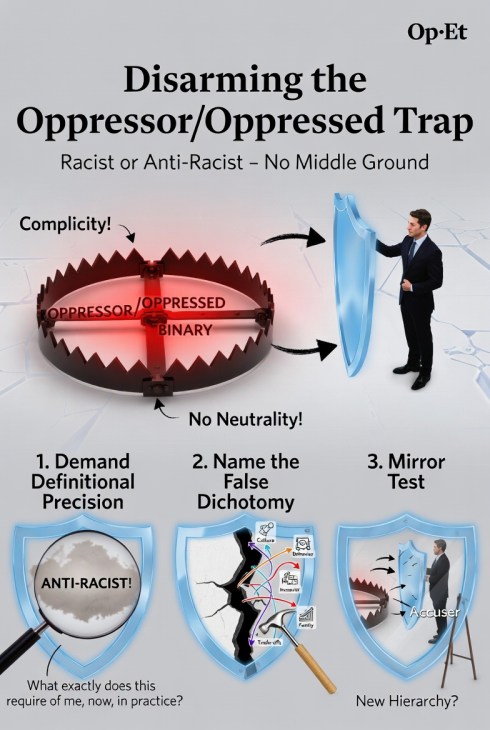
One of the most manipulative habits in contemporary politics is the oppressor/oppressed binary. It takes a complicated society, flattens it into a morality play, and assigns everyone a role before the argument even begins. You are not allowed to be a citizen, a skeptic, or simply a person trying to judge a claim on its merits. You must be either a resister of oppression or an accomplice to it. There is no middle ground. There is no neutrality. There is only confession or guilt.
This is the logic behind slogans like Ibram X. Kendi’s claim that the opposite of racist is not “not racist,” but “anti-racist.” It sounds brave and morally serious. In practice, it is a trap. It abolishes the possibility that a person can reject racism while also rejecting activist dogma, racial essentialism, or race-based policy. Once the slogan is accepted, disagreement itself becomes incriminating. Silence is violence. Skepticism is fragility. Restraint is complicity. The argument is rigged before it starts.
That is what makes the framework so effective. It does not persuade. It corners. It takes a difficult moral and empirical question and turns it into a loyalty test. Once that move is made, debate stops being a search for truth and becomes a public sorting ritual. On affirmative action, immigration, policing, school curricula, crime, history, or speech, the details matter less than whether you submit to the script. You are not judged by the quality of your reasoning. You are judged by whether you have signalled the right side.
The first way to break the trap is to demand definitional precision. Ask the simplest possible question: what, exactly, does “anti-racist” require of me here, now, in practice? What specific belief, action, or policy would prove that I am not complicit? Force the slogan to cash itself out. This matters because many activist terms draw their power from strategic vagueness. They sound morally elevated precisely because they are never pinned down. Once pinned down, they often expand into endless duties of confession, endorsement, and ideological retraining. When the standard can never be met, the point is no longer moral clarity. The point is obedience.
The second move is to name the false dichotomy. Calmly, but without apology. The binary assumes that every disparity is evidence of oppression and that every refusal to endorse the preferred remedy is therefore collaboration with injustice. But reality does not work that way. Human beings are not made of one motive. Institutions do not produce one kind of outcome. Policies have trade-offs. Causes are mixed. Incentives matter. Culture matters. History matters. Family structure matters. Behaviour matters. Human variation matters. A worldview that permits only one explanation is not morally deep. It is intellectually cheap.
“The point is no longer moral clarity. The point is obedience.”
Complexity starts to look like cowardice. Nuance starts to look like betrayal. Evidence that cuts against the preferred story is dismissed as harm. The framework protects itself the way bad frameworks always do: by treating every challenge as proof that the challenge was necessary.
The third move is the mirror test. If disagreement with your theory makes someone morally tainted, what exactly are you doing to dissenters? If refusal to use your language, endorse your policies, or accept your metaphysics makes a person an oppressor, then you have not abolished domination. You have redistributed it. You have built a new moral hierarchy with yourself at the top and everyone insufficiently converted beneath you. The names have changed. The structure has not.
This is why the binary feels so powerful. It flatters the speaker while shaming the listener. It offers moral clarity without the inconvenience of evidence. It turns political disagreement into a purity test and ordinary citizens into suspects. That is intoxicating, especially for people who enjoy the feeling of righteousness more than the discipline of thought.
Racism is real. Injustice is real. But so is the danger of any framework that treats disagreement as guilt and complexity as sin. Liberalism was built on the harder truth that citizens will differ, causes will be mixed, and power must be restrained even when exercised in the name of virtue. The oppressor/oppressed binary rejects that discipline. It wants a world of permanent accusation, permanent sorting, and permanent moral theatre.
Do not argue inside that trap. Do not accept the role of defendant in someone else’s catechism. Ask for definitions. Expose the binary. Turn the logic back on itself. The moment a moral framework abolishes the right to dissent, it has stopped being a tool of justice and become a costume for power.
When people say “trans rights,” they often smuggle in the conclusion before the argument has even begun. The phrase suggests a class of basic liberties being withheld from a minority population. In most liberal democracies, that is not the real dispute. Trans-identifying people already possess the same ordinary civil rights as everyone else: to vote, work, speak, worship, associate, and live free from assault or arbitrary exclusion. The real conflict begins when contested demands are framed as rights claims in order to place them beyond criticism.
That distinction matters. A right is not the same thing as a demand for access, validation, or institutional compliance. Female sports were not created out of prejudice, but out of recognition that sex differences matter in strength, speed, endurance, and physical risk. Female shelters, prisons, and changing rooms were built on the same logic. They exist because privacy, safety, fairness, and dignity are not imaginary goods. They are concrete protections, won through long struggle, and they do not cease to matter because a new vocabulary has been imposed on the debate.
Once this is seen clearly, much of the rhetoric falls apart. If a male-bodied person demands entry into a female space, the objection is not that he lacks human worth. It is that women have sex-based boundaries, and those boundaries exist for reasons. If a parent objects to gender ideology in schools, that is not the denial of anyone’s basic rights. It is the defense of parental authority in an area of profound moral and developmental consequence. If a citizen resists compelled pronouns or refuses to treat metaphysical claims about sex as binding fact, that is not violence. It is a refusal to surrender conscience and language to activist pressure.
“When one group’s ‘rights’ require another group to surrender privacy, fairness, or conscience, the conflict is no longer about equality. It is about power.”
This is where the phrase “trans rights” does its real work. It pre-loads the moral verdict. It makes disagreement sound like oppression before the argument has even begun. Once that framing is accepted, women’s boundaries become cruelty, parental caution becomes hatred, and democratic disagreement becomes abuse. But this is not a serious use of rights language. It is a way of insulating contested claims from scrutiny by wrapping them in the prestige of civil rights.
None of this means every accommodation is unreasonable, or that every dispute is zero-sum. Ordinary civility and equal treatment in public life are not difficult standards to defend. But when one group’s claimed “rights” require another group to surrender privacy, fairness, language, or the right to maintain sex-based boundaries, the conflict has moved beyond equal citizenship. It has become a struggle over whose moral framework will rule, and whose objections will be permitted to count.
That is why the language matters. “Trans rights” sounds like a plea for equal liberty. In many of the most contentious cases, it is something else: a demand that others yield, affirm, and rearrange long-standing social boundaries on command. When women refuse that erasure, or parents refuse that indoctrination, or citizens refuse that compelled speech, they are not violating rights. They are defending their own.
Online discourse is exhausting for a simple reason: certain words are used not to describe reality, but to end the conversation. The label does the work. The argument never has to.
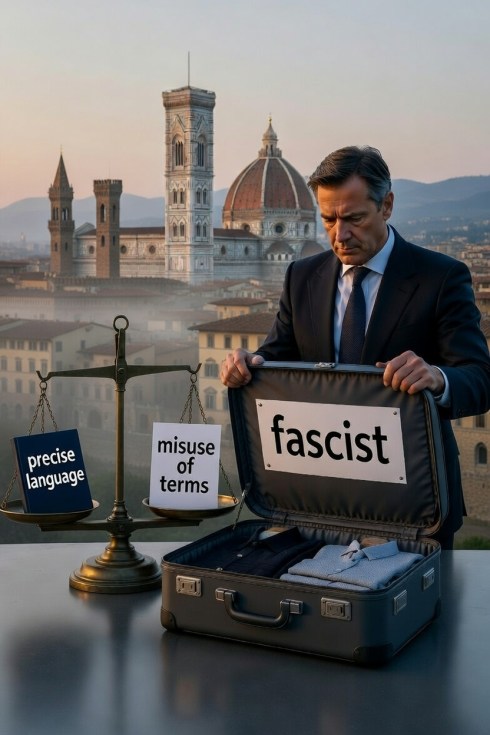
“Fascist” is one of those words.
In current usage, it often functions as a moral airhorn: you’re beyond the pale; you’re dangerous; you’re not worth debating. It gets tossed at people over ordinary ideological disputes about sex and gender, about speech norms, about state power, about immigration, about education. Sometimes it’s malice. Sometimes it’s a sincere attempt to name something authoritarian using the most nuclear term available. Either way, the practical effect is the same: “fascist” becomes a conversation-stopper rather than a description.
That’s why definitions matter. Not because language never evolves (it does), but because political language has consequences. When a term carries a freight of historical evil, using it casually is not “rhetorical adaptation.” It’s moral inflation. Moral inflation does not stay rhetorical for long.
Fascism isn’t just “authoritarian”
Start with what fascism is not.
Fascism is not merely “oppressive, dictatorial control.” That’s too broad. Plenty of regimes are oppressive. Plenty of dictators are brutal. If “fascist” just means “authoritarian,” it becomes a synonym for “bad,” and then it means nothing at all.
Fascism is a historically specific modern political project. A workable definition, tight enough to guide usage and broad enough to cover the main cases, looks like this:
Fascism is an authoritarian mass movement aimed at national rebirth, organized around the leader principle, hostile to liberal constraints (pluralism, due process, free speech), willing to use intimidation or violence against opponents, and committed to subordinating institutions to a single national story.
Notice the “mass movement” piece. Fascism is not only what the state does; it’s what a mobilized public is trained to do for the regime. It does not merely punish dissent. It cultivates a moral atmosphere in which dissent feels like treason, contamination, sabotage.
Economically, fascist systems often preserve nominal private ownership while subordinating markets, labour, and industry to regime goals through state direction and corporatist control. That’s not the essence, but it’s part of the recognizable package: the economy exists for the national project, not the other way around.
History: what it looked like when it was real
Words should cash out in the world.
Historically, fascism is anchored in early 20th-century Europe, most centrally Mussolini’s Italy and Hitler’s Germany. They differed in important ways, but the family resemblance is clear: politics becomes a spiritual drama of national humiliation and promised restoration; the leader becomes the embodiment of the nation; opposition becomes illegitimate by definition; and coercion becomes normalized as “necessary” for unity and renewal.
The methods are recognizably modern: propaganda, spectacle, the disciplining of media and education, the weaponization of law, the tolerated use of street-level intimidation, and the steady narrowing of permissible speech and association. It’s not merely “the government is strong.” It’s the fusion of power with myth, enforced socially and legally.
A practical threshold: not one trait, a cluster
If you want to use “fascist” responsibly, you need a threshold. Not a single feature, a cluster.
The label starts to become warranted only when several of these are present together:
- Leader principle: politics organized around a singular figure or party claiming a unique right to rule.
- Myth of national rebirth: humiliation plus promised restoration demanding unity and purification.
- Anti-pluralism: opponents treated as enemies, not fellow citizens.
- Suppression of dissent: legal, institutional, or social narrowing of speech and association.
- Propaganda and spectacle: mass emotional mobilization replacing open contest.
- Normalization of intimidation: harassment, threats, “consequences,” or violence used as political tools.
- Institutional capture: courts, schools, media, and professions bent into ideological instruments.
This is also how you keep your head when the internet offers you cheap clarity. If someone is merely wrong, stubborn, rude, or convinced, that is not fascism. If someone wants stronger regulation, that is not fascism. If someone defends free speech, or argues about sex and gender, that is certainly not fascism by definition. Those are disputes inside ordinary politics, however heated.
A concrete misuse: the pattern in miniature
Here’s the move you see constantly:
A person says, “I think compelled speech policies in workplaces and schools are a mistake.”
The reply is not, “I disagree, because…”
The reply is, “Fascist.”
What did the label accomplish? It converted a claim about policy into an accusation about moral essence. It implied the speaker is not merely mistaken but dangerous; not merely wrong but disqualifying. Once you have categorized someone as a “fascist,” the next steps feel justified: deplatforming, professional punishment, social exile, denial of hearing.
Maybe the labeler was “just venting.” Maybe it was “good-faith hyperbole.” But hyperbole has downstream effects. It trains the audience to treat coercion as civic hygiene.
Symmetry: this is not a left-only sin
And yes: the right does its own version. “Marxist” becomes a synonym for “liberal.” “Communist” becomes “anyone who wants a program.” “Groomer” becomes a sloppy club for any disagreement about education. “Traitor” becomes shorthand for “opponent who won.” Same mechanism, different tribe: labels as argument-substitutes and permission structures.
If we’re going to complain about language used as a weapon, we don’t get to only notice it when it hits our side.
Why this matters beyond the internet
The problem isn’t just vibes on social media. Label inflation spills into institutions.
When terms like “fascist” become casual descriptors, workplaces and professional bodies begin treating contested political disagreement as a safety issue. Media narratives start pre-sorting dissent as extremism. Politicians learn to substitute moral denunciation for persuasion. The public learns to fear argument and love punishment.
The final irony is that this habit corrodes the liberal norms that make pluralistic society possible: the expectation of disagreement, the discipline of evidence, and the moral restraint of not treating opponents as vermin.
A better standard
Here’s the rule I’m adopting: I’ll reserve “fascist” for cases where I can point to the cluster. Leader principle, anti-pluralism, suppression, intimidation, institutional capture, mythic rebirth. Not merely the heat of the dispute.
When I mean “authoritarian,” I’ll say authoritarian. When I mean “illiberal,” I’ll say illiberal. When I mean “coercive,” I’ll say coercive.
Definitions aren’t pedantry. They are the line between argument and excommunication, a public safety measure for language. “Fascist” should be a diagnosis you can defend, not a mood you can perform. If we flatten every disagreement into fascism, we train ourselves to crave punishment instead of persuasion, and we teach institutions to treat dissent as contamination. That habit does not protect democracy. It rots the muscles that make democracy possible, and it turns politics into a brawl we will eventually call governance.
Collin May has published a long, ambitious essay in the C2C journal (Hearts of Darkness: How the Left Uses Hate to Fuel its 21st Century Universal Imperium) on cancel culture, “hate” rhetoric, and the modern left’s moral posture. It is broader than I would write, more philosophical than most readers will tolerate, and occasionally overbuilt. But it names a pattern that matters, and one I return to often here: once “hate” becomes a universal accusation, institutions stop persuading and start policing.
May’s most useful contribution is not just the complaint (“cancel culture exists”) but the mechanism: “hate” stops being a moral description and becomes a category that pre-sorts who may be argued with and who may simply be managed.
That is the issue.
Not whether hatred exists. It does. Not whether some speech is vicious. It is. The issue is what happens when “hate” becomes the default label for disagreement, skepticism, refusal, dissent, or plain moral and factual judgments that cut against elite narratives.
At that point, the term stops describing and starts doing administrative work.
You can watch this happen across the institutions that shape public life: media, HR departments, professional bodies, universities, bureaucracies, and the expanding quasi-legal space around speech regulation. The sequence is familiar. Someone raises a concern about policy, ideology, language rules, school programming, medical ethics, public safety, immigration, religion, or sex-based rights. Instead of answering the argument, the institution reframes the speaker. Not wrong—harmful. Not questioning—spreading hate. Not participating in democratic friction—a threat to social order.
That move changes the rules of engagement. A wrong claim can be debated. A “hateful” claim can be quarantined. Once a claim is reclassified as harm rather than argument, the institutional response changes with it: less rebuttal, more restriction.
This language matters because it is not only moral language. It is managerial language. It justifies deplatforming, censorship, professional discipline, reputational destruction, and exclusion from ordinary civic legitimacy. It creates a class of people whose arguments no longer need to be answered on the merits. It also trains bystanders to confuse moral panic with moral seriousness.
May explains this through a large historical and philosophical genealogy. Fair enough. I am less interested in the full genealogy than in the practical result in front of us. In plain terms: the rhetoric of “hate” is often used to centralize authority in institutions that no longer trust the public and no longer feel obliged to reason with them.
That is one reason trust keeps collapsing.
People can live with disagreement. They can even live with policies they dislike. What they do not tolerate for long is being handled—being told their questions are illegitimate before they are heard. Once citizens conclude that institutions are using moral language as a shield against scrutiny, every future statement gets discounted. Even true statements are heard as spin.
And then the damage compounds. If “hate” is defined so broadly that it includes dissent, genuinely hateful speech becomes harder to identify and confront. The category gets inflated, politicized, and cheapened. Meanwhile, ordinary democratic disagreement becomes harder to conduct without professional or social risk.
That is not a confident free society. It is a managerial one.
Canada is not exempt. We have our own versions of this habit: speech debates reframed as safety debates, policy criticism recoded as identity harm, and public disputes (including over schools, sex-based rights, and even routine civic rituals like land acknowledgements) routed through tribunals, regulators, HR offices, and media scripts instead of open argument. The details vary by case. The mechanism does not. This tactic is not unique to one political tribe, but it is now especially entrenched in progressive-managerial institutions, which is precisely why it has so much reach.
The answer is not to deny hatred exists, or to become casual about cruelty. The answer is to recover civic discipline.
Name actual incitement when it occurs. Enforce existing laws where there are real threats, harassment, or violence. But stop using “hate” as a catch-all for disfavoured views. Stop treating condemnation as a substitute for evidence. Stop teaching institutions that the way to win an argument is to disqualify the speaker.
May quotes Pope Francis on cancel culture as something that “leaves no room.” Whether or not one follows his full historical argument, that phrase captures the operational problem.
A liberal society cannot function if citizens are only permitted to disagree inside moral boundaries drawn in advance by bureaucrats, activists, and legacy media.
The test is simple: can a claim be examined without first being moralized into silence?
If the answer is no, that is not moral confidence. It is institutional insecurity backed by power.
That is the pattern worth naming. And that is why essays like May’s, even when they overshoot, remain worth reading.

References
Collin May, “Hearts of Darkness: How the Left Uses Hate to Fuel its 21st Century Universal Imperium,” C2C Journal (February 16, 2026), https://c2cjournal.ca/2026/02/hearts-of-darkness-how-the-left-uses-hate-to-fuel-its-21st-century-universal-imperium/. (C2C Journal)











 bleatmop
 Mystro


 Dead Wild Roses
Your opinions…