
You are currently browsing the tag archive for the ‘civil liberties’ tag.
Editors Note : This essay is a summation of recent podcast interview between Peter Boghossian and Sarah McLaughin.
Free speech is often defended too narrowly, as if it were mainly a permission slip for rude people, a tolerance ritual for offensive opinions, or a legal loophole that allows unpleasant citizens to be unpleasant in public.
That misses the deeper issue.
Free speech matters least when the opinion is popular, fashionable, institutional, or already protected by status. Those opinions usually have no trouble finding a microphone. Free speech matters most when the speaker is disliked, the claim is offensive, the argument is premature, or the government would prefer the matter not be discussed at all.
That is what makes Sarah McLaughlin’s defence of free speech useful. In her conversation with Peter Boghossian, she does not frame free speech as a favour extended to difficult people. She frames it as a limit on power.
The distinction matters because, in McLaughlin’s account, the First Amendment does not give people their speech rights. It restrains government from taking those rights away. The right comes first. The state comes second. Human beings possess speech rights by virtue of their dignity as human beings, not because a minister, judge, administrator, or police officer has granted them a temporary licence to speak.
Once that principle is reversed, free speech becomes a managed privilege. Government decides how much speech citizens may have, which topics are too dangerous, which emotions deserve protection, which claims count as misinformation, and which controversies must be moved from public argument into administrative control.
At that point, censorship does not need to announce itself as censorship. It can arrive as safety, anti-hate policy, national security, child protection, or a database entry no one tells you about.
That is one of McLaughlin’s strongest points. Censorship is not only a formal ban on a book, a newspaper, or a speech. It can also be the use of state pressure to make lawful expression risky. It can be a police visit, a record, an investigation, or the quiet creation of consequences around speech that the law has not actually made criminal.
Her example from the United Kingdom is revealing. She describes people being visited by police over legal tweets under the non-crime hate incident regime. In some cases, the person might not even know a complaint had been made, yet the incident could still be recorded in a government database and potentially become visible in employment-related contexts.
That is not the robust confidence of a free society so much as suspicion with paperwork. It also shows why “but no one was jailed” is not always a sufficient answer. A state does not have to imprison every dissenter to chill speech. It only has to teach citizens that lawful expression may bring police attention, reputational risk, bureaucratic trouble, or future consequences they cannot easily see or contest.
People learn the lesson quickly. They stop saying what they think, institutions stop asking hard questions, and the public square remains technically open while everyone gradually learns where the soft fences are.
McLaughlin’s argument is not that speech is harmless. This is important. She does not make the weak case for free speech by pretending words have no power. She concedes that speech can hurt, anger, provoke, disturb, and unsettle. But she turns that fact around: speech is powerful, and that is precisely why it must be protected. Scientific progress, political reform, religious dissent, civil rights, and moral correction all require the ability to say things that others may find offensive, dangerous, or wrong at the time.
The case for free speech is not that words are trivial. The case for free speech is that words are how free people fight without reaching for force.
This is why the claim that “speech is violence” is so corrosive. If speech becomes violence, then censorship becomes self-defence. If silence becomes violence, then compelled speech becomes moral duty. If offence becomes harm, then whoever claims injury first can demand power over the speaker.
McLaughlin rejects that collapse. Words and violence are not the same thing. A society that loses the distinction between being insulted and being assaulted has lost one of the basic habits that allows people to live together without constant coercion.
That does not mean speech has no limits. Actual threats are not mere disagreement. Incitement is not mere offensiveness. Harassment is not mere criticism. Criminal conduct does not become protected just because it has a political slogan attached to it.
McLaughlin’s approach is not anarchic. It is disciplined. Existing legal categories such as true threats and incitement to imminent lawless action matter because they are narrow. They require more than ugliness, anger, or offence. They require a serious connection to actual unlawful conduct.
That narrowness is the protection. Without it, “incitement” can become whatever makes people furious, and once that happens, the most volatile people in society get to set the boundaries of everyone else’s rights.
That is the heckler’s veto. If a mob threatens violence because someone burns a book, draws a cartoon, criticizes a religion, questions a movement, or says something politically forbidden, the proper response is not to punish the speaker for provoking the mob. The proper response is to stop the violence. Rights cannot depend on the emotional discipline of those who oppose them.
The law’s job is not to protect citizens from ever being angered. It is to prevent anger from becoming violence.
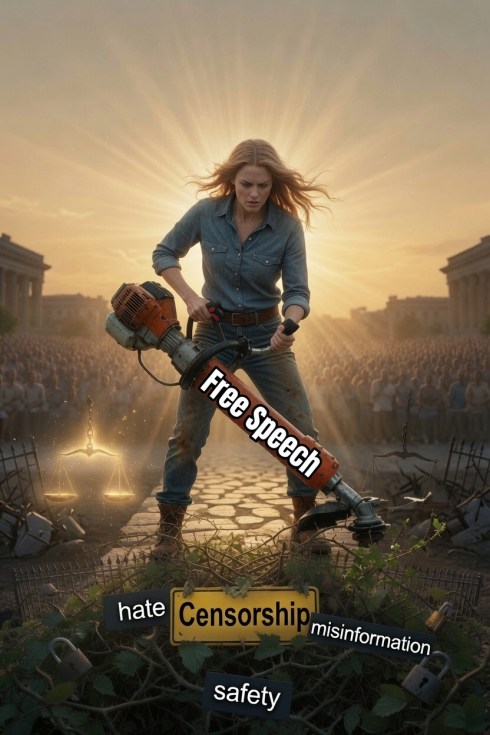
The most useful part of McLaughlin’s framework is her account of the four justifications governments use when they want to censor speech:
- Hate — the claim that some speech is too socially disruptive, cruel, or degrading to be tolerated.
- National security — the claim that dissent, protest, or criticism threatens public safety or the state itself.
- Misinformation — the claim that government must determine truth and suppress what officials judge to be false.
- Children — the claim that protecting minors justifies broad restrictions that often reach adults as well.
Each justification begins with a real concern. Hatred exists. National security threats exist. Falsehoods can cause damage. Children do need protection. But a real problem does not automatically justify broad state control over expression. The question is not whether something ugly, false, dangerous, or harmful can be identified somewhere. Of course it can. The question is whether the proposed cure gives officials power they cannot be trusted to wield honestly, narrowly, or evenly.
Who decides what counts as hate? Who decides when political criticism becomes misinformation? Who decides when national security includes criticism of government policy? Who decides what material is too harmful for children, and how many adult rights must be narrowed in the name of protecting them?
These categories expand because power has an appetite. Hate begins with threats and ends with legal speech recorded by police. National security begins with terrorism and ends with protest signs. Misinformation begins with fraud and ends with dissent from official narratives. Child protection begins with shielding minors and ends with surveillance architecture for everyone.
McLaughlin’s examples cut across partisan comfort zones. She criticizes the UK. She criticizes Hungary. She criticizes American government actions. She criticizes China’s efforts to control not only domestic speech but how the Chinese government is discussed abroad.
That matters because free speech cannot survive as a team sport. If speech rights matter only when our side is speaking, then they are not rights. They are privileges for allies. A serious free speech principle protects the person we dislike, the argument we reject, the protest we think foolish, the religious claim we find absurd, the political claim we find dangerous, and the joke we think cruel.
Not because all speech is good, but because government power becomes more dangerous when it gets to decide which speech is good enough.
The deeper defence of free speech is not merely moral. It is epistemological. Human beings are fallible. Governments are fallible. Experts are fallible. Majorities are fallible. Institutions are fallible. Every society needs some way to discover error before error becomes policy, dogma, or law.
Free speech is part of that correction mechanism. It allows citizens to test claims, challenge authority, expose dishonesty, revise beliefs, hear minority viewpoints, and discover what people actually think. Without it, bad ideas do not disappear. They go underground. Official ideas do not become truer. They become safer to repeat. Citizens do not become wiser. They become more careful.
A coerced society may look orderly from a distance, but it does not know itself.
That is why compelled speech is also a problem. Forcing people to repeat approved formulas does not produce conviction. It produces performance. It teaches people which words keep them safe. It rewards dishonesty and calls the result consensus.
A society built on forced agreement may still function for a while, but it cannot correct itself honestly.
McLaughlin’s closing point is the one free speech defenders need to remember: free speech works for everyone, but only if people are willing to protect it for everyone else.
That is the bargain. We protect the speech we hate because one day someone else may hate ours. We defend the dissenter because one day the institution may be wrong. We limit government because one day the people holding power will not be our friends.
Free speech is not a guarantee that public life will be gentle, wise, or pleasant. It is a safeguard against something worse: a society where the state decides which thoughts may be spoken, which questions may be asked, and which truths may be pursued.
Censorship does not always arrive with a censor’s stamp. Sometimes it arrives with kinder language, but that does not make it less dangerous.
Free speech is often defended badly.
Sometimes it is treated as a license to say anything without consequence. Sometimes it is reduced to personal self-expression. Sometimes it is framed as a courtesy extended to polite, harmless, approved opinions.
That misses the deeper point.
In a classically liberal society, free speech serves a practical purpose: it lets citizens search for truth, correct error, restrain power, and govern themselves.
It is not decorative. It is part of the machinery of a free society.
1. Free speech helps society find truth
Human beings are fallible.
Individuals can be wrong. Experts can be wrong. Majorities can be wrong. Governments can be wrong. Institutions can be wrong. Moral crusades can be wrong.
Free speech matters because no authority is wise enough to decide, permanently and in advance, which ideas may be questioned.
Some claims are false, foolish, dishonest, or ugly. But the answer to bad claims is usually better argument, better evidence, open criticism, and public testing.
A society that cannot question its own certainties may still call its beliefs truth, but it has stopped checking.
2. Free speech protects dissent
Free speech is easy to support when everyone agrees.
Its real test comes when speech is irritating, unpopular, offensive, inconvenient, or aimed at powerful people.
Many ideas now considered obvious were once treated as dangerous, immoral, foolish, or socially disruptive. That does not make every dissenter right. Much dissent is mistaken, partial, crankish, or premature. But we often cannot know which is which until dissent is allowed to be heard and tested.
A society that protects only approved speech protects consensus, not free speech.
Dissent needs room before it becomes respectable.
3. Free speech restrains power
Free speech allows citizens to question institutions.
What are you doing? Why are you doing it? What evidence supports it? Who benefits? Who pays? What are the tradeoffs? What are you hiding?
Those questions matter because institutions tend to protect themselves. Governments, corporations, universities, professional bodies, media organizations, activist movements, and bureaucracies all prefer deference when they have power.
Free speech keeps authority answerable to public challenge. Without it, institutions can govern through status, expertise, fear, or moral pressure instead of justification.
4. Free speech makes self-government possible
Democracy requires more than voting.
Citizens need to argue about laws, leaders, policies, institutions, values, evidence, and public priorities. If people can vote but cannot freely discuss what they are voting about, democracy becomes managed consent.
Free speech allows citizens to hear competing arguments, compare claims, criticize leaders, expose failures, and persuade one another.
It is not only an individual right. It is a condition of honest public judgment.
5. Free speech includes the right to be wrong
A meaningful free-speech principle must protect some false or mistaken speech.
If only “true” speech is protected, someone must decide what counts as true before debate even begins. That power rarely stays neutral.
This does not protect fraud, defamation, threats, perjury, direct incitement, or criminal harassment. Free speech has limits.
But contested public questions cannot be settled by official truth-arbiters. Free societies answer error through argument wherever possible, because the cure for bad speech can easily become worse than the disease.
6. Free speech protects listeners too
Free speech is not only the right to speak.
It is also the right to hear, read, compare, consider, reject, and decide.
Censorship does not only silence the speaker. It also treats the listener as too fragile, foolish, or dangerous to encounter the wrong idea.
A free citizen is not merely someone allowed to express approved thoughts. A free citizen is someone trusted to hear arguments and judge them.
7. Free speech is uncomfortable by design
Free speech requires citizens to tolerate disagreement, offence, criticism of cherished beliefs, and ideas they consider wrong or dangerous.
That discomfort is not a flaw. It is the price of living among free adults rather than under enforced consensus.
A free society does not remain peaceful because no one disagrees. It remains peaceful because disagreement can be spoken, challenged, mocked, answered, revised, and defeated without being driven underground or handed over to the state.

Free speech allows disagreement to remain public, peaceful, and answerable to reason.
In summary
Free speech is the right to speak, hear, question, criticize, argue, publish, dissent, and persuade without unlawful censorship or coercion.
Its purpose is not merely self-expression. It is the error-correction system of a free society. It helps test truth, expose mistakes, restrain power, protect dissent, and make self-government possible.
Free speech does not mean every claim is wise. It does not mean speech has no limits. It does not mean freedom from criticism, disagreement, ridicule, or consequence.
It means no authority gets final ownership of public truth.
Free speech is not a luxury for when society agrees.
It is the mechanism that allows disagreement to remain peaceful, public, and answerable to reason.
The government is right about one thing: children are not safe in much of online life. But that does not make every child-safety law wise, limited, or safe for a free society.
Parents have a real responsibility to monitor their children’s welfare, and that includes internet activity. Freedom does not mean abandoning children to whatever social media companies, algorithms, predators, influencers, or peer-status machines decide to push at them next. A free society still expects adults to act like adults.
But parental responsibility is not the same thing as state permissioning. Bill C-34, the federal government’s Safe Social Media Act, should be read with that distinction in mind. The issue is not whether children should be protected from online harm. They should. The issue is whether protecting them requires building the habits, infrastructure, and bureaucracy of identity-gated internet access.
That danger is sharpened by how much the bill leaves to regulation. Many of the most important questions — which services are covered, how age will be verified, what exemptions will exist, and how the new regulator will enforce compliance — are not settled in the public-facing moral language of child safety. They are pushed into future administrative machinery.
That matters. A social media ban for users under sixteen cannot enforce itself. Platforms must know who is under sixteen. To know that, they must verify age. And once age verification becomes normal, adults are pulled into the same machinery because they must prove they are not children.
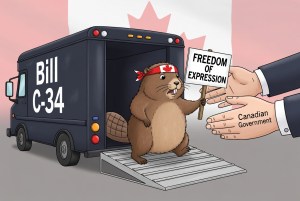
Child safety should not require Canadians to trade the open internet for a permission slip.
This is where the civil-liberties danger begins. The stated aim is child safety. The operating mechanism is identity checking. Once identity checking becomes a normal condition of access, it will not stay politely confined to one narrow category of service forever.
The strongest argument for the bill is not frivolous. Social media companies have profited from addictive design, algorithmic pressure, sexualized content, bullying, and misery dressed up as engagement. Parents are right to be angry. Governments are right to ask whether platforms have been allowed to externalize too much harm onto children and families.
But good intentions do not make a bad tool harmless.
Online anonymity is not just a convenience for trolls. It matters for political dissent, unpopular opinions, whistleblowing, vulnerable people, religious minorities, abuse victims, workers criticizing employers, and ordinary citizens who do not want every thought, search, argument, or association tied back to their legal identity.
For some Canadians, anonymity is not a luxury. It is part of how they remain able to think and speak honestly. Teachers, nurses, public servants, professionals, small-business owners, and employees in ideologically narrow workplaces all understand the problem. A person can hold lawful, serious, defensible opinions and still know that one bad-faith complaint, one screenshot, or one HR process can turn ordinary dissent into a professional liability.
Canadians should not reject child protection simply because the state has chosen a bad tool. If there are unobtrusive ways to reduce children’s exposure to exploitation, addiction loops, algorithmic pressure, and adult content without creating surveillance architecture, we should pursue them. Better parental tools, device-level controls, digital literacy, stronger enforcement against predators, and less addictive platform design are all fair subjects for debate.
“Child safety is real. Identity-gated access is still a dangerous cure.”
But a checkpoint internet is not a small price to pay. It changes the relationship between citizen and screen, reader and state, speaker and regulator. Once access depends on verification, the open internet begins to look less like a public square and more like a permissioned space.
That is too much power to normalize under the language of safety.
Our rights in Canada are unlikely to be taken away all at once. They erode gradually: one safety measure, one administrative convenience, one temporary verification requirement at a time, until the extraordinary becomes ordinary and the ordinary becomes mandatory.
Then, one day, pedestrianly, Canadians may discover that freedoms they thought were secure have become permissions they must ask for.
This is how activists frame their lies and misdirection.
Here is their bullshittery in full:
The introduction of new rules restricting participation in women’s sport categories to “biological females”, determined through mandatory genetic screening and testing, imposes exclusionary criteria. These measures not only bar transgender women from competition, but target and disqualify cisgender women with differences in sex development.
This policy will apply to the Los Angeles 2028 Olympic Games and beyond, despite the absence of clear evidence that any transgender women were poised to participate in those Games. The IOC’s approach aligns itself with the U.S. government’s 2025 executive order “Keeping Men Out of Women’s Sports” which threatened to withdraw funding from organizations that permit transgender athletes to compete and to deny visas to certain athletes seeking to participate in the Los Angeles Olympics. The convergence of international sport governance with exclusionary state policy raises serious concerns about the politicization of athletic participation and the erosion of independent, rights-respecting governance.
“While framed as a measure to ensure fairness, this policy imposes exclusionary criteria that will disproportionately harm transgender women and also place cisgender women at risk, particularly those with natural biological variations,” says Aaden Pearson, Trans Rights Legal Fellow at the Canadian Civil Liberties Association. “The policy authorizes intrusive scrutiny of women’s bodies and asserts authority over who gets to participate as a ‘real’ woman under the guise of regulation.”
This policy will have detrimental impact on Canadian athletes that may be barred from participating in the Olympics because of this policy who otherwise would qualify to represent Canada.
A rights-respecting approach to sport must be grounded in inclusion, evidence, and proportionality. Fairness and human dignity are not mutually exclusive. The legitimacy of sport depends on ensuring that all athletes are able to participate without discrimination.
The CCLA calls on the IOC and national sporting bodies to:
- Immediately reconsider the implementation of these eligibility rules;
- Ensure that any policies governing participation in sport are evidence-based, proportionate, and consistent with international human rights obligations; and
- Uphold the principle that sport must be accessible to all, without discrimination.
The legitimacy of sport depends not only on fairness in competition, but on fairness in access. Policies that exclude, surveil, and stigmatize athletes have no place in a rights-respecting sporting system.”
————————
When a civil liberties organization cannot define a category, it cannot defend a right.
That is the move.
The IOC’s policy does not abolish sport as a “human right.” It sets an eligibility rule for the female category: from LA 2028 onward, athletes in that category must pass a one-time SRY gene screen, using saliva, a cheek swab, or blood. Athletes who do not qualify are still eligible for male, mixed, or open categories. This is not exclusion from sport. It is boundary enforcement within sport.
That distinction is the entire argument, and the CCLA refuses to engage it.
Instead, it leans on the language of “inclusion” as though inclusion means entitlement to every category. But sport has never worked that way. Weight classes exclude. Age divisions exclude. Paralympic classifications exclude. Women’s sport exists because sex matters. Calling sex-based eligibility “exclusionary” does not answer that reality. It simply renames the boundary and hopes no one notices.
The claim that the policy “targets cisgender women with differences in sex development” is similarly evasive. The IOC framework uses SRY screening because it is strong evidence of male development. World Boxing’s policy is explicit: eligibility for the women’s category excludes athletes with Y-chromosome material or male androgenization. The relevant question is not whether someone identifies as a woman, but whether they have undergone male development. The CCLA substitutes sympathetic language for that question rather than answering it.
The argument about there being no “clear evidence” of transgender women poised to compete in LA 2028 is weaker still. Rules are not written only after a problem becomes numerically large. They are written to clarify the category before competition begins. “There aren’t many” is not an argument against having a rule. It is an admission that the rhetoric is disproportionate to the scale of the issue.
“It treats female sport as though it were an access program rather than a sex-based category.”
The claim of “intrusive scrutiny” is also inflated. The IOC’s first-line test is a one-time genetic screen using saliva, cheek swab, or blood. That is not the same thing as the mid-20th century abuses activists like to invoke. A serious civil-liberties analysis would distinguish between limited modern verification and historical excess. This statement deliberately blurs them.
And then there is the core contradiction. The CCLA says fairness and dignity are not mutually exclusive. That is true. But it follows that female athletes can be treated with dignity and retain a protected category that excludes males. The CCLA resolves this tension by dissolving the category instead. In practice, its position requires female athletes to absorb the cost: compromised fairness, weakened boundaries, and—in contact sports—elevated risk.
That is not a neutral rights framework.
It is a redefinition of rights in which access to the female category is prioritized, and the integrity of that category is treated as negotiable.
A civil liberties organization should be able to state the purpose of a category before it critiques its rules. The CCLA does not. It treats the female category as a site for validating identity claims rather than as a sporting class organized around sex.
Once that happens, the conclusion is pre-determined.
Female boundaries become suspect.
Enforcement becomes cruelty.
And reality becomes something to be managed with language.
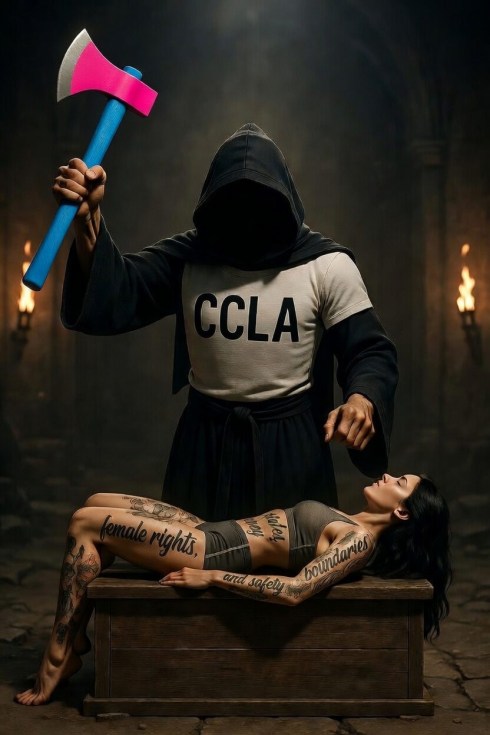
Collin May has published a long, ambitious essay in the C2C journal (Hearts of Darkness: How the Left Uses Hate to Fuel its 21st Century Universal Imperium) on cancel culture, “hate” rhetoric, and the modern left’s moral posture. It is broader than I would write, more philosophical than most readers will tolerate, and occasionally overbuilt. But it names a pattern that matters, and one I return to often here: once “hate” becomes a universal accusation, institutions stop persuading and start policing.
May’s most useful contribution is not just the complaint (“cancel culture exists”) but the mechanism: “hate” stops being a moral description and becomes a category that pre-sorts who may be argued with and who may simply be managed.
That is the issue.
Not whether hatred exists. It does. Not whether some speech is vicious. It is. The issue is what happens when “hate” becomes the default label for disagreement, skepticism, refusal, dissent, or plain moral and factual judgments that cut against elite narratives.
At that point, the term stops describing and starts doing administrative work.
You can watch this happen across the institutions that shape public life: media, HR departments, professional bodies, universities, bureaucracies, and the expanding quasi-legal space around speech regulation. The sequence is familiar. Someone raises a concern about policy, ideology, language rules, school programming, medical ethics, public safety, immigration, religion, or sex-based rights. Instead of answering the argument, the institution reframes the speaker. Not wrong—harmful. Not questioning—spreading hate. Not participating in democratic friction—a threat to social order.
That move changes the rules of engagement. A wrong claim can be debated. A “hateful” claim can be quarantined. Once a claim is reclassified as harm rather than argument, the institutional response changes with it: less rebuttal, more restriction.
This language matters because it is not only moral language. It is managerial language. It justifies deplatforming, censorship, professional discipline, reputational destruction, and exclusion from ordinary civic legitimacy. It creates a class of people whose arguments no longer need to be answered on the merits. It also trains bystanders to confuse moral panic with moral seriousness.
May explains this through a large historical and philosophical genealogy. Fair enough. I am less interested in the full genealogy than in the practical result in front of us. In plain terms: the rhetoric of “hate” is often used to centralize authority in institutions that no longer trust the public and no longer feel obliged to reason with them.
That is one reason trust keeps collapsing.
People can live with disagreement. They can even live with policies they dislike. What they do not tolerate for long is being handled—being told their questions are illegitimate before they are heard. Once citizens conclude that institutions are using moral language as a shield against scrutiny, every future statement gets discounted. Even true statements are heard as spin.
And then the damage compounds. If “hate” is defined so broadly that it includes dissent, genuinely hateful speech becomes harder to identify and confront. The category gets inflated, politicized, and cheapened. Meanwhile, ordinary democratic disagreement becomes harder to conduct without professional or social risk.
That is not a confident free society. It is a managerial one.
Canada is not exempt. We have our own versions of this habit: speech debates reframed as safety debates, policy criticism recoded as identity harm, and public disputes (including over schools, sex-based rights, and even routine civic rituals like land acknowledgements) routed through tribunals, regulators, HR offices, and media scripts instead of open argument. The details vary by case. The mechanism does not. This tactic is not unique to one political tribe, but it is now especially entrenched in progressive-managerial institutions, which is precisely why it has so much reach.
The answer is not to deny hatred exists, or to become casual about cruelty. The answer is to recover civic discipline.
Name actual incitement when it occurs. Enforce existing laws where there are real threats, harassment, or violence. But stop using “hate” as a catch-all for disfavoured views. Stop treating condemnation as a substitute for evidence. Stop teaching institutions that the way to win an argument is to disqualify the speaker.
May quotes Pope Francis on cancel culture as something that “leaves no room.” Whether or not one follows his full historical argument, that phrase captures the operational problem.
A liberal society cannot function if citizens are only permitted to disagree inside moral boundaries drawn in advance by bureaucrats, activists, and legacy media.
The test is simple: can a claim be examined without first being moralized into silence?
If the answer is no, that is not moral confidence. It is institutional insecurity backed by power.
That is the pattern worth naming. And that is why essays like May’s, even when they overshoot, remain worth reading.

References
Collin May, “Hearts of Darkness: How the Left Uses Hate to Fuel its 21st Century Universal Imperium,” C2C Journal (February 16, 2026), https://c2cjournal.ca/2026/02/hearts-of-darkness-how-the-left-uses-hate-to-fuel-its-21st-century-universal-imperium/. (C2C Journal)











 bleatmop
 Mystro
 The Arbourist


 Dead Wild Roses
Your opinions…