
You are currently browsing the tag archive for the ‘Culture War’ tag.
Culture wars are easy to dismiss when your side is winning one.
The phrase suggests an artificial conflict manufactured by activists who cannot leave ordinary life alone. Yet every society teaches its members what is admirable, shameful, natural and just. The dispute begins when we ask who is doing the teaching—and what vision of society their institutions are working to produce.
Ideas hostile to the classical liberal principles upon which Western societies were founded have gained commanding influence across many of the institutions that produce and transmit culture. Schools, universities, publishers, arts organizations, media outlets and professional associations increasingly interpret society through categories of power, identity, oppression and liberation, while individual responsibility, equality before the law and freedom of conscience are treated with suspicion.
This did not happen because a secret committee issued instructions from a hidden room. Cultural change rarely works that neatly. People enter institutions carrying particular assumptions, hire and promote others who share them, reward work that conforms to the emerging consensus and gradually redefine what respectable people are permitted to believe. The framework also offers something many post-religious institutions lack: moral purpose, a vocabulary of sin and redemption, and a hierarchy of virtue in which conformity can be experienced as courage.
Over time, ideology becomes professional common sense.
To understand how this occurred, we need to return to a problem that confronted Marxists in the early twentieth century. Classical Marxism predicted that the working class in advanced capitalist societies would eventually rise against the bourgeois order. That revolution did not materialize in the industrial democracies of the West, where workers frequently remained attached to their countries, churches, families and inherited ways of life.
Antonio Gramsci, an Italian Marxist writing from a Fascist prison, attempted to explain why.
Gramsci argued that Western societies were not maintained by economic coercion or state violence alone. Their stability also depended upon what he called cultural hegemony: the network of institutions, customs and moral assumptions through which people came to regard the existing order as legitimate. Government possessed force, but civil society produced consent.
Churches, schools, universities, newspapers, unions, voluntary associations and intellectual institutions all helped form the common sense of the population. Together they created a protective structure around the political order, making a direct revolutionary assault far more difficult than Marxist theory had anticipated.
Gramsci did not leave behind a five-point infiltration manual. What he provided was more important: an explanation of why political revolution in the West required a prior struggle over culture. Before a movement could capture the state, it would have to establish intellectual and moral authority within civil society by cultivating its own educators, organizers, artists and “organic intellectuals.”
Gramsci called this prolonged cultural contest a “war of position.” Decades later, Rudi Dutschke gave a related strategy its memorable name: the “long march through the institutions.” The phrase was Dutschke’s, and direct intellectual transmission from Gramsci is disputed, but both recognized the same strategic reality: durable political transformation required sustained work within the institutions that formed public consciousness.
That contest has travelled a considerable distance. The economic categories of classical Marxism did not disappear, but they were joined by cultural categories drawn from race, sex, sexuality and identity. Society was increasingly interpreted as a struggle between oppressors and oppressed, while inherited norms and institutions were treated as mechanisms through which dominant groups preserved their power.
This is what I mean by cultural Marxism. Critics object that this is not orthodox Marxism, and they are correct in the narrow sense. It is Marxism adapted to a cultural register, retaining the moral architecture of oppressor and oppressed while changing the principal categories through which that conflict is understood.
This does not require an omnipotent conspiracy in which every progressive activist takes orders from a central authority. It describes the migration of Marxist habits of thought into the wider culture: the elevation of group identity over individual responsibility, the reduction of social relationships to power, the assumption that unequal outcomes demonstrate oppression and the belief that liberation requires the transformation of inherited institutions.
The institutional consequences are no longer theoretical. The Canada Council for the Arts explicitly applies equity principles across its funding programs and provides targeted support to designated priority groups. Its stated purpose is to correct persistent barriers, not to advance Marxism, but the policy illustrates how cultural resources are increasingly allocated through group-based concepts of equity rather than formally equal treatment. The Council describes that policy in its own terms.
Universities provide another measure of the emerging consensus. In a 2024 survey by the Foundation for Individual Rights and Expression, more than half of conservative faculty respondents reported at least occasionally concealing their political beliefs from colleagues to protect their careers. That does not prove that every campus has become ideologically uniform, but it does show that institutional culture can impose professional costs without requiring formal censorship. FIRE’s faculty report documents the wider pattern.
Politics lies downstream of this cultural formation. People arrive at elections with moral intuitions already shaped by the stories they have encountered, the history they have been taught and the institutions they have learned to trust. If children encounter Western civilization primarily through slavery, colonialism, racism and exclusion, they should not surprise us by concluding that their inheritance is uniquely shameful.
Those failures belong in the historical record and must not be concealed. Progressives can reasonably argue that many institutional changes corrected genuine exclusions, and they are right. Western societies did not always honour their own principles, while appeals to tradition sometimes protected injustice.
The dividing line is not whether institutions may change. It is whether reform extends liberal principles to people previously denied them or replaces those principles with group entitlement, inherited guilt and political tests. A civilization taught only through its crimes does not produce citizens equipped to improve it; it produces citizens emotionally prepared to repudiate it.
Classical liberals and conservatives have too often responded downstream. They pour money into elections, policy organizations, advertising and social media campaigns while giving comparatively little attention to the institutions that form political instincts before a campaign begins. They criticize ideological films without supporting better filmmakers, mock politicized novels without helping dissenting writers reach readers and complain about educational capture without cultivating teachers capable of presenting a richer account of Western history.
They are searching beneath the political streetlamp because that is where the light is better, even though the cultural keys were lost somewhere else.
Winning a culture war therefore requires more than defeating a candidate or exposing the latest ideological absurdity. Writers, filmmakers, musicians, teachers, publishers and artists who value freedom need patrons, professional networks, durable institutions and routes to an audience. Expecting every dissenting creator to finance, market and distribute his own work while established institutions subsidize the prevailing orthodoxy is not a serious cultural strategy.
This does not mean manufacturing classical liberal propaganda. Ideological art remains ideological art regardless of which side produces it, while characters who exist only to recite correct opinions are no more compelling when those opinions happen to be ours. The alternative culture must succeed as culture: truthful about human nature, alive to tragedy, unafraid of beauty and capable of showing why freedom is both valuable and demanding.
It must also teach Western history honestly enough to acknowledge cruelty and failure while explaining the development of individual rights, constitutional government, scientific inquiry, religious toleration and equality before the law. Positive cultural confidence does not require collective innocence, because a mature society can admit what its ancestors got wrong without pretending they built nothing worth inheriting.
Nor does national pride require hostility toward other peoples. It means recognizing that a country and civilization can possess a distinctive inheritance worthy of gratitude, stewardship and improvement. We can criticize our institutions while remaining committed to them, correct injustice without abandoning individual responsibility and reform society without teaching people to hate it.
The alternative offered by revolutionary politics is not merely reform at a faster pace. A movement that treats individual rights, procedural neutrality and freedom of conscience as instruments of oppression cannot be trusted to preserve those protections after acquiring power. Activists who regard institutions principally as weapons against their enemies may discover that revolutionary institutions have little tolerance for activists once the revolution is complete.

The proper response is not to imitate that illiberalism from the Right, but to contest the culture while remaining faithful to the classical liberal order we are trying to defend. That requires recovering the confidence to say that Western civilization, although imperfect, has produced achievements worth preserving; that freedom is more than camouflage for power; and that individuals cannot be reduced to racial, sexual or economic categories.
Politics still matters, but it cannot permanently defend principles that the culture has taught people to despise. If we want different political outcomes, we must begin further upstream, in the institutions and stories that teach each generation what is true, what is admirable and what kind of society deserves to survive.
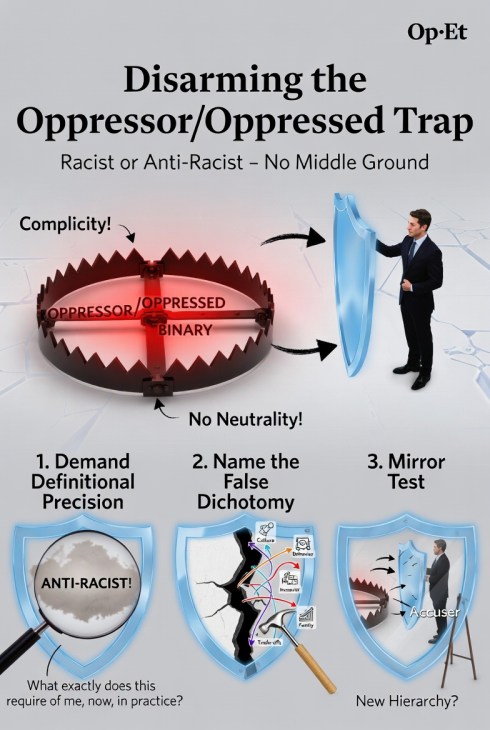
One of the most manipulative habits in contemporary politics is the oppressor/oppressed binary. It takes a complicated society, flattens it into a morality play, and assigns everyone a role before the argument even begins. You are not allowed to be a citizen, a skeptic, or simply a person trying to judge a claim on its merits. You must be either a resister of oppression or an accomplice to it. There is no middle ground. There is no neutrality. There is only confession or guilt.
This is the logic behind slogans like Ibram X. Kendi’s claim that the opposite of racist is not “not racist,” but “anti-racist.” It sounds brave and morally serious. In practice, it is a trap. It abolishes the possibility that a person can reject racism while also rejecting activist dogma, racial essentialism, or race-based policy. Once the slogan is accepted, disagreement itself becomes incriminating. Silence is violence. Skepticism is fragility. Restraint is complicity. The argument is rigged before it starts.
That is what makes the framework so effective. It does not persuade. It corners. It takes a difficult moral and empirical question and turns it into a loyalty test. Once that move is made, debate stops being a search for truth and becomes a public sorting ritual. On affirmative action, immigration, policing, school curricula, crime, history, or speech, the details matter less than whether you submit to the script. You are not judged by the quality of your reasoning. You are judged by whether you have signalled the right side.
The first way to break the trap is to demand definitional precision. Ask the simplest possible question: what, exactly, does “anti-racist” require of me here, now, in practice? What specific belief, action, or policy would prove that I am not complicit? Force the slogan to cash itself out. This matters because many activist terms draw their power from strategic vagueness. They sound morally elevated precisely because they are never pinned down. Once pinned down, they often expand into endless duties of confession, endorsement, and ideological retraining. When the standard can never be met, the point is no longer moral clarity. The point is obedience.
The second move is to name the false dichotomy. Calmly, but without apology. The binary assumes that every disparity is evidence of oppression and that every refusal to endorse the preferred remedy is therefore collaboration with injustice. But reality does not work that way. Human beings are not made of one motive. Institutions do not produce one kind of outcome. Policies have trade-offs. Causes are mixed. Incentives matter. Culture matters. History matters. Family structure matters. Behaviour matters. Human variation matters. A worldview that permits only one explanation is not morally deep. It is intellectually cheap.
“The point is no longer moral clarity. The point is obedience.”
Complexity starts to look like cowardice. Nuance starts to look like betrayal. Evidence that cuts against the preferred story is dismissed as harm. The framework protects itself the way bad frameworks always do: by treating every challenge as proof that the challenge was necessary.
The third move is the mirror test. If disagreement with your theory makes someone morally tainted, what exactly are you doing to dissenters? If refusal to use your language, endorse your policies, or accept your metaphysics makes a person an oppressor, then you have not abolished domination. You have redistributed it. You have built a new moral hierarchy with yourself at the top and everyone insufficiently converted beneath you. The names have changed. The structure has not.
This is why the binary feels so powerful. It flatters the speaker while shaming the listener. It offers moral clarity without the inconvenience of evidence. It turns political disagreement into a purity test and ordinary citizens into suspects. That is intoxicating, especially for people who enjoy the feeling of righteousness more than the discipline of thought.
Racism is real. Injustice is real. But so is the danger of any framework that treats disagreement as guilt and complexity as sin. Liberalism was built on the harder truth that citizens will differ, causes will be mixed, and power must be restrained even when exercised in the name of virtue. The oppressor/oppressed binary rejects that discipline. It wants a world of permanent accusation, permanent sorting, and permanent moral theatre.
Do not argue inside that trap. Do not accept the role of defendant in someone else’s catechism. Ask for definitions. Expose the binary. Turn the logic back on itself. The moment a moral framework abolishes the right to dissent, it has stopped being a tool of justice and become a costume for power.
Collin May has published a long, ambitious essay in the C2C journal (Hearts of Darkness: How the Left Uses Hate to Fuel its 21st Century Universal Imperium) on cancel culture, “hate” rhetoric, and the modern left’s moral posture. It is broader than I would write, more philosophical than most readers will tolerate, and occasionally overbuilt. But it names a pattern that matters, and one I return to often here: once “hate” becomes a universal accusation, institutions stop persuading and start policing.
May’s most useful contribution is not just the complaint (“cancel culture exists”) but the mechanism: “hate” stops being a moral description and becomes a category that pre-sorts who may be argued with and who may simply be managed.
That is the issue.
Not whether hatred exists. It does. Not whether some speech is vicious. It is. The issue is what happens when “hate” becomes the default label for disagreement, skepticism, refusal, dissent, or plain moral and factual judgments that cut against elite narratives.
At that point, the term stops describing and starts doing administrative work.
You can watch this happen across the institutions that shape public life: media, HR departments, professional bodies, universities, bureaucracies, and the expanding quasi-legal space around speech regulation. The sequence is familiar. Someone raises a concern about policy, ideology, language rules, school programming, medical ethics, public safety, immigration, religion, or sex-based rights. Instead of answering the argument, the institution reframes the speaker. Not wrong—harmful. Not questioning—spreading hate. Not participating in democratic friction—a threat to social order.
That move changes the rules of engagement. A wrong claim can be debated. A “hateful” claim can be quarantined. Once a claim is reclassified as harm rather than argument, the institutional response changes with it: less rebuttal, more restriction.
This language matters because it is not only moral language. It is managerial language. It justifies deplatforming, censorship, professional discipline, reputational destruction, and exclusion from ordinary civic legitimacy. It creates a class of people whose arguments no longer need to be answered on the merits. It also trains bystanders to confuse moral panic with moral seriousness.
May explains this through a large historical and philosophical genealogy. Fair enough. I am less interested in the full genealogy than in the practical result in front of us. In plain terms: the rhetoric of “hate” is often used to centralize authority in institutions that no longer trust the public and no longer feel obliged to reason with them.
That is one reason trust keeps collapsing.
People can live with disagreement. They can even live with policies they dislike. What they do not tolerate for long is being handled—being told their questions are illegitimate before they are heard. Once citizens conclude that institutions are using moral language as a shield against scrutiny, every future statement gets discounted. Even true statements are heard as spin.
And then the damage compounds. If “hate” is defined so broadly that it includes dissent, genuinely hateful speech becomes harder to identify and confront. The category gets inflated, politicized, and cheapened. Meanwhile, ordinary democratic disagreement becomes harder to conduct without professional or social risk.
That is not a confident free society. It is a managerial one.
Canada is not exempt. We have our own versions of this habit: speech debates reframed as safety debates, policy criticism recoded as identity harm, and public disputes (including over schools, sex-based rights, and even routine civic rituals like land acknowledgements) routed through tribunals, regulators, HR offices, and media scripts instead of open argument. The details vary by case. The mechanism does not. This tactic is not unique to one political tribe, but it is now especially entrenched in progressive-managerial institutions, which is precisely why it has so much reach.
The answer is not to deny hatred exists, or to become casual about cruelty. The answer is to recover civic discipline.
Name actual incitement when it occurs. Enforce existing laws where there are real threats, harassment, or violence. But stop using “hate” as a catch-all for disfavoured views. Stop treating condemnation as a substitute for evidence. Stop teaching institutions that the way to win an argument is to disqualify the speaker.
May quotes Pope Francis on cancel culture as something that “leaves no room.” Whether or not one follows his full historical argument, that phrase captures the operational problem.
A liberal society cannot function if citizens are only permitted to disagree inside moral boundaries drawn in advance by bureaucrats, activists, and legacy media.
The test is simple: can a claim be examined without first being moralized into silence?
If the answer is no, that is not moral confidence. It is institutional insecurity backed by power.
That is the pattern worth naming. And that is why essays like May’s, even when they overshoot, remain worth reading.

References
Collin May, “Hearts of Darkness: How the Left Uses Hate to Fuel its 21st Century Universal Imperium,” C2C Journal (February 16, 2026), https://c2cjournal.ca/2026/02/hearts-of-darkness-how-the-left-uses-hate-to-fuel-its-21st-century-universal-imperium/. (C2C Journal)
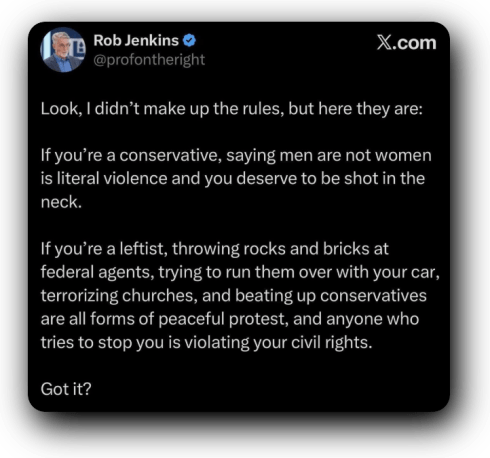
The X post is doing something familiar: it takes two ugly sentences, assigns one to “conservatives” and one to “leftists,” and then says, See? The rules are different. It’s a compressed morality play about “two-tier” reality—speech treated as violence on one side, actual violence laundered as “peaceful protest” on the other. The point isn’t subtle. The point is that subtlety is for suckers.
And yes: there is a real intellectual touchstone for the logic the meme is gesturing at—Herbert Marcuse and his essay Repressive Tolerance. Marcuse’s argument, in brief, is not “be nice to everyone equally.” It’s that “tolerance” inside an unjust system can function as a stabilizer for the powerful. If the social order is already rigged, then neutral tolerance becomes complicity. So “tolerance” may need to become selective: intolerance toward movements judged oppressive; preferential latitude toward movements judged emancipatory.
That is a mechanism you can recognize in our current atmosphere even if you reject Marcuse’s conclusions. Once you accept that framework—“neutral rules are a mask for power”—you quickly get to the idea that the formal categories we inherited (free speech, due process, viewpoint neutrality, equal enforcement) are not the point. The point is the moral direction of history. If you think the stakes are existential, then anything that slows “liberation” looks like violence, and anything that advances it starts to look excusable.
That’s the lure. It feels like moral seriousness.
It also tends to produce the exact thing the meme is ridiculing: asymmetric permission structures. On paper: “We oppose violence.” In practice: “We oppose violence when it serves the other tribe.” On paper: “Words have consequences.” In practice: “Words are violence when spoken by the wrong person, and merely ‘context’ when spoken by the right one.” If you want to defend selective enforcement as justice, Marcuse gives you a vocabulary. If you want to mock selective enforcement as hypocrisy, this meme gives you an image.
But the meme cheats in two ways.
First, it packages maximal caricatures as if they are the daily policy of real institutions: “people deserve to be shot,” “running over agents is peaceful,” “terrorizing churches is civil rights.” Those aren’t arguments; they’re adrenaline. They’re useful precisely because they let the reader skip the hard work: which specific cases, which authorities, which jurisdictions, which outcomes, which standards? A meme that can’t name a case doesn’t want to inform you. It wants to recruit you.
Second, it collapses three distinct questions into one hot blob:
- What is the law?
- How is it being enforced?
- Should the law be changed?
You can have a serious conversation about two-tier policing and still be allergic to meme logic. Two-tier policing isn’t a vibe; it’s an empirical claim: similar conduct, different outcomes, explained by ideology rather than facts. That’s testable, at least in principle. Pick comparable cases. Compare charging decisions, bail, sentencing, media framing, institutional statements, internal policies, and (crucially) what evidence was available at the time. If the pattern holds, you’ve found something corrosive.
Neutrality is never clean. Discretion and bias are baked into enforcement. That’s why consistency and transparency aren’t niceties; they’re the only way discretion doesn’t become patronage.
And if the pattern doesn’t hold? Then the meme is just a mood board for resentment.
Here’s the deeper issue: equal application of the law is not a decorative liberal slogan. It’s the only thing that keeps politics from becoming a permanent emergency. The moment your faction decides that formal neutrality is merely “repressive tolerance,” you have granted yourself a standing exemption. The moment the other faction learns that lesson, you get escalation, then retaliation, then institutional rot. The system stops being a referee and becomes a weapon. Everyone notices. Nobody trusts verdicts. Everything becomes a street fight conducted through courts, bureaucracies, and HR policies.
Which is, ironically, a recipe for more repression—just not evenly distributed. 🙂
If you want to critique selective enforcement without becoming a partisan mirror image, try this simple discipline:
- Name the standard (what rule should apply?).
- Name the comparator (what similar case was treated differently?).
- Name the decision point (who chose not to enforce, or enforced aggressively?).
- Say what you’d accept if the tribes were swapped.
Sometimes the double standard is real. The remedy is not revenge; it’s comparison—same conduct, same rule, same consequence, even when it’s your side.
That last one is the lie detector. Most people fail it quickly. That’s not because they’re stupid; it’s because the incentive structure is poisonous. If you’re convinced the other side is not merely wrong but illegitimate, “neutral rules” start to feel like self-harm.
Marcuse understood that temptation and tried to turn it into theory. The meme understands the temptation and turns it into a dunk.
My view is more boring and therefore more useful: a society can survive deep disagreement; it cannot survive the public belief that enforcement is a tribal privilege. If you think we have two-tier policing or two-tier moral accounting, don’t answer with a meme that trains your readers to crave revenge. Answer with receipts, standards, comparators, and the willingness to be constrained by the rule you want applied to your enemies.
Otherwise, you’re not defending fairness. You’re just changing who gets to do the repressing.

Meghan Murphy
This week, three Canadian writers launched a petition demanding the Toronto Public Library cancel a room rental for a sold-out event, ‘Gender Identity: What Does It Mean for Society, the Law, and Women?’ Sounds frightening, I know.
The local women organizing the event, a group called Radical Feminists Unite, asked me in June if they could bring me to Toronto to speak about gender identity legislation and women’s rights, unhappy that the debate was not being given space in their city. This is not an uncommon sentiment. The events I have been asked to participate in generally have been organized by regular women who have serious concerns about how gender identity ideology and policy could affect, and already is affecting, women’s sex-based rights. Canada in particular has been resistant to this discussion. Due to media blackouts, harassment, bullying, threats of violence, smear campaigns, censorship, and ostracization, a few brave women have had to force the conversation, at great risk.
In January, a couple women took it upon themselves to organize an event in Vancouver, ‘Gender Identity Ideology and Women’s Rights.’ These women had no budget, no public or political power, no history in activism or organizing events, and no agenda, other than to open up a conversation they feel is desperately needed. The panel, held at the Vancouver Public Library, featured me and two other longtime feminist activists with impeccable records fighting male violence against women. The organizers and I received numerous death and rape threats, were protested, and were libeled by politicians and the media. The VPL forced us to move the event after hours (to 9:30 p.m. on a weeknight), claiming that protesters posed a risk to patrons and staff. They attempted to charge us thousands in security fees in an effort to pressure us to choose another venue, surely aware we didn’t have that kind of budget. The chief librarian, Christina de Castell, issued a statement saying the library did not agree with ‘the views of Feminist Current,’ my website. Castell did not say which views the library disagreed with (protecting women’s sex-based rights or the idea that sexist gender stereotypes are not innate?), but regardless, she should not have taken a position, as a representative of a public institution meant to be neutral, nor should she have spoken on behalf of the VPL, as not everyone at the library is in agreement with her apparent opposition to both biology and women’s rights. Vancouver’s mayor labeled me ‘despicable’. Canada’s national public broadcaster, the CBC, located across the street from the library, refused to cover the event or contact me for comment, despite hosting a panel prior to the event, speculating whether panelists might say anything constituting ‘hate speech’. Of course none did. Despite protests, the event went off without a hitch and was incredibly respectful, inspiring, and galvanizing. The impassioned talks are available on YouTube for anyone to watch and see for themselves.
But why bother? Listening to words and forming an educated opinion based on said words is no longer a popular pastime.
Things have played out similarly in Toronto. The primary difference is that it is now writers leading the charge. You know, people who should be invested in reading and using words correctly.
Not only that, but writers of all people should be defending freedom of expression and a public library’s decision to uphold its mandate, which, per the TPL’s response to the petition, is to ensure meeting rooms are available to the public ‘on an equitable basis, regardless of the beliefs or affiliations of individuals or groups requesting their use’. The statement goes on to say: ‘As a public institution, our primary obligation is to uphold the fundamental freedoms of freedom of thought, belief, opinion and expression as enshrined in the Canadian Charter of Rights and Freedoms.’
This response was unacceptable to the writers and thousands of Torontonians (many of whom I’m certain would consider themselves ‘progressive,’ even ‘feminist’) wanting my talk canceled. Indeed, those who have signed the petition, ‘Stop Hate Speech from Being Spread at the Toronto Public Library,’ have publicly stated I am guilty of ‘hate speech’ and compared the organizers to a ‘hate group’. The petition, authored by Alicia Elliot, Catherine Hernandez, and Carrianne Leung, reads:
‘Those who want to disseminate hate speech today know that they can misrepresent, then weaponize the phrase ‘freedom of speech’ in order to get what they want: an audience, and space to speak to and then mobilize that audience against marginalized communities. While everyone has freedom of speech, we want to once again point to the limits of those freedoms when certain acts and speech infringe on the freedom of others, particularly those in marginalized communities. We also want to point out that hate groups do not have a right to use publicly funded facilities to meet and organize. This is precisely why TPL has a community and event space policy: to determine who and who does not have the right to use its facilities. There is a difference between denying free speech—and what is known as deplatforming, which is when you refuse to allow hate speech to be disseminated in your facility. This has been an effective tactic to stop those who capitalize on spreading hate speech, such as Meghan Murphy.’
The problem is I’ve never engaged in hate speech. I have made very basic statements about biology, such as ‘men aren’t women’ and ‘male bodies and female bodies are different.’ I have also argued that some spaces should be women-only, including changing rooms, transition houses, and prisons. I have said that individuals cannot change sex through self-declaration and that a boy is not a girl because he prefers dresses to pants. I have said that women have particular rights in this world due to the fact of being born female. I have said that women have not experienced discrimination in the workplace, in the home, in universities, and in politics because of anything they feel or because they somehow ‘identify’ with feminine stereotypes. In fact, it is the desire not to be limited to gender roles that inspired feminists’ ongoing fight.
Usually, I say this all warmly. I’m not generally an angry person but quite jovial, in fact. I don’t spend much of my energy hating anyone beyond slow walkers and morning people. I’m just telling the truth.
The writers who initiated the petition say they will no longer participate in events held at the TPL unless the library cancels my talk, which is fine, I suppose. It is their prerogative if they wish to hold readings for their friends in spaces untainted by free thought. Surely the condos their parents bought them have shared rec rooms available for such gatherings? Cozy bubbles seem better suited for those needing to protect themselves from triggers such as people with different opinions and experiences, anyway.
The whole scene strikes me as nauseatingly elitist, especially the entitlement with which these ‘progressive’ people approach members of the public — in this case, women with no particular social, political, or economic power — as though they should have the power to determine what we all think or say. As though they have the right to dictate what a library, of all places, should allow to be discussed within its walls.
These protesters are primarily middle- and upper-class people who have had access to opportunities most people in this world have not. Who live in relative safety, free from state persecution — who have the privilege of freedom in a world that continues to host dictatorships and incredibly repressive regimes that quite literally jail and murder those who fail to toe the party line. They have taken a postmodernist theory invented primarily within the walls of academia — that is, the notion that material reality is determined by inner feelings — and are attempting to impose it on the general public via force. These people have taken on the position of dictator, threatening to throw those who won’t adopt their nonsensical mantras in jail. Indeed, a former politician with the NDP, Canada’s leftist party, publicly claimed the event was ‘illegal’ while her supporters said I should be jailed.
On Thursday, Toronto mayor John Tory said he had contacted the library in an attempt to have the event canceled and is ‘disappointed’ the library declined to do so. What is in fact ‘disappointing’ (indeed, appalling) is that the mayor of Toronto does not understand the TPL’s mandate as a public institution and opposes freedom of expression.
These leftists seem unaware that opposition to free speech has not treated their presumed heroes kindly. They have so easily forgotten Emma Goldman, who was imprisoned for distributing information about birth control. And Rosa Luxemburg, arrested and killed by the GKSD, a German paramilitary unit instructed to suppress the communists. Surely the suffragettes deserved to be jailed and beaten for fighting to win women the right to vote, as their ideas were deemed too ‘radical’, not only by their opponents but other feminists and abolitionists. They have apparently not paid much attention to the female activists arrested and tortured in Saudi Arabia for advocating that women be allowed to drive. Journalists continue to be murdered in Mexico for reporting on police corruption and the drug war. But no matter. Protecting free expression is clearly a relic of the past, before we had multi-billion-dollar social media companies on hand to police dangerous speech. (‘On top of that, she has been banned from Twitter for violating their Hateful Conduct Policy’, the petition reads, as though In Big Tech We Trust is an appropriate mantra for supposed social justice advocates.)
At what point in history has suppressing subversive speech benefited the marginalized? Or anyone, really?
The CBC again failed to include the organizers or myself, the speaker, in its ‘coverage’ of the event. On a segment that aired Wednesday, Gill Deacon, host of Here and Now Toronto, spoke with Elliot, who stated that I was ‘trying to take away the rights of people’, ‘preach[ing] against human rights’, and did not believe ‘transwomen should have protections’ under the Human Rights Act or Criminal Code, claiming this constituted ‘spreading hate’. That none of this is accurate was of no concern to Deacon or Elliot. The CBC sees no need to allow me to speak for myself and explain my apprehensions because, I assume, my arguments are so reasonable people might agree with me. While Elliot claimed that I was ‘lying’ when arguing that gender identity legislation could override women’s rights, this has, unfortunately, already happened, as we’ve seen men transferred to women’s prisons, where they have assaulted female prisoners; women forced to leave shelters and transition houses on account of being made to share rooms with men; women and girls made to compete with and against males in sport; women’s organizations denied funding for having a women-only policy; and of course as we’ve seen a number of estheticians dragged to the British Columbia Human Rights Tribunal for declining to wax a man’s balls, because that man claimed to be female. What Elliot says there is no evidence for, there is ample evidence for. Which of course she would know, had she ever read my work, listened to my talks, or engaged in conversation with me, rather than using her platform to spout bigoted nonsense.
Ironically, if not for free speech, these individuals would not feel so safe to libel those they don’t like — which appears to be the go-to strategy of the Woke and Online. One wonders why they believe their speech should protected — even when hateful or slanderous — but not the speech of others. It is a modern hypocrisy I will never understand.
Unfortunately for these protesters and petitioners, the TPL will not be canceling the event, and I will continue to speak the truth in the face of threats, slander, harassment, ostracization, and actual hate speech. I will do this not because I have anything personally to gain from doing so but because I could not live with myself otherwise. I will not be silent while women’s rights are eroded, and I will not lie either under duress or to make friends. My integrity is worth more to me than my comfort or popularity, and yours should be too.
Meghan Murphy is a writer in Vancouver, British Columbia. Her website is Feminist Current.
It has come to the attention of credible journalists and serious Christian scholars, that Starbucks – owned by a JEW!!! – hates Baby Jesus, Christians, and Christmas, and has been trying to subvert and destroy Christian America(TM)’s sacred Christmas traditions, by gradually removing Christian imagery from its Holiday CHRISTmas red cups! Clearly the End Times are upon us, as persecution of Christians everywhere ramps up to levels unheard of in modern times!
I have undertaken to document Starbucks’ dastardly deed over the last 11 years, so that evidence of their perfidious treachery will be preserved – the Internet is forever!!! Below the cut: my trenchant analysis of the anti-Christian trend of Starbucks’ Holiday CHRISTmas cup imagery! Read the rest of this entry »











 bleatmop
 Mystro
 The Arbourist


 Dead Wild Roses
Your opinions…