
You are currently browsing the tag archive for the ‘Compelled speech’ tag.
Most social lies do not begin as lies. They begin as little acts of politeness.
You laugh at a joke that was not funny. You say “no problem” when there was, in fact, a problem. You sit through a meeting where everyone knows the plan makes no sense, but nobody wants to be the person who slows the room down. Ordinary life requires tact. Not every uncomfortable truth needs to be hurled across the table the moment it appears.
But there is a difference between tact and required unreality.
Tact says we should not be needlessly cruel. Required unreality says we must say the false thing, affirm the false thing, organize institutions around the false thing, and treat anyone who refuses as morally suspect.
That difference matters because societies rarely drift away from truth in one dramatic leap. They drift through small accommodations. A phrase changes here. A courtesy becomes expected there. A workplace norm hardens into policy. A school form gets rewritten. A professional guideline quietly changes the question everyone is allowed to ask.
Then, one day, ordinary people look around and realize they are being asked to deny things they can see with their own eyes.
The debate over sex and gender is one of the clearest examples.
The first move was linguistic. “Sex observed at birth” became “sex assigned at birth.” Many people shrugged. It sounded harmless, maybe even compassionate. Why fight over wording? But the change was not neutral. “Observed” describes the recognition of a biological fact. “Assigned” suggests an administrative decision, something imposed, possibly mistaken, perhaps unjust.
No parent waits for a committee to assign sex. They see the baby. They know. The doctor observes. The parents understand. The paperwork follows reality; it does not create it.
But once “assigned” becomes normal, the ground has shifted. The old reality has not disappeared, but the language around it has been loosened. A fact starts to sound like an opinion. An observation starts to sound like an imposition. What was once obvious becomes something polite people are encouraged not to say too firmly.
Pronouns came next for many ordinary people. “What is the harm?” they were told. “It is just politeness.”
And in private life, adults can choose whatever courtesies they want. People use nicknames. People avoid sore spots. People soften language to keep peace with neighbours, coworkers, students, friends, and family. That is normal human life.
The difficulty begins when courtesy becomes compulsory and everyone is expected to speak as though sex has disappeared from the room.
A teacher pauses before saying “she.” A coworker catches himself mid-sentence. A parent sits through a school meeting and says nothing because every adult in the room knows what is being asked, and nobody wants to be first to break the spell. So people go along. They use words they do not quite believe. They tell themselves it is only a small thing.
“Those arguments matter. But before any of them can be had honestly, people must be allowed to say what they know is true.”
Small things train larger habits. Once people become accustomed to saying what they do not believe, the person who says, “wait, this is not accurate,” becomes the problem. Not the falsehood. Not the policy built on it. The person who interrupts the shared performance.
That is how a real slippery slope works. It is not that one concession magically causes the next. It is that each concession changes the moral conditions under which the next demand is judged.
If sex is “assigned,” and pronouns are only kindness, and refusing preferred language is cruelty, then female-only spaces start to look morally suspicious. The sign on the changing room may stay the same, but the rule underneath it changes. The word “women” remains on the door. What it means has been quietly edited.
That edit does not stay abstract. It reaches the sports team someone’s daughter trains with. It reaches shelters, prisons, changing rooms, rape-crisis services, and lesbian boundaries. All can be reframed as sites of exclusion. The question quietly changes from “Do women and girls have sex-based rights?” to “Why are you being unkind to this vulnerable person?”
None of this denies that some people experience genuine distress about their bodies. They do. The question is whether compassion requires everyone else to rewrite reality around that distress.
By then, the argument has already moved. Women are no longer asking to preserve boundaries rooted in sex. They are being asked to justify why those boundaries should exist at all.
That is not an abstract problem. It changes institutions. It changes policies. It changes what children are taught. It changes what professionals are allowed to say. It changes whether parents, teachers, doctors, athletes, and ordinary citizens are permitted to name reality without being accused of hatred.
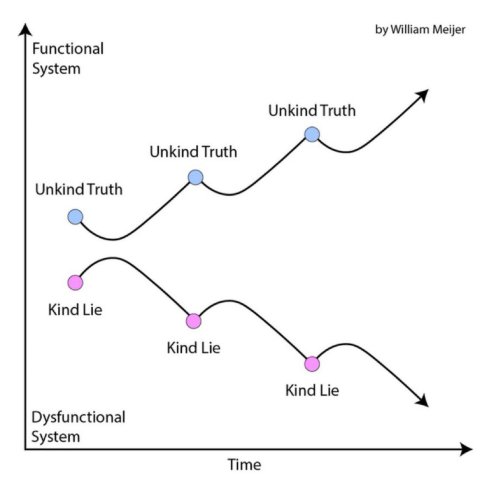
The kind lie does not remain kind once people are punished for refusing it.
We can debate the details of medicine, sports, schools, safeguarding, and law. Those arguments matter. But before any of them can be had honestly, people must be allowed to say what they know is true.
Reality has a way of waiting. Bodies still exist. Sex still matters in medicine, sport, privacy, reproduction, vulnerability, and patterns of violence. Institutions can change their language, but language does not abolish the facts underneath it. Step away from truth for long enough and eventually reality supplies the correction.
Reality always bats last.
The point is not that every hard truth should be spoken harshly. Decency matters. So does compassion. But compassion detached from truth becomes something else. It becomes a demand that some people absorb real costs so everyone else can feel morally clean.
That is the part ordinary people need to notice. Every time they play along with a claim they know is not true, they are not merely being polite. They may be helping build the next rule, the next policy, the next institutional punishment for the person who finally says no.
Women do not need permission to define themselves.
The word woman already has a meaning. It is not hateful to say so, and it is not extremist to defend female boundaries, female privacy, female sports, or female-only spaces. Women are adult human females. That definition is not a slur. It is the basis on which women’s rights were built.
The public silence around this issue is starting to crack because too many people can now see where the trajectory leads. A society that cannot define women cannot reliably protect them. Rights tied to sex become fragile once sex itself is treated as optional language.
Enough of the intimidation. Enough of the compelled speech. Enough of the social blackmail that brands ordinary women as bigots for wanting boundaries previous generations understood as normal, necessary, and humane.
The next step is not private agreement. It is public resistance, steady enough that institutions can no longer pretend the objection belongs only to cranks and extremists.
Write to elected officials and demand that sex-based protections be clarified in law as applying to biological sex. Support groups defending women’s sports, shelters, prisons, and female-only services. Push back in schools, workplaces, unions, professional associations, and public consultations when policies dissolve female boundaries into identity claims. Refuse the language games that make reality harder to discuss. Speak plainly, calmly, and repeatedly.
Support the journalists, writers, academics, whistleblowers, parents, athletes, and ordinary women who are absorbing the punishment for saying what millions still believe. Do not leave them standing alone while quietly agreeing with them afterward in private.
That private agreement is one of the main things keeping this machine alive. Institutions interpret silence as consent. Bureaucracies advance until they meet resistance, and too many citizens have been trained to mistake politeness for surrender.
This resistance does not require rage or cruelty. It requires steadiness, numbers, and the willingness to stop pretending obvious things are unsayable.
The backlash already underway across the Western world is not driven by hatred. It is driven by exhaustion with the claim that female boundaries are negotiable, that biology is taboo, and that dissent itself is immoral.
Women have the right to their own spaces, language, associations, and political interests. No court ruling or policy document can erase that reality.

When people say “trans rights,” they often smuggle in the conclusion before the argument has even begun. The phrase suggests a class of basic liberties being withheld from a minority population. In most liberal democracies, that is not the real dispute. Trans-identifying people already possess the same ordinary civil rights as everyone else: to vote, work, speak, worship, associate, and live free from assault or arbitrary exclusion. The real conflict begins when contested demands are framed as rights claims in order to place them beyond criticism.
That distinction matters. A right is not the same thing as a demand for access, validation, or institutional compliance. Female sports were not created out of prejudice, but out of recognition that sex differences matter in strength, speed, endurance, and physical risk. Female shelters, prisons, and changing rooms were built on the same logic. They exist because privacy, safety, fairness, and dignity are not imaginary goods. They are concrete protections, won through long struggle, and they do not cease to matter because a new vocabulary has been imposed on the debate.
Once this is seen clearly, much of the rhetoric falls apart. If a male-bodied person demands entry into a female space, the objection is not that he lacks human worth. It is that women have sex-based boundaries, and those boundaries exist for reasons. If a parent objects to gender ideology in schools, that is not the denial of anyone’s basic rights. It is the defense of parental authority in an area of profound moral and developmental consequence. If a citizen resists compelled pronouns or refuses to treat metaphysical claims about sex as binding fact, that is not violence. It is a refusal to surrender conscience and language to activist pressure.
“When one group’s ‘rights’ require another group to surrender privacy, fairness, or conscience, the conflict is no longer about equality. It is about power.”
This is where the phrase “trans rights” does its real work. It pre-loads the moral verdict. It makes disagreement sound like oppression before the argument has even begun. Once that framing is accepted, women’s boundaries become cruelty, parental caution becomes hatred, and democratic disagreement becomes abuse. But this is not a serious use of rights language. It is a way of insulating contested claims from scrutiny by wrapping them in the prestige of civil rights.
None of this means every accommodation is unreasonable, or that every dispute is zero-sum. Ordinary civility and equal treatment in public life are not difficult standards to defend. But when one group’s claimed “rights” require another group to surrender privacy, fairness, language, or the right to maintain sex-based boundaries, the conflict has moved beyond equal citizenship. It has become a struggle over whose moral framework will rule, and whose objections will be permitted to count.
That is why the language matters. “Trans rights” sounds like a plea for equal liberty. In many of the most contentious cases, it is something else: a demand that others yield, affirm, and rearrange long-standing social boundaries on command. When women refuse that erasure, or parents refuse that indoctrination, or citizens refuse that compelled speech, they are not violating rights. They are defending their own.

The most important part of the British Columbia Human Rights Tribunal’s decision in Chilliwack Teachers’ Association v. Neufeld (No. 10) is not the political noise around it. It is a short passage in page 19 paragraph 55. [attributed as paragraph 19, originally].
That passage matters because it appears to recode a contested idea as a condition of basic civic recognition. In plain terms, it moves from “do not discriminate against people” toward “you must affirm a specific theory to count as accepting them.”
This primer focuses on that point only. It does not attempt to relitigate the entire case.
The tribunal’s decision was issued February 18, 2026, indexed as 2026 BCHRT 49.
What this article argues in one paragraph
TL;DR: The BCHRT can punish discrimination without requiring Canadians to affirm a contested theory of sex and gender as the price of being considered non-discriminatory. Paragraph 19 matters because it blurs that line: it treats disagreement with a conceptual framework as “existential denial” of a person. That is a legal and civic problem, even for people who support anti-discrimination protections.
What this critique is not saying
Before the legal and logical analysis, a boundary line.
This critique is not saying:
- LGBTQ teachers cannot suffer real harm from public rhetoric.
- Human rights law cannot address discriminatory publications or poisoned work environments.
- Every criticism of SOGI, gender identity policy, or youth transition debates is lawful.
- Barry Neufeld’s rhetoric was prudent, fair, or wise.
The tribunal found multiple contraventions under the Code, including ss. 7(1)(a), 7(1)(b), and 13, and the decision contains detailed findings about workplace impact and discriminatory effects.
This primer makes a narrower claim:
Page 19 paragraph 55 uses an analogy that collapses the distinction between recognizing a person and affirming a contested ideological premise.
That distinction matters for free expression, legal clarity, and public trust.
The passage that changes the frame
Here is the core language from parge 19, paragraph 55 (including the definitional lead-in):
“Transpeople are, by definition, people ‘whose gender identity does not align with the sex assigned to them at birth’…”
“If a person elects not to ‘believe’ that gender identity is separate from sex assigned at birth, then they do not ‘believe’ in transpeople. This is a form of existential denial…”
“A person does not need to believe in Christianity to accept that another person is Christian. However, to accept that a person is transgender, one must accept that their gender identity is different than their sex assigned at birth.”
This is the paragraph Canadians should read for themselves.
The issue is not whether one can be civil. The issue is whether civil recognition is being redefined as mandatory assent to a disputed concept.
The core problem: equivocation on “accept” and “believe”
The tribunal’s analogy uses accept and believe as if they do the same work in both examples. They do not.
Christianity example
In the Christianity example, “accept that another person is Christian” usually means:
- acknowledging a descriptive fact about that person’s profession of faith,
- recognizing what they claim to believe,
- without requiring your own doctrinal agreement.
You can think Christianity is false and still accurately say, “Yes, that person is Christian.”
That is descriptive recognition.
Transgender example (as framed in para. 55)
In the tribunal’s wording, “accept that a person is transgender” is not left at description. It is tied to a required premise:
- that gender identity is separate from sex assigned at birth, and
- that this premise must be accepted in order to count as accepting the person at all.
That is not merely descriptive recognition. It is affirmation of a contested theory built into the definition.
That is the logical shift.
Why this matters legally and civically
A liberal legal order normally distinguishes between:
- Recognition of persons
- Protection from discrimination
- Compelled assent to contested beliefs
Paragraph 55 blurs those lines.
A person can acknowledge all of the following without contradiction:
- that someone identifies as transgender,
- that the person may experience distress, dysphoria, or social vulnerability,
- that harassment or discrimination against them is wrong,
while still disputing:
- whether sex is best described as “assigned” rather than observed,
- whether gender identity should override sex in all legal contexts,
- whether specific policies (sports, prisons, shelters, schools) should follow from that framework.
If disagreement on those latter questions is relabeled as “existential denial,” the public is no longer being asked to tolerate persons. It is being asked to affirm a framework.
That is the warning.
A concrete example most readers can use
Here is the distinction in everyday terms.
A teacher, coach, employer, or colleague can:
- treat a transgender person courteously,
- avoid harassment,
- maintain ordinary workplace civility,
- refrain from discriminatory conduct,
without conceding that sex categories disappear in every policy context.
For example, a person may choose to use a student’s preferred name in daily interaction and still argue that elite female sports should remain sex-based. A person may reject insults and harassment and still dispute whether “sex assigned at birth” is the best scientific language.
That is not incoherence. That is how pluralist societies work.
Paragraph 19 pressures this distinction by framing conceptual dissent as equivalent to non-recognition of the person.
The definitional trap in paragraph 55
Paragraph 19 does something subtle but powerful.
It defines “transpeople” using a specific conceptual framework (“gender identity” versus “sex assigned at birth”), then treats non-acceptance of that framework as non-acceptance of trans people themselves.
That is a question-begging structure:
- Premise (built into the definition): trans identity necessarily means gender identity distinct from sex assigned at birth.
- Conclusion: if you reject that premise, you deny trans people.
But the premise is precisely what is contested in public debate.
A tribunal can rule against discriminatory conduct. It can interpret the Code. It can assess workplace effects. But once it turns a contested framework into the test of whether one “accepts” a class of persons at all, it risks moving from adjudication into ideological gatekeeping.
Context matters, but it does not fix the analogy
To be fair to the decision, the tribunal is not writing in a vacuum.
The reasons frame Mr. Neufeld’s rhetoric as part of a broader pattern of statements the tribunal found denigrating, inflammatory, and connected to the work environment of LGBTQ teachers. The tribunal also found a direct connection between his public rhetoric and a school climate that felt unsafe to many LGBTQ teachers.
That context may explain the tribunal’s forceful language.
It does not solve the logic problem in paragraph 19.
Even in hard cases, legal reasoning should preserve key distinctions:
- personhood vs. theory,
- conduct vs. belief,
- discrimination vs. disagreement.
When those lines blur, institutions may satisfy partisans while losing credibility with ordinary readers who can still detect the category error.
Remedies matter too (and should be stated plainly)
This was not a symbolic ruling.
The tribunal ordered multiple remedies, including a cease-and-refrain order, $442.00 to Teacher C for lost wages/expenses, and a $750,000 global award for injury to dignity, feelings, and self-respect to be paid to the CTA for equal distribution to class members. It also ordered interest on monetary amounts as specified.
The tribunal also states that the dignity award is compensatory and “not punitive.”
Readers can disagree about the amount. They should still understand that paragraph 19 sits inside a decision with real legal and financial consequences.
Why Canadians should pay attention
Most Canadians will never read a tribunal decision. They will hear summaries.
That is why paragraph page 19 paragraph 55 deserves attention.
If public institutions begin treating disagreement with a contested theory as “existential denial,” the zone of legitimate disagreement shrinks by definition. The public is no longer told only, “Do not discriminate.” It is told, in effect, “Affirm this framework, or your dissent may be treated as denial of persons.”
That is not a stable basis for pluralism.
A rights-respecting society needs a better rule:
- protect people from discrimination,
- punish actual harassment and unlawful conduct,
- preserve space for lawful disagreement on contested concepts.
Paragraph 55, as written, weakens that line.

Glossary for readers
Page 19, Paragraph 55
A specific paragraph in the tribunal’s reasons that contains the Christianity analogy and the “existential denial” language. This primer focuses on that paragraph.
“Existential denial”
The tribunal’s phrase in para. 19 for refusing to “believe” that gender identity is separate from sex assigned at birth, which it links to not “believing in transpeople.”
Section 7(1)(a) (BC Human Rights Code)
A Code provision dealing with discriminatory publications (as applied by the tribunal in this case).
Section 7(1)(b) (BC Human Rights Code)
A Code provision dealing with publications likely to expose a person or group to hatred or contempt (the tribunal found some publications met this threshold).
Section 13 (BC Human Rights Code)
A Code provision dealing with discrimination in employment, including discriminatory work environments (the tribunal found a poisoned work environment for the class of LGBTQ teachers).
“Poisoned work environment”
A human rights / employment law concept referring to a workplace atmosphere made discriminatory through conduct, speech, or conditions connected to protected grounds.
SOGI 1 2 3
Resources discussed in the decision in connection with BC public education and inclusion policies; the tribunal notes they are resources and addresses their role in the factual background. (See source map below.)
Source map so readers can verify for themselves
Use this map to read the decision directly and check each claim the PDF is available here.
Case identification and issuance
- Paras. 1–3 (intro/citation/date/caption)
- Verified from the front matter: issued February 18, 2026, indexed as 2026 BCHRT 49.
Overview of findings and what was decided
- Paras. 4–6 (high-level findings; which Code sections were violated)
- Tribunal later reiterates finding the complaint justified in part and violations of ss. 7(1)(a), 7(1)(b), and 13.
Freedom of expression framework / limits
- Paras. 8–10 (overview-level framing)
- Also see Part VII heading “Freedom of expression and its limits” in the table of contents.
SOGI factual background
- Paras. 13–15 (background on SOGI 1 2 3 in public education)
- See TOC references to “SOGI 1 2 3 in public education” and Neufeld’s response.
The key analogy and “existential denial”
- Para. 19 (full lead-in + Christianity analogy + “existential denial” language)
This is the central paragraph for the primer.
Tribunal’s “veneer of reasonableness” concern
- Para. 55 (same paragraph; immediate context of the analogy)
Workplace impact evidence / climate findings
- Paras. 38 onward (teacher evidence and climate effects)
- Example evidence and findings on climate and workplace effects are reflected in the teacher testimony excerpts and the tribunal’s acceptance of a direct connection to unsafe school climate.
s. 13 conclusion (employment discrimination)
- Para. 82 (and surrounding paras.) / section conclusion in Part V-C
- Tribunal concludes violation of s. 13 for the class.
Remedies overview (s. 37(2))
- Paras. 99 onward (remedies discussion starts in the remedies part)
- Includes declaration, cease/refrain order, expenses, dignity award, and interest.
Cease and refrain order
- Remedies section, Part A (paras. around 100–101)
- “We order him to cease the contravention and refrain from committing the same or a similar contravention…”
Training remedy requested but declined
- Part B (ameliorative steps) (paras. around 102)
- Tribunal says it was not persuaded mandatory training would have a beneficial effect in this case.
Teacher C expenses ($442)
- Part C (expenses incurred) (paras. around 103)
- Tribunal orders $442.00 to Teacher C.
Dignity award ($750,000 global)
- Part D (compensation for injury to dignity…) (paras. around 104–111)
- Tribunal says the purpose is compensatory, not punitive; later orders $750,000 to the CTA for equal distribution to class members.
Interest orders
- Part E (Interest) (paras. around 112)
- Tribunal orders interest as set out in the Court Order Interest Act.
On December 3, 2025, Calgary pastor Derek Reimer was arrested for breaching the conditions of his conditional sentence order after refusing to write a court-mandated letter of apology to a public library manager and members of the LGBTQ+ community. The apology stemmed from his earlier conviction for criminal harassment related to protests against Drag Queen Story Hour events at Calgary libraries in 2023, where he had confronted organizers and posted videos online.
Reimer, citing his sincerely held religious beliefs, argued that complying would constitute compelled speech in violation of Canada’s Charter of Rights and Freedoms; however, the court deemed his refusal a breach, leading to his immediate detention.At a bail hearing on December 5-6, 2025, no decision was reached on Reimer’s release, and he remains in custody awaiting a further hearing on Tuesday, December 9. The case highlights the extraordinary nature of the original sentencing requirement: court-ordered apologies are rare in Canadian criminal law and typically reserved for restorative justice or defamation contexts, not as a tool to enforce ideological conformity. By jailing a citizen for refusing to express remorse that contradicts his conscience, the justice system effectively punishes thought and belief rather than solely actions, raising serious concerns about state overreach.
This incident exemplifies growing authoritarian tendencies in Canada’s legal approach to dissent on cultural issues, where protections for freedom of expression and religion appear subordinated to enforcing compliance with progressive orthodoxies. Forcing individuals to voice insincere apologies—or face imprisonment—echoes compelled speech regimes in totalitarian systems, undermining the Charter’s guarantees and signaling that the government views certain religious convictions as incompatible with public order. As of December 6, 2025, Reimer’s continued detention without resolution further illustrates how such measures can be used to silence opposition through prolonged pre-trial incarceration.

Here are some reliable sources for readers seeking more details on Pastor Derek Reimer’s case, including the original protests, the court-ordered apology, his December 3, 2025 arrest for non-compliance, and the ongoing bail proceedings as of December 6, 2025:
- Original X post highlighting the case: https://x.com/RealMattA_/status/1997166177433321898 (Quotes journalist Chris Dacey’s update on the bail hearing delay.)
- Video update from the December 6 bail hearing (posted by
@chrisdacey
): https://x.com/chrisdacey/status/1997152423396204956 (Confirms no bail decision was reached and Reimer remains in custody until December 9.)
- Western Standard – Arrest coverage: https://www.westernstandard.news/news/watch-calgary-pastor-arrested-after-refusing-to-apologize-to-librarian/69520 (Includes details on the breach and compelled speech concerns.)
- Rebel News – Breaking arrest report: https://www.rebelnews.com/derek_reimer_arrested_after_refusing_court_ordered_apology (Features video of the arrest and background on the conditional sentence order.)
- Caldron Pool – Analysis of compelled speech: https://caldronpool.com/compelled-speech-canadian-pastor-arrested-for-refusing-to-issue-court-ordered-apology/ (Discusses Charter violations and Reimer’s religious objections.)
- LifeSiteNews – Recent developments: https://www.lifesitenews.com/news/canadian-pastor-arrested-for-refusing-to-write-apology-to-librarian-who-hosted-drag-queen-story-hour/ (Covers the arrest and broader context of protests against drag events for children.)
The case of Catherine Kronas, an elected parent member of the school council at Ancaster High Secondary School within the Hamilton-Wentworth District School Board (HWDSB) in Ontario, Canada, exemplifies a significant conflict between institutional policies promoting cultural sensitivity and the protection of individual rights to free expression. On April 9, 2025, during a school council meeting, Kronas respectfully objected to the practice of land acknowledgements—formal statements recognizing Indigenous peoples as the original stewards of the land—asserting that they constitute compelled speech and are politically controversial. She requested that her objection be recorded in the meeting minutes, causing no disruption. Nevertheless, on May 22, 2025, the HWDSB suspended her from her council role, citing allegations of causing harm and violating the board’s Code of Conduct policy. The Justice Centre for Constitutional Freedoms (JCCF) responded by issuing a legal warning letter, arguing that the suspension infringes on Kronas’s freedom of expression under the Canadian Charter of Rights and Freedoms. This situation underscores the broader tension between fostering inclusivity through practices like land acknowledgements and safeguarding individual rights to dissent, raising critical questions about free speech and compelled speech in educational settings.
Free speech is a cornerstone of democratic societies, ensuring that individuals can express diverse viewpoints without fear of censorship or retaliation. In educational contexts, this principle is paramount, as schools are environments where students, parents, and educators should engage in open dialogue to foster critical thinking and intellectual growth. The suspension of Kronas for voicing a dissenting opinion on land acknowledgements risks stifling such discourse, creating an atmosphere where conformity is prioritized over debate. This not only undermines the educational mission but also sets a concerning precedent for how dissent is managed in democratic institutions. Protecting free speech in schools allows for the exploration of controversial issues, encouraging students and community members to develop informed perspectives through reasoned discussion. The Kronas case illustrates the importance of maintaining an environment where differing viewpoints can be expressed without penalty, ensuring that educational institutions remain spaces for intellectual freedom and democratic engagement.
Compelled speech, where individuals are required to express or endorse statements contrary to their beliefs, poses significant risks to personal autonomy and freedom of expression. In Kronas’s case, the HWDSB’s expectation that council members participate in or refrain from objecting to land acknowledgements effectively compelled her to align with a statement she viewed as political and divisive. Her suspension for merely requesting that her objection be noted demonstrates how institutional mandates can penalize dissent, potentially violating Section 2(b) of the Canadian Charter of Rights and Freedoms, which guarantees freedom of thought, belief, opinion, and expression. Such actions may create a chilling effect, where individuals self-censor to avoid repercussions, eroding the foundation of free expression. The JCCF’s legal challenge highlights the lack of procedural fairness, as Kronas was not given an opportunity to respond to the allegations against her. While land acknowledgements aim to honor Indigenous histories, their mandatory imposition in public settings must be balanced against the rights of individuals to dissent. The Kronas case serves as a critical reminder of the need to protect free speech and resist compelled speech to maintain a free and open society.

Key Citations
- School board reaffirms suspension of parent opposing land acknowledgement
- Parent suspended for objecting to land acknowledgement; legal warning sent
- Canadian school board suspends parent for opposing Indigenous land claims
- Legal warning sent to Ontario school board for suspending elected school council member
- Legal warning sent to Ontario school board for suspending elected school council member
- Compelled Expression
- Compelled Speech on Canadian Campuses
- Free Speech
- Compelled Speech
- Section 2(b) – Freedom of expression
- Indigenous Education
- Indigenous Education Policy
- What’s wrong with land acknowledgments, and how to make them better
- Land Acknowledgement
Having recently gotten into a discussion about the misnamed “Gender Affirming Care” with some of my acquaintances we broached many contentious topics but one point that stuck out was when we got into pronoun territory.
My interlocutor was brought up the idea that the shortening of names – like Stan for Stanley – was a preference and that people were just being polite by referring to the individual as they would like to be referred to.
I stumbled a bit on proposing a counter argument for this point – in hindsight it is fairly straightforward to construct a response.
If a person insists on calling a self proclaimed “Stan”, “Stanley” it might indeed be considered a bit offensive. So how is this different that using she/her pronouns for a male who is under the false notion that he is female?
Well, Stan and Stanly are both terms that are technically correct for the person in question. Is it inconsiderate to ignore their wishes, yes certainly, but here in this free society we don’t have to associate with people who we judge are inconsiderate toward us.
The male expecting people to use “she/her” when to referring to him is a completely different case. Pronouns and preferred names are not in the same category of linguistic use. In English pronouns are sexed, thus males are attributed he/him and females are attributed she/her.
If you hold a set of beliefs that do not comport with reality – that is a male believing that he is somehow a woman (adult human female) – that is perfectly fine. Your personal belief about your reality are of no concern to anyone else in society.
The expectation though of people outside your gender delusion to play along with and be party to your departure from the material reality we all share is not acceptable, especially if you are a person that sees the harm Gender Ideology does to women and society.
Thus, the argument of using a preferred name vs. a pronoun is distinctly a false equivalence as in the first case two real descriptors that accurately represent reality are being offered. In the second case using the “wrong” pronouns is a decision to comport with reality or the decision to ignore the evidence your senses are reporting and submit to someone else’s interpretation of reality – no one is obliged to do so.
Both cases associated with someone is who you perceive to be offensive is not usually not a mandatory experience. Occasionally being offended in society is a part of life and one must learn to deal with it.
Compelling the speech of others is a distinctly authoritarian notion and should not be encouraged in a society that values freedom of thought and expression.











 bleatmop
 Mystro
 The Arbourist


 Dead Wild Roses
Your opinions…