
You are currently browsing the tag archive for the ‘Religious Freedom’ tag.
The distinction between Islam and Islamism is useful. Islam is a diverse religion; Islamism is the political project of ordering society and the state according to an assertedly Islamic system. Confusing the two turns every Muslim into a political suspect. Pretending they have nothing important to do with one another, however, requires a different kind of dishonesty.
Islamism also covers more than terrorism or armed jihad. Its adherents may pursue power through political parties, welfare and religious institutions, demands for parallel jurisdiction, pressure for censorship and blasphemy laws, or violence. Those methods are not morally equivalent, but they share the conviction that Islam supplies not merely private belief or moral guidance, but the authoritative framework by which public life should be governed.
A recent New Discourses podcast approaches the issue through Sayyid Qutb’s Milestones, one of the formative texts of modern revolutionary Islamism. In its chapter on jihad, Qutb argues that establishing God’s sovereignty means enforcing divine law and abolishing laws made by human beings. Preaching alone cannot accomplish this because the institutions exercising political and social power will not voluntarily surrender it. Religious proclamation must therefore operate alongside “the movement,” which confronts the material obstacles standing between belief and Islamic rule.
Qutb’s formulation exposes something that polite Western discussion often obscures. Islamism is not merely ordinary authoritarianism wearing an Islamic costume, nor is it an alien ideology arbitrarily grafted onto an otherwise private faith. Its concepts—divine sovereignty, sharia, jihad, the ummah and the exemplary authority of Muhammad and the early Muslim community—are drawn from Islam itself. Islamists may interpret those sources selectively or radically, but they are not citing them by accident.
The argument becomes weaker, however, if Qutb is allowed to speak for Islam as a whole. He was a twentieth-century revolutionary who assembled older Islamic concepts into a modern political program, not the neutral curator of an uncontested tradition. Muslims have produced rival interpretations across centuries, and many today accept religious pluralism and democratic government. Their existence cannot be dismissed as counterfeit belief merely because Qutb would have dismissed it that way.
Nor does recognizing Islamism’s Islamic roots assign collective guilt to Muslims. Ideas have genealogies; people have agency. A Muslim who rejects the coercive political project is not responsible for it simply because an Islamist invokes the same scripture. By the same measure, Islamists cannot be insulated from scrutiny by insisting that any examination of their religious claims constitutes hatred of Muslims.
Both errors serve the extremists. Collapsing Islam into Islamism grants Islamists the status they covet as the authentic representatives of every Muslim. Severing the two protects Islamist doctrine from the criticism applied to every other political ideology.
The classical liberal answer is equal liberty under neutral rules. Muslims possess the same freedom of conscience, worship, speech and political participation as everyone else. What they do not possess—and what no religious or political constituency should possess—is an exemption from laws governing intimidation, obstruction or the use of public space.
Mass public prayer is protected religious expression. If a gathering blocks roads, occupies civic space without authorization or prevents others from exercising their rights, however, the relevant rules should be enforced exactly as they would be against Christians, environmentalists or striking workers. When authorities relax enforcement because they fear communal tension or accusations of prejudice, tolerance has curdled into unequal treatment.
The language surrounding “Islamophobia” presents a related danger. Anti-Muslim hatred and discrimination are real and should be opposed. Islam, however, is a body of religious claims, not a person possessing civil rights. When “Islamophobia” is used to collapse criticism of Islamic doctrine into hostility toward Muslims, it becomes an ideological shield against examination. People are entitled to equal protection; religions are not entitled to protection from criticism.
Militant Islamism is not a hypothetical challenge. Through terrorism, intimidation, blasphemy enforcement and campaigns to subordinate civil law, it has demonstrated its hostility to liberal society. Western nations must confront that threat openly—in policing, security policy and the public square.
The paradox of tolerance is not a licence to suppress Muslims or peaceful belief. It is a warning that tolerance cannot survive if it grants coercive movements the freedom to destroy the conditions that make tolerance possible. Islamism grows from within Islam; it is neither the whole tree nor a foreign vine. Opposing it without collective guilt requires candour, equal enforcement and the confidence to defend our liberal inheritance.
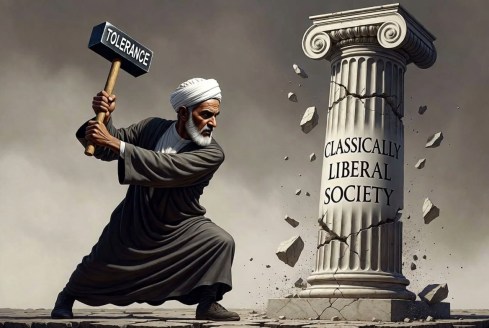
A former Muslim recently wrote something on X that deserves to be taken seriously:
“I was never a practising, observant Muslim. Yet, even I wanted Islam to take over Europe and the West until I was a teenager.”
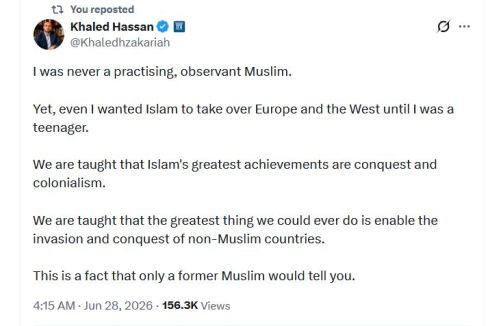
That is not a small admission. It is a glimpse into a religious-political imagination many Westerners have been trained not to notice, or at least not to describe plainly.
The issue is not ordinary Muslim citizens living ordinary lives. The issue is the version of Islam that understands itself not merely as private faith, but as a total system of law, society, politics, and conquest. That distinction matters because Muslim Brotherhood-style Islamism does not present itself as a hobby, an identity, or a private devotional life. It presents itself as a movement, with a theory of history, a theory of law, a theory of society, and a theory of liberation.
At its centre is the belief that human beings are not truly free until they submit to divine law. That may sound pious in abstraction, but it immediately raises the question liberal societies cannot avoid: what happens to people who do not want to live under that law?
Sayyid Qutb’s Milestones gives one answer. Qutb was not merely writing about personal religious improvement. He was writing a revolutionary text for Islamism, one that treated Islam as both religion and movement. In that framework, Sharia is not one moral tradition among others; it is the only legitimate law. Other systems of law are not merely different, mistaken, or incomplete. They are jahili: ignorant, illegitimate, and awaiting correction.
This is the part Western liberal societies keep trying to soften into something less threatening. The problem is not that Muslims pray, fast, worship, build families, open businesses, or form communities. The problem is a doctrine that treats civil law as false law, liberal democracy as ignorance, and non-Islamic societies as places that must eventually be transformed.
There are Muslims who reject this. There are reformist Muslims, secular Muslims, quietist Muslims, and ordinary Muslims who want nothing to do with Qutbist revolutionary politics. They are not the target of this critique. The target is the Islamist doctrine that treats their moderation as compromise, their citizenship as suspect, and their acceptance of civil law as evidence that they have submitted to something other than God.
From there, the conflict with liberal democracy becomes unavoidable. Qutb’s framework does not simply say that Muslims should be faithful within their own private lives. It says society itself must be reordered around submission to God’s law. It rejects the idea that human beings may legislate for themselves outside divine command; worse, it treats such legislation as a form of servitude, because human authority has supposedly usurped the authority of God.
Every civilization has conquest in its past. The issue is not that Islamic empires, like other empires, expanded through force. The issue is what later ideologies teach people to feel about that expansion. Was it ordinary human empire, subject to the same moral scrutiny as any other empire? Or was it sacred victory, proof of divine favour, and a model for the future?
That is the trick at the centre of the ideology. The Islamist does not necessarily think he is enslaving others. He may think he is freeing them from man-made law, rescuing them from ignorance, and liberating them from the false gods of democracy, secularism, nationalism, pluralism, or individual liberty. But domination does not become freedom because the dominator calls it liberation.
A liberal society can tolerate deep religious difference. It can protect mosques, churches, synagogues, temples, and atheists alike. It can defend the right of people to pray, preach, publish, criticize, convert, leave, and dissent. That is what religious freedom means, and it is one of liberal civilization’s great achievements.
But religious freedom is not a suicide pact. A society built on equal citizenship and civil law has no obligation to pretend that a movement seeking to replace civil law with religious law is merely asking for inclusion. It is asking for room to build a rival sovereignty; it wants the freedoms of liberal society while denying the legitimacy of the liberal order that makes those freedoms possible.
Former Muslims often understand this in a way polite Western elites do not. They know the internal language, the heroic stories, the childhood assumptions, the selective memory, and the pressure to treat Islamic expansion as something nobler than ordinary imperial ambition. When a former Muslim says he was taught that Islam’s greatest achievements were conquest and colonialism, we should not rush to explain the statement away. We should ask what kind of moral education produces that desire in a teenager who was not even especially observant.
Conquest does not always begin with armies. It begins with a story: one law is holy and all others are illegitimate; one community has submitted while the rest of the world lives in ignorance; ordinary civic loyalty is lesser than religious loyalty; the surrounding society is not a common home but a problem to be transformed.
Once that story takes hold, liberal tolerance can be turned against liberal civilization itself.
Western societies have become very good at speaking about “extremism” in the abstract, as though radicalization were a mysterious weather system that occasionally rolls through alienated communities. We condemn “hate” without asking what the hated object actually is. We speak endlessly about inclusion, but hesitate when inclusion is demanded by movements that do not intend to return the favour.
The hesitation is not harmless. The target of Muslim Brotherhood-style Islamism is not merely Western foreign policy, social prejudice, or insufficient accommodation. Its target is the liberal settlement itself: equal citizenship, freedom of conscience, freedom of speech, secular civil law, and the right to live without submitting to a religious legal order.
A society cannot remain liberal if it treats every challenge to liberalism as just another form of diversity. There is a difference between welcoming Muslim citizens and making excuses for Islamic supremacism; between protecting private faith and accommodating political theology; between religious freedom and religious domination.
Those distinctions matter because liberal democracy depends on reciprocity. Citizens may believe different things, worship differently, argue fiercely, and disagree about ultimate truth; what they may not do is claim that their sacred law has a superior right to govern everyone else.
That is the line that must be defended, at all costs to preserve any society that does not wish to follow Sharia law.
When a movement teaches that non-believers live in ignorance until brought under divine law, it is not offering pluralism. When it treats civil law as illegitimate because only Sharia is legitimate, it is not asking for equal citizenship. When it remembers conquest as sacred achievement rather than domination, the West should stop pretending that the problem is misunderstanding.
The issue is Islamic supremacism: a religious-political project that seeks power over others while calling that power liberation.
No liberal society should be embarrassed to say so.
Conquest is not made holy by scripture. Colonialism is not redeemed by prayer. And religious domination is still domination, even when it arrives speaking the language of faith.
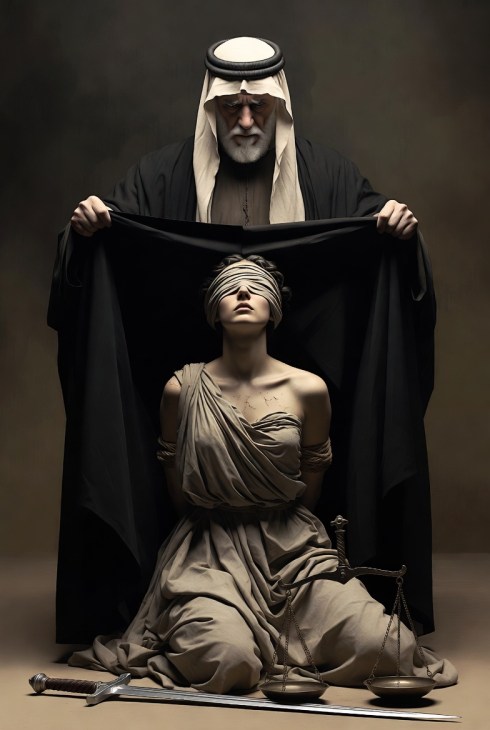
When religious law claims supremacy over civil law, justice is no longer blind; it is bound.
References and Source Material
This essay was prompted by a former Muslim’s post on X describing being taught to admire Islamic conquest and colonialism.
It also draws on discussion of Sayyid Qutb’s Milestones and Muslim Brotherhood-style Islamism in the New Discourses podcast episode provided in transcript form.
On December 3, 2025, Calgary pastor Derek Reimer was arrested for breaching the conditions of his conditional sentence order after refusing to write a court-mandated letter of apology to a public library manager and members of the LGBTQ+ community. The apology stemmed from his earlier conviction for criminal harassment related to protests against Drag Queen Story Hour events at Calgary libraries in 2023, where he had confronted organizers and posted videos online.
Reimer, citing his sincerely held religious beliefs, argued that complying would constitute compelled speech in violation of Canada’s Charter of Rights and Freedoms; however, the court deemed his refusal a breach, leading to his immediate detention.At a bail hearing on December 5-6, 2025, no decision was reached on Reimer’s release, and he remains in custody awaiting a further hearing on Tuesday, December 9. The case highlights the extraordinary nature of the original sentencing requirement: court-ordered apologies are rare in Canadian criminal law and typically reserved for restorative justice or defamation contexts, not as a tool to enforce ideological conformity. By jailing a citizen for refusing to express remorse that contradicts his conscience, the justice system effectively punishes thought and belief rather than solely actions, raising serious concerns about state overreach.
This incident exemplifies growing authoritarian tendencies in Canada’s legal approach to dissent on cultural issues, where protections for freedom of expression and religion appear subordinated to enforcing compliance with progressive orthodoxies. Forcing individuals to voice insincere apologies—or face imprisonment—echoes compelled speech regimes in totalitarian systems, undermining the Charter’s guarantees and signaling that the government views certain religious convictions as incompatible with public order. As of December 6, 2025, Reimer’s continued detention without resolution further illustrates how such measures can be used to silence opposition through prolonged pre-trial incarceration.

Here are some reliable sources for readers seeking more details on Pastor Derek Reimer’s case, including the original protests, the court-ordered apology, his December 3, 2025 arrest for non-compliance, and the ongoing bail proceedings as of December 6, 2025:
- Original X post highlighting the case: https://x.com/RealMattA_/status/1997166177433321898 (Quotes journalist Chris Dacey’s update on the bail hearing delay.)
- Video update from the December 6 bail hearing (posted by
@chrisdacey
): https://x.com/chrisdacey/status/1997152423396204956 (Confirms no bail decision was reached and Reimer remains in custody until December 9.)
- Western Standard – Arrest coverage: https://www.westernstandard.news/news/watch-calgary-pastor-arrested-after-refusing-to-apologize-to-librarian/69520 (Includes details on the breach and compelled speech concerns.)
- Rebel News – Breaking arrest report: https://www.rebelnews.com/derek_reimer_arrested_after_refusing_court_ordered_apology (Features video of the arrest and background on the conditional sentence order.)
- Caldron Pool – Analysis of compelled speech: https://caldronpool.com/compelled-speech-canadian-pastor-arrested-for-refusing-to-issue-court-ordered-apology/ (Discusses Charter violations and Reimer’s religious objections.)
- LifeSiteNews – Recent developments: https://www.lifesitenews.com/news/canadian-pastor-arrested-for-refusing-to-write-apology-to-librarian-who-hosted-drag-queen-story-hour/ (Covers the arrest and broader context of protests against drag events for children.)
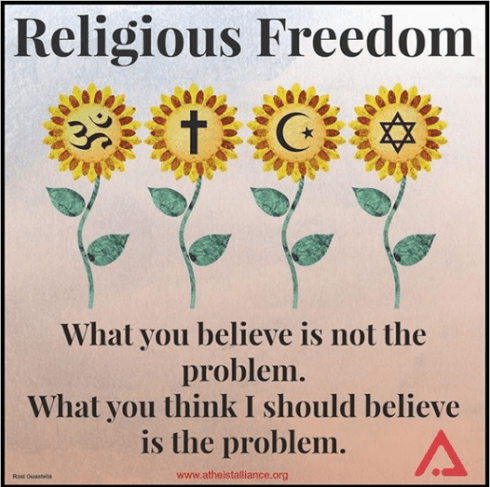
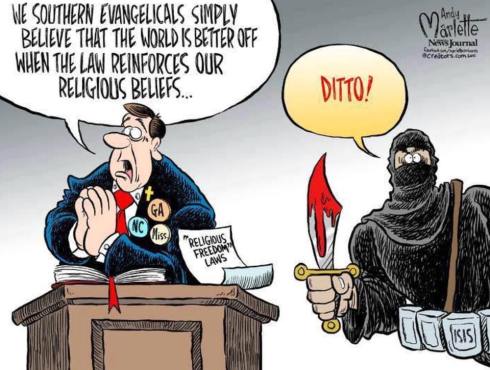
The separation of church and state is a necessary part of a modern civilized society. Laws must be made in accordance with the reality that we know grounded in facts that the scientific method has allowed us to uncover. Does this necessarily happen even in so called civilized society? Of course not, secular societies are not much better when it comes to making rational laws and standards, but I do believe they have a better chance of legislating appropriately that religiously addled societies that need to take into account what the great mumbo-jumbo in the sky has to say on the pertinent issues at hand.
We have not featured Betty Bowers for awhile, thus, enter her definitely non-satirical take on the topic of religious freedom.
The world does not need more stupid. Honest. Yet it would seem that christianity is busily adding more coal to the IDiot furnace every day and pump pump pump pumping those bellows(!!) to spread their inane horseshit far and wide. Hobby Lobby is just the latest pinnacle of horseshit dispensary that is trying earnestly to keep their bronze age mumbo-jumbo sacred and impose it on others (typical behaviour for the religiously addled, one might add).
A -Pro Tip- for my foolish christian friends: Religious freedom means that you can do whatever you like with regard to religion…as long as it affects only you. When it starts affecting other people, you’re infringing on their religious freedom. If you run a company, your religious influence ends where benefits to your employees starts. Period. (thank you,Bionic Dance for the comment)











 bleatmop
 Mystro
 The Arbourist


 Dead Wild Roses
Your opinions…