
You are currently browsing the tag archive for the ‘islamism’ tag.
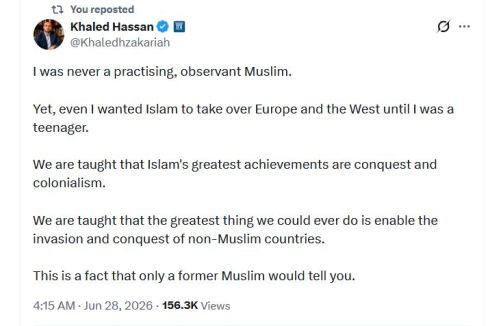
A former Muslim recently wrote something on X that deserves to be taken seriously:
“I was never a practising, observant Muslim. Yet, even I wanted Islam to take over Europe and the West until I was a teenager.”
That is not a small admission. It is a glimpse into a religious-political imagination many Westerners have been trained not to notice, or at least not to describe plainly.
The issue is not ordinary Muslim citizens living ordinary lives. The issue is the version of Islam that understands itself not merely as private faith, but as a total system of law, society, politics, and conquest. That distinction matters because Muslim Brotherhood-style Islamism does not present itself as a hobby, an identity, or a private devotional life. It presents itself as a movement, with a theory of history, a theory of law, a theory of society, and a theory of liberation.
At its centre is the belief that human beings are not truly free until they submit to divine law. That may sound pious in abstraction, but it immediately raises the question liberal societies cannot avoid: what happens to people who do not want to live under that law?
Sayyid Qutb’s Milestones gives one answer. Qutb was not merely writing about personal religious improvement. He was writing a revolutionary text for Islamism, one that treated Islam as both religion and movement. In that framework, Sharia is not one moral tradition among others; it is the only legitimate law. Other systems of law are not merely different, mistaken, or incomplete. They are jahili: ignorant, illegitimate, and awaiting correction.
This is the part Western liberal societies keep trying to soften into something less threatening. The problem is not that Muslims pray, fast, worship, build families, open businesses, or form communities. The problem is a doctrine that treats civil law as false law, liberal democracy as ignorance, and non-Islamic societies as places that must eventually be transformed.
There are Muslims who reject this. There are reformist Muslims, secular Muslims, quietist Muslims, and ordinary Muslims who want nothing to do with Qutbist revolutionary politics. They are not the target of this critique. The target is the Islamist doctrine that treats their moderation as compromise, their citizenship as suspect, and their acceptance of civil law as evidence that they have submitted to something other than God.
From there, the conflict with liberal democracy becomes unavoidable. Qutb’s framework does not simply say that Muslims should be faithful within their own private lives. It says society itself must be reordered around submission to God’s law. It rejects the idea that human beings may legislate for themselves outside divine command; worse, it treats such legislation as a form of servitude, because human authority has supposedly usurped the authority of God.
Every civilization has conquest in its past. The issue is not that Islamic empires, like other empires, expanded through force. The issue is what later ideologies teach people to feel about that expansion. Was it ordinary human empire, subject to the same moral scrutiny as any other empire? Or was it sacred victory, proof of divine favour, and a model for the future?
That is the trick at the centre of the ideology. The Islamist does not necessarily think he is enslaving others. He may think he is freeing them from man-made law, rescuing them from ignorance, and liberating them from the false gods of democracy, secularism, nationalism, pluralism, or individual liberty. But domination does not become freedom because the dominator calls it liberation.
A liberal society can tolerate deep religious difference. It can protect mosques, churches, synagogues, temples, and atheists alike. It can defend the right of people to pray, preach, publish, criticize, convert, leave, and dissent. That is what religious freedom means, and it is one of liberal civilization’s great achievements.
But religious freedom is not a suicide pact. A society built on equal citizenship and civil law has no obligation to pretend that a movement seeking to replace civil law with religious law is merely asking for inclusion. It is asking for room to build a rival sovereignty; it wants the freedoms of liberal society while denying the legitimacy of the liberal order that makes those freedoms possible.
Former Muslims often understand this in a way polite Western elites do not. They know the internal language, the heroic stories, the childhood assumptions, the selective memory, and the pressure to treat Islamic expansion as something nobler than ordinary imperial ambition. When a former Muslim says he was taught that Islam’s greatest achievements were conquest and colonialism, we should not rush to explain the statement away. We should ask what kind of moral education produces that desire in a teenager who was not even especially observant.
Conquest does not always begin with armies. It begins with a story: one law is holy and all others are illegitimate; one community has submitted while the rest of the world lives in ignorance; ordinary civic loyalty is lesser than religious loyalty; the surrounding society is not a common home but a problem to be transformed.
Once that story takes hold, liberal tolerance can be turned against liberal civilization itself.
Western societies have become very good at speaking about “extremism” in the abstract, as though radicalization were a mysterious weather system that occasionally rolls through alienated communities. We condemn “hate” without asking what the hated object actually is. We speak endlessly about inclusion, but hesitate when inclusion is demanded by movements that do not intend to return the favour.
The hesitation is not harmless. The target of Muslim Brotherhood-style Islamism is not merely Western foreign policy, social prejudice, or insufficient accommodation. Its target is the liberal settlement itself: equal citizenship, freedom of conscience, freedom of speech, secular civil law, and the right to live without submitting to a religious legal order.
A society cannot remain liberal if it treats every challenge to liberalism as just another form of diversity. There is a difference between welcoming Muslim citizens and making excuses for Islamic supremacism; between protecting private faith and accommodating political theology; between religious freedom and religious domination.
Those distinctions matter because liberal democracy depends on reciprocity. Citizens may believe different things, worship differently, argue fiercely, and disagree about ultimate truth; what they may not do is claim that their sacred law has a superior right to govern everyone else.
That is the line that must be defended, at all costs to preserve any society that does not wish to follow Sharia law.
When a movement teaches that non-believers live in ignorance until brought under divine law, it is not offering pluralism. When it treats civil law as illegitimate because only Sharia is legitimate, it is not asking for equal citizenship. When it remembers conquest as sacred achievement rather than domination, the West should stop pretending that the problem is misunderstanding.
The issue is Islamic supremacism: a religious-political project that seeks power over others while calling that power liberation.
No liberal society should be embarrassed to say so.
Conquest is not made holy by scripture. Colonialism is not redeemed by prayer. And religious domination is still domination, even when it arrives speaking the language of faith.
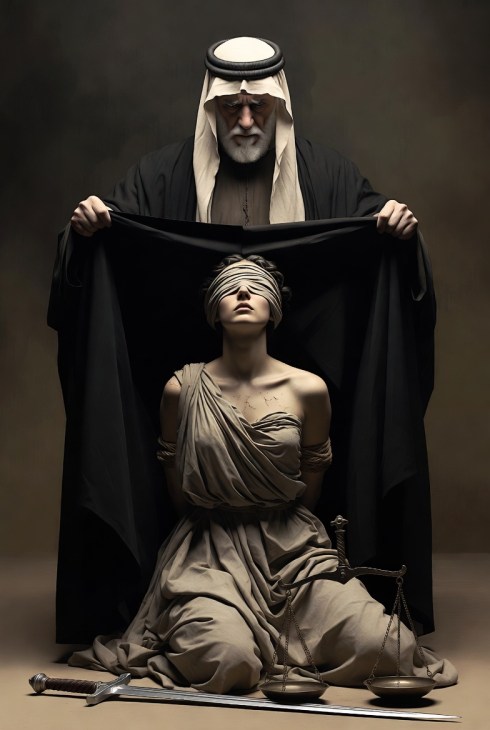
When religious law claims supremacy over civil law, justice is no longer blind; it is bound.
References and Source Material
This essay was prompted by a former Muslim’s post on X describing being taught to admire Islamic conquest and colonialism.
It also draws on discussion of Sayyid Qutb’s Milestones and Muslim Brotherhood-style Islamism in the New Discourses podcast episode provided in transcript form.
The West keeps making a category error. It treats Islam as “a religion” in the narrow civic sense modern liberal societies usually mean: private belief, voluntary worship, and a clean separation between pulpit and state.
Islam can be lived that way. Many Muslims do live that way. But Islam, as a tradition, also carries a developed legal–political vocabulary: a picture of how authority, law, community, and public order ought to be arranged. That does not make Muslims suspect. It makes Western assumptions incomplete. A liberal society can only defend what it can name.
A faith that has historically included law
In the classical Islamic tradition, sharia is not only “spiritual guidance.” It is commonly described as governing interpersonal conduct and regulating ritual practice, and in some countries it is applied as governing law or in specific legal domains. (Judiciaries Worldwide) That matters because the modern West is built on a particular settlement: religious freedom inside a civic order that does not belong to any religion.
The relationship between religion and governance in Islamic history also does not map neatly onto the European story of Church versus state. Even critics of the simplistic slogan that Islam “fuses religion and politics” concede a real point beneath it: Muslim thinkers draw distinctions between din (religion) and dawla (state), but the domains and their interrelations do not mirror the European pattern. (MERIP)
So when Western elites insist, “Islam is just a religion,” they are not being tolerant. They are being imprecise. And imprecision is how liberal societies lose arguments before they begin.
The distinction that matters: Islam and Islamism
Precision starts by separating two things that get blurred, sometimes by ignorance, sometimes by strategy:
- Islam: a religion with immense internal diversity, spiritual, legal, philosophical, cultural.
- Islamism (political Islam): a broad set of political ideologies that draw on Islamic symbols and traditions in pursuit of sociopolitical objectives. (Encyclopedia Britannica)
A devout Muslim can reject Islamism. A culturally Muslim person can reject Islamism. A believer can treat sharia as personal ethics while rejecting its coercive imposition in a pluralist state. Islamic sources themselves contain the frequently cited line: “Let there be no compulsion in religion.” (Quran.com)
But it is also true that in many parts of the world, substantial numbers of Muslims express support for making sharia “the official law of the land.” (Pew Research Center) That doesn’t prove anything about your Muslim neighbour in Edmonton. It does establish something narrower and important: the political question is not imaginary. It is not a fringe invention.
The engine: infallible doctrine, universal horizon
The political question is whether a movement treats its doctrine as a governing blueprint, one that must eventually become public authority. That is what makes Islamism different from ordinary piety: it is not satisfied with private devotion or voluntary community. It wants law, policy, and state power aligned to a sacred ideal.
If you want a useful analogue for how Islamism works, look at Marxism. Not in theology, mechanics. The doctrine is treated as infallible, so failure can’t belong to the doctrine; it must belong to the people, the impurities, or the enemies. That logic produces a predictable politics: dissent becomes not an alternative view but a problem to be managed, re-educated, or removed.
From there, the “universal” impulse makes sense. This is not always military conquest talk. More often it is a civilizational horizon: the expectation that Islam should be socially and politically ascendant, with public authority aligned to that vision. Classical Islamic political vocabulary has long included categories describing the realm where Islam has “ascendance,” historically paired with an external realm. (Encyclopedia Britannica)
A liberal society can coexist with any faith. It cannot coexist with a program that treats liberal pluralism as a temporary obstacle to be overcome.
What the West keeps getting wrong
Western discourse often collapses three claims into one muddy accusation:
- “Muslims are dangerous.” False, unfair, and morally corrosive.
- “Islam has a legal–political tradition.” True, and visible in texts, history, and institutions. (Judiciaries Worldwide)
- “Islamism is a modern political project that can conflict with liberal norms.” True, and increasingly relevant. (Encyclopedia Britannica)
If claims (2) and (3) are denied out of fear of sounding like (1), the result is not compassion. It is blindness. And blindness is not a strategy.
What a liberal society should do
This does not require panic. It requires clarity.
First, speak precisely. Say “Islamism” when you mean political ideology. Say “Islam” when you mean the religion broadly. Don’t use a sweeping civilizational label to do the work of a specific critique.
Second, draw the civic line cleanly: the liberal state is not negotiable. Freedom of worship is protected. Violence and harassment are punished. Attempts to import coercive religious governance into public law are rejected.
Third, stop outsourcing integration to slogans. Liberalism is not a magic solvent. It is a culture of habits, rights, obligations, and red lines that must be taught and applied evenly.
Fourth, refuse collective guilt. Defend liberal norms without treating ordinary Muslims as a fifth column. A society can oppose an illiberal political project while still welcoming neighbours who want to live in peace.
Here is the honesty sentence: if political Islam is largely marginal in Western societies, with negligible institutional influence and no meaningful appetite for parallel authority, the urgency of this argument drops. If, instead, organized efforts continue to carve out exemptions from liberal norms, to pressure institutions into censorship, or to substitute religious authority for civic law, the urgency rises.
The West doesn’t need a religious war. It needs vocabulary. It needs the courage to name ideological ambition without demonizing human beings. And it needs to remember that liberalism is not the default state of humanity. It is a fragile achievement that survives only when people are willing to defend it
References
- Federal Judicial Center, “Islamic Law and Legal Systems” (overview of sharia as governing interpersonal conduct/ritual practice; sometimes governing law). (Judiciaries Worldwide)
- Encyclopaedia Britannica, “Islamism” (definition as political ideologies pursuing sociopolitical objectives using Islamic symbols/traditions). (Encyclopedia Britannica)
- Pew Research Center, The World’s Muslims: Religion, Politics and Society (overview and chapter on beliefs about sharia; questionnaire language on making sharia official law). (Pew Research Center)
- MERIP, “What is Political Islam?” (discussion of din/dawla and why European categories don’t map neatly). (MERIP)
- MERIP, “Islamist Notions of Democracy” (notes the common modern formulation of “religion and state” and its relationship to secularism debates). (MERIP)
- Qur’an 2:256 (“no compulsion in religion”) and Ibn Kathir tafsir page commonly cited in discussion. (Quran.com)
- Encyclopaedia Britannica, “Dār al-Islām” (political-ideological category describing the realm where Islam has ascendance, traditionally paired with an external realm). (Encyclopedia Britannica)











 bleatmop
 Mystro


 Dead Wild Roses
Your opinions…