
You are currently browsing the tag archive for the ‘state capacity’ tag.

One of the more unsettling ideas in political history is that civilization may depend not only on teaching people virtue, but on steadily removing the people least capable of civilized life.

That is the thesis Peter Frost and Henry Harpending explore in Western Europe, State Formation, and Genetic Pacification. It cuts against the modern habit of explaining violent disorder almost entirely through environment, incentives, poverty, trauma, and weak institutions. Those things matter. But Frost and Harpending press a harder possibility: what if the long pacification of Western Europe was driven not only by stronger states and changing norms, but also by selection against the men most prone to chronic violence? (PubMed)

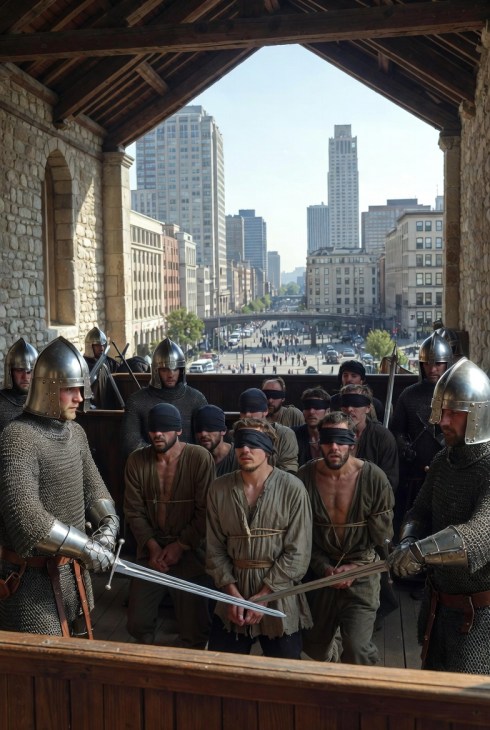
The historical pattern they point to is clear. In medieval Europe, homicide rates were vastly higher than in the modern West. Over time, as states consolidated their monopoly on violence and private vengeance receded, courts imposed the death penalty more systematically. Frost and Harpending argue that by the late Middle Ages, courts were condemning between 0.5 and 1.0 percent of all men of each generation to death, with perhaps as many more violent offenders dying at the scene of crimes or in prison while awaiting trial. Meanwhile, long-run homicide rates in Western Europe fell dramatically across the centuries. That broader decline is visible not only in their paper but in later summaries built from Manuel Eisner’s historical homicide datasets. (PubMed; Our World in Data)

That much already matters. Peace is not the natural resting state of a society. It is achieved. It is enforced. It is built through institutions capable of suppressing predation. The state does not merely administer order after the fact. It creates the conditions under which ordinary trust can exist. Without that floor, commerce, family stability, education, beauty, and freedom remain fragile.

But Frost and Harpending are interested in more than deterrence. Their stronger claim is that repeated removal of violent men from the breeding population may have altered the population itself over many generations. In plain language: if men most disposed to impulsive violence, predation, and chronic criminality are disproportionately executed, killed while offending, or otherwise prevented from reproducing, then over centuries one should expect some reduction in the prevalence of those tendencies. The state, in that account, does not just restrain violence from the outside. It may slowly reshape the human material with which the society reproduces itself. (PubMed)

That is the interesting part of the thesis, and the part that needs the cleanest handling. Frost and Harpending present it not as a settled master key to European history, but as a plausible co-factor alongside state formation, punishment, and cultural conditioning. Direct genomic confirmation remains absent. Other explanations place more weight on the state’s monopoly on violence, changing norms of self-control, declining honor culture, economic development, and improved policing. So the strongest honest claim is not that the paper has solved the history of European pacification. It is that it raises a serious possibility modern readers are strongly conditioned not to consider. (PubMed)


“Civilization is not sustained by kindness alone. It rests on a prior achievement: order strong enough to protect the peaceable from the predatory.”


Even with that caution in place, the paper still does useful work. It moves the discussion beyond the sterile split between “bad systems” and “bad individuals.” It suggests a layered civilizing process: institutions suppress violent conduct, norms change under the shelter of that order, and then, possibly, population traits shift over time as the most antisocial men are less likely to survive and reproduce. Culture and coercion do not sit in separate boxes here. They interact.

You do not have to buy every part of that model to see why it has force. A society does not begin from zero every generation. It inherits habits, expectations, institutions, and distributions of temperament formed over long stretches of time. If Western Europe became unusually low in interpersonal violence by world-historical standards, that happened through a civilizing process measured in centuries, not slogans. It was produced by a long narrowing of the space in which violent men could operate, flourish, and reproduce themselves socially.

That last phrase matters because reproduction here is not only biological. Violent men reproduce disorder culturally as well. They shape neighborhoods, train younger males, normalize intimidation, degrade family life, and turn predation into a viable strategy. Once that ecology is established, disorder becomes self-reinforcing. The reverse is also true. When a state reliably incapacitates the worst predators, peace can become self-reinforcing too.

That is part of why modern examples like El Salvador draw so much attention. The cases are not equivalent, and they do not prove Frost and Harpending’s genetic hypothesis. What they do show is older and simpler: when a state decisively removes a violent criminal stratum from daily circulation, social peace can return with surprising speed. The IMF reported in 2025 that El Salvador’s homicide rate fell from 54 per 100,000 in 2018 to 1.8 in 2024, and tied the improvement in security to stronger growth, tourism, remittances, and investor confidence. Human Rights Watch, from the opposite moral angle, also reports a significant decline in gang violence while warning that restricted data access and changes in homicide counting complicate full independent verification. (IMF; HRW; AP)

That is where a serious reader has to keep both truths in view at once. El Salvador does not demonstrate multi-generational selection. It demonstrates the older principle that predators must be removed from circulation if ordinary life is to recover. At the same time, Human Rights Watch documents arbitrary detention, torture, ill-treatment, and deaths in custody under the state of exception. The rights costs are real. The case does not prove that every harsh regime is wise. It proves that liberal societies often flatter themselves about how peace is maintained. (HRW)

This is not an argument for population engineering or collective guilt. It is an argument for recognizing that a small fraction of high-rate violent offenders can do outsized damage, and that civilization depends on their incapacitation. Modern liberal societies are comfortable discussing prevention, rehabilitation, and root causes. They are much less comfortable discussing the incorrigible. But any serious civilization needs a theory of that minority and the will to act on it long enough for the peaceable majority to live normally.

That, in the end, is the value of Frost and Harpending’s paper. Not that it offers a final key to history. Not that every part of its model has been settled beyond dispute. It matters because it reopens a forbidden question: how much of social peace depends not merely on teaching better values, but on the long-term suppression of the people least fit for peaceful life? Even readers who reject the paper’s stronger selection claim should still feel the pressure of that deeper point. Order is not self-generating. It has to be maintained against people who would dissolve it if allowed.

Modern states, at their best, answer that problem more humanely than medieval ones did. They use prisons rather than gallows. They rely on due process rather than spectacle. Good. They should. But the softer method does not abolish the harder principle. Social peace depends on removing certain people from the field, sometimes for a very long time.

That is the truth buried beneath the discomfort here. Civilization is not sustained by kindness alone. It rests on a prior achievement: order strong enough to protect the peaceable from the predatory. Everything higher comes after that.
References

Peter Frost and Henry C. Harpending, “Western Europe, State Formation, and Genetic Pacification,” Evolutionary Psychology 13, no. 1 (2015). PubMed: https://pubmed.ncbi.nlm.nih.gov/25748943/ ; journal page: https://journals.sagepub.com/doi/10.1177/147470491501300114

International Monetary Fund, El Salvador: Request for Extended Arrangement Under the Extended Fund Facility (2025). IMF page: https://www.elibrary.imf.org/view/journals/002/2025/058/article-A001-en.xml ; PDF: https://www.imf.org/-/media/files/publications/cr/2025/english/1slvea2025001-print-pdf.pdf

Human Rights Watch, “World Report 2026: El Salvador.” https://www.hrw.org/world-report/2026/country-chapters/el-salvador

Our World in Data, historical homicide materials drawing on Manuel Eisner’s data: https://ourworldindata.org/data-insights/homicide-rates-have-declined-dramatically-over-the-centuries and https://ourworldindata.org/grapher/homicide-rates-across-western-europe

Associated Press, “El Salvador closes 2024 with a record low number of homicides.” https://apnews.com/article/69384a8705267eaddd18dcd28a53465b

This week’s Sunday Disservice starts with a conversation many institutions would rather classify than confront.

In a recent podcast, @PeterBoghossian interviews @RaymondIbrahim on Islamic history, immigration, persecution, and what the West is currently too timid to say plainly. The discussion is blunt, often provocative, and at points rhetorically hot. But beneath the heat is a real question—one our political and media class keeps trying to bury under etiquette:

What happens when a civilization with weak borders, weak confidence, and elite moral vanity collides with a religious-political tradition that contains militant, expansionist, and supremacist strains in its textual and legal history?

That is not a “hate” question. It is a civilizational one.

Let me state the guardrails clearly before the usual bad-faith scripts arrive. This is not a blanket condemnation of Muslims as people. It is a warning about militant political Islam (Islamism), doctrinal honesty, and Western cowardice. If we cannot distinguish between peaceful Muslim neighbours, ordinary religious practice, and organized Islamist ambitions, then we cannot think clearly, legislate clearly, or defend liberal norms.

That distinction is not a concession. It is the price of seriousness.

One of the most useful things about the Boghossian/Ibrahim conversation is that it forces several taboo questions onto the table at once. Do Islamic texts and traditions contain durable frameworks of conquest and subjugation? What happens when Western nations import large populations faster than they can assimilate them into a liberal civic culture? Why is criticism of doctrine so quickly recoded as “Islamophobia” before the argument is even heard? And why do elite institutions consistently treat ideology as a tone problem?

That last point matters most. The West has become exceptionally good at policing language and exceptionally bad at confronting ideology. We can produce endless seminars on inclusion, sensitivity, and anti-bias procedures. But ask whether a movement’s legal and political doctrines are compatible with free speech, equality before the law, women’s rights, or national sovereignty, and suddenly the room gets nervous.

This is where the conversation gets hard, and where it needs to stay hard.

We should be wary of militant political Islam because it is not merely a private spirituality. In its political forms, it makes claims about law, social order, blasphemy, apostasy, gender hierarchy, and rule. And yes, some of those claims are rooted in texts, jurisprudence, and historical models that include conquest, submission, and supremacy. Pretending otherwise does not make us tolerant. It makes us unserious.

A free society’s first duty is not to flatter itself for being “inclusive.” It is to identify, as accurately as possible, which ideas and movements can coexist with liberal order and which ones seek to erode or replace it.

That is where the West keeps failing.

We fail first by collapsing distinctions. Instead of discriminating analytically between doctrine, movement, community, and individual, institutions collapse everything into one emotional command: Do not stigmatize. That may feel humane in the short term. In practice it disables scrutiny and protects bad actors who thrive in ambiguity.

We fail second by treating assimilation as cruelty. A functioning country is allowed to expect newcomers to adapt to its laws, civic norms, and constitutional order. That is not oppression. That is state survival. Multiculturalism without boundaries is not pluralism; it is administrative denial.

We fail third by confusing criticism of ideology with hatred of persons. If criticism of Christianity is permitted (and it is, loudly), criticism of Islamic doctrine must also be permitted. Equal standards are not bigotry. They are the baseline of intellectual honesty.

This is why the topic belongs squarely in DWR territory. It is not only an immigration question. It is a women’s-rights question, a free-speech question, and a state-capacity question.

You cannot defend women’s rights while refusing to examine ideological systems that normalize coercive gender hierarchy. You cannot defend free speech while treating some doctrines as effectively criticism-proof. And you cannot maintain democratic legitimacy if citizens are only allowed to discuss immigration inside a narrow moral frame pre-approved by media, bureaucracy, and activist gatekeepers.

Canada is not Europe. But Canada is not exempt from the same habits of evasion.

Our elite reflex is managerial: smooth the language, moralize the critics, and call that social peace. But a country cannot govern immigration, integration, and security through branding. It has to ask adult questions: Who is coming? On what terms? Into what civic culture? With what expectations of assimilation? And what happens when imported norms clash with Charter norms?

If those questions are treated as taboo, then policy has already outrun democratic consent.

A serious country should be able to say five things at once:

  1. Most Muslims are not terrorists.
  2. Islamist ideology is real.
  3. Religious doctrines can and should be criticized.
  4. Immigration policy must consider assimilation and social cohesion.
  5. Women’s rights and free speech are non-negotiable in the West.

If we cannot say all five, we are not having a serious conversation. We are managing appearances.

That is why this episode matters. @PeterBoghossian and @RaymondIbrahim are not valuable here because they are provocative (though they are). They are valuable because they are willing to press on a question many people can feel but fewer are willing to state plainly: a society that loses the nerve to name ideological conflict in clear language eventually loses the ability to govern it.

The deeper problem is not only extremism. It is conceptual weakness at the top.

We are being trained to treat clarity as cruelty and euphemism as virtue. That is how free societies become soft targets.

The test is simple: can we examine doctrine, policy, immigration, and assimilation without being moralized into silence?

If not, then the surrender has already begun—not at the border, but in the mind.


What say you?
Is the West’s bigger problem right now extremism itself — or a ruling class too timid to name it accurately?

This Blog best viewed with Ad-Block and Firefox!

What is ad block? It is an application that, at your discretion blocks out advertising so you can browse the internet for content as opposed to ads. If you do not have it, get it here so you can enjoy my blog without the insidious advertising.

Like Privacy?

Change your Browser to Duck Duck Go.

Enter your email address to follow this blog and receive notifications of new posts by email.

Join 383 other subscribers

Categories

April 2026
M T W T F S S
 12345
6789101112
13141516171819
20212223242526
27282930  

Archives

Blogs I Follow

The DWR Community

  • Unknown's avatar
  • Unknown's avatar
  • Unknown's avatar
  • tornado1961's avatar
  • Unknown's avatar
  • Unknown's avatar
  • Paul S. Graham's avatar
  • Unknown's avatar
  • Unknown's avatar
  • Unknown's avatar
Kaine's Korner

Religion. Politics. Life.

Connect ALL the Dots

Solve ALL the Problems

Myrela

Art, health, civilizations, photography, nature, books, recipes, etc.

Women Are Human

Independent source for the top stories in worldwide gender identity news

Widdershins Worlds

LESBIAN SF & FANTASY WRITER, & ADVENTURER

silverapplequeen

herstory. poetry. recipes. rants.

Paul S. Graham

Communications, politics, peace and justice

Debbie Hayton

Transgender Teacher and Journalist

shakemyheadhollow

Conceptual spaces: politics, philosophy, art, literature, religion, cultural history

Our Better Natures

Loving, Growing, Being

Lyra

A topnotch WordPress.com site

I Won't Take It

Life After an Emotionally Abusive Relationship

Unpolished XX

No product, no face paint. I am enough.

Volunteer petunia

Observations and analysis on survival, love and struggle

femlab

the feminist exhibition space at the university of alberta

Raising Orlando

About gender, identity, parenting and containing multitudes

The Feminist Kitanu

Spreading the dangerous disease of radical feminism

trionascully.com

Not Afraid Of Virginia Woolf

Double Plus Good

The Evolution Will Not BeTelevised

la scapigliata

writer, doctor, wearer of many hats

Teach The Change

Teaching Artist/ Progressive Educator

Female Personhood

Identifying as female since the dawn of time.

Not The News in Briefs

A blog by Helen Saxby

SOLIDARITY WITH HELEN STEEL

A blog in support of Helen Steel

thenationalsentinel.wordpress.com/

Where media credibility has been reborn.

BigBooButch

Memoirs of a Butch Lesbian

RadFemSpiraling

Radical Feminism Discourse

a sledge and crowbar

deconstructing identity and culture

The Radical Pen

Fighting For Female Liberation from Patriarchy

Emma

Politics, things that make you think, and recreational breaks

Easilyriled's Blog

cranky. joyful. radical. funny. feminist.

Nordic Model Now!

Movement for the Abolition of Prostitution

The WordPress C(h)ronicle

These are the best links shared by people working with WordPress

HANDS ACROSS THE AISLE

Gender is the Problem, Not the Solution

fmnst

Peak Trans and other feminist topics

There Are So Many Things Wrong With This

if you don't like the news, make some of your own

Gentle Curiosity

Musing over important things. More questions than answers.

violetwisp

short commentaries, pretty pictures and strong opinions

Revive the Second Wave

gender-critical sex-negative intersectional radical feminism


