
You are currently browsing the tag archive for the ‘criminal justice’ tag.
We feel safe in places like Alberta for a simple reason. Not because the system is especially gentle, and not because people are unusually kind, but because we believe the rules will be enforced, reliably and without fear or favour.
That belief does most of the work. It sits quietly in the background of daily life, doing its job precisely because it rarely has to announce itself. You don’t need to know the Criminal Code in detail. You only need to trust that when someone breaks it in a serious way, the response will reduce the chance of it happening again.
When that belief weakens, the shift is subtle at first. It doesn’t arrive as a declaration. It shows up in patterns. Arrest, release, reoffend, repeat. People notice, not as legal experts, but as observers of outcomes. The conclusion they draw is not complicated: the system is no longer reliably containing those who break its rules.
That is where trust begins to erode.
In Canada, this question intersects with a specific and sensitive legal reality. Sentencing is not strictly uniform. Courts are required to consider the unique systemic and historical circumstances of Indigenous offenders through what are commonly called Gladue factors, originating in R v Gladue and reaffirmed in R v Ipeelee. These rulings direct judges to account for the effects of residential schools, displacement, and intergenerational trauma when determining an appropriate sentence.
The intent here is not trivial. Indigenous Canadians make up roughly 4 to 5 percent of the population, yet account for over 30 percent of those in custody, with incarceration rates approaching ten times that of non-Indigenous Canadians. A justice system that ignored that disparity entirely would risk perpetuating injustice under the banner of neutrality.
That is the strongest case for Gladue principles, and it deserves to be taken seriously.
“A system that adjusts sentencing to account for historical injustice may be justified in principle. But if those adjustments affect how long repeat offenders are incapacitated, the question is not ideological. It is practical: does the system reduce harm?”
But a justice system is not judged by intent alone. It is judged by outcomes, particularly where public safety is concerned. And those outcomes sit alongside another set of facts that are harder to keep in view.
Indigenous women experience violent victimization at more than double the national rate. They are killed at rates several times higher than non-Indigenous women. Much of this violence occurs within known social networks rather than as random acts, which places the question of repeat offending and system response directly at the centre of the issue.
At the same time, recidivism is not a marginal phenomenon. Data from Correctional Service Canada shows that a significant proportion of offenders reoffend after release, with rates notably higher among Indigenous offenders. That does not make reoffending inevitable. It does establish that risk is real, and that it clusters.
Placed together, these realities create a tension that cannot be resolved by appeal to intent alone. A system that adjusts sentencing to account for historical injustice may be justified in principle. But that same system operates in a world where victimization is not evenly distributed, and where recidivism is not negligible. If those adjustments meaningfully affect how long repeat offenders are incapacitated, then the question is not ideological. It is practical: does the system, in aggregate, reduce harm?
To ask that question is not to deny the moral foundation of the policy. It is to take it seriously enough to test it against reality.
This is where the conversation often breaks down. Raising the issue is treated as a signal of bias rather than a request for evaluation. But a high-trust society cannot function on selective clarity. It has to be able to hold two things in view at once: that historical injustice matters, and that the primary function of a justice system is to protect the public from repeat harm. These aims are not mutually exclusive. But neither are they automatically aligned.
If they come into tension, and in some cases they do, the answer cannot be to ignore the friction because it is uncomfortable. Nor can it be to retreat into abstract claims about equality that bypass real differences in circumstance. The harder task is to examine whether the current balance is working as intended.
None of this implies that Gladue principles should be abandoned, nor that historical context should be ignored. It implies something narrower, and more demanding. Any system that modifies sentencing must also ensure that high-risk, repeat offenders, regardless of background, are reliably identified and contained. If those goals cannot be reconciled in practice, then the framework requires adjustment, not rhetorical defense.
Because the cost of getting this wrong is not abstract. It is paid in the quiet erosion of trust, and in the lived reality of those most exposed to harm.
High-trust societies are not sustained by kindness alone. They are sustained by the belief that rules are enforced, that serious harm is contained, and that the system works in the direction of protection. When that belief weakens through patterns rather than proclamations, trust does not collapse all at once.
It erodes.
And once it erodes far enough, it does not matter how compassionate the system intended to be.
It will no longer be believed.

Glossary
Gladue Factors
Legal considerations requiring Canadian judges to account for the unique systemic and historical circumstances affecting Indigenous offenders when determining a sentence. These can include the legacy of residential schools, intergenerational trauma, and community conditions.
R v Gladue
A Supreme Court of Canada decision establishing that courts must consider the background and systemic factors affecting Indigenous offenders under section 718.2(e) of the Criminal Code.
R v Ipeelee
A follow-up Supreme Court decision reinforcing that Gladue principles must be applied in all cases involving Indigenous offenders and clarifying their importance in sentencing.
Recidivism
The tendency of a convicted individual to reoffend after being released from custody or completing a sentence.
High-Trust Society
A society in which individuals broadly believe that institutions, laws, and fellow citizens operate predictably and fairly, reducing the need for constant vigilance or defensive behavior.
References
Statistics Canada – Indigenous victimization and incarceration data
https://www150.statcan.gc.ca/n1/pub/85-002-x/2023001/article/00006-eng.htm
https://www150.statcan.gc.ca/n1/pub/85-002-x/2023001/article/00004-eng.htm
Correctional Service Canada – Recidivism data
https://www.canada.ca/en/correctional-service/corporate/library/research/emerging-results/19-02.html
Department of Justice Canada – Gladue background and application
https://www.justice.gc.ca/eng/rp-pr/jr/gladue/p2.html
National Inquiry into Missing and Murdered Indigenous Women and Girls – Final report and findings
https://www.mmiwg-ffada.ca/final-report/
R v Gladue – Full decision (CanLII)
https://www.canlii.org/en/ca/scc/doc/1999/1999canlii679/1999canlii679.html
R v Ipeelee – Full decision (CanLII)
https://www.canlii.org/en/ca/scc/doc/2012/2012scc13/2012scc13.html
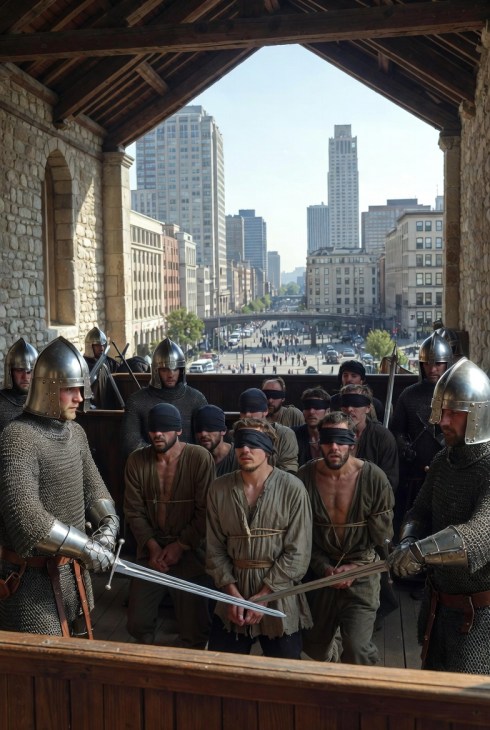
One of the more unsettling ideas in political history is that civilization may depend not only on teaching people virtue, but on steadily removing the people least capable of civilized life.
That is the thesis Peter Frost and Henry Harpending explore in Western Europe, State Formation, and Genetic Pacification. It cuts against the modern habit of explaining violent disorder almost entirely through environment, incentives, poverty, trauma, and weak institutions. Those things matter. But Frost and Harpending press a harder possibility: what if the long pacification of Western Europe was driven not only by stronger states and changing norms, but also by selection against the men most prone to chronic violence? (PubMed)
The historical pattern they point to is clear. In medieval Europe, homicide rates were vastly higher than in the modern West. Over time, as states consolidated their monopoly on violence and private vengeance receded, courts imposed the death penalty more systematically. Frost and Harpending argue that by the late Middle Ages, courts were condemning between 0.5 and 1.0 percent of all men of each generation to death, with perhaps as many more violent offenders dying at the scene of crimes or in prison while awaiting trial. Meanwhile, long-run homicide rates in Western Europe fell dramatically across the centuries. That broader decline is visible not only in their paper but in later summaries built from Manuel Eisner’s historical homicide datasets. (PubMed; Our World in Data)
That much already matters. Peace is not the natural resting state of a society. It is achieved. It is enforced. It is built through institutions capable of suppressing predation. The state does not merely administer order after the fact. It creates the conditions under which ordinary trust can exist. Without that floor, commerce, family stability, education, beauty, and freedom remain fragile.
But Frost and Harpending are interested in more than deterrence. Their stronger claim is that repeated removal of violent men from the breeding population may have altered the population itself over many generations. In plain language: if men most disposed to impulsive violence, predation, and chronic criminality are disproportionately executed, killed while offending, or otherwise prevented from reproducing, then over centuries one should expect some reduction in the prevalence of those tendencies. The state, in that account, does not just restrain violence from the outside. It may slowly reshape the human material with which the society reproduces itself. (PubMed)
That is the interesting part of the thesis, and the part that needs the cleanest handling. Frost and Harpending present it not as a settled master key to European history, but as a plausible co-factor alongside state formation, punishment, and cultural conditioning. Direct genomic confirmation remains absent. Other explanations place more weight on the state’s monopoly on violence, changing norms of self-control, declining honor culture, economic development, and improved policing. So the strongest honest claim is not that the paper has solved the history of European pacification. It is that it raises a serious possibility modern readers are strongly conditioned not to consider. (PubMed)
“Civilization is not sustained by kindness alone. It rests on a prior achievement: order strong enough to protect the peaceable from the predatory.”
Even with that caution in place, the paper still does useful work. It moves the discussion beyond the sterile split between “bad systems” and “bad individuals.” It suggests a layered civilizing process: institutions suppress violent conduct, norms change under the shelter of that order, and then, possibly, population traits shift over time as the most antisocial men are less likely to survive and reproduce. Culture and coercion do not sit in separate boxes here. They interact.
You do not have to buy every part of that model to see why it has force. A society does not begin from zero every generation. It inherits habits, expectations, institutions, and distributions of temperament formed over long stretches of time. If Western Europe became unusually low in interpersonal violence by world-historical standards, that happened through a civilizing process measured in centuries, not slogans. It was produced by a long narrowing of the space in which violent men could operate, flourish, and reproduce themselves socially.
That last phrase matters because reproduction here is not only biological. Violent men reproduce disorder culturally as well. They shape neighborhoods, train younger males, normalize intimidation, degrade family life, and turn predation into a viable strategy. Once that ecology is established, disorder becomes self-reinforcing. The reverse is also true. When a state reliably incapacitates the worst predators, peace can become self-reinforcing too.
That is part of why modern examples like El Salvador draw so much attention. The cases are not equivalent, and they do not prove Frost and Harpending’s genetic hypothesis. What they do show is older and simpler: when a state decisively removes a violent criminal stratum from daily circulation, social peace can return with surprising speed. The IMF reported in 2025 that El Salvador’s homicide rate fell from 54 per 100,000 in 2018 to 1.8 in 2024, and tied the improvement in security to stronger growth, tourism, remittances, and investor confidence. Human Rights Watch, from the opposite moral angle, also reports a significant decline in gang violence while warning that restricted data access and changes in homicide counting complicate full independent verification. (IMF; HRW; AP)
That is where a serious reader has to keep both truths in view at once. El Salvador does not demonstrate multi-generational selection. It demonstrates the older principle that predators must be removed from circulation if ordinary life is to recover. At the same time, Human Rights Watch documents arbitrary detention, torture, ill-treatment, and deaths in custody under the state of exception. The rights costs are real. The case does not prove that every harsh regime is wise. It proves that liberal societies often flatter themselves about how peace is maintained. (HRW)
This is not an argument for population engineering or collective guilt. It is an argument for recognizing that a small fraction of high-rate violent offenders can do outsized damage, and that civilization depends on their incapacitation. Modern liberal societies are comfortable discussing prevention, rehabilitation, and root causes. They are much less comfortable discussing the incorrigible. But any serious civilization needs a theory of that minority and the will to act on it long enough for the peaceable majority to live normally.
That, in the end, is the value of Frost and Harpending’s paper. Not that it offers a final key to history. Not that every part of its model has been settled beyond dispute. It matters because it reopens a forbidden question: how much of social peace depends not merely on teaching better values, but on the long-term suppression of the people least fit for peaceful life? Even readers who reject the paper’s stronger selection claim should still feel the pressure of that deeper point. Order is not self-generating. It has to be maintained against people who would dissolve it if allowed.
Modern states, at their best, answer that problem more humanely than medieval ones did. They use prisons rather than gallows. They rely on due process rather than spectacle. Good. They should. But the softer method does not abolish the harder principle. Social peace depends on removing certain people from the field, sometimes for a very long time.
That is the truth buried beneath the discomfort here. Civilization is not sustained by kindness alone. It rests on a prior achievement: order strong enough to protect the peaceable from the predatory. Everything higher comes after that.
References
Peter Frost and Henry C. Harpending, “Western Europe, State Formation, and Genetic Pacification,” Evolutionary Psychology 13, no. 1 (2015). PubMed: https://pubmed.ncbi.nlm.nih.gov/25748943/ ; journal page: https://journals.sagepub.com/doi/10.1177/147470491501300114
International Monetary Fund, El Salvador: Request for Extended Arrangement Under the Extended Fund Facility (2025). IMF page: https://www.elibrary.imf.org/view/journals/002/2025/058/article-A001-en.xml ; PDF: https://www.imf.org/-/media/files/publications/cr/2025/english/1slvea2025001-print-pdf.pdf
Human Rights Watch, “World Report 2026: El Salvador.” https://www.hrw.org/world-report/2026/country-chapters/el-salvador
Our World in Data, historical homicide materials drawing on Manuel Eisner’s data: https://ourworldindata.org/data-insights/homicide-rates-have-declined-dramatically-over-the-centuries and https://ourworldindata.org/grapher/homicide-rates-across-western-europe
Associated Press, “El Salvador closes 2024 with a record low number of homicides.” https://apnews.com/article/69384a8705267eaddd18dcd28a53465b











 bleatmop
 Mystro
 The Arbourist


 Dead Wild Roses
Your opinions…