
You are currently browsing the tag archive for the ‘Civilization’ tag.
Truth is the lifeblood of any serious civilization. Not comfort, not ideological harmony, and not the temporary social peace that comes from teaching people to suppress what they can plainly see.
A society can survive mistakes. It can survive corruption. It can survive periods of confusion and even mass foolishness, provided enough people remain willing to describe reality honestly when the pressure arrives to do otherwise. What societies struggle to survive is organized dishonesty.
Reality is the brick wall waiting at the end of every false belief. You can postpone the collision for a while. You can build bureaucracies around the falsehood, invent softer language to cushion it, and punish people for pointing at the wall. The impact still comes.
That is why a recent quote from J. K. Rowling landed with such force:
“The West is currently divided between people who know he is a man and are prepared to say so and those who know this is a man but lie out of obedience to an ideology. There is no third option. Literally nobody on earth thinks ‘Roxanne Tickle’ is actually a woman.”
The quote unsettled people because it named something many Western institutions have spent years trying to blur: the widening gap between public language and private belief.
Large numbers of people now routinely say things in public that they would once have regarded as obviously false, not because the underlying biology changed, but because the social cost of dissent rose dramatically. That distinction matters, because this is not primarily a debate about kindness.
A decent society should discourage cruelty. It should not encourage humiliation, harassment, or needless malice toward people struggling with alienation, identity, or psychological distress. Most ordinary people understand this instinctively. But courtesy is not the same thing as compelled belief.
Calling someone by a preferred name is one thing. Demanding that citizens affirm propositions they do not believe to be true is something else entirely. The first is social grace. The second is ideological obedience.
 Nor is this an argument for replacing one rigid orthodoxy with another. Conservative traditions have their own temptations toward enforced piety, inherited blindness, and social punishment for inconvenient truths. Any worldview, religious or secular, progressive or reactionary, becomes dangerous when it starts protecting sacred assumptions from scrutiny. The standard cannot be nostalgia or novelty. The standard has to be reality itself: when a belief hits the brick wall, the belief must yield.
Modern Western institutions increasingly refuse to yield.
People learn quickly which observations are permitted and which ones carry risk. Teachers self-censor in classrooms. Employees rehearse approved language in HR seminars. Professionals choose silence over scrutiny. Friends whisper obvious opinions privately, then publicly perform uncertainty they do not actually feel. Entire bureaucracies now operate through euphemism, ritual language, and carefully managed ambiguity designed less to clarify reality than to avoid conflict with activist moral frameworks.
The social choreography becomes exhausting to watch because everyone notices the contradiction, while almost nobody wants to be the first person to say so aloud.
That atmosphere corrodes more than speech. It corrodes trust itself.
Once institutions begin demanding verbal loyalty to claims that large numbers of people privately reject, public language starts losing contact with reality. Words stop functioning primarily as descriptive tools and become signals of social compliance. The goal is no longer clarity. The goal is demonstrating moral alignment with the approved consensus.
History offers repeated warnings about where this habit leads. Not always to catastrophe on cinematic scales. Sometimes the damage is quieter and more banal than that. Institutions become incapable of self-correction because honest feedback becomes socially dangerous. Bad ideas survive longer than they should. Obvious failures remain unacknowledged. Citizens retreat into cynicism. Public trust declines because people can feel the gap between official language and observable reality widening in real time.
The lie does not even need to convince everyone to become destructive. It only needs to become socially mandatory.
That is the deeper danger here. A liberal society depends on the ability of ordinary people to speak plainly about reality without fear that disagreement itself will be treated as moral contamination. Once that principle collapses, coercion inevitably expands to fill the space left behind, not always through laws, but often through softer mechanisms: reputational pressure, professional risk, social isolation, algorithmic mobbing, institutional gatekeeping. The effect is similar either way. Silence becomes safer than honesty, and so more people stay silent.
The defenders of this system often insist they are merely asking for compassion. In many cases, I suspect some genuinely believe that. But compassion detached from truth eventually mutates into something harsher. If reality itself becomes negotiable, then social power determines what may be spoken. At that point the argument is no longer about tolerance. It becomes a struggle over who has authority to define reality for everyone else.
That is not progress. It is regression wrapped in therapeutic language.
None of this requires cruelty toward individuals or hatred. It requires only the willingness to say that observable reality still matters, even when saying so becomes socially uncomfortable. Reality does not disappear when institutions stop acknowledging it.
The brick wall remains where it always was, and civilizations that train themselves to look away rarely avoid the collision forever.
This Is Not a Theology Argument
There’s a version of this argument that collapses on contact.
“Christian societies succeed because Christianity is true.”
That’s not serious. It’s too broad, too easy to counter, and it drags the discussion into theology. That’s not what this is.
This is narrower.
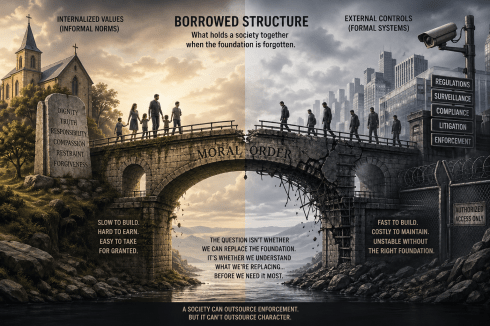
Modern successful societies appear to rely on a set of moral assumptions that did not arise randomly—and may not sustain themselves indefinitely once detached from the structures that produced them.
Not proof, not prophecy, but rather… dependence.
Name the Structure, Not the Institution
When I refer to “Judeo-Christian ethics,” I’m not talking about the historical behavior of churches or states. That record is mixed at best and often indefensible. It doesn’t need rescuing here.
I’m pointing to a moral architecture—a cluster of ideas that shaped behavior long before belief began to fade:
- intrinsic human worth
- moral equality beyond tribe
- limits on power
- individual responsibility
- restraint
- forgiveness over vendetta
These now feel obvious.
They weren’t.
What looks like baseline morality is often inherited structure—and inheritance has a way of disguising itself as inevitability.
Christianity Is Not the Only Path—And That Matters
If the claim were simply “Judeo-Christian societies do better,” it would fail.
There are Christian-majority countries that struggle. There are secular societies that thrive. There are atrocities carried out under religious banners that no serious reader will ignore.
And then there’s Japan.
Japan is not a counterexample. It’s a correction.
It demonstrates that similar outcomes—order, trust, cohesion—can emerge from entirely different traditions. Which means the key variable isn’t Christianity itself.
It’s something deeper.
Japan suggests the underlying requirement is not a specific doctrine, but a sufficiently internalized system of obligation—whether grounded in universal dignity or social duty. The forms differ. The function is similar: behavior is constrained before enforcement becomes necessary.
Not all structures are interchangeable. But high-functioning societies tend to converge on systems that reliably produce restraint, accountability, and continuity across generations—however they justify them.
These systems are not immune to strain. Japan’s own pressures—aging demographics, declining birth rates, and shifting social norms—suggest that even deeply internalized frameworks are not static under modern conditions.
What These Systems Actually Do
Strip away the language and look at function.
These frameworks tend to produce:
- higher social trust
- delayed gratification
- stable family structures
- informal accountability
- expectations that limit the use of power
These are not abstract outcomes. They follow from repeated behaviors:
- when restraint is internalized, fewer actions require enforcement
- when accountability is expected, trust rises and transaction costs fall
- when power is seen as limited, institutions stabilize rather than dominate
Over time, these behaviors compound into systems that rely less on coercion and more on expectation.
That sounds mundane. It isn’t. It’s what makes large, complex societies livable.
None of this requires belief.
But it does require internalization.
And internalization is slow, uneven, and difficult to rebuild once it thins out.
The Enlightenment Didn’t Start From Zero
The Enlightenment didn’t sweep this away and replace it with reason.
It reorganized it.
It challenged religious authority, formalized rights, and built institutions that still define modern life. That’s real progress and it shouldn’t be minimized.
But it did not begin from moral zero.
The assumptions were already there—about equality, dignity, and limits on power. The Enlightenment clarified and extended them. It did not generate them out of nothing.
The harder question is whether reason alone can reproduce the same depth of commitment, especially when those commitments become costly.
Reason is excellent at organizing systems. It is less reliable at compelling sacrifice—and societies eventually run into situations where something has to give.
The Problem Friedrich Nietzsche Identified
Nietzsche is often invoked carelessly. This isn’t that.
His point wasn’t that religion should be preserved. It was that removing it has consequences that don’t show up immediately.
You can discard a system and keep its language for a while.
You can keep its assumptions even longer.
What you can’t do indefinitely is treat the foundation as optional while expecting the structure to remain stable.
That process doesn’t announce itself.
It drifts—and by the time it becomes obvious, it is usually well underway.
Drift Shows Up as Substitution
Drift doesn’t look like collapse.
It looks like substitution.
As informal norms weaken, societies compensate with formal mechanisms:
- more regulation
- more surveillance
- more litigation
- more explicit enforcement of what was once assumed
That shift isn’t inherently catastrophic. In many cases it works.
But it changes how order is maintained. It replaces internal constraint with external management—and that trade is rarely free.
You can see it at the margins: rising regulatory density, increased reliance on formal compliance systems in workplaces and institutions, growing legal mediation of disputes that were once handled informally. These trends have multiple causes, but they share a common feature—behavior that once required little enforcement now requires more of it.
The Secular Case—and Its Limit
A secular answer exists.
We can justify these norms through reason, reciprocity, and shared interest. We don’t need theology to understand cooperation or stability.
And in many cases, this works. High-trust secular societies demonstrate that norms can be transmitted without widespread religious belief.
The question is not whether this is possible.
It clearly is.
The question is whether these systems are fully self-sustaining over long time horizons, or whether they depend—quietly—on inherited assumptions that become harder to justify as those assumptions lose coherence.
That dependency is easy to miss because it feels like common sense.
It isn’t. It’s memory.
If these systems are fully self-sustaining, we would expect high-trust, high-restraint behavior to remain stable even as the underlying moral frameworks continue to thin. If they are not, the pressure will show up first at the margins—in declining informal trust, rising enforcement costs, and increasing reliance on explicit rules to maintain baseline order.
What This Argument Is—and Is Not
This is not an argument for belief.
It’s an argument against pretending we’re starting from nothing.
Societies that function well do not run on law and incentives alone. They rely on internalized limits—on what people will not do, even when they can.
Judeo-Christian ethics provided one version of that in the West. Other civilizations developed their own.
The open question is not whether we can discard those frameworks.
We already have.
The question is whether we understand what they were doing well enough to replace them—or whether we are still relying on them while insisting we are not.
The Uncomfortable Conclusion
Removing a foundation does not collapse a structure immediately.
It exposes, slowly, what the structure depended on—and whether we’ve mistaken inheritance for design.
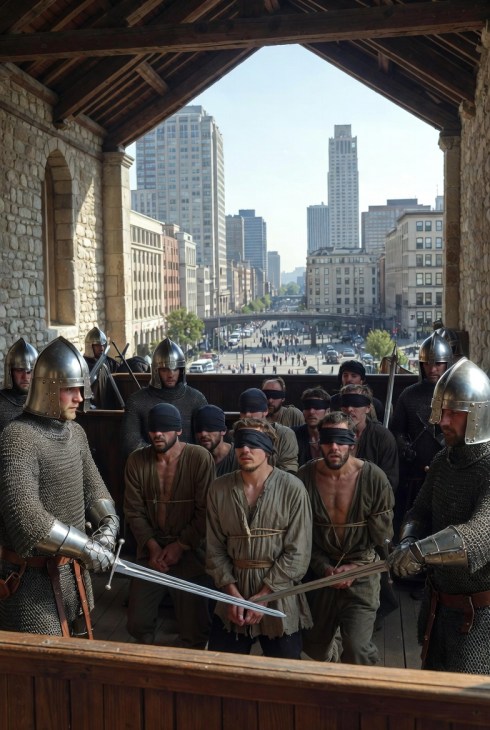
One of the more unsettling ideas in political history is that civilization may depend not only on teaching people virtue, but on steadily removing the people least capable of civilized life.
That is the thesis Peter Frost and Henry Harpending explore in Western Europe, State Formation, and Genetic Pacification. It cuts against the modern habit of explaining violent disorder almost entirely through environment, incentives, poverty, trauma, and weak institutions. Those things matter. But Frost and Harpending press a harder possibility: what if the long pacification of Western Europe was driven not only by stronger states and changing norms, but also by selection against the men most prone to chronic violence? (PubMed)
The historical pattern they point to is clear. In medieval Europe, homicide rates were vastly higher than in the modern West. Over time, as states consolidated their monopoly on violence and private vengeance receded, courts imposed the death penalty more systematically. Frost and Harpending argue that by the late Middle Ages, courts were condemning between 0.5 and 1.0 percent of all men of each generation to death, with perhaps as many more violent offenders dying at the scene of crimes or in prison while awaiting trial. Meanwhile, long-run homicide rates in Western Europe fell dramatically across the centuries. That broader decline is visible not only in their paper but in later summaries built from Manuel Eisner’s historical homicide datasets. (PubMed; Our World in Data)
That much already matters. Peace is not the natural resting state of a society. It is achieved. It is enforced. It is built through institutions capable of suppressing predation. The state does not merely administer order after the fact. It creates the conditions under which ordinary trust can exist. Without that floor, commerce, family stability, education, beauty, and freedom remain fragile.
But Frost and Harpending are interested in more than deterrence. Their stronger claim is that repeated removal of violent men from the breeding population may have altered the population itself over many generations. In plain language: if men most disposed to impulsive violence, predation, and chronic criminality are disproportionately executed, killed while offending, or otherwise prevented from reproducing, then over centuries one should expect some reduction in the prevalence of those tendencies. The state, in that account, does not just restrain violence from the outside. It may slowly reshape the human material with which the society reproduces itself. (PubMed)
That is the interesting part of the thesis, and the part that needs the cleanest handling. Frost and Harpending present it not as a settled master key to European history, but as a plausible co-factor alongside state formation, punishment, and cultural conditioning. Direct genomic confirmation remains absent. Other explanations place more weight on the state’s monopoly on violence, changing norms of self-control, declining honor culture, economic development, and improved policing. So the strongest honest claim is not that the paper has solved the history of European pacification. It is that it raises a serious possibility modern readers are strongly conditioned not to consider. (PubMed)
“Civilization is not sustained by kindness alone. It rests on a prior achievement: order strong enough to protect the peaceable from the predatory.”
Even with that caution in place, the paper still does useful work. It moves the discussion beyond the sterile split between “bad systems” and “bad individuals.” It suggests a layered civilizing process: institutions suppress violent conduct, norms change under the shelter of that order, and then, possibly, population traits shift over time as the most antisocial men are less likely to survive and reproduce. Culture and coercion do not sit in separate boxes here. They interact.
You do not have to buy every part of that model to see why it has force. A society does not begin from zero every generation. It inherits habits, expectations, institutions, and distributions of temperament formed over long stretches of time. If Western Europe became unusually low in interpersonal violence by world-historical standards, that happened through a civilizing process measured in centuries, not slogans. It was produced by a long narrowing of the space in which violent men could operate, flourish, and reproduce themselves socially.
That last phrase matters because reproduction here is not only biological. Violent men reproduce disorder culturally as well. They shape neighborhoods, train younger males, normalize intimidation, degrade family life, and turn predation into a viable strategy. Once that ecology is established, disorder becomes self-reinforcing. The reverse is also true. When a state reliably incapacitates the worst predators, peace can become self-reinforcing too.
That is part of why modern examples like El Salvador draw so much attention. The cases are not equivalent, and they do not prove Frost and Harpending’s genetic hypothesis. What they do show is older and simpler: when a state decisively removes a violent criminal stratum from daily circulation, social peace can return with surprising speed. The IMF reported in 2025 that El Salvador’s homicide rate fell from 54 per 100,000 in 2018 to 1.8 in 2024, and tied the improvement in security to stronger growth, tourism, remittances, and investor confidence. Human Rights Watch, from the opposite moral angle, also reports a significant decline in gang violence while warning that restricted data access and changes in homicide counting complicate full independent verification. (IMF; HRW; AP)
That is where a serious reader has to keep both truths in view at once. El Salvador does not demonstrate multi-generational selection. It demonstrates the older principle that predators must be removed from circulation if ordinary life is to recover. At the same time, Human Rights Watch documents arbitrary detention, torture, ill-treatment, and deaths in custody under the state of exception. The rights costs are real. The case does not prove that every harsh regime is wise. It proves that liberal societies often flatter themselves about how peace is maintained. (HRW)
This is not an argument for population engineering or collective guilt. It is an argument for recognizing that a small fraction of high-rate violent offenders can do outsized damage, and that civilization depends on their incapacitation. Modern liberal societies are comfortable discussing prevention, rehabilitation, and root causes. They are much less comfortable discussing the incorrigible. But any serious civilization needs a theory of that minority and the will to act on it long enough for the peaceable majority to live normally.
That, in the end, is the value of Frost and Harpending’s paper. Not that it offers a final key to history. Not that every part of its model has been settled beyond dispute. It matters because it reopens a forbidden question: how much of social peace depends not merely on teaching better values, but on the long-term suppression of the people least fit for peaceful life? Even readers who reject the paper’s stronger selection claim should still feel the pressure of that deeper point. Order is not self-generating. It has to be maintained against people who would dissolve it if allowed.
Modern states, at their best, answer that problem more humanely than medieval ones did. They use prisons rather than gallows. They rely on due process rather than spectacle. Good. They should. But the softer method does not abolish the harder principle. Social peace depends on removing certain people from the field, sometimes for a very long time.
That is the truth buried beneath the discomfort here. Civilization is not sustained by kindness alone. It rests on a prior achievement: order strong enough to protect the peaceable from the predatory. Everything higher comes after that.
References
Peter Frost and Henry C. Harpending, “Western Europe, State Formation, and Genetic Pacification,” Evolutionary Psychology 13, no. 1 (2015). PubMed: https://pubmed.ncbi.nlm.nih.gov/25748943/ ; journal page: https://journals.sagepub.com/doi/10.1177/147470491501300114
International Monetary Fund, El Salvador: Request for Extended Arrangement Under the Extended Fund Facility (2025). IMF page: https://www.elibrary.imf.org/view/journals/002/2025/058/article-A001-en.xml ; PDF: https://www.imf.org/-/media/files/publications/cr/2025/english/1slvea2025001-print-pdf.pdf
Human Rights Watch, “World Report 2026: El Salvador.” https://www.hrw.org/world-report/2026/country-chapters/el-salvador
Our World in Data, historical homicide materials drawing on Manuel Eisner’s data: https://ourworldindata.org/data-insights/homicide-rates-have-declined-dramatically-over-the-centuries and https://ourworldindata.org/grapher/homicide-rates-across-western-europe
Associated Press, “El Salvador closes 2024 with a record low number of homicides.” https://apnews.com/article/69384a8705267eaddd18dcd28a53465b
What makes our society run? Where does one begin?
Devon Eriksen tackles that question in a though provoking and I think useful way. During his discussion of this topic the concept of a Chesterson’s Fence is made several times and to understand Eriksen’s thinking you need to know what a Chesterson’s Fence is.
The concept of a Chesterson Fence is the notion that we need to engage in second order thinking when evaluating a problem or situation. Or to use the original analogy:
“Do not remove a fence until you know why it was put up in the first place.”
“Fences are built by people who carefully planned them out and “had some reason for thinking [the fence] would be a good thing for somebody.” Until we establish that reason, we have no business taking an ax to it. The reason might not be a good or relevant one; we just need to be aware of what the reason is. Otherwise, we may end up with unintended consequences: second- and third-order effects we don’t want, spreading like ripples on a pond and causing damage for years.”
So, we can already observe we’ll be tackling some second and even third order thinking in Eriksen’s work.
“It’s time we all admitted it.
Intolerance in pre-1900s western civilization was a load-bearing structure.
It stopped certain groups from doing certain anti-civilization things that they kinda wanted to do, because they were too busy trying to fit it, look harmless, and be accepted as normal.
Which people? What things?
Well, lots of people have opinions on that, but we’re not actually connected to any unbroken line of generational knowledge on the subject. Because somewhere along the line, some people learned to hack western civilization by pointing out that stereotyping, behavioral enforcement, and gatekeeping, are cruel.
Well, duh.
What these people are trying very hard to keep the rest of us from noticing is that civilization requires cruelty.
Civilization is an unnatural state. It is an bubble of peace and plenty, rising through a vast dark ocean of poverty and war.
That bubble is fragile. In order to prevent it from bursting, we have to prevent certain things from happening inside it.
Which means we have to tell the people inside that they can’t do certain things they want to do, even though they will be sad when they don’t get to do them.
Which is mean.
And it means we have to keep people outside the bubble if they won’t stop doing those things, even though they will be sad if they don’t get to come there, or stay.
Which is mean.
You cannot have civilization unless you are willing to be mean and make certain people sad.
But here’s the important question… which cruelties are load-bearing, and which are pointless and unnecessary?
Well, we don’t know.
And for this, I blame traditionalists. Every time they put up Chesterton’s Fence, they neglected to top it with Chesterton’s Signpost, explaining why the fence was there and what it was intended to do.
Instead, they stamped it with one of their two rubber stamps “we’ve always done it this way”, and “the will of {insert local deity here}”.
This makes it extremely difficult to defend the fence, and all but impossible to know which fences are load-bearing and need defending.
[Individual on twitter] appears to think that all the anti-traditionalist things she wants to do are okay, and forbidding or even disparaging them is pointless cruelty, but anti-traditionalist things she doesn’t want to do are horrific acts of civilizational destruction.
This is, of course, selfish and hypocritical, but what I’m noticing is that everyone else is, too.
All the way from tradcath freaks who want to ban IVF, forbid premarital sex, and kill all the Protestants, to tranny freaks who want to take your children away and sterilize them, everyone thinks their precise type and level of deviance is complete fine, and anything one step beyond what they personally want to do is anathema.
None of this is the least bit informative about which of the rules of the old world are actually load-bearing, and right now, we are all having such fun finding out the hard way.
If western civilization doesn’t survive, then neither does humanity, because the second world isn’t going to get us off this single fragile rock, and neither is the third.
Which means we have some serious house-cleaning to do. We’re going to have to derive civilization-preserving rules from first principles again, because every goddamned fence the Chestertons of the world put up in the past is labelled with unhelpful bullshit explanations, and not only are some of them necessary and some of them not, but a further some of them are so obsoleted by technological advancement that they are actually now anti-civilizational forces in and of themselves.
But what are these first principles?
I’m sure the comments are going to contain lots of answers where people suggest their favorite thing, be it liberty, or their version of morality, or their favorite religion, but most of the things that people think of as ends are actually means.
The end is preserving and advancing human civilization.
To that end, I can think of three first principles off the top of my head, things that civilization cannot exist without. There may be more that will occur to me later.
They are:
1. Investment.
Human civilization requires people to invest effort in things. People will not do this if the results of that effort can be taken from them more easily than they can be created. This means property rights. Any civilization which does not vigorously defend both individual and collective investment will fail.
2. Fertility.
This one is unique to humans. Our reproductive cycle is uniquely fragile, pushed to its extreme limits by evolutionary pressure to produce infants with giant heads. Women’s fertile years are such a small fraction of their total lifespan, pregnancy is so taxing and resource-intensive, and infants and children so helpless and vulnerable for so long, that the slightest interference, seemingly innocuous, can destroy a population’s ability to replace itself. Or, worse yet, it can selectively destroy the ability to replace the small sub-population of highly effective humans that drive civilization forward.
3. Innovation.
This is the whole point. This is how humans survive, and without it, we won’t. The whole evolutionary strategy of humanity is to use those huge brains which we pay such a fertility cost to obtain — use them to understand the universe, and leverage that understanding to control it. But tech innovation relies on many factors, which is why so few civilizations are able to get their shit together to consistently do it, and show up on the beach with sailing ships, guns, and steel while the natives are still hunting deer with stone-tipped arrows.
That’s my basic idea: for everything we forbid, and everything we permit, we need to understand how it impacts investment, fertility, and innovation.
Because those are the things we actually need.
[…]”
I think that Investment, Fertility, an Innovation are worthy contenders as first principles of civilization, but there are more that deserve to be on the list. :)
Two views on the current state of the West. Both share a fairly grim tone. We need to as nations of the West turn things around. The classical liberal* principles that our societies were founded on need to be restored and refreshed in their primacy of how we exist as people in society.
There are competing narratives of how we are supposed to advance society, I think if we stray from the path we’re on we going to be in trouble.
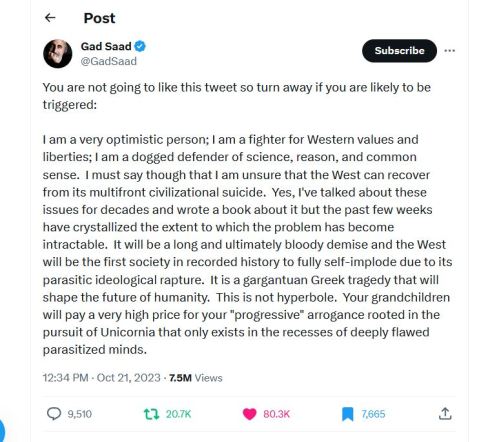
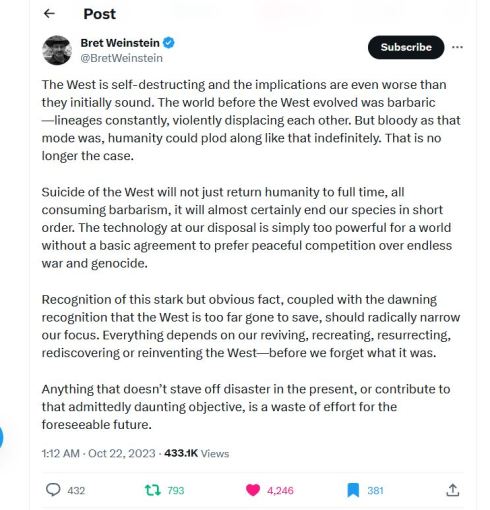
*Classical liberalism is a political tradition and a branch of liberalism which advocates free market and laissez-faire economics; and civil liberties under the rule of law, with special emphasis on individual autonomy, limited government, economic freedom, political freedom and freedom of speech
Cheery stuff I know, but its interesting to see some of the trajectories we are on, and maybe if we shed enough light on them, we can can change them. Optimistic? Absolutely, but I’d rather have the motivation to continue the struggle than the gilded-glitz peace of the nihilist who has given up.
“Greer estimates that it takes, on average, about 250 years for civilizations to decline and fall, and he finds no reason why modern civilization shouldn’t follow this “usual timeline.”[3]
But Greer’s assumption is built on shaky ground because industrial civilization differs from all past civilizations in four crucial ways. And every one of them may accelerate and intensify the coming collapse while increasing the difficulty of recovery.
Difference #1: Unlike all previous civilizations, modern industrial civilization is powered by an exceptionally rich, NON-renewable, and irreplaceable energy source—fossil fuels. This unique energy base predisposes industrial civilization to a short, meteoric lifespan of unprecedented boom and drastic bust. Megacities, globalized production, industrial agriculture, and a human population approaching 8 billion are all historically exceptional—and unsustainable—without fossil fuels. Today, the rich easily exploited oilfields and coalmines of the past are mostly depleted. And, while there are energy alternatives, there are no realistic replacements that can deliver the abundant net energy fossil fuels once provided.[4] Our complex, expansive, high-speed civilization owes its brief lifespan to this one-time, rapidly dwindling energy bonanza.
Difference #2: Unlike past civilizations, the economy of industrial society is capitalist. Production for profit is its prime directive and driving force. The unprecedented surplus energy supplied by fossil fuels has generated exceptional growth and enormous profits over the past two centuries. But in the coming decades, these historic windfalls of abundant energy, constant growth, and rising profits will vanish.
However, unless it is abolished, capitalism will not disappear when boom turns to bust. Instead, energy-starved, growth-less capitalism will turn catabolic. Catabolismrefers to the condition whereby a living thing devours itself. As profitable sources of production dry up, capitalism will be compelled to turn a profit by consuming the social assets it once created. By cannibalizing itself, the profit motive will exacerbate industrial society’s dramatic decline.
Catabolic capitalism will profit from scarcity, crisis, disaster, and conflict. Warfare, resource hoarding, ecological disaster, and pandemic diseases will become the big profit makers. Capital will flow toward lucrative ventures like cybercrime, predatory lending, and financial fraud; bribery, corruption, and racketeering; weapons, drugs, and human trafficking. Once disintegration and destruction become the primary source of profit, catabolic capitalism will rampage down the road to ruin, gorging itself on one self-inflicted disaster after another.[5]
Difference #3: Unlike past societies, industrial civilization isn’t Roman, Chinese, Egyptian, Aztec, or Mayan. Modern civilization is HUMAN, PLANETARY, and ECOCIDAL. Pre-industrial civilizations depleted their topsoil, felled their forests, and polluted their rivers. But the harm was far more temporary and geographically limited. Once market incentives harnessed the colossal power of fossil fuels to exploit nature, the dire results were planetary. Two centuries of fossil fuel combustion have saturated the biosphere with climate-altering carbon that will continue wreaking havoc for generations to come. The damage to Earth’s living systems—the circulation and chemical composition of the atmosphere and the ocean; the stability of the hydrological and biogeochemical cycles; and the biodiversity of the entire planet—is essentially permanent.
Humans have become the most invasive species ever known. Although we are a mere .01 percent of the planet’s biomass, our domesticated crops and livestock dominate life on Earth. In terms of total biomass, 96 percent of all the mammals on Earth are livestock; only 4 percent are wild mammals. Seventy percent of all birds are domesticated poultry, only 30 percent are wild. About half the Earth’s wild animals are thought to have been lost in just the last 50 years.[6] Scientists estimate that half of all remaining species will be extinct by the end of the century.[7] There are no more unspoiled ecosystems or new frontiers where people can escape the damage they’ve caused and recover from collapse.
Difference #4: Human civilization’s collective capacity to confront its mounting crises is crippled by a fragmented political system of antagonistic nations ruled by corrupt elites who care more about power and wealth than people and the planet. Humanity faces a perfect storm of converging global calamities. Intersecting tribulations like climate chaos, rampant extinction, food and freshwater scarcity, poverty, extreme inequality, and the rise of global pandemics are rapidly eroding the foundations of modern life.
Yet, this fractious and fractured political system makes organizing and mounting a cooperative response nearly impossible. And, the more catabolic industrial capitalism becomes, the greater the danger that hostile rulers will fan the flames of nationalism and go to war over scarce resources. Of course, warfare is not new. But modern warfare is so devastating, destructive, and toxic that little would remain in its aftermath. This would be the final nail in civilization’s coffin.”
How quickly we slip in barbarity. From Normalizing Atrocity, Ken Orphan writes on Counterpunch:
“Thousands of socialists and leftists were marched into stadiums in Chile in the 1970s and gunned down, tortured, or disappeared in a country with a much smaller military than the US. Between 1965 and 1966, at least a million communists, or those believed to be communists, were hunted down and brutally murdered in Indonesia by rightwing death squads and the police. And millions of Jews, Roma, communists, homosexuals and the disabled were persecuted, rounded up and sent to concentration camps in the 1930s and 40s in Germany and Nazi occupied countries, where most perished at a time when many ordinary people thought “the logistics” of doing something like that were too “enormous” to fathomed, much less carried out. And each atrocity was preceded by the rise of a pernicious fascism and the language of dehumanization by leaders.
The notion that atrocity “can’t happen here” is soundly refuted by the fact that it has happened here. And countless times. The US, a nation founded upon organized ethnic cleansing and genocide of the native population, and the brutal enslavement of millions of Africans, has also been home to more recent mass atrocities. Thousands of black and brown men and some women were lynched over the early part of the 20th century. Events organized and sanctioned by authorities, police and politicians, where popcorn, postcards and body parts were sold as souvenirs to the ghoulish onlookers. Thousands of Japanese Americans were rounded up and put in internment camps in the desert during WW2 for the sake of “national security.”
The US has many a precedent to follow with regards to mass detainment and slaughter.
And even a short historical account of the American ruling establishment and its institutions reveals that it has the capacity to participate and administer the most heinous crimes against humanity that have ever been conceived. ICE is more than happy to follow his dictates, and establishment Democrats, the so-called “resistance,” have indicated time and time again that they will unite with Republicans in defending the most odious of American policies.
One thing history has proven is that mass atrocity can be committed with few people, with great efficiency at a moment’s notice, little technology, and with shocking approval or the complacence of the majority of ordinary people. But it must first be normalized. To be sure, if a people can tolerate dehumanizing language of entire groups by its leader, and the utterly sadistic policy of ripping children from the arms of their parents and putting them in cages, or pregnant women being shackled to beds, or the torture of non-violent LGBTQ and mentally ill migrants via solitary confinement for days, or militias working in tandem with government agencies to round up unarmed migrants, or a government prosecuting those who provide water and shelter to other human beings in desperate need, it is certainly capable of tolerating, or even applauding, even worse monstrous depravity. And without a doubt, we are only one absurd tweet away from that potential nightmare.
Election time in 2020. War abroad and societal repression on the homefront perfect for reelecting an populist incumbent president.











 bleatmop
 Mystro
 The Arbourist


 Dead Wild Roses
Your opinions…