
You are currently browsing the tag archive for the ‘ethics’ tag.
There is a moment in certain debates where everything speeds up. Morality is called subjective; subjectivity becomes preference; preference becomes power—and once power is named, the conversation is over. What began as a question about right and wrong turns into a contest of will. The move is effective because it presses on something real: if moral claims have no grounding beyond preference, it’s not obvious why anyone should follow them, especially when defection pays.
The pressure is genuine. The leap that follows is not.
The argument doesn’t stop at identifying the problem. It slides past it. The claim arrives fully formed: without objective grounding, morality collapses into power; if there is grounding, it must lie beyond human beings. From there, the appeal to a higher authority presents itself as the only way out. It’s clean, decisive—and too quick. It skips a possibility that does not depend on metaphysics at all.
You don’t need a higher power to get constraint. You need a world that pushes back. That is already enough for science. The success of a model has little to do with who proposes it and everything to do with whether it survives contact with reality. When it fails, it fails for everyone. No appeal to authority rescues it. That is objectivity without metaphysical scaffolding.
Something similar appears in moral life, though in a different register. Human beings are not abstract choosers floating above circumstance. We are vulnerable, dependent, and locked into repeated interaction with others who are very much like us. That combination exerts pressure. Cooperation is not optional if anything stable is to be built; defection carries costs that accumulate; control over outcomes is partial at best; and roles do not remain fixed. Over time, those conditions shape what can persist.
Rules that cannot be justified beyond advantage tend to fracture. Norms that work only when you hold power lose their grip as soon as power shifts. Arrangements that fail under reversal—when you are no longer the beneficiary—erode the moment they are tested from the other side. You can see this in ordinary disputes: a speech rule that feels protective when applied to your side quickly feels suppressive when applied against it. None of this descends from above. It emerges from the conditions under which people have to live together.
“You don’t need a higher power to get constraint. You need a world that pushes back.”
This is why a simple question keeps resurfacing, even among people with no interest in philosophy: would this still make sense if I were on the receiving end? You don’t need theology to ask it. You don’t need a theory of value to feel when the answer is no. You need only to notice that positions change, that vulnerability is shared, and that rules have to survive that movement. That alone rules some things out. Not everything. But not nothing.
The familiar objection comes back quickly: if this is all human arrangement, isn’t it still just power? The answer is that power without constraint is unstable. Systems built on dominance invite resistance; rules applied asymmetrically invite defection; norms that cannot justify themselves beyond advantage lose legitimacy the moment advantage shifts. These are not floating intuitions. They are structural pressures. They can be ignored for a time. They do not disappear.
The point of the “nuke” is not to prove that morality is objective in the way gravity is objective, or that every moral question has a single correct answer waiting to be discovered. It does something narrower and more useful. It removes the claim that, absent a higher power, morality collapses into arbitrary preference backed by force. There is a third option: morality can be constructed and constrained at the same time—neither invented freely nor dictated from above, but shaped by the conditions under which human beings must deal with one another.
The attraction of higher grounding is easy to understand. It promises certainty, authority, final answers. Naturalism offers something thinner: no absolute guarantees, no universal enforcement, no resolution that settles every dispute. What it does offer is a way to sort between rules that hold up and those that don’t, to explain why some norms persist while others unravel, and to resist both relativism and coercion without appealing to anything outside the world.
Scientific objectivity does not require a perfect observer; it requires that models fail when they are wrong. Moral objectivity does not require a divine lawgiver; it requires that rules fail when they cannot withstand contact with the people they govern. That is a narrower claim than the one often made. It is also enough.
You can believe that morality ultimately rests beyond human beings. You can also see that, even without that belief, moral systems do not collapse into chaos. They bend, strain, and sometimes fail, then rebuild under pressure. They are not unconstrained—because we are not unconstrained.
And that pressure, more than any proclamation, is what gives morality its shape.
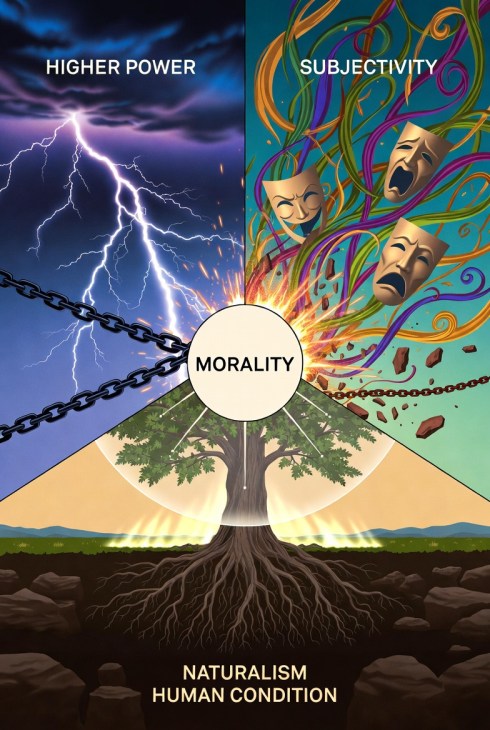
Something feels off. You can hear it in the way certain arguments move too quickly, collapsing a complex moral landscape into a stark choice. On one side, morality is said to be subjective—nothing more than preference, culture, or perspective. On the other, we are told that without objective grounding, morality collapses into power. The argument is clean, decisive, and rhetorically effective. It is also incomplete.
The appeal of this framing lies in its speed. If morality is subjective, then moral claims reduce to preference. If they reduce to preference, there is no truth to adjudicate between them. And if there is no truth, disagreement can only be resolved through assertion and enforcement. The conclusion follows with a kind of mechanical certainty: without objective morality, ethics becomes power. It is a compelling chain, particularly in live discussion, where the pressure to respond quickly prevents careful unpacking. But the speed of the move is part of its strength—and its limitation. It skips over something most people already rely on in practice, even if they do not articulate it.
In everyday life, we do not treat all moral claims as interchangeable. Some feel as though they hold even in the face of disagreement; others do not. What distinguishes them is rarely stated explicitly, but it shows up in how people respond to rules and expectations. A simple test often operates in the background: does the rule apply both ways? Does it still make sense when the roles are reversed? Does it remain defensible when you are no longer the one benefiting from it?
You can see this play out in familiar disputes. A rule that restricts speech when it targets your side may feel justified; the same rule, applied in reverse, often feels like suppression. A policy that advantages your group can look like fairness in one direction and bias in the other. The reaction people have in those moments—that sense that something has shifted or isn’t being applied evenly—is not random. It’s the symmetry test quietly asserting itself.
“The question isn’t whether a rule benefits you—it’s whether it still makes sense if it doesn’t.”
When the answers line up, the rule tends to feel legitimate. When they don’t, something begins to grate. This is not a formal proof of moral truth. It is, however, a constraint on what people are willing to accept.
One way to bring that constraint into focus is through the thought experiment proposed by John Rawls. Imagine choosing the rules of a society without knowing who you will be within it—your position, your advantages, your vulnerabilities. From that standpoint, you cannot design the system to suit your own interests. You are forced to consider whether the rules would still be acceptable if you ended up on the losing side of them. Rawls does not claim to discover moral truth through this device. What he does is remove the most obvious avenue for bias and ask what remains once that advantage is gone.
What remains is not a set of metaphysical truths written into the structure of the universe. It is something more modest and, in practice, more useful: a constraint on justification. Some rules cannot be defended once you no longer know where you will stand. They rely too heavily on asymmetry, on the assumption that the person invoking them will not have to bear their cost. When that assumption is removed, the rule loses its force. This does not make morality objective in the way physical laws are objective, but it does show that not all moral systems are equally defensible.
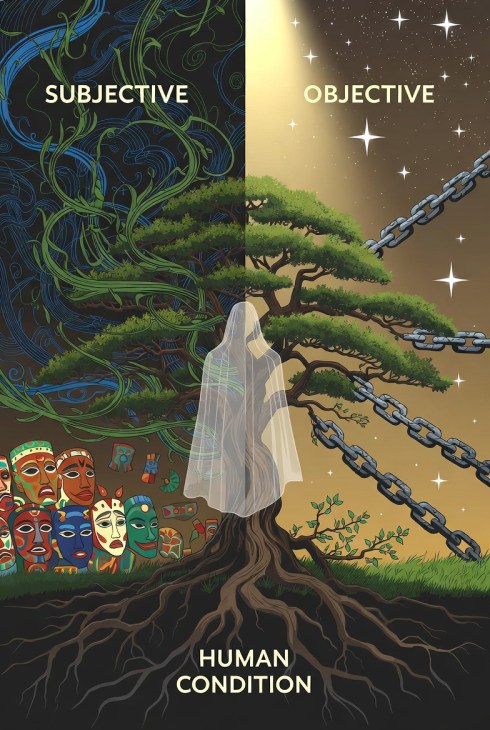
This is the space the binary argument overlooks. Morality does not have to be either fully objective in a metaphysical sense or entirely subjective and arbitrary. Most functioning moral systems occupy a middle ground. They are constructed and maintained through norms, institutions, and shared expectations, but they are also bounded by the conditions under which human beings live. We are vulnerable, dependent, and engaged in repeated interaction. Rules that exploit these conditions too aggressively tend to collapse under their own weight. Rules that can survive role reversal and long-term interaction tend to persist. They are not inevitable, but neither are they arbitrary.
The force of the “collapse into power” argument comes from its focus on weak forms of subjectivism. If morality is reduced to mere preference, then the conclusion follows quickly. But this is not how most moral reasoning operates in practice. Even absent a claim to objective truth, people appeal to considerations that go beyond preference: reciprocity, fairness, stability, and the costs of defection. These are not metaphysical foundations, but they are not empty either. They generate real limits on behavior and real expectations about what can be justified.
The question, then, is not simply whether morality is objective. That framing compresses too much into a single term. A more useful question is what constrains moral reasoning so that it does not collapse into preference or power. Rawls offers one answer in the form of symmetry under uncertainty. Ordinary social life offers another in the form of rules that must hold under repetition and reversal. Both point to the same underlying fact: moral systems are not free to take any shape whatsoever. They are limited by the requirements of justification and the conditions of human interaction.
This brings us back to the original feeling that something is off. That reaction often arises when a rule is applied inconsistently, when a principle shifts depending on who benefits, or when an argument demands compliance without offering a justification that would hold if positions were reversed. You do not need a fully developed moral philosophy to recognize that pattern. You only need to notice when the symmetry breaks.
Scientific objectivity does not require perfect scientists; it requires that their models survive contact with reality. Moral objectivity, if the term is to mean anything useful, does not require metaphysical certainty. It requires that the rules we live by survive contact with each other—across differences in position, power, and perspective. That is a narrower claim than the one often made in debate, but it is also a more defensible one.
Morality does not need to be written into the fabric of the universe to resist collapse. It needs something simpler: rules that can be justified without knowing who will bear their consequences, and that continue to function when they are applied to anyone over time. Once that is clear, the stark choice between objective truth and raw power begins to lose its grip. The problem is not that morality lacks a foundation, but that we often look for it in the wrong place.
Where This Goes Next
The question raised in the previous discussion—whether anything can meaningfully constrain our claims without collapsing into preference or power—does not end with morality.
It appears again, more sharply, in how we think about science itself.
If there is no constraint beyond social agreement, then scientific claims begin to look like moral ones at their weakest: negotiated, enforced, and revised under pressure. If there is a constraint, then we need to be precise about what it is and how it operates, because that distinction determines whether we are tracking reality or simply tracking consensus.
The essays that follow take up that question directly. They move from the same starting point—something feels off—to a clearer account of what, if anything, resists that collapse.
This Is Not a Theology Argument
There’s a version of this argument that collapses on contact.
“Christian societies succeed because Christianity is true.”
That’s not serious. It’s too broad, too easy to counter, and it drags the discussion into theology. That’s not what this is.
This is narrower.
Modern successful societies appear to rely on a set of moral assumptions that did not arise randomly—and may not sustain themselves indefinitely once detached from the structures that produced them.
Not proof, not prophecy, but rather… dependence.
Name the Structure, Not the Institution
When I refer to “Judeo-Christian ethics,” I’m not talking about the historical behavior of churches or states. That record is mixed at best and often indefensible. It doesn’t need rescuing here.
I’m pointing to a moral architecture—a cluster of ideas that shaped behavior long before belief began to fade:
- intrinsic human worth
- moral equality beyond tribe
- limits on power
- individual responsibility
- restraint
- forgiveness over vendetta
These now feel obvious.
They weren’t.
What looks like baseline morality is often inherited structure—and inheritance has a way of disguising itself as inevitability.
Christianity Is Not the Only Path—And That Matters
If the claim were simply “Judeo-Christian societies do better,” it would fail.
There are Christian-majority countries that struggle. There are secular societies that thrive. There are atrocities carried out under religious banners that no serious reader will ignore.
And then there’s Japan.
Japan is not a counterexample. It’s a correction.
It demonstrates that similar outcomes—order, trust, cohesion—can emerge from entirely different traditions. Which means the key variable isn’t Christianity itself.
It’s something deeper.
Japan suggests the underlying requirement is not a specific doctrine, but a sufficiently internalized system of obligation—whether grounded in universal dignity or social duty. The forms differ. The function is similar: behavior is constrained before enforcement becomes necessary.
Not all structures are interchangeable. But high-functioning societies tend to converge on systems that reliably produce restraint, accountability, and continuity across generations—however they justify them.
These systems are not immune to strain. Japan’s own pressures—aging demographics, declining birth rates, and shifting social norms—suggest that even deeply internalized frameworks are not static under modern conditions.
What These Systems Actually Do
Strip away the language and look at function.
These frameworks tend to produce:
- higher social trust
- delayed gratification
- stable family structures
- informal accountability
- expectations that limit the use of power
These are not abstract outcomes. They follow from repeated behaviors:
- when restraint is internalized, fewer actions require enforcement
- when accountability is expected, trust rises and transaction costs fall
- when power is seen as limited, institutions stabilize rather than dominate
Over time, these behaviors compound into systems that rely less on coercion and more on expectation.
That sounds mundane. It isn’t. It’s what makes large, complex societies livable.
None of this requires belief.
But it does require internalization.
And internalization is slow, uneven, and difficult to rebuild once it thins out.
The Enlightenment Didn’t Start From Zero
The Enlightenment didn’t sweep this away and replace it with reason.
It reorganized it.
It challenged religious authority, formalized rights, and built institutions that still define modern life. That’s real progress and it shouldn’t be minimized.
But it did not begin from moral zero.
The assumptions were already there—about equality, dignity, and limits on power. The Enlightenment clarified and extended them. It did not generate them out of nothing.
The harder question is whether reason alone can reproduce the same depth of commitment, especially when those commitments become costly.
Reason is excellent at organizing systems. It is less reliable at compelling sacrifice—and societies eventually run into situations where something has to give.
The Problem Friedrich Nietzsche Identified
Nietzsche is often invoked carelessly. This isn’t that.
His point wasn’t that religion should be preserved. It was that removing it has consequences that don’t show up immediately.
You can discard a system and keep its language for a while.
You can keep its assumptions even longer.
What you can’t do indefinitely is treat the foundation as optional while expecting the structure to remain stable.
That process doesn’t announce itself.
It drifts—and by the time it becomes obvious, it is usually well underway.
Drift Shows Up as Substitution
Drift doesn’t look like collapse.
It looks like substitution.
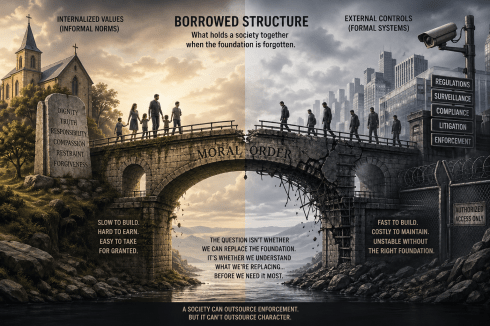
As informal norms weaken, societies compensate with formal mechanisms:
- more regulation
- more surveillance
- more litigation
- more explicit enforcement of what was once assumed
That shift isn’t inherently catastrophic. In many cases it works.
But it changes how order is maintained. It replaces internal constraint with external management—and that trade is rarely free.
You can see it at the margins: rising regulatory density, increased reliance on formal compliance systems in workplaces and institutions, growing legal mediation of disputes that were once handled informally. These trends have multiple causes, but they share a common feature—behavior that once required little enforcement now requires more of it.
The Secular Case—and Its Limit
A secular answer exists.
We can justify these norms through reason, reciprocity, and shared interest. We don’t need theology to understand cooperation or stability.
And in many cases, this works. High-trust secular societies demonstrate that norms can be transmitted without widespread religious belief.
The question is not whether this is possible.
It clearly is.
The question is whether these systems are fully self-sustaining over long time horizons, or whether they depend—quietly—on inherited assumptions that become harder to justify as those assumptions lose coherence.
That dependency is easy to miss because it feels like common sense.
It isn’t. It’s memory.
If these systems are fully self-sustaining, we would expect high-trust, high-restraint behavior to remain stable even as the underlying moral frameworks continue to thin. If they are not, the pressure will show up first at the margins—in declining informal trust, rising enforcement costs, and increasing reliance on explicit rules to maintain baseline order.
What This Argument Is—and Is Not
This is not an argument for belief.
It’s an argument against pretending we’re starting from nothing.
Societies that function well do not run on law and incentives alone. They rely on internalized limits—on what people will not do, even when they can.
Judeo-Christian ethics provided one version of that in the West. Other civilizations developed their own.
The open question is not whether we can discard those frameworks.
We already have.
The question is whether we understand what they were doing well enough to replace them—or whether we are still relying on them while insisting we are not.
The Uncomfortable Conclusion
Removing a foundation does not collapse a structure immediately.
It exposes, slowly, what the structure depended on—and whether we’ve mistaken inheritance for design.
Before we can decide what is right, we must first know what is true. Yet our culture increasingly reverses this order, making moral conviction the starting point of thought rather than its conclusion. Peter Boghossian, the philosopher best known for challenging ideological thinking in academia, once argued that epistemology must precede ethics. The claim sounds abstract, but it describes a very practical problem: when we stop asking how we know, we lose the capacity to judge what’s right.
Epistemology—the study of how we know what we know—deals with questions of evidence, justification, and truth. It asks: What counts as knowledge? How do we tell when a belief is warranted? What standards should guide our acceptance of a claim? Ethics, by contrast, deals with what we should do, what is good, and what is right. The two are inseparable, but they are not interchangeable. Ethics without epistemology is like navigation without a compass: passionate, determined, and directionless.
The Missing First Question
Socrates, history’s first great epistemologist, spent his life asking not “What is right?” but “How do you know?” In dialogues like Euthyphro, he exposes the instability of moral conviction built on unexamined belief. When his interlocutor claims to know what “piety” is because the gods approve of it, Socrates presses: Do the gods love the pious because it is pious, or is it pious because the gods love it? In that moment, ethics collapses into epistemology—the question of truth must be settled before morality can stand.
This ordering of inquiry—first truth, then virtue—was not mere pedantry. Socrates saw that unexamined moral certainty leads to cruelty, because it allows one to justify any act under the banner of righteousness. He was eventually executed by men convinced they were defending moral order. His death, paradoxically, vindicated his philosophy: without the discipline of knowing, moral zealotry becomes indistinguishable from moral error.
Why Epistemology Matters
Epistemology is not a luxury for philosophers; it is the foundation of all responsible action. It demands that we distinguish between evidence and wishful thinking, between understanding and propaganda. To have a sound epistemology is to have habits of mind—skepticism, curiosity, proportion, humility—that protect us from self-deception.
When those habits decay, moral reasoning falters. Consider the Salem witch trials. The judges sincerely believed they were protecting their community from evil, yet their evidence—dreams, hearsay, spectral visions—was epistemically bankrupt. Their moral horror was real; their epistemic standards were not. The result was ethical disaster.
We see similar failures today whenever moral conviction outruns verification. A viral video circulates online; a crowd declares guilt before facts emerge. Outrage replaces investigation. The moral fervor feels righteous because it’s anchored in empathy or justice—but its epistemic foundation is sand. Ethical action requires knowing what actually happened, not what we wish had happened.
When Knowing Guides Doing
When epistemology is sound, ethics becomes coherent, fair, and humane.
Take the principle “innocent until proven guilty.” It is not primarily a moral rule; it is an epistemic one. It asserts that belief in guilt must be justified by evidence before punishment can be ethically administered. That epistemic restraint is what makes justice possible.
The same holds true in science. Before germ theory, doctors believed disease arose from “bad air,” leading them to act ethically—by their lights—yet ineffectively. Once scientific evidence clarified the true cause of infection, moral duties became clearer: sterilize instruments, wash hands, protect patients. Knowledge refined morality. Sound epistemology made better ethics possible.
John Stuart Mill saw this dynamic as essential to liberty. In On Liberty, he wrote that “he who knows only his own side of the case knows little of that.” Mill’s insight is epistemological but its consequences are ethical: humility in belief breeds tolerance in practice. A society that cultivates open inquiry and debate is not merely more intelligent—it is more moral. For Mill, the freedom to question was not just an intellectual right but a moral obligation to prevent the tyranny of false certainty.
The Modern Inversion: Ethics Before Epistemology
Boghossian’s warning is timely because modern culture tends to invert the proper order. Many moral debates now begin not with questions of truth but with declarations of allegiance—what side are you on? The epistemic virtues of skepticism, evidence, and debate are recast as moral vices: to question a prevailing narrative is “denialism,” to request evidence is “harmful,” to doubt is “bigotry.”
The result is a moral discourse unanchored from truth. People act with conviction but without comprehension, certain of their goodness yet blind to their errors. Boghossian’s point is not that ethics are unimportant but that they cannot stand alone. If we do not first establish how we know, then our “oughts” become detached from reality, and moral judgment degenerates into moral fashion.
Hannah Arendt, reflecting on the moral collapse of ordinary Germans under Nazism, described this as the banality of evil—evil committed not from monstrous intent but from thoughtlessness. For Arendt, the failure was epistemic before it was ethical: people stopped thinking critically about what was true, deferring instead to the slogans and appearances sanctioned by authority. Their moral passivity was the fruit of epistemic surrender.
This same danger confronts us whenever ideology replaces inquiry—when images and narratives dictate belief before evidence is examined. To act justly, we must first see clearly; to see clearly, we must learn how to know.
The Cave and the Shadows
Plato’s Allegory of the Cave captures the enduring tension between knowledge and morality. Prisoners, chained since birth, mistake the shadows on the wall for reality. When one escapes and sees the sunlit world, he realizes how deep the deception ran. But when he returns to free the others, they resist, preferring the comfort of illusion to the pain of enlightenment.
We are those prisoners whenever we take appearances for truth—when we confuse social consensus with knowledge or mistake moral passion for understanding. The shadows dance vividly before us in the glow of our screens, and we feel certain we are seeing the world as it is. But unless we discipline our minds—testing claims, questioning sources, distinguishing truth from spectacle—we remain captives.
The allegory endures because it teaches that the pursuit of truth is not an abstract exercise but a moral struggle. To turn toward the light is to accept the discomfort of doubt, the humility of error, and the labor of learning. That discipline is the beginning of both knowledge and virtue.
Truth as the First Kindness
Epistemology precedes ethics because truth precedes goodness. To act ethically without first grounding oneself in what is true is to risk doing harm in the name of good. Socrates taught us to ask how we know; Mill reminded us to hear the other side; Arendt warned us what happens when we stop thinking; and Boghossian calls us back to the first principle that makes all ethics possible: the honest pursuit of truth.
In an age that rewards outrage over understanding, defending epistemology may seem quaint. Yet it is precisely our only defense against the moral chaos of a world that feels right but knows nothing.
Before we can do good, we must first be willing to know.
Truth, as it turns out, is the first kindness we owe one another.

References
- Arendt, H. (1963). Eichmann in Jerusalem: A Report on the Banality of Evil. New York: Viking Press.
- Boghossian, P. (2013). A Manual for Creating Atheists. Durham, NC: Pitchstone Publishing.
- Boghossian, P. (2006). “Epistemic Rules.” The Journal of Philosophy, 103(12), 593–608.
- Mill, J. S. (1859). On Liberty. London: John W. Parker and Son.
- Plato. (c. 380 BCE). The Republic, Book VII (The Allegory of the Cave). Translated by Allan Bloom, Basic Books, 1968.
- Plato. (c. 399 BCE). Euthyphro. In The Dialogues of Plato, translated by G.M.A. Grube. Hackett, 1981.
- Salem Witch Trials documentary sources: Salem Witch Trials: Documentary Archive and Transcription Project. University of Virginia, 2020.
- Socratic method reference: Vlastos, G. (1991). Socratic Studies. Cambridge University Press.
Author’s Reflection:
This piece was drafted with the aid of AI tools, which accelerated research and organization. Still, every idea here has been examined, rewritten, and affirmed through my own reasoning. Since the essay itself argues that epistemology must precede ethics, it seemed right to disclose the epistemic means by which it was written.
Hannah Arendt’s Eichmann in Jerusalem: A Report on the Banality of Evil remains one of the twentieth century’s most incisive dissections of moral failure. Published in 1963, the book emerged from Arendt’s firsthand reporting on the 1961 trial of Adolf Eichmann in Jerusalem, a mid-level Nazi bureaucrat whose role in orchestrating the deportation of millions of Jews to death camps defined the Holocaust’s logistical horror. Expectations ran high for a portrait of unalloyed monstrosity, yet Arendt delivered something far more unsettling: a portrait of profound ordinariness. Eichmann was no ideological zealot or sadistic fiend, but a careerist adrift in clichés and administrative jargon, driven by ambition and an unswerving commitment to hierarchy. From this unremarkable figure, Arendt forged her enduring concept of the banality of evil, a framework that exposes how systemic atrocities arise not from demonic intent but from the quiet abdication of critical thought.
The Trial That Shattered Expectations
Arendt arrived in Jerusalem as a correspondent for The New Yorker, tasked with chronicling the prosecution of Eichmann, the architect of the Nazis’ “Final Solution” in practice if not in origin. What she witnessed defied the trial’s dramatic staging. Eichmann, perched in his glass booth, projected not menace but mediocrity. He droned on in a flat, bureaucratic patois, insisting his actions stemmed from dutiful obedience rather than personal malice. “I never killed a Jew,” he protested, as if the euphemism absolved the machinery he oiled. This was no Iago or Macbeth, but a joiner par excellence: shallow, conformist, and utterly unable to grasp the human weight of his deeds. Arendt’s revulsion crystallized mid-trial, in her notebooks, where she first sketched the phrase that would redefine her legacy. The banality of evil was born not from Eichmann’s depravity, but from his incapacity for reflection—a thoughtlessness that rendered him complicit in genocide without the depth to comprehend it.
Unpacking the Banality: From Demonic to Mundane
At its core, the banality of evil upends the romanticized view of wickedness as inherently profound or radical. Evil, Arendt contended, often manifests as banal: the work of unimaginative souls who drift through conformity, failing to interrogate their roles in larger systems. Eichmann exemplified this through his linguistic sleight of hand. He evaded the raw truth of extermination, speaking instead of “transportations” and “processing,” terms that sanitized slaughter into spreadsheet entries. Hatred played little part; obedience, careerism, and social inertia sufficed. The terror lay in his normalcy. As Arendt observed, evil flourishes not among isolated monsters but in societies where individuals relinquish moral judgment to rules, authorities, or routines. This banality, she later clarified, arises from an active refusal to exercise judgment, transforming ordinary people into cogs of catastrophe.
Arendt wove this insight into her broader philosophical tapestry, where thinking emerges as the essential moral safeguard. In the Socratic tradition, genuine thought demands we question the rightness of our actions, bridging the gap between knowledge and ethics. Eichmann’s failure was not intellectual deficiency alone, but a willful suspension of this faculty—substituting slogans and protocols for scrutiny. She identified thoughtlessness as totalitarianism’s hallmark, a regime that trains citizens to obey without asking why, eroding the pluralistic dialogue vital to human freedom. Against this, Arendt posited “natality,” the human capacity for birth and renewal, as a counterforce: each new beginning compels us to initiate thought, disrupting entrenched banalities.
The Firestorm of Controversy
Arendt’s conclusions ignited immediate backlash. Critics, including Jewish intellectuals like Gershom Scholem, accused her of exonerating Eichmann and scapegoating victims by critiquing the Jewish councils’ coerced cooperation with Nazi demands. Her dispassionate tone struck many as callous, diluting the Holocaust’s singularity into a lesson in human frailty. Yet Arendt sought neither absolution nor minimization; her aim was diagnostic. Evil in bureaucratic modernity, she argued, stems from collective complicity, not just from fanatics. The ordinary enablers—those who obey without question—sustain the system as surely as the architects. This polemic endures, with debates persisting over whether Arendt undervalued antisemitism’s visceral role, but her thesis has proven resilient, outlasting the initial fury.
Philosophical Stakes: Redefining Moral Agency
Arendt’s innovation lies in relocating moral responsibility from sentiment to cognition. Agency begins not with feeling but with thought: the deliberate act of judging actions against universal principles. This aligns her work with deeper epistemic concerns, where unexamined beliefs pave the way for ethical collapse. Without the courage to probe “Is this true? Is this right?”, reasoning devolves into rote compliance. The banality of evil thus warns of disengagement in any apparatus—state, corporation, or ideology—where “just following orders” masks profound harm. In an age of institutional sprawl, her call to vigilant judgment remains a bulwark against the mindless perpetuation of injustice.
Lessons for Our Fractured Age: Thoughtlessness in Ideological Currents
Arendt’s framework offers stark lessons amid the ascendance of critical social constructivism, woke Marxism, and gender ideology—movements that, in their zealous conformity, risk replicating the very thoughtlessness she decried. Critical social constructivism, with its insistence that reality bends to narrative power, echoes Eichmann’s euphemistic detachment: truths are “constructed” not discovered, fostering a relativism where evidence yields to doctrinal fiat. Proponents, often ensconced in academic silos, propagate this without interrogating its epistemic costs, much as Arendt saw totalitarianism erode pluralistic inquiry. The result? A moral landscape where dissent is pathologized as “harm,” inverting Socratic dialogue into inquisitorial purity tests.
Woke Marxism, blending identity politics with class warfare rhetoric, amplifies this banality through performative allegiance. What begins as equity advocacy devolves into bureaucratic rituals—DEI mandates, cancel campaigns—that demand uncritical adherence, sidelining the reflective judgment Arendt deemed essential. Critics from leftist traditions note how this mirrors the “administrative massacres” she analyzed, where ideological slogans supplant ethical scrutiny, enabling everyday cruelties under the guise of progress. Ordinary adherents, like Eichmann’s clerks, comply not from malice but from careerist inertia, blind to the dehumanization they abet.
Gender ideology presents perhaps the most poignant parallel, transforming biological verities into fluid “affirmations” via sanitized language that obscures irreversible interventions. Global market projections for sex reassignment surgeries, valued at $3.13 billion in 2025, anticipate reaching $5.21 billion by 2030, underscoring this commodified banality: procedures framed as “care” evade the long-term harms to minors, much as Nazi logistics masked extermination. Voices like J.K. Rowling invoke Arendt directly, highlighting how euphemisms prevent equating these acts with “normal” knowledge of human development. Shallow conformity here—fueled by fear of ostracism—propagates misogynistic erosions of women’s spaces and youth safeguards, all without the depth to confront consequences.
Arendt’s antidote is uncompromising: reclaim thinking as moral praxis. In our screen-lit caves, where algorithms curate consensus and ideologies brook no doubt, we must cultivate epistemic humility—the willingness to question, to pluralize, to judge anew. Only thus can we arrest banality’s creep, ensuring that goodness, radical in its depth, prevails over evil’s empty routine. Thoughtlessness is not fate; it is choice. And in choosing reflection, we honor the dead by fortifying the living against their shadows.

References
Arendt, H. (1963). Eichmann in Jerusalem: A Report on the Banality of Evil. New York: Viking Press.
Arendt, H. (1958). The Human Condition. Chicago: University of Chicago Press. (For concepts of natality and action.)
Berkowitz, R. (2013). “The Banality of Hannah Arendt.” The New York Review of Books, June 6. (On ongoing debates of her thesis.)
Mordor Intelligence. (2024). Sex Reassignment Surgery Market Size, Trends, Outlook 2025–2030. Retrieved October 5, 2025, from https://www.mordorintelligence.com/industry-reports/sex-reassignment-surgery-market.
Rowling, J. K. [@jk_rowling]. (2024, December 28). “This astounding paper reminds me of Hannah Arendt’s The Banality of Evil…” [Post]. X. https://x.com/jk_rowling/status/1873048335193653387.
Scholem, G. (1964). “Reflections on Eichmann: The Trial of the Historian.” Encounter, 23(3), 25–31. (Open letter critiquing Arendt’s portrayal.)
Villa, D. (1996). Arendt and Heidegger: The Fate of the Political. Princeton: Princeton University Press. (For connections to Socratic thinking and totalitarianism.)
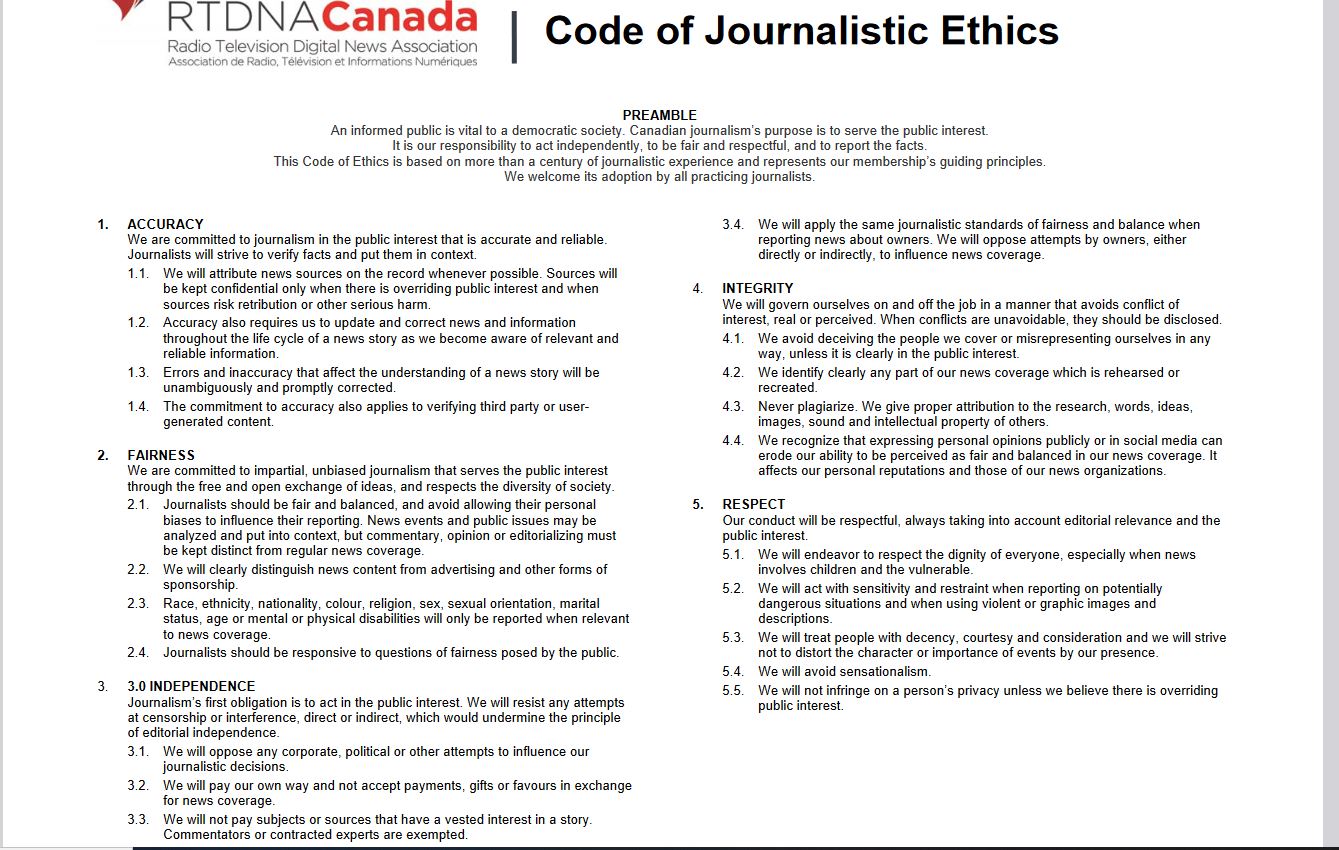
We need a media we can put more trust in. Let’s start with this.
“The psychopath’s response to people who suffer indicates that what we recognise as morality might be grounded not simply in positive, prosocial emotions but also in negative, stressful and self-oriented ones. This is not some cuddly version of empathy, but a primitive aversive reaction that seemingly has little to do with our caring greatly for the humanity of others.
Yet what exposes our common humanity more than the fact that I become personally distressed by what happens to you? What could better make me grasp the importance of your suffering? The personal part of empathic distress might be central to my grasping what is so bad about harming you. Thinking about doing so fills me with alarm. Arguably, it’s more important that I curb my desire to harm others for personal gain than it is for me to help a person in need. Social psychology research has focused on how we’re moved to help others, but that’s led us to ignore important aspects of ethics. Psychopathy puts personal distress back in the centre of our understanding of the psychological underpinnings of morality.
The last lesson we can learn concerns whether sentimentalists or rationalists are right when it comes to interpretations of the moral deficits of psychopaths. The evidence supports both positions. We don’t have to choose – in fact, it would be silly for us to do so. Rationalist thinkers who believe that psychopaths reason poorly have zoomed in on how they don’t fear punishment as we do. That has consequences down the line in their decision making since, without appropriate fear, one can’t learn to act appropriately. But on the side of the sentimentalists, fear and anxiety are emotional responses. Their absence impairs our ability to make good decisions, and facilitates psychopathic violence.
Fear, then, straddles the divide between emotion and reason. It plays the dual role of constraining our decisions via our understanding the significance of suffering for others, and through our being motivated to avoid certain actions and situations. But it’s not clear whether the significance of fear will be palatable to moral philosophers. A response of distress and anxiety in the face of another’s pain is sharp, unpleasant and personal. It stands in sharp contrast to the common understanding of moral concern as warm, expansive and essentially other-directed. Psychopaths force us to confront a paradox at the heart of ethics: the fact that I care about what happens to you is based on the fact I care about what happens to me.”
 We’ve all experienced the inner hardening, and turning away when faced with another human being in need. Of course it isn’t indicative of us being a psychopath, but the ability to realize that ethical distance is trait we all share. I realize the pain and suffering of people who are starving, but they are far away and I can turn away and ignore their suffering and get along with my life.
Seems kinda shitty once you think about it, and the fact that most people do it doesn’t lessen the gravity of this particular ethical failure. Yet, the behaviour will persist, a dubious solution to the real life situations that run up against our moral understanding of the world.
This sort of ethical dilemma is illustrated in the series Breaking Bad. I’m almost done (two episodes left) watching Breaking Bad, and the moral path Walter White chooses to walk seems to illustrate the how muddy ‘good ethical behaviour’ gets once it hits the real word.
“To be clear, a moral injury is not a psychiatric diagnosis. Rather, it’s an existential disintegration of how the world should or is expected to work—a compromise of the conscience when one is butted against an action (or inaction) that violates an internalized moral code. It’s different from post-traumatic stress disorder, the symptoms of which occur as a result of traumatic events. When a soldier at a checkpoint shoots at a car that doesn’t stop and kills innocents, or when Walter White allows Jesse’s troublesome addict girlfriend to die of an overdose to win him back as a partner, longstanding moral beliefs are disrupted, and an injury on the conscience occurs.”
What quality makes people bounce back from a moral injury, or turn further toward questionable moral choices? We’d all like to think we belong to the class of upstanding, moral citizens – but how long does that last once the unkind vicissitudes of life go into overdrive?











 bleatmop
 Mystro
 The Arbourist


 Dead Wild Roses
Your opinions…