
The distinction between Islam and Islamism is useful. Islam is a diverse religion; Islamism is the political project of ordering society and the state according to an assertedly Islamic system. Confusing the two turns every Muslim into a political suspect. Pretending they have nothing important to do with one another, however, requires a different kind of dishonesty.
Islamism also covers more than terrorism or armed jihad. Its adherents may pursue power through political parties, welfare and religious institutions, demands for parallel jurisdiction, pressure for censorship and blasphemy laws, or violence. Those methods are not morally equivalent, but they share the conviction that Islam supplies not merely private belief or moral guidance, but the authoritative framework by which public life should be governed.
A recent New Discourses podcast approaches the issue through Sayyid Qutb’s Milestones, one of the formative texts of modern revolutionary Islamism. In its chapter on jihad, Qutb argues that establishing God’s sovereignty means enforcing divine law and abolishing laws made by human beings. Preaching alone cannot accomplish this because the institutions exercising political and social power will not voluntarily surrender it. Religious proclamation must therefore operate alongside “the movement,” which confronts the material obstacles standing between belief and Islamic rule.
Qutb’s formulation exposes something that polite Western discussion often obscures. Islamism is not merely ordinary authoritarianism wearing an Islamic costume, nor is it an alien ideology arbitrarily grafted onto an otherwise private faith. Its concepts—divine sovereignty, sharia, jihad, the ummah and the exemplary authority of Muhammad and the early Muslim community—are drawn from Islam itself. Islamists may interpret those sources selectively or radically, but they are not citing them by accident.
The argument becomes weaker, however, if Qutb is allowed to speak for Islam as a whole. He was a twentieth-century revolutionary who assembled older Islamic concepts into a modern political program, not the neutral curator of an uncontested tradition. Muslims have produced rival interpretations across centuries, and many today accept religious pluralism and democratic government. Their existence cannot be dismissed as counterfeit belief merely because Qutb would have dismissed it that way.
Nor does recognizing Islamism’s Islamic roots assign collective guilt to Muslims. Ideas have genealogies; people have agency. A Muslim who rejects the coercive political project is not responsible for it simply because an Islamist invokes the same scripture. By the same measure, Islamists cannot be insulated from scrutiny by insisting that any examination of their religious claims constitutes hatred of Muslims.
Both errors serve the extremists. Collapsing Islam into Islamism grants Islamists the status they covet as the authentic representatives of every Muslim. Severing the two protects Islamist doctrine from the criticism applied to every other political ideology.
The classical liberal answer is equal liberty under neutral rules. Muslims possess the same freedom of conscience, worship, speech and political participation as everyone else. What they do not possess—and what no religious or political constituency should possess—is an exemption from laws governing intimidation, obstruction or the use of public space.
Mass public prayer is protected religious expression. If a gathering blocks roads, occupies civic space without authorization or prevents others from exercising their rights, however, the relevant rules should be enforced exactly as they would be against Christians, environmentalists or striking workers. When authorities relax enforcement because they fear communal tension or accusations of prejudice, tolerance has curdled into unequal treatment.
The language surrounding “Islamophobia” presents a related danger. Anti-Muslim hatred and discrimination are real and should be opposed. Islam, however, is a body of religious claims, not a person possessing civil rights. When “Islamophobia” is used to collapse criticism of Islamic doctrine into hostility toward Muslims, it becomes an ideological shield against examination. People are entitled to equal protection; religions are not entitled to protection from criticism.
Militant Islamism is not a hypothetical challenge. Through terrorism, intimidation, blasphemy enforcement and campaigns to subordinate civil law, it has demonstrated its hostility to liberal society. Western nations must confront that threat openly—in policing, security policy and the public square.
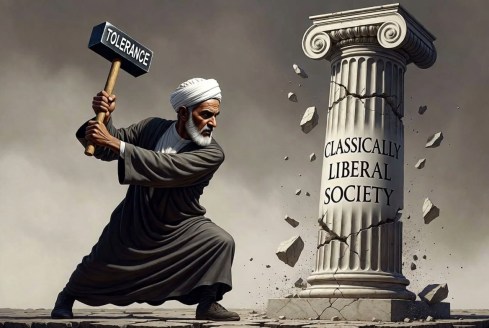
The paradox of tolerance is not a licence to suppress Muslims or peaceful belief. It is a warning that tolerance cannot survive if it grants coercive movements the freedom to destroy the conditions that make tolerance possible. Islamism grows from within Islam; it is neither the whole tree nor a foreign vine. Opposing it without collective guilt requires candour, equal enforcement and the confidence to defend our liberal inheritance.











 bleatmop
 Mystro
 The Arbourist


 Dead Wild Roses
7 comments
Comments feed for this article
August 2, 2026 at 5:55 am
Vala
Barbarians, all of them.
LikeLike
August 2, 2026 at 7:19 am
tildeb
Islam is a totalitarian religion. There is no ‘extremism’. One is either a good Muslim or a bad Muslim. Everyone outside of that is kafir, someone who denies God and worthy if not of death then certainly subhuman treatment. History demonstrates the truth of this belief.
Sure, many part of the Koran (and Hadith) will talk about peace and kindness and love and yada, yada, yada, yet all of these fall under the sword of abrogation (9:5) , meaning these verses of scripture and early history of Mohamad are subordinate to the violence and call to holy war the later Koran (and Hadith) makes on every good Muslim.
To pretend Islam and Islamism are separate and distinct branches that run from liberal to moderate to extremism of this totalitarian belief system that can be moderated by reason misunderstands and misreports the fundamental totalitarianism always at work. Fear of this totalitarian colonizing intolerant system in all its guises is what’s reasonable because it reaches into every aspect of human life and dictates ‘correct’ behaviour, ‘correct’ beliefs’. Individual rights and freedoms are incompatible and therefore evil, an affront to God, worthy of death for anyone who so affronts Allah this way. The duty of every Muslim is to obey (and carry out the five pillars).
The fact of the matter is that there simply is no compromise with Islam allowed in any area of life allowed that isn’t condemned by Islam as being kafir. There is no tolerance for kafir beliefs. There is only condemnation. Of course, the reverse is not true. Muslims expect tolerance and state protection and group rights until Islam can take totalitarian control. To believe Islam is anything other than totalitarian is a direct threat to every human who is not accepting of Islam. This narrative contrary to reality is beyond foolish even if it is the kumbaya version forwarded by AI; it is a guarantee of servitude and death for all of us. It’s certainly the death of the West and will be at a never-ending state of war with any other totalitarian system.
LikeLike
August 2, 2026 at 7:51 am
tildeb
Because antisemitism is demanded by Islamic scripture, there can never be any lasting peace and tolerance but annihilation of every Jew and, of course, Israel. We see this play out ad infinitum inside every country that is accepting of Islam.
Canada specifically must be called out on this appeasement under the banner of ‘Islamophobia’ because belief in this term undermines any and all reasonable responses, a way to cast any legitimate and justified criticism of expressions and impositions motivated by Islam as if a ‘hate’ crime. The country is now overtly hostile to Jews through official inaction of actual hate and violence responded to with biased action-thwarting committees and we are seeing the exodus of Jews. Who is the real target of hate?
All of this is perfectly acceptable to every level of government and growing segment of the population while we slowly slit our own liberal throats to better accommodate Islam’s eventual triumph. Tolerating Islam in the public square is a death knell.
LikeLiked by 1 person
August 2, 2026 at 9:10 am
The Arbourist
@tildeb
I think we agree about most of the danger. Islam contains political and legal doctrines that are incompatible with liberal democracy, and Islamist movements are actively trying to advance them. Some Muslim communities resist integration and seek accommodation for beliefs that liberal societies should firmly reject. I am not minimizing any of that.
This is why I write pieces like this. I am trying to work out what principles a liberal society must follow if it intends to preserve the creed that makes it possible. This is not a plea for mealymouthed tolerance or an excuse to avoid naming the threat. It is a demand that society hold itself to the laws and principles it purports to honour, especially when doing so is difficult.
That means confronting Islamist organizations, enforcing one civil law, protecting freedom of speech and refusing demands for parallel religious authority. It also means judging individuals by what they believe and do. A serious threat can exist within doctrines, movements and communities without making every Muslim an agent of it.
If a Muslim accepts equal citizenship, civil law and freedom of conscience while rejecting the coercive enforcement of sharia, I will judge him accordingly. If he seeks religious supremacy or unequal rights for unbelievers, I will judge that accordingly as well.
Once religious identity itself becomes evidence of guilt, we have adopted the totalizing friend–enemy distinction we claim to oppose. Liberal society can defend itself forcefully, but its defence still has to remain liberal.
LikeLike
August 2, 2026 at 9:28 am
The Arbourist
*Si vis pacem, para bellum*—if you want peace, prepare for war. I agree with that principle, and Canada has not prepared itself well.
Islamic scripture and tradition contain deeply anti-Jewish material, and those elements continue to feed Islamist antisemitism. The rise in threats, vandalism and violence directed at Canadian Jews is real. Our governments have responded too slowly and inconsistently, often substituting consultations and committees for the enforcement of laws already on the books. “Islamophobia” must never be allowed to turn legitimate criticism of Islamic doctrine or Islamist politics into an accusation of hatred against Muslims.
Preparation, however, requires accurate distinctions. It means secure borders, competent intelligence services, the prosecution of terrorist networks, protection for Jewish institutions, equal enforcement of public-order laws and an unapologetic defence of free speech and civil law.
I cannot follow you from there to the conclusion that allowing Islam in the public square is itself a death sentence. That makes Muslim identity evidence of hostility before any individual belief or action has been established.
There is also a strategic reason to resist that conclusion. Islamist extremists benefit when liberal societies overreact. ISIS openly described its desire to eliminate the “gray zone” in which Muslims and non-Muslims coexist. An indiscriminate response helps them persuade Muslims that peaceful citizenship is impossible and non-Muslims that every Muslim is an enemy.
We should confront Islamist antisemitism without hesitation. We should also understand that provocation and polarization are among the methods used against us. If our response eliminates every distinction between an Islamist demanding religious supremacy and a Muslim accepting equal citizenship, we have helped create the conflict the extremists want.
A liberal society must be capable of defending itself, but competent defence begins by identifying the actual enemy.
LikeLike
August 2, 2026 at 9:52 am
tildeb
The solution starts only by recognizing the problem. The problem is that we are collectively failing to grant equality rights to all AND enforce liability for transgressing this necessary fence. Islam supported in the public domain is fatal to equality rights and all human freedoms. This is a fact. So the solution must be to disallow Islam to be supported or even tolerated in the public domain. That’s the dividing line. But the freedom to believe Islamic doctrine can co-exist with liberal values ONLY in the private domain… like any other religious belief must do for our collective and shared rights and freedoms to believe as we wish to believe to survive the inevitable incompatibility when implemented in the public domain. That cannot be allowed to happen. Private = allowable and tolerated. Public = not allowable and met with necessary institutional intolerance.
Because so many people confuse individuality and public behaviour as if synonymous, we get Islam supplanting liberalism in the public domain. This is its totalitarian goal. We as a civilization allow this supplanting to occur under our watch only by exchanging our rights and freedoms with a faux-tolerance of its stealth attack against them. Disagreeing with this exchange is our civic duty.
LikeLike
August 2, 2026 at 10:09 am
tildeb
When any criticism is considered ‘islamophobic’ and, by definition a hate crime, we’ve lost the battle. Throw in ‘racism’ to create the perfect triumvirate to excuse this appeasement as not wanting to ‘instigate’ more ‘extremism’ or promote ‘racism’ binds us to an official path of submission to Islam. That’s exactly how we get Pakistani rape gangs working under tacit acceptance by all public institutions for decades creating literally hundreds of thousands of victims and two tiered policing. That’s how we get the larger crime of ‘hating’ official policy versus the smaller crime of subverting western liberal democracy and undermining all liberal values to the point of irrelevancy and institutionalized social dysfunction. This is our chosen path and we are well down it. No solution rests outside of standing firmly against the public encroachment of an incompatible totalitarian religion we only call ‘extreme’ in order to continue the fiction that there is such a thing as a ‘moderate’ version of it.
LikeLike