
You are currently browsing the tag archive for the ‘Rhetoric’ tag.
There is a reason the recent interview on TRIGGERnometry featuring Andrew Wilson has drawn attention. Wilson does not simply argue positions; he shifts the ground beneath them. In a discussion about subjective morality and objective truth, that ability is decisive. Much of his effectiveness comes not from the novelty of his claims, but from the speed and clarity with which he forces his interlocutors to confront the implications of their own assumptions.
At the center of his argument is a compressed but powerful move. If morality is subjective, then moral claims reduce to preference. If they reduce to preference, then disagreement cannot be resolved through appeal to truth, but only through assertion and enforcement. From there, the conclusion follows: without objective morality, ethics collapses into power. It is a clean chain of reasoning, rhetorically efficient and difficult to interrupt in real time, especially when opponents have not fully examined the foundations of their own views.
Part of what makes this approach so effective is that it presses on a genuine weakness in much contemporary moral discourse. Secular arguments about morality often appeal to harm, fairness, or consensus. These are intuitively compelling and widely shared, but they are not self-grounding in a strict sense. They rely on assumptions that are rarely defended at a deeper level. When Wilson asks why these principles should bind anyone who does not already accept them, the hesitation that follows is real. Moral language tends to present itself as if it refers to something objective, even when speakers explicitly deny that such objectivity exists. That tension creates an opening, and Wilson exploits it with precision.
There is, in other words, a strong version of his argument. If moral claims are entirely subjective, then their authority becomes difficult to justify beyond the boundaries of a given framework. The question “why should anyone outside your system care?” is not rhetorical; it is a genuine challenge. It exposes the gap between the way people speak about morality and the way they often ground it, if they ground it at all. On this point, Wilson is not merely performing. He is identifying a real philosophical pressure.
The difficulty lies in what follows. Wilson moves from the observation that subjective morality has grounding problems to the conclusion that it therefore collapses into power. That step is doing more work than it appears. It bypasses a large middle space in which most moral systems actually operate. Societies do not typically function by reducing all moral claims to arbitrary preference, nor do they rely on universally agreed metaphysical truths. They operate through a combination of norms, institutions, reciprocal expectations, and forms of reasoning that are neither purely objective nor wholly arbitrary. These structures impose real constraints on behavior. They shape incentives, establish boundaries, and generate predictability over time.
A simple example makes the point. Most people keep small promises—returning a borrowed item, showing up when they say they will—not because of objective moral truth, but because repeated interaction makes reliability valuable and defection costly. Over time, those expectations harden into norms that feel binding, even if their origin is entirely practical.
Underlying Wilson’s move is an assumption that if a claim is not objectively grounded, it has no binding force. That assumption is not obviously correct. Much of what governs human behavior lacks objective grounding in a strict philosophical sense. Laws, contracts, and social norms are not objective truths in the way physical laws are, yet they bind behavior effectively. Their force arises from shared expectations, enforcement mechanisms, and the long-term costs of violation. The relevant question, then, is not simply whether morality is objective, but what kinds of systems are capable of generating stable and predictable constraints on human conduct.
“Wilson doesn’t defeat morality without objectivity—he defeats weaker versions of it faster than they can defend themselves.”
Wilson’s own solution—grounding morality in God—does attempt to solve this problem by anchoring obligation outside human preference. Whether that succeeds is a separate question. It secures authority for those who accept it, but does not obviously resolve disagreement among those who do not.
This is where the conversation in the interview begins to fragment. Wilson is arguing at the level of justification: what ultimately grounds moral claims and gives them authority. The hosts, by contrast, are operating at the level of function: how moral systems work in practice and how societies maintain order and cooperation. These are related but distinct questions. One concerns philosophical legitimacy; the other concerns social viability. When they are treated as interchangeable, the discussion collapses into confusion. Wilson’s advantage is that he keeps the focus tightly on justification, where his binary framing is strongest. The hosts attempt to shift toward function, but without fully articulating how functional systems can resist the collapse he describes, their responses remain incomplete.
A more effective reply would have acknowledged the grounding problem while resisting the forced conclusion. Even if morality is not objectively grounded, it does not follow that it is arbitrary or that it reduces to raw power. Systems of cooperation and constraint can emerge from the conditions of human life itself: shared vulnerability, repeated interaction, and the high cost of disorder. These factors generate incentives for stable norms and predictable behavior. They do not eliminate conflict or disagreement, but they provide a framework within which those disagreements can be managed without constant recourse to coercion.
This does not eliminate the binding problem entirely. Functional systems explain why cooperation emerges and persists, but they do not fully answer why an individual should comply when defection is advantageous and enforcement is weak. That tension remains, even in the most stable societies.
Wilson’s rhetorical strength lies in the fact that he does not need to defeat this more complex position. He only needs to expose the instability of a weaker one. Once his opponents concede that morality is subjective without offering a robust account of how subjective systems generate binding norms, he can recast their position as preference backed by social pressure and, ultimately, by force. That recasting is not entirely wrong, but it is incomplete. It compresses a complicated reality into a stark alternative, and in doing so it gains persuasive force at the cost of nuance.
The result is an argument that is both powerful and limited. It succeeds as a critique of poorly grounded moral subjectivism, but it overreaches when it claims that subjectivity necessarily entails collapse into power. In practice, moral systems occupy a space between objective truth and arbitrary preference. They are constructed, negotiated, and enforced, but they are also constrained by human conditions that make certain arrangements more stable than others.
Wilson is, in this sense, asking a legitimate question. The problem is that he answers it too quickly. By collapsing the range of possible moral systems into a binary, he forces clarity but sacrifices accuracy. That trade-off is what makes him such an effective debater. It is also what limits the depth of the conclusions he draws.
[Note: The listening/mirroring technique here is adapted from approaches outlined in How to Have Impossible Conversations.]
Most arguments don’t fail because one side is wrong.
They fail because neither side is actually listening.
What passes for debate is often parallel monologue: each person waiting for their turn to correct, reframe, or condemn. The collapse happens early—sometimes before the first real claim is even made. A label is applied, a motive is assigned, a conclusion is declared. The exchange ends before it begins.
If you can get past that—and sometimes you can—there is a simple discipline that changes the quality of the conversation.
It feels slow.
It feels like you’re giving something up.
It works.
The Three-Step Method
1. Listen Without Drafting Your Rebuttal
This is the constraint.
When you disagree, your mind races ahead. You start assembling the counter while the other person is still speaking. You catch fragments, miss structure, and fill the gaps with what you expect them to say.
That is how you end up arguing with a version of their position that exists mostly in your own head.
If you want a real exchange, you have to let the argument land in full before you touch it.
2. Mirror the Argument Back
Once they’ve finished, restate their position in your own words:
“If I’ve got you right, you’re saying…”
This is not a rhetorical move. It is a calibration step.
You’re trying to capture the claim, the mechanism, and the stakes as you understand them—not a weaker version, not a cleaner version, but the version you think they actually mean.
3. Ask for Confirmation
Then check it:
“Is that a fair representation?”
If they say yes, you now share a starting point.
If they say no, you’ve just prevented a wasted argument.
Either way, you’ve improved the conversation.
Why This Works
Most arguments fail at the level of misunderstanding, not disagreement.
People talk past each other, attack softened targets, and leave thinking they’ve won. What they’ve done is avoid contact.
Mirroring forces contact.
It aligns the map before you start fighting over the territory.
The Cost
It is slower than trading blows.
It feels like conceding ground.
And it requires a small act of restraint: you prioritize their clarity before your correction.
That runs against instinct, especially when you’re confident they’re wrong.
The Payoff
When you mirror someone accurately, two things happen:
- Their defensiveness drops because they’ve been understood
- Your criticism lands because it targets their actual position
Now the disagreement can do useful work.
Not louder. Not sharper.
Just accurate.
Verdict
Arguing is an art.
But listening—disciplined, deliberate, and verified—is the condition that makes the art possible.
Without it, you’re not debating.
You’re performing.

Posted by the NDP’s Peggy Wright on X.

There is a recurring pattern in modern policy debates that most people sense but struggle to name. The argument presented to the public is not the policy that gets implemented. Instead, a broadly agreeable claim—something no reasonable person would oppose—is used to carry a far more specific and contested agenda into law. By the time the details become visible, the argument has already been won at the level that matters.
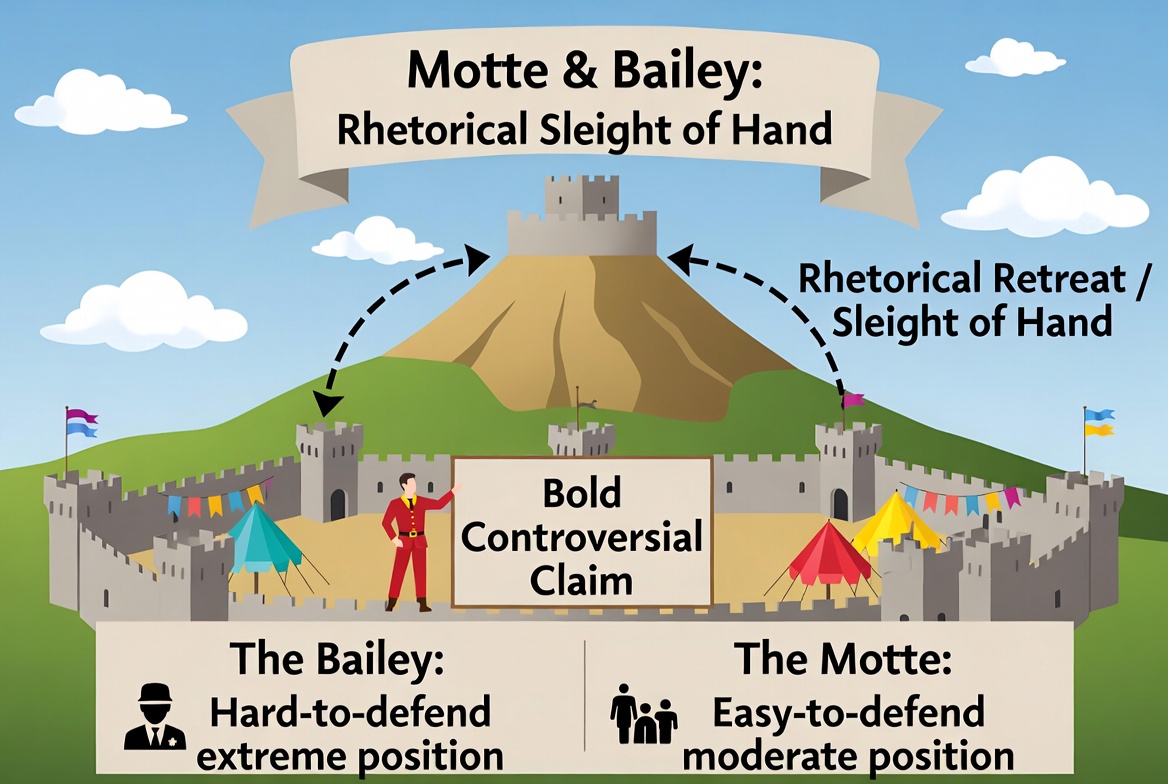
This is the structure known as the motte and bailey. The “motte” is the safe, defensible position: a statement so benign it feels almost churlish to resist. The “bailey” is the real position—the one with consequences, tradeoffs, and enforcement mechanisms. The move is simple. Sell the motte. Build the bailey. When challenged, retreat to the motte and accuse critics of attacking something obviously good.
You can see the pattern clearly in the recent dispute over education language. The public claim is that schools should be “welcoming,” “inclusive,” and respectful of “diversity.” No serious person objects to that in the abstract. But those terms are not operating as neutral descriptions. They have acquired specific policy meanings, often tied to particular ideological frameworks, institutional practices, and expectations placed on teachers and students. When legislation attempts to narrow or neutralize that language—shifting toward behavior-based standards like “safe and caring” environments grounded in responsibility and respect—the response is immediate: the government is “removing welcome,” attacking “diversity,” harming children. The motte is invoked as if it were the policy itself. The bailey disappears from view.
Watch the Move
In a recent legislative speech, MLA Peggy Wright provides a clean example of how this works in practice. She begins with a familiar image:
“Albertans put welcome mats in front of their doors. It means ‘come on in’ and we’re glad you are here.”
No disagreement is possible there. It is a moral and cultural baseline. But then the shift occurs. A change in statutory language becomes:
“the UCP is pulling up the welcome mat from all public schools.”
A metaphor replaces the policy. The audience is invited to react to exclusion rather than examine the legislation. The escalation continues:
“Gone are the days when schools were welcoming and inclusive places… celebrating diversity and uniqueness.”
At this point, the argument is no longer about wording. It is about intent, character, and harm. The key moment follows:
“the latest amendments… would strip words like ‘welcoming’ and ‘diversity’ from it.”
This is where the real question should be asked: does removing those words remove the underlying protections, or does it replace one framework of description with another? That question is never addressed. Instead, the speech returns immediately to moral framing:
“Diversity is a strength.”
In the abstract, yes. But the dispute is not over the abstract claim. It is over what “diversity” means in policy and practice. By collapsing the contested meaning into the harmless one, the argument avoids defending the actual implications. Criticism of the policy is recast as opposition to a universal good.
“The argument people agree to is not the policy that gets implemented.”
The most revealing line in the speech is this:
“Words are important… because they set the tone.”
That is true—and it explains the entire strategy.
This pattern isn’t random. It reflects a broader shift in how language is used in politics. Words like “diversity,” “inclusion,” and “safety” are no longer just descriptive. They function as instruments. If language helps shape how institutions operate and how people interpret reality, then controlling definitions becomes a form of power. Under that logic, you don’t need full public agreement on the details of a policy. You need agreement on the framing. Once that is secured, the content can expand behind it.
That helps explain why the motte and bailey is so effective. It allows advocates to operate on two levels at once. The public-facing level is morally attractive and broadly supported. The operational level is narrower, more contested, and often insulated from direct scrutiny. When the two are conflated, consent is manufactured. People believe they are endorsing a general principle when, in practice, they are enabling a specific program.
It works because most people are not trained to interrogate language this way. “Inclusion” sounds like inclusion. “Diversity” sounds like a mix of backgrounds and perspectives. “Safety” sounds like protection from harm. The terms carry moral weight before any definition is examined. By the time someone asks what they actually entail in practice, the rhetorical ground has already shifted. Opposition can be framed as hostility to the value itself rather than disagreement with its implementation.
The cost is not just confusion. It is the erosion of honest disagreement. If every critique of a policy can be recast as an attack on a universally accepted good, then meaningful debate becomes impossible. Language stops clarifying differences and starts concealing them. Institutions drift, not because the public has clearly chosen a direction, but because the terms of choice were never presented plainly.
This is why the technique matters. It is not just sharp rhetoric. It is a way of bypassing consent. If citizens cannot distinguish between the principle they are being asked to affirm and the policy that will follow from it, then they are no longer participating in a genuine democratic process. They are being managed through language.
If you think this reading is unfair, read the full remarks below and decide for yourself.
Appendix: Full Speech Transcript (April 2, 2026)
How to read this: Watch for the shift between general claims (“welcome,” “diversity”) and the specific policy being discussed. The argument depends on treating them as the same.
Full transcript of the video (Alberta Legislative Assembly session, ~1:57 long):
“Mr. Speaker, Albertans put welcome mats in front of their doors. It means ‘come on in’ and we’re glad you are here. And welcome to our house.But now the UCP is pulling up the welcome mat from all public schools.Gone are the days when schools were welcoming and inclusive places for students, celebrating diversity and uniqueness.That’s because the latest amendments to the Education Act would strip words like ‘welcoming’ and ‘diversity’ from it.This government combed through that bill and pulled the word ‘welcoming’ out eight times.Not satisfied with making our public schools less inviting — even as they function as important community hubs for many of our communities — then they went through and chopped the word ‘diversity’ out five times.Diversity is a strength.It used to say so in government policy, in legislation. But I guess not anymore.Words are important, Mr. Speaker, and that’s because they set the tone.When those in charge are threatened by words like diversity, welcome, and sense of belonging, there’s a problem. Because this is then about ideology and politics outside the classroom, not within.Instead of focusing on reducing class sizes, hiring teachers, and ensuring supports are there for all kids who need them, we get this distraction from a bill and government intent to narrow the frame so much that there is room for only one worldview: the UCP’s.And that’s the point.Straight out of the authoritarian playbook, Mr. Speaker.But, Mr. Speaker, our kids deserve that welcome mat back. I, for one, am extremely happy to let them know that they can expect it come next election, when it’s NDP in government and UCP — not our kids — who will find themselves unwelcome.”
Online discourse is exhausting for a simple reason: certain words are used not to describe reality, but to end the conversation. The label does the work. The argument never has to.
“Fascist” is one of those words.
In current usage, it often functions as a moral airhorn: you’re beyond the pale; you’re dangerous; you’re not worth debating. It gets tossed at people over ordinary ideological disputes about sex and gender, about speech norms, about state power, about immigration, about education. Sometimes it’s malice. Sometimes it’s a sincere attempt to name something authoritarian using the most nuclear term available. Either way, the practical effect is the same: “fascist” becomes a conversation-stopper rather than a description.
That’s why definitions matter. Not because language never evolves (it does), but because political language has consequences. When a term carries a freight of historical evil, using it casually is not “rhetorical adaptation.” It’s moral inflation. Moral inflation does not stay rhetorical for long.
Fascism isn’t just “authoritarian”
Start with what fascism is not.
Fascism is not merely “oppressive, dictatorial control.” That’s too broad. Plenty of regimes are oppressive. Plenty of dictators are brutal. If “fascist” just means “authoritarian,” it becomes a synonym for “bad,” and then it means nothing at all.
Fascism is a historically specific modern political project. A workable definition, tight enough to guide usage and broad enough to cover the main cases, looks like this:
Fascism is an authoritarian mass movement aimed at national rebirth, organized around the leader principle, hostile to liberal constraints (pluralism, due process, free speech), willing to use intimidation or violence against opponents, and committed to subordinating institutions to a single national story.
Notice the “mass movement” piece. Fascism is not only what the state does; it’s what a mobilized public is trained to do for the regime. It does not merely punish dissent. It cultivates a moral atmosphere in which dissent feels like treason, contamination, sabotage.
Economically, fascist systems often preserve nominal private ownership while subordinating markets, labour, and industry to regime goals through state direction and corporatist control. That’s not the essence, but it’s part of the recognizable package: the economy exists for the national project, not the other way around.
History: what it looked like when it was real
Words should cash out in the world.
Historically, fascism is anchored in early 20th-century Europe, most centrally Mussolini’s Italy and Hitler’s Germany. They differed in important ways, but the family resemblance is clear: politics becomes a spiritual drama of national humiliation and promised restoration; the leader becomes the embodiment of the nation; opposition becomes illegitimate by definition; and coercion becomes normalized as “necessary” for unity and renewal.
The methods are recognizably modern: propaganda, spectacle, the disciplining of media and education, the weaponization of law, the tolerated use of street-level intimidation, and the steady narrowing of permissible speech and association. It’s not merely “the government is strong.” It’s the fusion of power with myth, enforced socially and legally.
A practical threshold: not one trait, a cluster
If you want to use “fascist” responsibly, you need a threshold. Not a single feature, a cluster.
The label starts to become warranted only when several of these are present together:
- Leader principle: politics organized around a singular figure or party claiming a unique right to rule.
- Myth of national rebirth: humiliation plus promised restoration demanding unity and purification.
- Anti-pluralism: opponents treated as enemies, not fellow citizens.
- Suppression of dissent: legal, institutional, or social narrowing of speech and association.
- Propaganda and spectacle: mass emotional mobilization replacing open contest.
- Normalization of intimidation: harassment, threats, “consequences,” or violence used as political tools.
- Institutional capture: courts, schools, media, and professions bent into ideological instruments.
This is also how you keep your head when the internet offers you cheap clarity. If someone is merely wrong, stubborn, rude, or convinced, that is not fascism. If someone wants stronger regulation, that is not fascism. If someone defends free speech, or argues about sex and gender, that is certainly not fascism by definition. Those are disputes inside ordinary politics, however heated.
A concrete misuse: the pattern in miniature
Here’s the move you see constantly:
A person says, “I think compelled speech policies in workplaces and schools are a mistake.”
The reply is not, “I disagree, because…”
The reply is, “Fascist.”
What did the label accomplish? It converted a claim about policy into an accusation about moral essence. It implied the speaker is not merely mistaken but dangerous; not merely wrong but disqualifying. Once you have categorized someone as a “fascist,” the next steps feel justified: deplatforming, professional punishment, social exile, denial of hearing.
Maybe the labeler was “just venting.” Maybe it was “good-faith hyperbole.” But hyperbole has downstream effects. It trains the audience to treat coercion as civic hygiene.
Symmetry: this is not a left-only sin
And yes: the right does its own version. “Marxist” becomes a synonym for “liberal.” “Communist” becomes “anyone who wants a program.” “Groomer” becomes a sloppy club for any disagreement about education. “Traitor” becomes shorthand for “opponent who won.” Same mechanism, different tribe: labels as argument-substitutes and permission structures.
If we’re going to complain about language used as a weapon, we don’t get to only notice it when it hits our side.
Why this matters beyond the internet
The problem isn’t just vibes on social media. Label inflation spills into institutions.
When terms like “fascist” become casual descriptors, workplaces and professional bodies begin treating contested political disagreement as a safety issue. Media narratives start pre-sorting dissent as extremism. Politicians learn to substitute moral denunciation for persuasion. The public learns to fear argument and love punishment.
The final irony is that this habit corrodes the liberal norms that make pluralistic society possible: the expectation of disagreement, the discipline of evidence, and the moral restraint of not treating opponents as vermin.

A better standard
Here’s the rule I’m adopting: I’ll reserve “fascist” for cases where I can point to the cluster. Leader principle, anti-pluralism, suppression, intimidation, institutional capture, mythic rebirth. Not merely the heat of the dispute.
When I mean “authoritarian,” I’ll say authoritarian. When I mean “illiberal,” I’ll say illiberal. When I mean “coercive,” I’ll say coercive.
Definitions aren’t pedantry. They are the line between argument and excommunication, a public safety measure for language. “Fascist” should be a diagnosis you can defend, not a mood you can perform. If we flatten every disagreement into fascism, we train ourselves to crave punishment instead of persuasion, and we teach institutions to treat dissent as contamination. That habit does not protect democracy. It rots the muscles that make democracy possible, and it turns politics into a brawl we will eventually call governance.











 bleatmop
 Mystro


 Dead Wild Roses
Your opinions…