
You are currently browsing the category archive for the ‘Medicine & Institutions’ category.
Before a government can persecute large numbers of people, it has to solve a political problem.
It must persuade everyone else that the victims are not quite ordinary citizens—that their suffering is acceptable, deserved or simply too dangerous to oppose.
Maoist China developed a brutally effective method for doing this. Society was divided into politically approved and politically contaminated identities.
The favoured populations belonged to the Red Categories: workers, poor peasants, revolutionary soldiers, Party cadres and the families of revolutionary martyrs. Landlords, rich peasants, counter-revolutionaries, “bad elements” and rightists belonged to the Black Categories.
Red meant politically reliable; black meant politically suspect.
These categories were not merely descriptions of class or occupation. They distributed safety, status and opportunity. Being recognized as red could open doors, while being classified as black could close them—sometimes for an entire family.
More importantly, the system told every Chinese citizen how to behave toward the people the Party had marked.
Friendship with the wrong person could become evidence of disloyalty. Defending a black-category neighbour might endanger a career. Denunciation could demonstrate revolutionary commitment. Silence was safer than sympathy, while visible hostility could be rewarded.
The Party did not need everyone to become a committed revolutionary. It needed ordinary self-interest to reinforce the political category.
That is the process at the centre of this essay. The state identifies a troublesome population, assigns it a contaminated identity, isolates its members from ordinary society and removes the protections attached to citizenship. Once that work is complete, exploitation becomes easier—and resistance becomes more costly.
The original Black Categories belonged to Mao’s political campaigns. The labels have changed, but the method remains visible in the treatment of Falun Gong practitioners and Uyghurs.
The category is the weapon
In a system based on individual responsibility, the state begins with an act. It gathers evidence, identifies the person responsible and attempts to prove guilt.
Political classification reverses that order.
The state begins with a kind of person. Membership in the category becomes evidence of danger before any particular wrongdoing has been established.
A landlord was presumed exploitative because he belonged to the landlord class. A rightist was presumed hostile because the Party had named him a rightist. The label did not merely summarize an accusation; it reduced the need to prove one.
Once imposed, black status could follow a person long after the original circumstances had disappeared. Land had been confiscated, businesses nationalized and social relationships transformed, yet the former landlord or rich peasant remained politically stained.
Children could inherit the consequences of identities assigned to their parents. Education, employment, political participation, friendships and marriage prospects could all be affected by family background.
The supposed class category had become a moral caste.
Its power depended upon incentives. People wanted to be recognized as red because red status brought security and belonging. They avoided black-category families because association carried risk.
This transformed political persecution into social coercion. The state imposed the label, but neighbours, colleagues, teachers and relatives helped enforce it. By the time the police arrived, the condemned person could already be isolated.
Redemption through surrender
The black-category system did not always require physical destruction. Often, it demanded ideological submission.
The accused could confess, undergo self-criticism, denounce former beliefs and demonstrate that Party education had corrected the defective self.
This offered the appearance of a way out, but the price was significant. The person had to accept the state’s description of him.
A man classified as a class enemy was expected to acknowledge his guilt. A religious believer had to recognize faith as superstition or political manipulation. A dissident had to admit that disagreement revealed hostility rather than judgment.
The state converted an identity into an offence, assigned collective guilt and then demanded gratitude for providing the cure.
Refusal carried its own penalty. If someone would not confess, the Party could treat that resistance as proof that the person remained dangerous, stubborn or insufficiently transformed.
Disagreement therefore became self-confirming: submission proved that re-education had been necessary, while resistance proved that more coercion was required.
Falun Gong becomes a suspect population
The campaign against Falun Gong shows how readily this method could be transferred to a population that had nothing to do with Mao’s original class structure.
Falun Gong spread rapidly during the 1990s as a decentralized spiritual discipline involving meditation, physical exercises and moral teachings. The Chinese Communist Party banned it in 1999 and began a national campaign to eradicate the practice.
The Party did not limit its response to prosecuting people who had committed identifiable crimes. It classified Falun Gong itself as an “evil cult” and treated continued adherence as evidence of danger, irrationality or political disloyalty.
That designation compressed millions of individuals into a single suspect identity.
Practising publicly, possessing literature, distributing information or refusing to renounce the movement could expose a person to detention and coercive re-education. Human Rights Watch documented the use of labour camps and “transformation” facilities where practitioners were pressured to abandon their beliefs. Officials established transformation targets, while former detainees described physical and psychological abuse intended to produce recantation.
The Party first identified a population it could not fully control, then assigned it a category that carried its own accusation. Ordinary citizens were taught to regard practitioners as dangerous or deluded, while employers, schools, families and neighbourhood authorities were drawn into enforcing the distinction.
A practitioner could recover a measure of safety, but only by accepting the Party’s judgment and repudiating the identity that had made him suspect.
Falun Gong practitioners were never formally added to Mao’s Five Black Categories. They did not need to be.
They had been placed in the same political position: outside the circle of people whose conscience, liberty and bodily integrity commanded ordinary protection.
Uyghur identity becomes evidence
The Party has used a related process against Uyghurs and other predominantly Muslim peoples in Xinjiang.
China has faced real acts of separatist and terrorist violence. The state has a legitimate responsibility to investigate attacks and prosecute the individuals who organize or commit them.
The abuse begins when suspicion moves from perpetrators to a population.
Under the campaign against religious extremism, ordinary conduct has been treated as evidence that someone requires surveillance, detention or ideological correction. The UN human-rights assessment of Xinjiang found that people could be referred to so-called vocational education and training centres for reasons including wearing a veil or beard, applying for a passport, possessing certain communications software, maintaining foreign contacts or having more children than state policy permitted.
These are not findings that a particular individual planned an attack. They are identity markers.
Religious practice, family life, cultural difference and contact with the outside world become entries in a political risk profile. Once Uyghur identity is associated with extremism, officials no longer need to demonstrate that each person poses a threat. The classification supplies the suspicion.
Former detainees described being required to confess, repent and accept political instruction even when they did not understand what offence they had committed. The centres combined language and vocational programs with ideological “transformation,” while operating outside the ordinary safeguards of criminal justice.
The terminology is modern and technocratic, but the logic is older. The Party defines the acceptable identity, identifies deviations from it and offers restoration through surrender.
The Han-nationalist reversal
There is a particular irony in the treatment of Uyghurs.
Maoist doctrine officially condemned Han chauvinism. The Communist Party presented itself as the guardian of a multinational revolutionary state, not an instrument of ethnic domination by the Han majority.
That promise was never consistently honoured. Minority religion and culture were attacked during Maoist campaigns whenever they conflicted with revolutionary conformity.
Even so, the Party formally treated Han chauvinism as a political danger.
Today, Uyghur religious, linguistic and cultural difference is increasingly subordinated to a standardized national identity built around Party loyalty, Mandarin and cultural norms drawn largely from the Han majority.
The Party that once denounced Han chauvinism now pressures minorities to demonstrate their legitimacy by becoming less distinct from the Han-centred national mainstream.
The preferred identity has changed—from revolutionary class identity to national and civilizational unity—but the coercive authority remains the same. The Party still decides which identities are politically healthy and which require transformation.
From political unperson to biological inventory
This process helps explain how the conditions necessary for forced organ harvesting could be created.
Political classification does not prove that every person placed inside a suspect category will be killed for organs. Most people targeted by Maoist categories were not executed, and not every Falun Gong practitioner or Uyghur detainee has been subjected to the same treatment.
The category serves a broader purpose. It removes the expectation that each person must be treated as an individual citizen whose detention, injury or disappearance requires explanation.
A forced-organ procurement system would need more than corrupt surgeons and wealthy recipients. It would need captive populations that could be medically examined without meaningful consent, records hidden from public inspection, families unable to demand answers and officials confident that the disappearance of a politically contaminated person would not provoke the same response as the disappearance of someone considered respectable.
That infrastructure begins outside the hospital.
The process starts by identifying a problem group and assigning it a category associated with danger, sickness or moral contamination. Society is encouraged to withdraw sympathy—and to punish those who refuse—until the categorized population can be deprived of freedom, legal protection and bodily autonomy with little political cost.
Once that has been accomplished, human beings can be handled as state resources. Labour can be extracted from them. Confessions can be extracted from them. In the most extreme form of the system, organs can be extracted from them.
The hospital is the final stage, not the first.
Who dies?
The question is not answered simply by asking who has committed the most serious offence.
In a system governed by political categories, those most at risk are the people whom the state has successfully moved outside the moral community.
Mao’s Black Categories taught Chinese society that some identities carried guilt before an act had been proved. They gave citizens strong incentives to distance themselves from the condemned and stronger incentives to display loyalty to the favoured red identity.
Falun Gong practitioners and Uyghurs are not interchangeable with Maoist landlords or rightists. Their beliefs, histories and circumstances differ.
The continuity lies with the Party, which still identifies populations that resist or complicate complete political control, compresses individuals into suspect identities and demands confession, transformation and submission as the price of restored acceptance.
Most importantly, it still uses political classification to determine whose suffering can be ignored.
Before bodies can be farmed for organs, the people inside them must first be made into political unpeople.
The Black Categories provided the method.
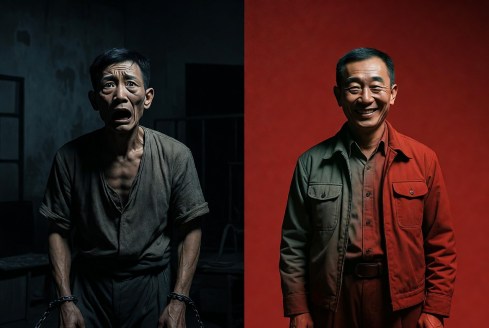
“Divided by Category: Red (favored, content) and Black (suspect, under duress) — the Maoist tool that made persecution socially acceptable.”
References and Further Reading
Maoist classifications and the Cultural Revolution
Guo Jian, Song Yongyi and Yuan Zhou, Historical Dictionary of the Chinese Cultural Revolution, Scarecrow Press, 2006.
A scholarly reference work covering the Five Black Categories, the favoured Red Categories, political campaigns, struggle sessions and other institutions of the Cultural Revolution.
https://books.google.com/books?id=T5-4zOdHKOIC&q=Five+Black+Categories
Song Yongyi, “Chronology of Mass Killings During the Chinese Cultural Revolution (1966–1976),” Sciences Po Mass Violence and Resistance Research Network, August 25, 2011.
An academic chronology of Cultural Revolution violence. It describes the Five Black Categories—landlords, rich peasants, counter-revolutionaries, bad elements and rightists—and documents how political classifications exposed individuals and their families to confiscation, expulsion, persecution and killing.
https://www.sciencespo.fr/mass-violence-war-massacre-resistance/en/document/chronology-mass-killings-during-chinese-cultural-revolution-1966-1976
Evan Osnos, “Born Red,” The New Yorker, March 30, 2015.
A profile of Xi Jinping that also describes the status attached to revolutionary family background during the Cultural Revolution. It includes the “born red” culture, inherited political prestige and the stigma imposed upon children of people classified as reactionaries.
https://www.newyorker.com/magazine/2015/04/06/born-red
Mao on ethnicity and Han chauvinism
Mao Zedong, “On the Ten Major Relationships,” April 25, 1956.
English text of Mao’s speech addressing relations between the Han majority and China’s minority nationalities. Mao formally identified Han chauvinism as a danger and argued that the Party should oppose discrimination by the Han majority.
https://www.marxists.org/reference/archive/mao/selected-works/volume-5/mswv5_51.htm
Falun Gong persecution and “transformation”
Human Rights Watch, “Falungong in Custody: Competing Accounts,” in Dangerous Meditation: China’s Campaign Against Falungong, January 2002.
Human Rights Watch’s examination of detention, re-education through labour, extrajudicial transformation centres and coercive attempts to force practitioners to renounce their beliefs. The report also discusses the difficulty of verifying claims because China prevented independent monitoring of prisons and labour camps.
The report documents official transformation targets and evidence of severe physical and psychological pressure, including torture and extreme pressure to recant.
https://www.hrw.org/reports/2002/china/China0102-04.htm
Uyghurs and the Xinjiang detention system
Office of the United Nations High Commissioner for Human Rights, Assessment of Human Rights Concerns in the Xinjiang Uyghur Autonomous Region, People’s Republic of China, August 31, 2022.
The principal UN assessment of China’s counter-extremism policies, methods for identifying “at risk” people, detention in vocational education and training centres, treatment in custody and restrictions upon religious, linguistic and cultural identity.
Permanent Mission of the People’s Republic of China to the United Nations Office at Geneva, “Response to the OHCHR Assessment,” August 2022.
China’s formal rebuttal to the UN assessment. The government rejects the allegations, describes the centres as lawful counterterrorism and vocational programs, and argues that the UN assessment relied upon politicized or unreliable sources.
https://www.ohchr.org/sites/default/files/documents/countries/2022-08-31/ANNEX_A.pdf
Organ profiling and the connection to the first essay
United Nations Office of the High Commissioner for Human Rights, “China: UN Human Rights Experts Alarmed by ‘Organ Harvesting’ Allegations,” June 14, 2021.
A statement by UN human-rights experts concerning reports that detained Falun Gong practitioners, Uyghurs, Tibetans, Muslims and Christians were subjected to blood tests and examinations of the heart, liver, kidneys and other organs without informed consent.
Organ transplantation is one of medicine’s genuine miracles.
A failing heart can be replaced. A patient whose kidneys no longer function can be freed from dialysis. An organ donated at the end of one life can preserve another for decades.
Yet the legitimacy of transplantation depends upon a boundary that cannot be negotiated away. The person providing the organ is a human being, not a supply of biological material. Consent must be genuine, death must be independently determined, and the physician’s duty to the donor cannot be subordinated to the needs of the recipient.
China’s transplant system has a documented history of crossing those boundaries. Its government has admitted that organs were taken from executed prisoners, although it now says that this practice ended in 2015 and that voluntary civilian donation supplies the country’s transplant hospitals.
That defence cannot simply be dismissed, but neither can it be accepted on trust.
China’s official donation statistics show signs of systematic manipulation. Its transplant registries are not publicly accessible. Chinese medical papers have described organ removals in which the procurement itself appears to have caused the donor’s death. Investigators have also assembled evidence that prisoners of conscience, particularly Falun Gong practitioners, have been medically tested and killed for their organs.
The exact number of victims remains uncertain. The evidence that China has not provided a credible account of its transplant system does not.
What China has admitted
For years, Chinese officials denied that prisoners supplied the country’s transplant industry. That position eventually became impossible to maintain, and in late 2005 officials publicly acknowledged that organs from executed prisoners had been used.
The historical numbers show how dependent the transplant system had become upon state custody. Chinese officials reported roughly 120,000 organ transplants between 1977 and 2009, but only 130 voluntary donors had been identified by the end of that period. The country did not yet possess a voluntary donation system remotely capable of supplying the number of organs being transplanted.
Calling these donors convicted criminals does not resolve the ethical problem. A prisoner awaiting execution exists under the absolute power of the state. Consent given under those conditions cannot safely be treated as free, especially when the organs have substantial financial value and hospitals benefit from their availability.
The relationship also creates a dangerous incentive. Once the justice system becomes a supplier to the medical system, a prisoner’s body acquires value that may influence the timing and purpose of the execution.
China announced that, beginning on January 1, 2015, hospital-based voluntary donors would become the sole lawful source of transplant organs. It established a national allocation system known as COTRS, developed hospital-based procurement organizations and said that donation would be voluntary, unpaid, transparent and traceable.
That is Beijing’s strongest answer to the allegations: whatever happened before 2015 belongs to an earlier system that has since been reformed.
There is evidence that genuine voluntary donation has grown in China, and it would be irresponsible to assume that every transplant performed there today involves an unwilling donor. The central question is whether the new system has replaced the old one or partly concealed it.
China has not permitted the independent access needed to settle that question.
Its official registries are not publicly available, and the limited figures released by officials are difficult to corroborate against hospital-level activity. Nor did the 2015 announcement begin cleanly. Shortly after it took effect, former vice-minister of health Huang Jiefu suggested that condemned prisoners could still “donate” by entering the civilian allocation system because they remained citizens. He later said those remarks had been philosophical rather than a description of actual practice.
If prisoner organs can be reclassified as civilian donations, a change in terminology may disguise continuity rather than establish reform.
Numbers that look designed
China reported extraordinary growth in its new voluntary system. According to official figures, annual deceased donors increased from 34 in 2010 to 6,316 in 2018. Reported kidney and liver transplants also rose rapidly.
Researchers Matthew Robertson, Raymond Hinde and Jacob Lavee examined those figures using forensic statistical methods. They compared national data from COTRS and the Chinese Red Cross, provincial reports, hospital records and donation patterns from 50 other countries.
They found that China’s official donor, kidney and liver totals followed simple mathematical curves with remarkable precision. The R-squared values were 0.9993, 0.9995 and 0.9989 respectively, approaching a perfect fit with a predetermined quadratic formula.
Actual organ donation depends upon accidents, illness, family consent, failed procurements, regional differences, hospital capacity and countless other unpredictable events. Even rapidly growing systems contain irregularity. The equivalent figures from the other 50 countries did not display anything close to China’s mathematical smoothness.
The researchers also identified contradictory provincial data, suspicious conformity with central quotas and apparent cases in which non-voluntary donors were classified as voluntary. They concluded that systematic manufacture and manipulation were the most plausible explanation for significant parts of the official record.
Their backgrounds should also be disclosed. Robertson has worked with the Victims of Communism Memorial Foundation, the Human Rights Law Foundation and End Transplant Abuse in China, and was formerly an editor at The Epoch Times. Lavee has served with Doctors Against Forced Organ Harvesting. Both had publicly opposed Chinese transplant abuses before publishing the study.
Those affiliations justify careful scrutiny of their assumptions and methods. They do not, by themselves, answer the statistical evidence. The paper was peer-reviewed, its methodology was published, its data sources were identified, and the international comparison can be examined independently.
The authors also did not claim that every voluntary donor was fictitious. They expressly acknowledged genuine voluntary transplant activity alongside the apparent manipulation.
Their conclusion was narrower: China’s official numbers cannot reliably demonstrate that voluntary donors account for its transplant activity.
That leaves the original question unanswered. If the published donor figures were manufactured or padded with non-voluntary cases, where did the actual organs come from?
When procurement becomes execution
Transplant medicine is governed by what is commonly called the dead donor rule.
Vital organs must not be removed from a living person in a way that causes death. The determination of death must be independent of the desire to obtain the organs. A physician cannot become an executioner because another patient needs a heart.
In 2022, Robertson and Lavee examined more than 120,000 Chinese-language medical publications and identified 71 papers, published between 1980 and 2015, in which the reported procedures failed to establish that the donors were properly dead before their hearts or lungs were removed.
The descriptions indicated that accepted tests for brain death had not been performed or could not have produced a valid declaration of death. The researchers concluded that, in these cases, removing the organs probably caused the donor’s death.
This dismantles a comforting distinction.
It is one thing to imagine doctors receiving organs after a prisoner has been executed. That would still involve coercion and serious medical abuse, but the transplant team could claim that it arrived after the killing.
It is another thing for organ removal to complete the execution. In that system, medicine does not merely benefit from state violence. The surgical procedure becomes part of it.
The order is reversed
In an ethical donation system, the donor appears first.
Someone dies under circumstances that allow donation. Consent is confirmed. Medical teams determine which organs remain viable, and allocation rules identify compatible recipients according to blood type, tissue compatibility, body size, urgency and time spent waiting.
The recipient waits because no hospital can promise when a compatible stranger will die.
Some of the most disturbing evidence from China describes that order being reversed.
Israeli transplant surgeon Jacob Lavee became concerned after one of his patients said that he had arranged a heart transplant in China approximately two weeks in advance. A heart cannot ordinarily be promised for a particular date through a system dependent upon unpredictable voluntary deaths.
A scheduled heart implies control over more than hospital availability. It implies that the system can locate a compatible donor and control when that person dies.
This is the logic behind the phrase “killed to order.” The recipient appears first, and a compatible person is then selected from a medically classified population.
The recipient may not understand how the organ was obtained. A gravely ill patient may be told only that China has an unusually efficient transplant system or a large donor pool.
But administrative efficiency cannot explain how a heart becomes available by appointment.
Prisoners of conscience
The most serious allegation is that China expanded its supply beyond condemned criminals to include people imprisoned for their religion, beliefs or political identity.
The largest body of evidence concerns Falun Gong practitioners.
Falun Gong is a spiritual discipline combining meditative exercises with moral teachings. After it grew rapidly during the 1990s, the Chinese Communist Party banned the practice in 1999 and subjected its followers to mass detention, imprisonment and ideological “transformation.”
Former detainees have described blood tests, X-rays, ultrasounds and organ examinations that bore little relationship to their medical welfare. Such tests would, however, be useful for determining blood type, tissue compatibility and organ condition.
In 2019, an independent people’s tribunal chaired by British barrister Sir Geoffrey Nice examined the allegations. The China Tribunal was not an international court and possessed no power to convict or punish anyone. It had been established by the International Coalition to End Transplant Abuse in China, an advocacy organization already committed to the issue.
Those limitations should be stated plainly.
The tribunal nevertheless heard more than 50 witnesses and experts and examined medical publications, hospital capacity, waiting times, recorded telephone calls, former-prisoner testimony and the official donor figures. It also considered material favourable to China and invited the Chinese government to participate. Beijing declined.
The tribunal concluded that forced organ harvesting had occurred for years on a significant scale and that Falun Gong practitioners had probably been the principal source. It also concluded that it had seen no evidence establishing that the practice had stopped.
That judgment does not carry the authority of a national or international court. It remains the finding of a privately convened inquiry, and readers are entitled to examine its evidence and institutional origins critically.
But the evidence does not vanish because the body examining it lacked formal jurisdiction.
Some investigators associated with the tribunal have estimated that China may perform between 60,000 and 100,000 transplant operations annually, far above the official totals. That figure is not a confirmed count of illicit procedures or identified victims. It was reconstructed from hospital beds, transplant wards, surgeon activity, hospital revenues and publicly stated capacity.
The essay does not need the upper estimate to be true.
China’s admitted reliance on prisoners, the statistical manipulation, the medical descriptions of execution by procurement, the short waiting periods and the testing of persecuted detainees already demand an explanation.
The warning from Xinjiang
Concern has also extended to Uyghurs and other religious minorities.
In June 2021, United Nations human-rights experts reported receiving credible information that detained Falun Gong practitioners, Uyghurs, Tibetans, Muslims and Christians were being subjected without informed consent to blood tests, ultrasounds, X-rays and examinations of organs such as the heart, liver and kidneys. Other prisoners were reportedly not subjected to the same testing.
The experts expressed extreme alarm and called upon China to permit independent international monitoring.
Their statement did not establish that every medically examined detainee had been entered into an organ database. Nor did it prove that Uyghurs had already been harvested on the same scale alleged for Falun Gong practitioners.
It identified selective organ-focused testing within populations already deprived of liberty and legal protection.
The distinction matters because evidence should not be stretched beyond what it demonstrates. Yet an authoritarian state cannot reasonably expect unexplained medical profiling to be interpreted in isolation from its admitted history of prisoner procurement and its refusal to open the transplant system to independent inspection.
Under those conditions, suspicion is not a substitute for evidence. It is a conclusion drawn from the evidence that is available.
What we know
The case can be stated without pretending that every uncertainty has been resolved.
China used organs from executed prisoners and denied doing so before eventually admitting the practice.
Its authorities say that prisoner procurement ended in 2015 and that voluntary civilian donation now supplies the transplant system.
A peer-reviewed statistical study found strong evidence that important official datasets had been manufactured or manipulated and that some non-voluntary donors may have been misclassified.
A second peer-reviewed investigation found Chinese medical reports in which doctors appear to have caused prisoners’ deaths by removing their organs before a valid determination of death.
Former detainees have reported selective medical testing, and UN experts have received similar allegations concerning several persecuted populations.
An independent but non-judicial tribunal concluded that prisoners of conscience, particularly Falun Gong practitioners, had been killed for their organs on a significant scale.
What remains uncertain is the full number of victims, the present annual volume, the proportion of organs supplied by each source and the degree to which particular hospitals continue illicit procurement today.
Those uncertainties should govern the language used to describe the system. They should not erase what is already known.
This is not a criminal trial, and secrecy alone cannot prove every allegation. But medical cooperation does not require proof beyond a reasonable doubt before ethical safeguards apply.
A transplant system seeking international legitimacy bears the responsibility of demonstrating that its donors consented, that their deaths were independently determined and that the organs did not come from prisoners or persecuted detainees.
China cannot withhold the records needed to verify those conditions and then demand that foreign institutions presume the system ethical.
The responsibility of the West
Western governments cannot force China to disclose every detention record or open every transplant hospital, but they can refuse to confer legitimacy upon a system that cannot demonstrate ethical sourcing.
Medical journals can reject research that does not identify donor sources or document valid consent. Universities and hospitals can suspend transplant training and institutional partnerships where records cannot be audited. Governments can prohibit their citizens from purchasing organs obtained without consent and deny entry to people involved in the trade.
Canada took an important step in December 2022 when Bill S-223 received royal assent. The law created offences for obtaining, removing or facilitating the removal of an organ without informed consent, including certain conduct committed abroad by Canadian citizens and permanent residents. It also made participation in organ trafficking grounds for inadmissibility to Canada.
The principle should extend beyond criminal prosecution. Where consent and donor identity cannot be independently verified, cooperation should stop.
That standard is not hostility toward Chinese physicians or Chinese people. Many of those raising the alarm are Chinese survivors, dissidents, families and medical professionals who understand what Party secrecy can conceal.
Nor does the case depend upon approving of Falun Gong, accepting its teachings or supporting the politics of organizations associated with it. Human rights are not rewards distributed to groups we find familiar or fashionable.
A person’s body does not become state property because the government has classified that person as dangerous, irrational or politically disobedient.
China has offered laws, announcements and aggregate numbers as evidence that its transplant system has changed. What it has not offered is the independent access required to verify the identity, consent and cause of death of the people whose organs supply its hospitals.
Until it does, the moral cloud over that system remains, along with the question Beijing has never credibly answered: where did the organs come from?
References and Further Reading
Primary research and official documents
Matthew P. Robertson, Raymond L. Hinde and Jacob Lavee, “Analysis of Official Deceased Organ Donation Data Casts Doubt on the Credibility of China’s Organ Transplant Reform,” BMC Medical Ethics, November 14, 2019.
Peer-reviewed statistical examination of China’s official donation and transplantation data. The authors found evidence of systematic data manufacture, manipulation and the apparent classification of some non-voluntary donors as voluntary donors.
https://link.springer.com/article/10.1186/s12910-019-0406-6
Matthew P. Robertson and Jacob Lavee, “Execution by Organ Procurement: Breaching the Dead Donor Rule in China,” American Journal of Transplantation, July 2022.
Peer-reviewed analysis of Chinese medical publications describing heart and lung procurement. The authors identified 71 papers in which the reported procedures indicated that organ removal probably caused the donor’s death.
https://doi.org/10.1111/ajt.16969
China Tribunal, Judgment, March 1, 2020.
The complete judgment of the independent people’s tribunal chaired by Sir Geoffrey Nice. It includes the tribunal’s methods, evidence, qualifications and conclusions regarding forced organ harvesting from prisoners of conscience.
https://chinatribunal.com/wp-content/uploads/2020/03/ChinaTribunal_JUDGMENT_1stMarch_2020.pdf
The tribunal was privately convened and possessed no formal judicial authority. Its institutional status and advocacy origins should be considered alongside the evidence it examined.
United Nations Office of the High Commissioner for Human Rights, “China: UN Human Rights Experts Alarmed by ‘Organ Harvesting’ Allegations,” June 14, 2021.
Official statement concerning credible information received by UN experts about non-consensual blood tests, ultrasounds, X-rays and organ examinations performed on detained religious and ethnic minorities.
Parliament of Canada, Bill S-223: An Act to Amend the Criminal Code and the Immigration and Refugee Protection Act (Trafficking in Human Organs), Royal Assent, December 15, 2022.
The complete text of the Canadian law criminalizing participation in organ removal without informed consent, including specified conduct committed outside Canada.
https://www.parl.ca/DocumentViewer/en/44-1/bill/S-223/royal-assent
Accessible reporting and summaries
Bethany Allen-Ebrahimian, “Study: Transplants in China Performed Before Proving Donor Brain Death,” Axios, April 4, 2022.
An accessible summary of Robertson and Lavee’s research into execution by organ procurement, including the case of a heart transplant reportedly scheduled in China approximately two weeks in advance.
https://www.axios.com/2022/04/04/study-transplants-china-donor-brain-death
Reuters, “China Is Harvesting Organs from Falun Gong Members, Finds Expert Panel,” June 17, 2019.
Contemporary reporting on the China Tribunal’s initial findings, China’s denial of the allegations and the persecution of Falun Gong practitioners.
The Alberta Medical Association and the Canadian Pediatric Society want Canadians to believe the debate over pediatric gender medicine is settled. It is not.
When Premier Danielle Smith announced restrictions on transgender medical interventions for minors, major medical bodies responded with the language of emergency. The Canadian Pediatric Society warned that Alberta’s policy would undermine the rights of transgender children and youth. The Alberta Medical Association’s pediatrics section argued that the government was targeting an already vulnerable population. The public message was clear enough: responsible doctors affirm; politicians interfere; children suffer.
 But that framing hides the central problem. There is no stable international medical consensus on pediatric transition. In fact, several European jurisdictions have moved in the opposite direction from Canada’s professional bodies, not because they have stopped caring about distressed children, but because they have begun applying more ordinary standards of evidence to extraordinary interventions.
That distinction matters. Puberty blockers and cross-sex hormones are not counselling, kindness, or protection from bullying. They are medical interventions into the development of physiologically healthy children and adolescents, often at an age when identity, sexuality, mental health, peer influence, family conflict, and neurodevelopmental conditions are still in motion. A serious medical institution should be able to say that without sounding frightened of its own profession.
Instead, Canadian medical institutions often speak as if caution itself is the danger.
The most revealing example is the suicide argument. Parents and voters have been told, sometimes openly and sometimes by implication, that restricting pediatric transition will kill children. The activist version is familiar: would you rather have a dead daughter or a trans son? The political version is not much better. Former Calgary mayor Naheed Nenshi told Premier Smith that “votes aren’t worth a few dead kids.”
That is not clinical reasoning. It is emotional coercion applied to frightened parents.
The evidence does not support the crude version of the claim. A 2024 Finnish register study in BMJ Mental Health examined more than 2,000 adolescents referred to gender identity services and compared them with more than 16,000 matched controls. The authors found that suicide deaths were rare, and that once psychiatric treatment history was accounted for, gender-referred youth did not show higher all-cause or suicide mortality than controls. The study does not say these young people are not distressed. It says the simple story — affirm or they die — is not evidence-based medicine.
That should change the conversation. Many adolescents presenting to gender clinics also carry depression, anxiety, autism, trauma histories, eating disorders, family instability, social isolation, or other serious mental-health burdens. If those burdens are treated as secondary to gender identity, medicine risks narrowing the diagnostic lens at exactly the moment it should be widening it.
This is one of the main lessons of the Cass Review in the United Kingdom. Cass did not recommend abandoning children with gender distress. It called for a more holistic model of care, better assessment, stronger evidence, and far more caution around medical pathways. NHS England subsequently stopped the routine prescription of puberty blockers for gender dysphoria in minors, moving them into a research setting rather than ordinary clinical use.
That is not a small update. It is a major warning to every country that imported the affirmative model and then treated dissent as bigotry.
The “pause button” metaphor has also aged badly. Puberty is not a decorative inconvenience. It is a central developmental process involving bones, brain maturation, sexual function, fertility, and identity formation. Cass specifically warned against assuming that drugs used for precocious puberty will have the same outcomes when used for children and adolescents with gender dysphoria. The medical context is different. The child is different. The purpose of the intervention is different. Pretending otherwise is not compassion; it is bad reasoning in therapeutic language.
The pathway concern is equally serious. If blockers were merely neutral time-buying devices, we would expect many children to pause, mature, and then step away from medicalization. But the available evidence shows high rates of progression from puberty blockers to cross-sex hormones. That does not prove every case is mishandled, and it does not prove no patient benefits. It does mean the intervention may help create the very path it claims merely to delay.
Other countries have noticed. France’s National Academy of Medicine urged “great medical caution” in treating gender-related distress in children and adolescents, citing vulnerability and the possibility of serious complications. The UK has moved puberty blockers away from routine use. Scotland paused new prescriptions for minors after the Cass Review. These are not fringe developments. They are evidence institutions pulling back after years of clinical momentum.
Canada’s professional bodies should be wrestling publicly with that reversal. Instead, they often sound as though the old consensus still exists.
“Institutional capture does not mean every doctor is corrupt. It means the institution has absorbed a political frame so deeply that it struggles to distinguish care from affirmation, caution from cruelty, and disagreement from harm.”
This is where the word “capture” becomes fair, but only if we are precise. Institutional capture does not mean every doctor is corrupt. It does not mean every pediatrician agrees with activists. It does not mean every child with gender distress is confused, lying, or socially influenced. It means the institution has absorbed a political frame so deeply that it struggles to distinguish care from affirmation, caution from cruelty, and disagreement from harm.
That is dangerous in any field. It is worse in pediatrics.
Children with gender distress deserve serious care. They deserve protection from bullying, family cruelty, humiliation, and ideological exploitation from every direction. They deserve psychological assessment, treatment for co-occurring mental-health problems, family involvement where safe, and adults who can tolerate uncertainty. The modern clinic population is also not the same as the older, smaller cohort of mostly childhood-onset cases; many services have seen a sharp rise in adolescent presentations, often with complex psychiatric and developmental profiles. A small number may continue to experience severe, persistent dysphoria into adulthood and may eventually choose medical transition. But that possibility does not justify allowing pediatric care to default into an affirmation-first pathway.
The honest position is not “do nothing.” The honest position is slow down, assess carefully, treat comorbidities, use exploratory psychological care rather than ideological confirmation, stop using suicide as a rhetorical weapon, and stop pretending that uncertain evidence becomes settled science because a professional association says so.
Medicine earns public trust when it disciplines itself. It loses that trust when it borrows the moral posture of activism and then demands deference as science.
The AMA and CPS still have a choice. They can defend vulnerable children by telling the whole truth: that distress is real, that cruelty is wrong, that some cases are complex, and that the evidence for routine medical transition in minors is weaker than Canadians have been led to believe. Or they can continue treating democratic oversight and parental caution as the real threat, while countries that reviewed the evidence more seriously move toward restraint.
“Medicine earns public trust when it disciplines itself. It loses that trust when it borrows the moral posture of activism and then demands deference as science.”
The issue is not whether vulnerable youth should be helped. They should.
The issue is whether Canadian medical institutions can still tell the difference between helping children and protecting an ideology from scrutiny.
Right now, the answer is not reassuring.
Alberta Premier Danielle Smith used her address at the Canada Strong and Free Network conference to frame her government’s recent legislative agenda as a direct challenge to what she called the “era of wokeism.”
The speech was not about one bill. It was a political inventory: professional regulation, classroom neutrality, parental rights, gender medicine for minors, female sport, and sexually explicit material in libraries. The through-line was institutional restraint. Schools, regulators, medical systems, and libraries should not become vehicles for ideological enforcement.
Smith pointed first to what supporters have called the “Jordan Peterson Law,” Alberta’s legislation aimed at professional regulators. The basic idea is that professional bodies should regulate competence and misconduct, not punish members for off-duty political or personal views unless those views clearly bear on professional conduct. Whatever one thinks of Peterson himself, the principle is larger than one man: licensing bodies are not supposed to become political conformity boards.
Education took up much of the speech. Alberta’s Bill 25, introduced March 31, 2026, is formally titled An Act to Remove Politics and Ideology from Classrooms and Amend the Education Act. The province says the bill is meant to keep classrooms neutral, impartial, and respectful of diverse viewpoints. It would require school authorities to avoid taking official positions on political, social, or ideological matters outside their education mandate, and would direct teachers to remain objective and present balanced perspectives.
That is the political nerve centre of the speech. For years, progressive activists have argued that schools cannot be neutral and must instead be actively “inclusive,” “anti-oppressive,” or “affirming.” Smith’s answer is that this logic has turned too many classrooms into ideological delivery systems. Her government’s position is that schools should teach students how to think, not quietly steer them toward approved political conclusions.
Smith also returned to Alberta’s laws on gender-related interventions for minors. The province’s Protecting Alberta’s Children Statutes Amendment Act invokes the notwithstanding clause to shield several measures from being struck down by courts. These include prohibitions on gender reassignment surgery for children under 18, restrictions on puberty blockers and hormone treatments for gender reassignment for children under 16, parental notice and consent rules around gender-related name and pronoun changes in schools, opt-in consent for teaching on gender identity, sexual orientation, or human sexuality, and rules limiting women’s and girls’ amateur competitive sports to those born female.
Supporters will call this child protection, parental rights, and fairness in female sport. Critics will call it state interference in the lives of transgender youth. That fight will not be settled by changing labels. It turns on deeper questions: what children can consent to, what parents are entitled to know, how strong the medical evidence is, and whether schools may keep consequential identity-related information from families.
Smith also addressed sexually explicit material in libraries. Alberta has proposed public-library measures aimed at limiting minors’ access to materials containing explicit visual depictions of sexual acts, while saying adults would retain access and that materials would not be removed from libraries. The government describes this as age-appropriate access control, not a book ban. Critics see it as censorship, especially given previous fights over school-library materials and LGBTQ-themed books.
The speech’s political purpose was obvious. Smith was not merely listing policies. She was tying them into a governing thesis: Alberta’s public institutions have drifted from their proper roles, and her government intends to pull them back.

That is the real argument underneath the “wokeism” language. Are schools, professional regulators, medical bodies, and libraries limited institutions with defined purposes? Or are they now expected to act as engines of progressive moral instruction?
Smith’s answer is blunt: no.
The word “wokeism” is not especially precise. It is a bucket term, and bucket terms can get sloppy fast. But in this case, it is pointing at something real: the steady conversion of public institutions into ideological enforcement systems, usually under softer language about safety, inclusion, equity, care, or professional standards.
Alberta’s new posture is simple: public institutions should serve the public under defined rules, not quietly reshape the public under activist supervision. That is the line Smith is trying to draw. The coming fight will be over whether Alberta is allowed to draw it.
This essay is not an argument against transgender adults living freely and being treated decently. It is an argument about a specific set of claims—metaphysical, political, and clinical—that tends to generate persistent institutional conflict because it lacks a shared stopping rule. By “stopping rule,” I mean a principled boundary that both sides can recognize as legitimate: a line where accommodation ends and coercion begins, or where uncertainty requires caution. When subjective identity claims are treated as authoritative and dissent is treated as harm, disputes recur across domains—speech norms, public policy, and pediatric medicine—because there is no common adjudicator capable of resolving the underlying disagreement.
1) Thesis and scope: what is being argued, and what is not
The claim here is procedural. Whatever one’s moral intuitions, systems built to enforce contested metaphysics predictably produce friction that neither side can permanently “win.” A pluralist society can enforce civility and prohibit harassment. It cannot, without escalating conflict, require citizens and institutions to treat an internally felt identity as the final authority over publicly legible categories—especially when those categories structure law, safety, and fairness.
2) Metaphysical claim: identity as authoritative reality
The metaphysical claim, stated minimally, is: when sex and self-declared gender conflict, identity is treated as the authoritative reality for how others must speak and for how institutions must categorize. In a liberal society, people routinely request courtesy; the tension begins when courtesy becomes a duty enforced by institutional sanctions, because that converts disagreements about contested concepts into compliance problems.
The mechanism is structural rather than psychological. If a proposition is treated as morally obligatory yet largely unverifiable, enforcement shifts from evidence to norms, and from norms to penalties. This does not require attributing motives; it is a predictable consequence of asking public systems to operationalize contested metaphysics. The cost is an expansion of “speech governance,” where ordinary interpersonal mistakes or dissenting beliefs are treated as policy violations rather than social disputes. The verdict: making subjective identity authoritative at the level of public rulemaking tends to destabilize shared norms, because the principle contains no internal boundary that can settle recurring disputes.
3) Political claim: institutions forced to referee contested categories
The political claim extends the metaphysical one: public institutions must treat identity as authoritative in classification and access. The “no stopping rule” problem becomes concrete when policy must decide eligibility, categories, and competing rights. Sport is not the whole controversy, but it is a clear case study because sex-segregated categories exist to preserve fairness under stable biological differences.
World Athletics’ 2023 regulations excluding transgender women who have experienced male puberty from elite female competition were an explicit attempt to draw a boundary grounded in performance-relevant biology rather than identity.(worldathletics.org) This example does not “prove” the broader thesis; it illustrates the governing dilemma: once identity is treated as determinative, any sex-based boundary becomes contestable on the same logic, and institutions are pulled into continuous adjudication. The cost is not only policy churn but legitimacy loss, as significant segments of the public come to see institutions as enforcing contested beliefs rather than administering neutral rules. The verdict: when institutions are made to referee contested metaphysical claims, policy disputes harden into identity conflicts and become difficult to resolve through ordinary pluralist compromise.
4) Clinical claim: minors, uncertainty, and the need for evidentiary brakes
The clinical claim is narrower and higher-stakes: affirmation-first protocols are often presented as the evidence-based default for minors, despite ongoing disputes about evidence quality, long-term outcomes, and appropriate thresholds for irreversible interventions.
The mechanism is again about stopping rules. In pediatrics, where patients may have limited capacity to grasp lifelong tradeoffs and where interventions can be difficult to reverse, uncertainty normally triggers caution: structured assessment, conservative pathways, and high evidentiary standards. In England, the Cass Review’s recommendations prompted major service redesign, and NHS England’s implementation document outlines steps already taken and planned in response to those recommendations.(england.nhs.uk) The UK government also announced that emergency restrictions on the private sale and supply of puberty blockers would be made indefinite following advice from the Commission on Human Medicines, citing safety concerns; the DHSC explainer situates this within a broader shift toward research frameworks.(gov.uk)
The point is not that UK policy settles the science. The point is procedural: a major public health system treated evidentiary uncertainty as a reason to tighten pathways and emphasize research structures. The cost of overstating certainty is predictable—trust erosion among families, clinicians, and the public when policy appears to run ahead of evidence. The verdict: for minors, uncertainty should operate as a brake; when it does not, clinical decision-making becomes vulnerable to political and ideological pressure.
5) Steelman, with a credibility caveat: what proponents argue, and why WPATH cannot be treated as neutral authority
A fair steelman starts with the humane premise: some young people experience profound distress; social rejection correlates with worse mental health; supportive environments may reduce suffering; and for adults, liberal societies generally presume wide autonomy over body and presentation. Observational research has reported short-term associations between receiving puberty blockers or hormones and lower reported depression or suicidality among transgender and nonbinary youth, while still facing the usual limitations of nonrandomized designs (selection effects, confounding, short follow-up).(jamanetwork.com)
Advocates often cite WPATH’s Standards of Care (SOC8) as a professional consensus reference point. A publishable essay, however, has to include a procedural caveat: SOC8 is now contested as an uncontested authority, particularly for minors, due to public disputes about guideline-development process and evidentiary representation. The “WPATH Files” publication by Environmental Progress alleges internal discussions inconsistent with the public posture of evidentiary confidence.(environmentalprogress.org) Separately, an HHS report alleged that during SOC8 development, WPATH suppressed certain systematic reviews considered potentially undermining to preferred protocols.(opa.hhs.gov) WPATH and USPATH responded by disputing key characterizations and criticizing the HHS report, framing it as misrepresenting evidence, and noting constraints around ongoing litigation and related processes.(wpath.org)
The responsible conclusion is limited but important: SOC8 may still be used to describe the best-case articulation of the pro-affirmation position, but it cannot function as a neutral “settled science” stamp—especially in a pediatric domain where evidentiary confidence must be demonstrable rather than asserted. The verdict: steelman the humane intent and the reported short-term associations; do not outsource epistemic certainty to a guideline whose development and representation are under active public dispute.
6) Synthesis: stopping rules as the governance solution
The practical question is governance, not moral panic: can a pluralistic society accommodate people without compelling metaphysical assent, and can pediatric medicine proceed without overstating certainty? The answer is unglamorous: stopping rules.
In institutions, stopping rules mean enforcing civil treatment and anti-harassment norms while refusing to treat metaphysical agreement as a condition of participation in public life. In medicine, stopping rules mean evidence thresholds, transparent review, and heightened caution for minors where long-term outcomes remain contested. If stopping rules are refused, conflict tends to migrate: from clinics to courts, from policy to punishment, from persuasion to compulsion. The cost is durable polarization and degraded trust in institutions. The verdict: if the goal is social peace and clinical integrity, the burden is on advocates and opponents alike to articulate boundaries that are evidence-responsive, rights-consistent, and enforceable without demanding ideological conformity.

Glossary
Affirmation-first: A clinical approach that treats a person’s stated gender identity as true and prioritizes support for it; critics argue it may reduce exploratory assessment, especially for minors.
Cass Review: Independent review commissioned by NHS England into child and adolescent gender services; its recommendations prompted service redesign and tighter evidence standards.(england.nhs.uk)
Observational study: Research that observes outcomes without random assignment; can show association but generally cannot prove causation.(pubmed.ncbi.nlm.nih.gov)
Puberty blockers (GnRHa): Medications that suppress pubertal development; debated in youth gender medicine due to evidence-quality and risk/benefit uncertainty.(gov.uk)
SOC8: WPATH Standards of Care, version 8 (2022), widely cited in gender medicine; currently disputed as neutral authority in some public controversies.(environmentalprogress.org)
Stopping rule: A principled boundary that can settle recurring disputes (e.g., evidence thresholds for minors; category rules in sport).
WPATH Files: A publication of alleged internal WPATH materials by Environmental Progress; relevant here because it is part of an ongoing credibility dispute about guideline development.(environmentalprogress.org)
References
- NHS England, Implementing the Cass Review recommendations (PDF). https://www.england.nhs.uk/wp-content/uploads/2024/08/PRN01451-implementing-the-cass-review-recommendations.pdf
- NHS England, Children and young people’s gender services: implementing the Cass Review recommendations (long read). https://www.england.nhs.uk/long-read/children-and-young-peoples-gender-services-implementing-the-cass-review-recommendations/
- UK Department of Health and Social Care, “Ban on puberty blockers to be made indefinite on experts’ advice” (11 Dec 2024). https://www.gov.uk/government/news/ban-on-puberty-blockers-to-be-made-indefinite-on-experts-advice
- DHSC Media Blog, “Puberty blockers: what you need to know.” https://healthmedia.blog.gov.uk/2024/12/11/puberty-blockers-what-you-need-to-know/
- World Athletics press release (Mar 2023) on female eligibility. https://worldathletics.org/news/press-releases/council-meeting-march-2023-russia-belarus-female-eligibility
- World Athletics eligibility regulations PDF. https://worldathletics.org/download/download?filename=c50f2178-3759-4d1c-8fbc-370f6aef4370.pdf&urlslug=C3.5A%20%E2%80%93%20Eligibility%20Regulations%20Transgender%20Athletes%20%E2%80%93%20effective%2031%20March%202023
- Tordoff et al., JAMA Network Open (2022). https://jamanetwork.com/journals/jamanetworkopen/fullarticle/2789423
- Environmental Progress, “The WPATH Files.” https://environmentalprogress.org/big-news/wpath-files
- HHS, Treatment for Pediatric Gender Dysphoria (Nov 2025). https://opa.hhs.gov/sites/default/files/2025-11/gender-dysphoria-report.pdf
- WPATH/USPATH response (May 2025). https://wpath.org/wp-content/uploads/2025/05/WPATH-USPATH-Response-to-HHS-Report-02May2025-3.pdf











 bleatmop
 Mystro
 The Arbourist


 Dead Wild Roses
Your opinions…