
You are currently browsing the tag archive for the ‘Human Rights’ tag.
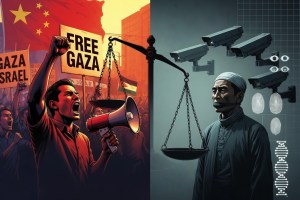 Governments and institutions that claim to speak for the Muslim world regularly invoke the ummah—the global Muslim community—as a source of political and moral authority. They demand solidarity across borders when Muslims suffer in Palestine, Kashmir or Myanmar.
When China constructed a police state around the Uyghurs, however, many of those governments did more than remain quiet. They defended Beijing, repeated its language and helped prevent international scrutiny.
That is the disparity worth examining. The charge is not that Muslims as a population have ignored the Uyghurs. Uyghur activists, dissidents and sympathetic Muslim organizations have worked for years to expose what is happening. The indictment belongs to the governments and institutions possessing the influence, diplomatic machinery and declared religious authority to act, but which chose accommodation with China instead.
The Muslims China decided to remake
In the Xinjiang Uyghur Autonomous Region, China has subjected Uyghurs and other predominantly Muslim peoples to mass surveillance, arbitrary detention, political indoctrination, coercive labour programs and severe restrictions on religious and cultural life.
The Office of the United Nations High Commissioner for Human Rights found credible allegations of torture, forced medical treatment, sexual violence and family separation. It concluded that China’s arbitrary and discriminatory detention of Uyghurs may constitute international crimes, particularly crimes against humanity. Beijing rejects those findings and describes the detention system as a counterterrorism and vocational-education program.
The repression extends beyond prisons and camps. Religious observance has been treated as evidence of extremism; families have been divided; children have been separated from parents; mosques, shrines and cemeteries have been altered or destroyed. Hundreds of Uyghur village names containing religious or historical references have reportedly been replaced with language reflecting Communist Party ideology and national unity. (Associated Press)
China is not negotiating how Islam should be accommodated in public life. It is deciding which portions of Uyghur identity may survive, and in what form.
The institutions that chose Beijing
The Organisation of Islamic Cooperation describes itself as the collective voice of the Muslim world. Yet in 2019, rather than confront China over Xinjiang, the OIC praised Beijing for “providing care to its Muslim citizens.” It accepted the language China used to describe political re-education and mass detention as social development and counter-extremism. (Organisation of Islamic Cooperation)
Individual governments made similar choices. Saudi Arabia, Pakistan, Egypt, the United Arab Emirates and Algeria were among the Muslim-majority states that supported statements commending China’s Xinjiang policies and its supposed achievements in counterterrorism and deradicalization. Qatar initially joined that defence before later withdrawing its support. (United Nations Human Rights Council)
The failure became even clearer after the UN human-rights office released its assessment in 2022. The Human Rights Council was asked only to hold a debate on the findings. The proposal failed by 19 votes to 17, with 11 abstentions. Pakistan, Indonesia, Qatar and the UAE voted against discussion, while Somalia was the rare Muslim-majority state that supported scrutiny. (Axios)
These governments were not working from rumours or social-media fragments. They had embassies, intelligence services, diplomatic missions and direct access to the UN report. Some of them claimed a special responsibility to defend Muslim interests while helping Beijing avoid even a formal debate about possible crimes against humanity.
Their conduct was not uniform, and it should not be treated as such. Somalia acted differently. Qatar withdrew from the earlier letter. Uyghur advocates have found allies in parts of the Muslim world.
The pattern among several of its most powerful governments remains unmistakable: when strategic and economic interests collided with proclaimed Muslim solidarity, solidarity gave way.
In some cases, the cooperation went further than diplomatic support. Researchers have documented Uyghurs being detained or returned from Arab states, including Egypt, Morocco, Saudi Arabia, Syria and the UAE, despite the danger of imprisonment upon return to China. (TIME)
The ummah, it seems, has boundaries set not only by faith but by Chinese investment, security relationships and diplomatic convenience.
Why Palestine mobilizes and Xinjiang does not
The contrast with Palestine-related activism is obvious, but it cannot be explained by hypocrisy alone.
Gaza is an active war covered daily through graphic footage, international reporting and social media. The Palestinian cause has decades of established institutions, political language, donor networks and diaspora organization behind it. Protesters can respond to events almost as they happen, and the adversaries they confront—Israel, Canada, the United States and European governments—are visible and accessible.
Xinjiang is a closed system. China restricts independent access, controls information and intimidates witnesses. Uyghurs abroad must consider whether public criticism will bring retaliation against relatives still inside China. The diaspora is smaller, its institutional reach is weaker, and the repression produces fewer fresh images capable of driving an attention economy built around immediacy.
Those differences matter. They help explain why one cause can mobilize vast numbers while another struggles for sustained attention.
China’s power matters even more. Beijing can threaten trade, investment and diplomatic relationships. It can pressure foreign governments to detain or repatriate Uyghurs, and it has demonstrated that criticism may carry consequences beyond the person speaking.
Liberal democracies are easier to confront because they tolerate confrontation. Activists can accuse Western governments of racism, colonialism or complicity without disappearing into a re-education system. China makes dissent expensive.
That is a real explanation for the disparity, but it is not an excuse for governments and institutions that claim leadership of the Muslim world. They possess resources individual dissidents do not. They do not need viral footage to understand a UN report, and they cannot plausibly invoke universal solidarity only when the political cost is manageable.
A principle proves very little when following it requires nothing.
The wrong kind of Muslim victim
The Uyghurs present an ideological inconvenience because their persecutor does not fit the political narratives that dominate much international activism.
China is not Israel, a Western democracy or a former European colonial power. It presents itself as an opponent of Western dominance, invests heavily across Muslim-majority countries and offers authoritarian governments a model of economic partnership without demands for democratic reform.
The victims therefore receive less political value. Their suffering cannot easily be attached to Western guilt, anti-colonial mythology or opposition to Israel. Beijing is remote, resistant to protest and willing to punish anyone who interferes.
This does not mean that Palestine activism exists only because Israel is Jewish, nor does it diminish the suffering of Palestinians. It does reveal an institutional hierarchy in which some Muslim victims become central symbols while others are subordinated to alliances, investments and ideological convenience.
The problem is not that Gaza receives too much concern. It is that governments claiming to represent global Muslim interests defended China while it suppressed Muslim life.
The Uyghur test
A serious commitment to Muslim solidarity would require the OIC to repudiate its praise of Beijing and demand independent access to Xinjiang. Muslim-majority governments would stop returning Uyghurs to Chinese custody, support international investigation and use their economic relationships with China as leverage rather than treating those relationships as reasons for silence.
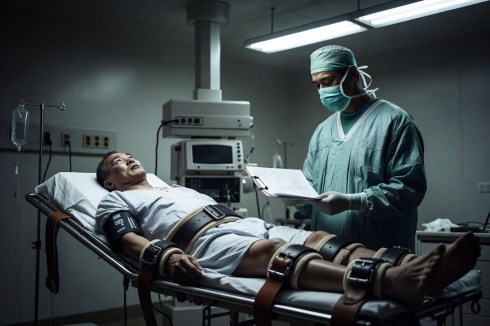
Islamic institutions and advocacy networks in the West could place Xinjiang on their agendas without abandoning Palestine. They could campaign against forced-labour supply chains, support Uyghur refugees and organize sustained pressure outside Chinese diplomatic missions. Medical organizations could demand verifiable proof that organs transplanted in China come from genuinely consenting donors.
China’s secrecy explains why evidence emerges slowly. Its economic and political power explains why governments hesitate. Neither absolves institutions that claim moral authority precisely on the basis of a borderless Muslim community.
Solidarity that flourishes against accessible adversaries but recedes when Beijing threatens consequences is not a universal moral commitment. It is foreign policy and political fashion wearing the language of religious principle.
The Uyghurs have made that distinction impossible to ignore.
Organ transplantation is one of medicine’s genuine miracles.
A failing heart can be replaced. A patient whose kidneys no longer function can be freed from dialysis. An organ donated at the end of one life can preserve another for decades.
Yet the legitimacy of transplantation depends upon a boundary that cannot be negotiated away. The person providing the organ is a human being, not a supply of biological material. Consent must be genuine, death must be independently determined, and the physician’s duty to the donor cannot be subordinated to the needs of the recipient.
China’s transplant system has a documented history of crossing those boundaries. Its government has admitted that organs were taken from executed prisoners, although it now says that this practice ended in 2015 and that voluntary civilian donation supplies the country’s transplant hospitals.
That defence cannot simply be dismissed, but neither can it be accepted on trust.
China’s official donation statistics show signs of systematic manipulation. Its transplant registries are not publicly accessible. Chinese medical papers have described organ removals in which the procurement itself appears to have caused the donor’s death. Investigators have also assembled evidence that prisoners of conscience, particularly Falun Gong practitioners, have been medically tested and killed for their organs.
The exact number of victims remains uncertain. The evidence that China has not provided a credible account of its transplant system does not.
What China has admitted
For years, Chinese officials denied that prisoners supplied the country’s transplant industry. That position eventually became impossible to maintain, and in late 2005 officials publicly acknowledged that organs from executed prisoners had been used.
The historical numbers show how dependent the transplant system had become upon state custody. Chinese officials reported roughly 120,000 organ transplants between 1977 and 2009, but only 130 voluntary donors had been identified by the end of that period. The country did not yet possess a voluntary donation system remotely capable of supplying the number of organs being transplanted.
Calling these donors convicted criminals does not resolve the ethical problem. A prisoner awaiting execution exists under the absolute power of the state. Consent given under those conditions cannot safely be treated as free, especially when the organs have substantial financial value and hospitals benefit from their availability.
The relationship also creates a dangerous incentive. Once the justice system becomes a supplier to the medical system, a prisoner’s body acquires value that may influence the timing and purpose of the execution.
China announced that, beginning on January 1, 2015, hospital-based voluntary donors would become the sole lawful source of transplant organs. It established a national allocation system known as COTRS, developed hospital-based procurement organizations and said that donation would be voluntary, unpaid, transparent and traceable.
That is Beijing’s strongest answer to the allegations: whatever happened before 2015 belongs to an earlier system that has since been reformed.
There is evidence that genuine voluntary donation has grown in China, and it would be irresponsible to assume that every transplant performed there today involves an unwilling donor. The central question is whether the new system has replaced the old one or partly concealed it.
China has not permitted the independent access needed to settle that question.
Its official registries are not publicly available, and the limited figures released by officials are difficult to corroborate against hospital-level activity. Nor did the 2015 announcement begin cleanly. Shortly after it took effect, former vice-minister of health Huang Jiefu suggested that condemned prisoners could still “donate” by entering the civilian allocation system because they remained citizens. He later said those remarks had been philosophical rather than a description of actual practice.
If prisoner organs can be reclassified as civilian donations, a change in terminology may disguise continuity rather than establish reform.
Numbers that look designed
China reported extraordinary growth in its new voluntary system. According to official figures, annual deceased donors increased from 34 in 2010 to 6,316 in 2018. Reported kidney and liver transplants also rose rapidly.
Researchers Matthew Robertson, Raymond Hinde and Jacob Lavee examined those figures using forensic statistical methods. They compared national data from COTRS and the Chinese Red Cross, provincial reports, hospital records and donation patterns from 50 other countries.
They found that China’s official donor, kidney and liver totals followed simple mathematical curves with remarkable precision. The R-squared values were 0.9993, 0.9995 and 0.9989 respectively, approaching a perfect fit with a predetermined quadratic formula.
Actual organ donation depends upon accidents, illness, family consent, failed procurements, regional differences, hospital capacity and countless other unpredictable events. Even rapidly growing systems contain irregularity. The equivalent figures from the other 50 countries did not display anything close to China’s mathematical smoothness.
The researchers also identified contradictory provincial data, suspicious conformity with central quotas and apparent cases in which non-voluntary donors were classified as voluntary. They concluded that systematic manufacture and manipulation were the most plausible explanation for significant parts of the official record.
Their backgrounds should also be disclosed. Robertson has worked with the Victims of Communism Memorial Foundation, the Human Rights Law Foundation and End Transplant Abuse in China, and was formerly an editor at The Epoch Times. Lavee has served with Doctors Against Forced Organ Harvesting. Both had publicly opposed Chinese transplant abuses before publishing the study.
Those affiliations justify careful scrutiny of their assumptions and methods. They do not, by themselves, answer the statistical evidence. The paper was peer-reviewed, its methodology was published, its data sources were identified, and the international comparison can be examined independently.
The authors also did not claim that every voluntary donor was fictitious. They expressly acknowledged genuine voluntary transplant activity alongside the apparent manipulation.
Their conclusion was narrower: China’s official numbers cannot reliably demonstrate that voluntary donors account for its transplant activity.
That leaves the original question unanswered. If the published donor figures were manufactured or padded with non-voluntary cases, where did the actual organs come from?
When procurement becomes execution
Transplant medicine is governed by what is commonly called the dead donor rule.
Vital organs must not be removed from a living person in a way that causes death. The determination of death must be independent of the desire to obtain the organs. A physician cannot become an executioner because another patient needs a heart.
In 2022, Robertson and Lavee examined more than 120,000 Chinese-language medical publications and identified 71 papers, published between 1980 and 2015, in which the reported procedures failed to establish that the donors were properly dead before their hearts or lungs were removed.
The descriptions indicated that accepted tests for brain death had not been performed or could not have produced a valid declaration of death. The researchers concluded that, in these cases, removing the organs probably caused the donor’s death.
This dismantles a comforting distinction.
It is one thing to imagine doctors receiving organs after a prisoner has been executed. That would still involve coercion and serious medical abuse, but the transplant team could claim that it arrived after the killing.
It is another thing for organ removal to complete the execution. In that system, medicine does not merely benefit from state violence. The surgical procedure becomes part of it.
The order is reversed
In an ethical donation system, the donor appears first.
Someone dies under circumstances that allow donation. Consent is confirmed. Medical teams determine which organs remain viable, and allocation rules identify compatible recipients according to blood type, tissue compatibility, body size, urgency and time spent waiting.
The recipient waits because no hospital can promise when a compatible stranger will die.
Some of the most disturbing evidence from China describes that order being reversed.
Israeli transplant surgeon Jacob Lavee became concerned after one of his patients said that he had arranged a heart transplant in China approximately two weeks in advance. A heart cannot ordinarily be promised for a particular date through a system dependent upon unpredictable voluntary deaths.
A scheduled heart implies control over more than hospital availability. It implies that the system can locate a compatible donor and control when that person dies.
This is the logic behind the phrase “killed to order.” The recipient appears first, and a compatible person is then selected from a medically classified population.
The recipient may not understand how the organ was obtained. A gravely ill patient may be told only that China has an unusually efficient transplant system or a large donor pool.
But administrative efficiency cannot explain how a heart becomes available by appointment.
Prisoners of conscience
The most serious allegation is that China expanded its supply beyond condemned criminals to include people imprisoned for their religion, beliefs or political identity.
The largest body of evidence concerns Falun Gong practitioners.
Falun Gong is a spiritual discipline combining meditative exercises with moral teachings. After it grew rapidly during the 1990s, the Chinese Communist Party banned the practice in 1999 and subjected its followers to mass detention, imprisonment and ideological “transformation.”
Former detainees have described blood tests, X-rays, ultrasounds and organ examinations that bore little relationship to their medical welfare. Such tests would, however, be useful for determining blood type, tissue compatibility and organ condition.
In 2019, an independent people’s tribunal chaired by British barrister Sir Geoffrey Nice examined the allegations. The China Tribunal was not an international court and possessed no power to convict or punish anyone. It had been established by the International Coalition to End Transplant Abuse in China, an advocacy organization already committed to the issue.
Those limitations should be stated plainly.
The tribunal nevertheless heard more than 50 witnesses and experts and examined medical publications, hospital capacity, waiting times, recorded telephone calls, former-prisoner testimony and the official donor figures. It also considered material favourable to China and invited the Chinese government to participate. Beijing declined.
The tribunal concluded that forced organ harvesting had occurred for years on a significant scale and that Falun Gong practitioners had probably been the principal source. It also concluded that it had seen no evidence establishing that the practice had stopped.
That judgment does not carry the authority of a national or international court. It remains the finding of a privately convened inquiry, and readers are entitled to examine its evidence and institutional origins critically.
But the evidence does not vanish because the body examining it lacked formal jurisdiction.
Some investigators associated with the tribunal have estimated that China may perform between 60,000 and 100,000 transplant operations annually, far above the official totals. That figure is not a confirmed count of illicit procedures or identified victims. It was reconstructed from hospital beds, transplant wards, surgeon activity, hospital revenues and publicly stated capacity.
The essay does not need the upper estimate to be true.
China’s admitted reliance on prisoners, the statistical manipulation, the medical descriptions of execution by procurement, the short waiting periods and the testing of persecuted detainees already demand an explanation.
The warning from Xinjiang
Concern has also extended to Uyghurs and other religious minorities.
In June 2021, United Nations human-rights experts reported receiving credible information that detained Falun Gong practitioners, Uyghurs, Tibetans, Muslims and Christians were being subjected without informed consent to blood tests, ultrasounds, X-rays and examinations of organs such as the heart, liver and kidneys. Other prisoners were reportedly not subjected to the same testing.
The experts expressed extreme alarm and called upon China to permit independent international monitoring.
Their statement did not establish that every medically examined detainee had been entered into an organ database. Nor did it prove that Uyghurs had already been harvested on the same scale alleged for Falun Gong practitioners.
It identified selective organ-focused testing within populations already deprived of liberty and legal protection.
The distinction matters because evidence should not be stretched beyond what it demonstrates. Yet an authoritarian state cannot reasonably expect unexplained medical profiling to be interpreted in isolation from its admitted history of prisoner procurement and its refusal to open the transplant system to independent inspection.
Under those conditions, suspicion is not a substitute for evidence. It is a conclusion drawn from the evidence that is available.
What we know
The case can be stated without pretending that every uncertainty has been resolved.
China used organs from executed prisoners and denied doing so before eventually admitting the practice.
Its authorities say that prisoner procurement ended in 2015 and that voluntary civilian donation now supplies the transplant system.
A peer-reviewed statistical study found strong evidence that important official datasets had been manufactured or manipulated and that some non-voluntary donors may have been misclassified.
A second peer-reviewed investigation found Chinese medical reports in which doctors appear to have caused prisoners’ deaths by removing their organs before a valid determination of death.
Former detainees have reported selective medical testing, and UN experts have received similar allegations concerning several persecuted populations.
An independent but non-judicial tribunal concluded that prisoners of conscience, particularly Falun Gong practitioners, had been killed for their organs on a significant scale.
What remains uncertain is the full number of victims, the present annual volume, the proportion of organs supplied by each source and the degree to which particular hospitals continue illicit procurement today.
Those uncertainties should govern the language used to describe the system. They should not erase what is already known.
This is not a criminal trial, and secrecy alone cannot prove every allegation. But medical cooperation does not require proof beyond a reasonable doubt before ethical safeguards apply.
A transplant system seeking international legitimacy bears the responsibility of demonstrating that its donors consented, that their deaths were independently determined and that the organs did not come from prisoners or persecuted detainees.
China cannot withhold the records needed to verify those conditions and then demand that foreign institutions presume the system ethical.
The responsibility of the West
Western governments cannot force China to disclose every detention record or open every transplant hospital, but they can refuse to confer legitimacy upon a system that cannot demonstrate ethical sourcing.
Medical journals can reject research that does not identify donor sources or document valid consent. Universities and hospitals can suspend transplant training and institutional partnerships where records cannot be audited. Governments can prohibit their citizens from purchasing organs obtained without consent and deny entry to people involved in the trade.
Canada took an important step in December 2022 when Bill S-223 received royal assent. The law created offences for obtaining, removing or facilitating the removal of an organ without informed consent, including certain conduct committed abroad by Canadian citizens and permanent residents. It also made participation in organ trafficking grounds for inadmissibility to Canada.
The principle should extend beyond criminal prosecution. Where consent and donor identity cannot be independently verified, cooperation should stop.
That standard is not hostility toward Chinese physicians or Chinese people. Many of those raising the alarm are Chinese survivors, dissidents, families and medical professionals who understand what Party secrecy can conceal.
Nor does the case depend upon approving of Falun Gong, accepting its teachings or supporting the politics of organizations associated with it. Human rights are not rewards distributed to groups we find familiar or fashionable.
A person’s body does not become state property because the government has classified that person as dangerous, irrational or politically disobedient.
China has offered laws, announcements and aggregate numbers as evidence that its transplant system has changed. What it has not offered is the independent access required to verify the identity, consent and cause of death of the people whose organs supply its hospitals.
Until it does, the moral cloud over that system remains, along with the question Beijing has never credibly answered: where did the organs come from?
References and Further Reading
Primary research and official documents
Matthew P. Robertson, Raymond L. Hinde and Jacob Lavee, “Analysis of Official Deceased Organ Donation Data Casts Doubt on the Credibility of China’s Organ Transplant Reform,” BMC Medical Ethics, November 14, 2019.
Peer-reviewed statistical examination of China’s official donation and transplantation data. The authors found evidence of systematic data manufacture, manipulation and the apparent classification of some non-voluntary donors as voluntary donors.
https://link.springer.com/article/10.1186/s12910-019-0406-6
Matthew P. Robertson and Jacob Lavee, “Execution by Organ Procurement: Breaching the Dead Donor Rule in China,” American Journal of Transplantation, July 2022.
Peer-reviewed analysis of Chinese medical publications describing heart and lung procurement. The authors identified 71 papers in which the reported procedures indicated that organ removal probably caused the donor’s death.
https://doi.org/10.1111/ajt.16969
China Tribunal, Judgment, March 1, 2020.
The complete judgment of the independent people’s tribunal chaired by Sir Geoffrey Nice. It includes the tribunal’s methods, evidence, qualifications and conclusions regarding forced organ harvesting from prisoners of conscience.
https://chinatribunal.com/wp-content/uploads/2020/03/ChinaTribunal_JUDGMENT_1stMarch_2020.pdf
The tribunal was privately convened and possessed no formal judicial authority. Its institutional status and advocacy origins should be considered alongside the evidence it examined.
United Nations Office of the High Commissioner for Human Rights, “China: UN Human Rights Experts Alarmed by ‘Organ Harvesting’ Allegations,” June 14, 2021.
Official statement concerning credible information received by UN experts about non-consensual blood tests, ultrasounds, X-rays and organ examinations performed on detained religious and ethnic minorities.
Parliament of Canada, Bill S-223: An Act to Amend the Criminal Code and the Immigration and Refugee Protection Act (Trafficking in Human Organs), Royal Assent, December 15, 2022.
The complete text of the Canadian law criminalizing participation in organ removal without informed consent, including specified conduct committed outside Canada.
https://www.parl.ca/DocumentViewer/en/44-1/bill/S-223/royal-assent
Accessible reporting and summaries
Bethany Allen-Ebrahimian, “Study: Transplants in China Performed Before Proving Donor Brain Death,” Axios, April 4, 2022.
An accessible summary of Robertson and Lavee’s research into execution by organ procurement, including the case of a heart transplant reportedly scheduled in China approximately two weeks in advance.
https://www.axios.com/2022/04/04/study-transplants-china-donor-brain-death
Reuters, “China Is Harvesting Organs from Falun Gong Members, Finds Expert Panel,” June 17, 2019.
Contemporary reporting on the China Tribunal’s initial findings, China’s denial of the allegations and the persecution of Falun Gong practitioners.
Zahra is fictional.
The system that would erase her is not.
I wrote The Girl Behind the Wall as a fictional composite because facts, while necessary, can become strangely weightless when they arrive only as numbers, reports, and policy summaries. “Girls banned from school” is true. “Women restricted from public life” is true. “Child marriage enabled by law and custom” is true. But those phrases rarely let us feel what they mean inside a house: the school shoes hidden behind a water jar, the notebook slipped under quilts, or the mother waiting for a boy’s permission before she can seek medicine.
That is what the three vignettes try to make visible.
This is not the diary of one real Afghan girl, and it should not be read as testimony. Zahra is a composite figure, built from documented restrictions and from the ordinary logic of life under Taliban rule: school taken away, movement made conditional, female voices lowered, male authority made necessary, and a girl’s consent treated as less important than the arrangements made around her.
The facts behind the fiction are not obscure. UNESCO reported in 2025 that Afghanistan is the only country in the world where secondary and higher education are strictly forbidden to girls and women, with nearly 2.2 million girls and women barred from schooling beyond the primary level. Human Rights Watch’s 2026 Afghanistan reporting describes Taliban authorities maintaining bans on secondary and higher education, restricting women’s freedom of expression, imposing severe restrictions on movement and public spaces, and enforcing strict rules on dress and behaviour. Amnesty International reported in 2026 that Taliban Decree No. 18 enables child marriage, restricts women’s and girls’ ability to challenge or leave such unions, and reinforces male guardianship over women’s personal lives.
That is the factual spine. The story is an attempt to put flesh back on it.
There is also a larger moral question here, and it cannot be avoided. Whatever else the West has failed at, its best inheritance insists that girls are persons, not property; citizens, not dependents; moral agents with rights, not family assets. That claim — that every human being possesses inherent dignity and equal standing before the law — is not decorative. It is the difference between a girl as a citizen and a girl as a possession.
Human dignity matters. Equality before the law matters. Freedom of conscience matters. Education matters. The right to speak, move, refuse, learn, worship, dissent, and be treated as a legal person matters.
Those values are not abstractions when a girl is standing in a room while men decide what to call her future.
There is a bitter irony in parts of the modern West, where enormous political energy is still spent debating whether biological sex is a philosophical riddle, even as girls in Afghanistan are being erased precisely because they are female. No school. No public voice. No ordinary freedom of movement. No equal standing before men. No meaningful right to refuse the future chosen for them. If the West cannot speak plainly about what a woman is, it will struggle to defend women when sex-based oppression appears in its most brutal and unmistakable form.
That does not mean every Muslim is the Taliban. It does not mean ordinary Muslim citizens living ordinary lives are the target of this critique. They are not.
The target is theocratic Islamism: a religious-political order that subordinates civil law, individual liberty, equality before the law, and freedom of conscience to religious authority. It is the ideology that treats girls as subordinate by design, men as guardians by right, and sacred law as an authority above ordinary human consent.
That order is not compatible with Western liberal values.
A society cannot defend girls like Zahra while apologizing for the system that makes them disappear. It cannot protect religious freedom by pretending religious domination is just another cultural difference. It cannot preserve equality before the law while excusing legal orders that place women and girls beneath men.
The point of The Girl Behind the Wall is not to sensationalize suffering. It is to make visible what polite language often conceals.
Theocracy does not only arrive as slogans, courts, decrees, or men with guns. It arrives as a gate a girl no longer approaches, a road she cannot walk without permission, a question she is not allowed to answer, and a name written on paper by someone else.
Zahra is fictional.
But the wall is real.
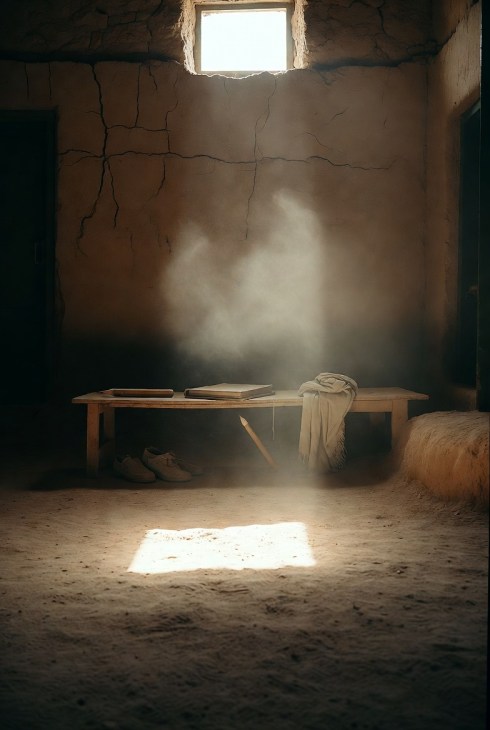
What remains when a girl’s future is taken from her is not silence alone, but the room that taught her to disappear.
References
UNESCO — education ban
UNESCO reported in August 2025 that Afghanistan is the only country in the world where secondary and higher education is strictly forbidden to girls and women, with nearly 2.2 million barred from schooling beyond the primary level.
Human Rights Watch — broader restrictions
Human Rights Watch’s World Report 2026: Afghanistan documents severe Taliban restrictions on women and girls’ movement, access to public spaces, dress, behaviour, education, and public life.
Amnesty International — child marriage decree
Amnesty International reported in June 2026 that Taliban Decree No. 18 enables child marriage and further restricts women’s and girls’ ability to challenge or leave such unions.
Final installment of a fictional composite in three vignettes about a girl coming of age under Taliban rule.
III. The Room Where They Discussed Me
The men came after evening prayer, when the bread cloth had already been shaken clean and folded.
My mother knew before they knocked. I could tell by the way she moved through the room, touching things that did not need touching: the cups, the kettle, the edge of the mat near the wall. She wiped the same place on the tray twice, then held it toward the lamp as if dust might have hidden there deliberately.
“Put on the blue dress,” she said.
I was rinsing lentils, and the water ran brown over my fingers.
“The blue one?”
She did not look at me. “Yes.”
The blue dress was folded beneath my winter shawl. I had worn it for Eid two years ago, when it still hung loose and my aunt said I would grow into it. I had grown. Now the sleeves stopped too high and the seam pulled under one shoulder, as if the dress itself knew I was no longer the girl it had been made for.
I changed behind the hanging cloth near the sleeping mats. When I came out, I saw my school shoes behind the water jar and nearly moved them, not because they were in the way, but because they looked like they belonged to someone who had expected morning to keep its promises.
Then the knock came.
My father opened the gate himself.
There were three men: my uncle, a man with a square beard and soft hands, and an older man I had seen twice near the mosque gate. They entered with the careful heaviness of men who expect a room to make space for them before they sit.
My mother sent me for tea.
The cups rattled once on the tray. I stopped walking until they stilled, then carried them in with both hands.
My father sat nearest the lamp, my uncle beside him. The man with soft hands sat opposite them, his knees wide beneath his coat, while the older man leaned on a stick and watched everything without appearing to watch.
At first they did not say my name.
They spoke about families, wheat, work, reputation, a cousin in another district, a man who had gone to Pakistan and returned with money, the price of flour, the danger of waiting too long. My uncle laughed once and said girls were like fruit; a father should not leave them where the weather could reach them.
The men smiled at that. My mother kept her hands around the teapot.
I placed the tea in front of them, starting with the oldest man because my mother had taught me the order years before. My hand passed through the lamp light, and the blue sleeve pulled tight at my shoulder.
The man with soft hands looked at the cuff, then at my face; not long, but long enough for the room to notice.
“She is modest,” my uncle said.
My father nodded.
The man asked how old I was, and my father answered before I could breathe. The number sounded smaller in his mouth, flattened and carried away from me as if it belonged to a household account, not to a person.
The man stirred his tea though there was no sugar in it. “Young girls learn a house more easily.”
My uncle said something agreeable, and the older man with the stick tapped the floor once, not loudly, only enough to remind everyone that he remained part of the judgment.
I stood with the empty tray against my stomach until my father looked at me and said, “Go help your mother.”
In the kitchen, my mother had both hands flat on the table. The lentils sat in the bowl, half-rinsed, while water dripped from the edge one slow drop at a time. I put the tray down, and she reached for a cloth, missed it, then found it with her other hand.
“Am I to be married?” I asked.
She wrung the cloth once. Brown water ran into the bowl.
“Your father is speaking.”
That was not an answer, which was how I knew it was one.
I wanted her to turn around and say no, or not yet, or I will speak to him, or I will stand in the door and not move. I wanted her to become larger than the room, larger than the men, larger than whatever law had made her small before I was even born.
Instead she wiped the table.
“They say he has work,” she said.
“Who?”
She folded the cloth, unfolded it, then folded it again.
“The son.”
“How old?”
Her fingers stopped.
“Older.”
From the front room came laughter. My father’s laugh arrived last, careful and low.
“Does he know about me?” I asked.
My mother finally turned. For a moment anger crossed her face, but it did not know where to go and found no door.
“Do not speak foolishly.”
I lowered my eyes.
She reached for my wrist. Her fingers closed, then loosened. When I was small and feverish, she used to hold my wrist while counting my pulse; I remembered waking in the night with her beside me, lips moving in prayer, thumb soft against the inside of my arm. Now her hand rested in the same place as if she were checking whether I was still there.
The older man called for more tea.
My mother let go.
The second time I entered, the room had grown quieter.
A paper had appeared on the mat. Not an official paper, not yet, but folded and smoothed, with names spoken over it as if speaking could make them settle. My father had taken the good pen from the shelf, the one he used only for serious things: debts, letters, forms, names that needed to remain after the voice was gone.
My uncle was saying that a girl is safest under the authority of a husband. The man with soft hands said his son was firm but fair. The older man said a wife learns.
I set down the cups.
My father’s pen rolled toward the edge of the paper, and I caught it before it fell.
For one second I held it.
The pen was heavier than my pencil had been: black lacquer, silver clip, my father’s name scratched faintly near the cap. Every man in the room saw it in my hand, and the seeing itself became another instruction.
I placed it beside the paper. My father picked it up without touching my fingers.
“She reads well,” my uncle said, as if apologizing for me.
The man with soft hands gave a small smile. “Reading is useful for children. A wife needs other skills.”
The older man tapped his stick again, and my father did not look at me when he told me to go.
I went back to the kitchen and stood beside the wall where the plaster had cracked. My mother was pouring hot water into the teapot. Steam rose between us, softening her face and disappearing before it reached the ceiling.
“I do not want this,” I said.
The steam moved.
My mother closed the teapot lid.
“You do not know what this is.”
“I know enough.”
Her voice sharpened, then fell at once as she looked toward the front room. “You know books. You know school. You know words. That is not the same as knowing what happens when men decide you are disobedient.”
A sound came from the front room: paper lifted, folded, unfolded.
I thought of my notebook beneath the books in the chest, the broken pencil wrapped in cloth, the shoes behind the water jar. All my little hidden things, gathered like crumbs.
The older man called my father’s name.
My mother took my face in both hands, startling me because she had not done that in years. Her palms were warm from the teapot, thumbs resting just below my cheekbones as if she could hold my whole future there if she pressed carefully enough.
“Listen to me,” she whispered. “If they ask you anything, lower your eyes.”
“No.”
The word came out before I could catch it.
My mother’s fingers tightened against my face. Her eyes filled so quickly it frightened me.
“Do not make them hear you,” she said.
The front room went quiet.
We both heard it.
She let go and turned toward the stove. I picked up the tray because my hands needed to be doing something, and because if hands are busy, sometimes the mouth remains closed.
When I entered, the men were watching.
The older man gestured toward the space near the door. “Come here.”
I obeyed, not because I wanted to, but because my feet had learned obedience long before my mouth began objecting to it.
The man with soft hands looked at me with the mild patience people use for animals they expect to behave.
“Your father has spoken well of you,” he said.
I looked at the edge of the mat.
“You are obedient?”
My father answered.
“She is.”
The man waited. Perhaps he wanted to hear my voice; perhaps he wanted only to see whether I understood where to place it. Behind me, in the doorway, I could hear my mother breathing.
The room held still around my silence until the older man nodded.
“Good.”
Something moved from my father’s side of the mat to the other man’s: not money exactly, or not only money. A folded cloth. A small packet. Words about timing, honour, God, safety, duty. Words that passed above my head and landed on the paper.
The pen scratched. My father’s hand moved.
My name appeared where I had not written it.
Zahra.
Upside down, it looked like someone else’s name.
The men drank their tea. The man with soft hands asked if I could cook rice properly; my uncle said my mother had trained me well, and the older man said too much education made girls restless. Everyone agreed in different ways, some with words and some by letting the words stand.
I remained near the door until my mother touched my elbow.
In the kitchen she took the tray from me before I dropped it. Only then did I realize my hands were shaking.
“Sit,” she said.
I sat on the floor beside the lentils. The bowl was still there, the water settled now, with a few pale skins floating on the surface.
My mother crouched in front of me, her knees cracking softly.
“There may still be time,” she whispered.
She did not say for what.
Time to persuade him. Time to delay. Time to fold another dress. Time to teach me which silences keep bones unbroken.
From the front room came my father’s voice, lower now, serious in the way men sound when they believe they are protecting what they own.
The men stayed a long time.
When they finally left, my father walked them to the gate. I heard the scrape of sandals, the murmur of farewells, the older man’s stick striking the ground three times before the latch closed again.
My father returned with the good pen in his hand and placed it on the shelf.
No one spoke.
My brother had slept through most of it. He woke when the room quieted, rolled over, and asked if there was bread left. My mother gave him some. He ate with his eyes half closed, and a crumb fell onto his schoolbook, where it sat on the open page until the lamp smoked and the room darkened around it.
Later, after the lamp was lowered and my father lay down with his back to the room, my mother came to my mat. She knelt beside me and tucked the blanket near my shoulder, though I was too old for that and the night was not cold.
“I will speak to him tomorrow,” she whispered.
Her voice sounded as if it had travelled a long way to reach me.
I nodded.
She touched my hair once through the blanket, then went back to her place.
I waited until the house settled.
The chest opened with its small complaint. I paused, listening, then reached inside and found the notebook beneath the books. My broken pencil was still wrapped in the scarf. I had sharpened it badly with the kitchen knife two days before, and the wood was uneven under my fingers.
I sat by the wall while the room held the evening’s remains: lamp smoke, lentils, men’s tea, and the dust their shoes had brought in.
For a long time I did not write.
At last, I put the pencil to the page.
Today they discussed me.
The words looked too small for what had happened, so I tried again beneath them.
They asked whether I was obedient.
The pencil left a dark point on the page where my hand rested too long.
I wanted to write that I had said no, but I had not said it where it mattered. I had said it in the kitchen, into steam, into my mother’s hands, into the narrow space before fear entered the room.
I turned the page.
Outside, beyond the courtyard wall, something moved in the lane: a man’s voice, a cough, a door closing. Farther away, boys would be sleeping before school, their books thrown wherever their hands had dropped them.
I wrote one more line.
I was in the room.
Then, after a while, I added:
No one asked me to sign.
The pencil point held.
I closed the notebook and wrapped it in the scarf, but did not put it back at once. I held it against my chest until the hard edge of the cover pressed into my ribs.
Behind the water jar, my school shoes waited in the dark. I looked at them for a long time and understood, finally, that they were not waiting for morning anymore.
I placed the notebook beside the shoes.
Not hidden. Not exactly. Just with the other things that had belonged to the girl I was before men sat in a room and decided what to call my future.
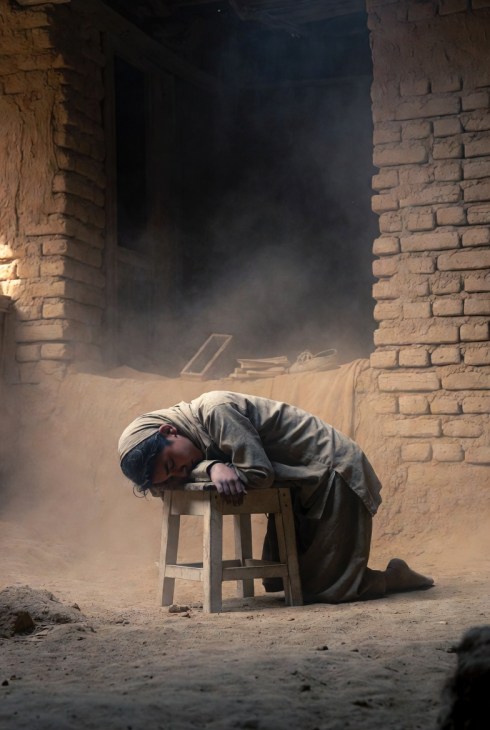
Zahra is fictional. But the wall is real.
A fictional composite in three vignettes about a girl coming of age under Taliban rule.
II. The Road That Needed A Boy
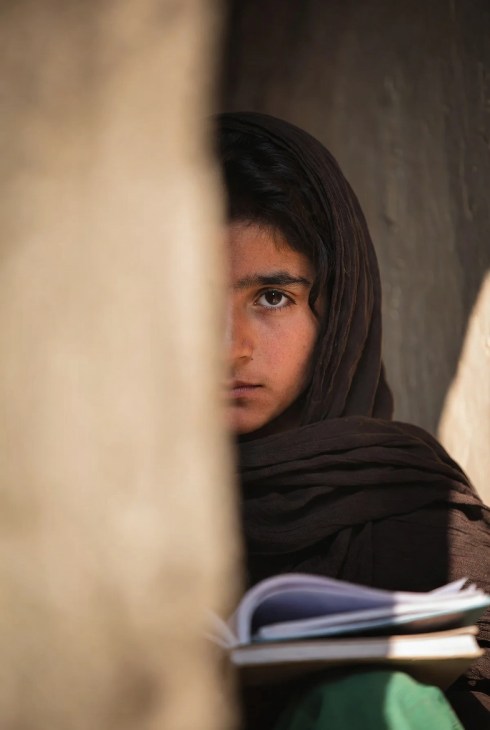
My mother woke with one hand pressed beneath her ribs.
She did not make a sound. I watched from my mat as the room brightened by slow degrees and my brother scratched himself awake for school. When he kicked off his blanket, his foot struck my ankle.
“Move,” he said.
I moved.
My mother closed her eyes.
At breakfast she broke the bread but did not eat it. My father had already gone to see a man about flour, and my brother was late and angry because his book was missing. It was under his own blanket. I saw the corner before he did, but waited while he lifted the cushion, cursed softly, and accused me of moving it.
“It is there,” I said, pointing.
He snatched it up.
“You should have said.”
My mother’s hand tightened under the table, only a little, only enough for me to see.
I lowered my eyes to the bread.
My brother left with crumbs on his sleeve and his bag half open. The gate knocked against the wall when he kicked it wide. A moment later his voice joined the other boys in the lane, careless and rising, already beyond the house.
My mother stood when he was gone, took two steps toward the stove, and stopped.
I reached her before she touched the wall. She leaned against me with only part of her weight, the way women lean when they are trying not to admit they have leaned at all.
“Sit,” I whispered.
She shook her head.
“Water first.”
I brought it. She drank and pressed the cup back into my hands without looking at me. The skin around her mouth had gone grey.
“We should go to the clinic,” I said.
She looked toward the gate.
My father was gone. My brother was gone. My uncle lived across the old road but might already be at the market. My cousin Farid sometimes came in the mornings, though he came when he wished and left when he wished, being fifteen and male and therefore important in ways no one had asked him to earn.
The clinic was not far. I could walk there with my mother before the sun cleared the neighbour’s roof. I knew the route better than Farid did: past the broken drain, left at the green door, around the corner where boys played football with a cloth ball, then straight until the road widened near the pharmacy.
I could have gone.
I did not move toward the gate.
My mother saw that too.
“Maybe it will pass,” she said.
She tried to stand straighter and failed.
I helped her to the cushion near the wall, then went to the shelf where she kept the old medicine paper folded inside a tin. I knew which one it was because she had taken the same tablets before, when the pain came after carrying water in winter. The writing had faded, but I could still read enough of it.
I had always been good at reading.
Outside, a cart rolled past. Men spoke near the corner. One laughed, and the laugh came through the gate as if the wood were thinner than before.
I folded the paper smaller and placed it beside the cup.
“We need someone to take us,” my mother said.
Us.
The word sat between us with its little insult folded inside it. She needed medicine; what we needed first was a boy.
By midmorning the room had grown warm. My mother sat with her back to the wall, eyes half closed, lips moving without sound. I swept the courtyard because I could not sit, then swept it again though the dust only moved from one side to another. When I bent near the gate, I heard girls laughing somewhere beyond the lane.
Not girls my age.
Small ones.
They passed like a handful of birds thrown into the morning, schoolbags bumping against their sides, shoes striking the road in quick uneven taps. One of them sang the first line of a lesson and forgot the rest. Another corrected her. They argued and kept walking.
I held the broom still until their voices were gone.
Then I swept the same clean place a third time.
Farid came near midday.
He did not knock properly, only called from outside as if our door owed him an answer. My mother straightened before I opened it. She wiped her face with the edge of her scarf and told me to bring the outer covering.
The cloth hung on a peg near the door.
I had worn it many times by then, but each time there was a moment — small, almost nothing — when my body remembered air on my face. The pause was brief. No one would have noticed it unless they were watching for rebellion.
I noticed it.
I put the covering on.
The room changed at once. The edges of things dulled; the door became a shape, the floor a dim path, my own hands something I had to lift close to see clearly. I adjusted the cloth where it fell near my eyes, then lowered it because Farid’s shadow had crossed the threshold.
He did not look sick. He looked bored.
“What is wrong with her?” he asked.
“With my mother?”
He shrugged, already glancing back toward the lane.
I handed him the folded medicine paper.
He looked at it, turned it once, then handed it back.
“You tell them.”
I kept my hand closed around the paper.
At the gate my mother paused, not from modesty but pain. Farid sighed, wanting us to know he had somewhere else to be.
I wanted to tell him she had waited half the morning for his permission to be ill.
Instead I stepped behind my mother and made sure the cloth did not catch in the latch.
The lane was brighter than I expected.
It always is, after days inside. The first glare made me blink, and for a moment the world disappeared; there was only cloth, footsteps, and the knowledge of where the road should be. My feet found the dip near the drain, the flat stone by the neighbour’s door, the place where rain had eaten a channel along the edge of the lane.
Farid walked ahead.
He took the wrong turn.
My mother did not notice. Her breath had shortened, and she was watching the ground in front of her feet. I stopped at the corner, then caught myself and stepped after him.
“Farid,” I said.
He kept walking.
“Farid.”
He turned, annoyed.
“That way,” I said, pointing with two fingers low at my side.
He looked at the road, then at me, then back at the road.
“I know.”
He came past us without hurrying.
We followed.
Near the football corner, three boys had drawn lines in the dust with a stick. They stopped playing when we passed. One of them was younger than me and stared because boys learn early that looking costs them nothing. Farid told them to move, and they did, slowly, dragging their feet through the lines they had made.
My mother’s sleeve brushed mine. I matched her pace.
At the wider road, a truck passed carrying men in the back. One held a rifle across his knees. Another tapped a stick against the metal side in a steady, bored rhythm. They were not looking at us, and still my mother shifted closer to the wall until her shoulder nearly touched the mud brick.
I shifted with her.
The wall was warm from the sun, though none of its warmth reached inside the cloth.
A woman ahead of us did the same thing, turning half-sideways with a child tucked behind her. When the truck moved on, no one spoke. The woman waited three breaths before stepping away from the wall, as if the road had to become safe again by itself.
At the pharmacy, the man behind the counter knew Farid’s name but not ours.
“What do you need?” he asked him.
Farid looked at me.
I held out the paper.
The pharmacist took it, squinting at the old writing. “Who is this for?”
“My aunt,” Farid said.
The man looked past him, toward my mother, then away. “Pain here?” He touched his own side.
My mother nodded.
“Fever?”
She opened her mouth.
Nothing came out.
Her eyes flicked to Farid, who was looking at a box of sweets near the counter.
“Yes,” I said softly.
The pharmacist’s eyes moved to me. Not sharply, not kindly either, only enough that I remembered where a girl’s voice was meant to stay.
My mother answered then, barely louder than the rustle of cloth. “No fever.”
The pharmacist took down a small packet and began explaining the tablets to Farid, who listened with the solemn face of someone trusted with knowledge he did not intend to carry far.
“After food,” the man said.
Farid nodded.
“Not too many.”
Farid nodded again.
“Morning and night.”
Farid looked toward the door.
I counted each instruction on my fingers inside the cloth where no one could see.
Morning.
Night.
Food.
Not too many.
When the pharmacist wrapped the packet, Farid reached for it before I could. My mother paid. The coins shook once in her hand, and I moved closer so my sleeve hid it.
Outside, Farid gave me the medicine only after we had turned away from the shop.
“You heard?” he asked.
I nodded.
“Good. I forgot.”
He laughed a little, as if this were charming.
On the way home, we passed the old beauty shop.
The sign was still there, though someone had scraped the painted face until only the mouth remained. Dust clouded the windows. A notice had been pasted to the door months ago and was peeling at one corner.
My cousin had gone there before her wedding.
I remembered her holding out her hands for us to admire, palms painted red, fingers curled as if she were carrying water she did not want to spill. Everyone had laughed because she would not touch anything until the colour dried. For one afternoon she had moved through the rooms slowly and grandly, pleased with herself, letting the younger girls look.
Now the shop stood with its mouth scratched away.
Farid saw me looking.
“Places like that made women foolish,” he said.
My mother kept walking.
I lowered my eyes, but not before I caught my reflection in the dusty window: cloth, shadow, the suggestion of a face that no longer belonged fully to the street.
At home, Farid did not come inside. He had done his duty and was already late for whatever boys do when no one is measuring their steps. My mother thanked him. He shrugged and went down the lane, kicking a stone ahead of him until it bounced into the drain.
I closed the gate.
The latch stuck, so I lifted it and tried again.
Inside, the house received us without interest: stove, wall, water jar, folded quilts, the chest beneath them. My mother sat slowly, one hand under her ribs, and I gave her the tablets after tearing the packet carefully along the edge.
“Morning and night,” I said. “After food. Not too many.”
She looked at me for a moment.
Then she nodded.
I poured water. She swallowed the first tablet and leaned back with her eyes closed. The covering had left a red line across her forehead. I wanted to touch it, but she looked too tired to be comforted.
In the courtyard, I shook dust from my covering.
Before I lifted it from my shoulders, I checked the gate.
Closed.
Then the windows.
Empty.
Then the roofline.
No one.
Only then did I pull the cloth back from my face.
Air touched my skin.
I stood with the covering gathered in both hands, breathing as quietly as I could. The courtyard wall rose above me, sun on the top half, shadow on the lower. A crack ran through one corner where last winter’s rain had softened the mud brick. I had watched that crack widen for months.
A small brown bird landed on the wall.
It hopped once, turned its head, and looked down into the courtyard with one bright eye. Nothing about it was beautiful. It was dusty and ordinary, the colour of road and seed husks. It opened its beak and gave a quick, careless sound.
I did not move.
The bird hopped again, closer to the edge. Its feet gripped the wall without asking whether the wall permitted it. Then it lifted itself into the air and crossed into the neighbour’s courtyard, where I could not see it anymore.
I stood there until my mother called my name.
The sound came through the house, tired and small.
I folded the covering carefully: outside from inside, dusty from clean, seen from unseen. By the door, my school shoes waited behind the water jar, still angled toward the gate.
I almost moved them back.
Then footsteps passed outside, and I carried the covering inside.
This is a fictional composite, told through three brief vignettes, about a girl coming of age under Taliban rule in Afghanistan.
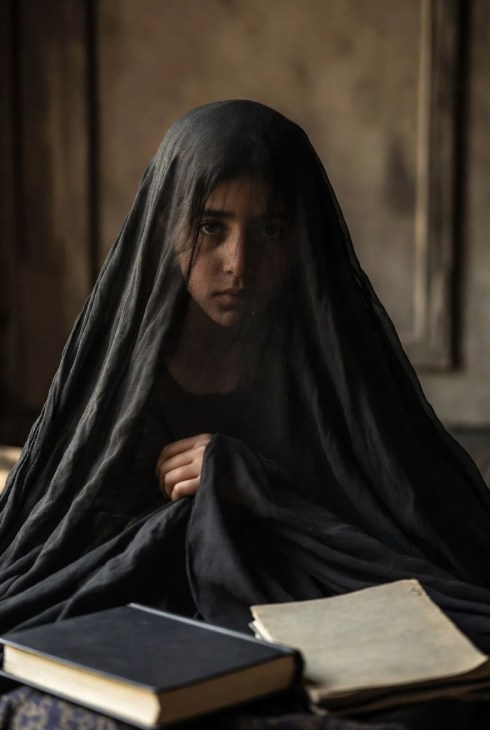
Her name is Zahra. She is not one real girl, but she stands in for many: girls whose schools were closed, whose movements were restricted, whose voices were lowered, whose futures were discussed by others before they were old enough to understand what was being taken.
The purpose is not to sensationalize suffering. It is to show, quietly and plainly, what theocratic power does when it reaches into the daily life of a girl: the books hidden away, the gate closed, the words swallowed, the future made smaller one obedience at a time.
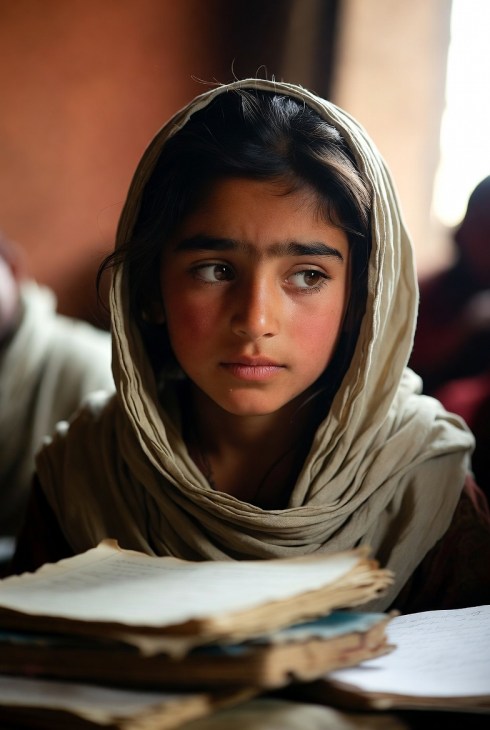
I. The Day School Ended
My name is Zahra, and last year I still ran to school.
Mariam and I used to race from the corner where the road dipped, skirts catching dust, scarves slipping. She would say the teacher was going to scold us; I would tell her she would be scolded first because her scarf made her look like a goat tangled in laundry. By the time we reached the green gate, we were holding our sides, trying to breathe quietly and failing, already guilty and already happy.
This morning, before prayer, my brother kicked the wall in his sleep and knocked dust from the mud brick.
He slept with one arm flung out from the blanket, mouth open, hair flattened on one side, as if sleep itself gave boys more room than it gave girls. When my mother bent over him and shook his shoulder, he dragged the quilt over his head and made a low miserable sound, the kind boys make when the world asks them to rise and they believe the request itself is an injury.
“Get up,” she whispered.
He did not move until she said, “Your father will hear.” Then he sat up slowly, face swollen with sleep, scratching at his stomach while the house gathered itself around morning: the kettle lid clicking on the stove, my father coughing once from the other room, someone outside sweeping a courtyard in long dry pulls.
“I don’t want to go,” my brother said.
My mother picked up his shirt from the floor and shook it once. “Then go unwilling.”
He looked at me as if I might laugh, so I lowered my eyes to the blanket before he could see anything cross my face.
His slate lay near my foot, its corner chipped, one side clouded with old sums half-wiped away. He had left it there the night before, careless as always, and I moved my toes back so I would not touch it by accident.
My own shoes waited beside the door, dusty at the toes, the right lace still shorter than the left because I had tied it too quickly on the last morning I went to school. Mariam had been calling for me from the lane, impatient and bright, and I had bent over the knot with one hand on the doorframe, laughing because she was always early when she claimed to be late.
They still fit.
I knew because two nights ago, after everyone slept, I had put them on and stood beside the door long enough to feel the shape of the old morning rise through my feet.
My brother complained that his shoes were tight, and my mother told him to bring them closer. She pressed the leather with her thumb, frowned, and said he was growing again. When he suggested he might stay home, my father coughed from the other room, and my brother reached for the shoes without another word.
The chest was beneath the folded quilts, not hidden exactly, but not offered to the room either. I waited until my mother turned back toward the stove before lifting the lid. It gave a small wooden complaint, and I paused with one hand still on the edge, listening to see whether the sound had reached anyone.
No one looked at me, so I opened it the rest of the way.
The books were wrapped in my aunt’s old scarf: mathematics, Dari, science with the corner chewed by a mouse, and my English reader, thin and soft from use. When I rested my hand on it, the classroom came back so suddenly that I had to press my fingers flat against the cover: chalk dust, damp wool in winter, the cheap orange soap our teacher used, the warmth near the stove where all of us pretended not to shiver.
Then my brother knocked over a cup.
The sound closed the chest for me before I had decided to close it.
Tea spread across the floor. My mother said his name sharply, and he grabbed a cloth only to push the spill wider. I went to help, stopped because he had hands and could wipe his own mess, then saw my mother look at me.
I took the cloth from him.
By the time he was ready, the sun had reached the top of the courtyard wall. He shoved bread into his mouth, tucked his slate under one arm, forgot his book, cursed softly when my mother sent him back for it, and then kicked the gate open with his heel because both hands were full.
“Do not kick the gate,” my mother called, but he was already outside, where the other boys waited in the lane.
Their voices came through the open gate in pieces: a joke, a shove, someone laughing too loudly, someone calling for my brother to hurry. He ran to meet them with his bag slapping against his back, his own voice rising to join theirs before he reached the corner.
The gate swung half shut behind him, and I moved toward it before I knew I had moved, only one step, small enough to deny if anyone asked.
My mother’s hand touched my sleeve.
She did not pull, because she did not need to. I stepped back, and she went to the gate and closed it with her hip. The latch fell into place while I stood there holding the wet cloth in both hands.
After breakfast I rinsed the cups, swept the courtyard, shook crumbs from the bread cloth, and folded my brother’s shirt from yesterday. There was ink on one sleeve, and I rubbed at it with water until the fabric darkened under my fingers, though the stain only spread and made a larger shadow. Near the back wall, my father’s coat hung from a peg with burrs clinging to the hem, so I picked them out one by one and set them in a little pile on the floor.
My mother kneaded dough beside me, pressing, folding, turning, and I matched her rhythm without meaning to: pick and drop, pick and drop, pick and—
From somewhere beyond the houses came the sound of boys reciting.
I knew the shape of it at once, even before I could hear the words. The teacher asked; the class answered, not together exactly, because boys never answered together properly. One voice rushed ahead, two lagged behind, and one shouted because he liked the sound of himself.
My hand closed around a burr, and the point went into my thumb.
I put it in my mouth before the blood could show where my mother might see.
The recitation came again, louder this time, lifted by the wind and broken against the courtyard wall, and I picked up the coat and shook it hard, though there was nothing left to shake out.
In the afternoon, my aunt came with Mariam, who is seven and still small enough for school.
She entered with dust on her hem and a notebook clutched against her chest. Her cheeks were red from the cold, and she smelled of outside air. Before she had even greeted my mother properly, she climbed beside me and pushed the notebook into my lap.
“Zahra, look.”
Her letters leaned across the page, some too fat, some too thin, some collapsing into the next as if they were tired. She had pressed too hard with the pencil, denting the paper beneath each line, and I reached for her hand before remembering myself. I folded my hands together instead.
“Very good,” I said.
She smiled as if I had given her something precious.
The pencil was still behind her ear, the yellow paint bitten at the end. I could see exactly what she was doing wrong, how she held it too high and forced the letters from the shoulder instead of letting the wrist guide them. The correction rose into my mouth so naturally that I nearly spoke it, but my aunt was sitting across from us, and my mother had gone still near the stove.
I swallowed the words.
Mariam turned the page and showed me more. The second page was worse, one letter even facing the wrong direction, and I smoothed the curled corner with my thumb while looking long enough for the urge to fix it to pass.
“Will you come back to school when they let big girls come?” she asked.
My aunt adjusted the edge of her scarf. My mother wiped flour from her wrist though her hands were already clean. Outside, a cart rolled past and one wheel struck a stone.
The silence answered for us.
Mariam looked from face to face, still expecting one of the grown women to make the world make sense again. When no one did, I smiled because she was little, and because little girls should be allowed to keep foolish hopes a little longer.
“Show me the next page,” I said.
After they left, I found an old pencil under the chest. It was short, bitten at one end, split near the point, the kind of pencil no one would think important enough to take. I held it in my palm while my mother and aunt spoke near the door in voices that were not secret, only low, which is different.
When my aunt finally went home, I rolled the pencil once between my fingers and slipped it into my sleeve before I had decided what I was hiding it from.
At evening, my brother lay on his stomach near the lamp, schoolbook open, feet moving lazily in the air. He had ink on his sleeve again. The stain I had rubbed earlier was still there, only wider now.
He frowned at a word and said my name.
I looked up from the onions.
“How do you spell this?”
He pushed the book toward me without moving from his stomach. I wiped my hands on my dress and leaned close enough to see, though the answer came before my eyes had finished reaching the page. My finger rose automatically, the way it had for years in class.
I pulled it back as if the page had burned me.
He waited.
I told him the letters slowly, and he wrote them badly, with the second one crooked and wrong. For a moment I watched the mistake settle on the page, black and permanent, while the lamp flame bent sideways and recovered.
“Is that right?” he asked.
“Yes,” I said.
He shrugged and turned the page, and I went back to the onions. The knife slipped once against my finger, barely touching skin, not enough to bleed.
After everyone slept, I opened the chest again.
This time I moved slowly, because the hinge complained near the top, and I knew how far I could lift the lid before the sound carried. I reached inside by feel: cloth, book edge, notebook. The pencil in my sleeve had left a grey mark against my wrist.
I sat with my back to the wall while the house breathed around me: my brother’s uneven sleep, my father’s heavier one, my mother turning once on her mat. Somewhere outside, a dog barked and stopped.
The notebook opened to a blank page. The lines were faint but still there, and I wrote the date carefully because my teacher had once said careless dates made careless minds. Then I held the pencil above the next line and tried to picture my classroom: the green gate, the cracked step near the door, the teacher’s blue scarf, my place beside the window.
I could see all of it.
When I tried to remember what grade I would be in now, my hand began to shake, so I placed it flat against the page until it stopped.
On the first line beneath the date, I wrote:
Future
The pencil point broke on the last letter, making a sound so small I looked toward my mother to see whether she had heard it.
She had not.
I sat for a long time with the broken pencil in my hand, feeling the rough edge of the wood with my thumb. Then I wrapped the notebook again and slid it beneath the books, not on top where it had been before. When I closed the chest, the latch did not catch, so I opened it again, lifted the cloth, tucked one corner of the scarf out of sight, and closed it properly.
In the dark, I took my school shoes from beside the door and placed them behind the water jar.
Not hidden.
Not exactly.
Just somewhere no one would ask why they were still waiting.
The Taliban understand something too many Western progressives pretend not to: the education of women is civilization-level power.
That is why they ban it. That is why they silence girls. That is why they bury half the country alive and call it virtue.
A society that fears educated women is not protecting tradition. It is confessing its own cowardice.











 bleatmop
 Mystro


 Dead Wild Roses
Your opinions…