
You are currently browsing the category archive for the ‘Medicine’ category.
Organ transplantation is one of medicine’s genuine miracles.
A failing heart can be replaced. A patient whose kidneys no longer function can be freed from dialysis. An organ donated at the end of one life can preserve another for decades.
Yet the legitimacy of transplantation depends upon a boundary that cannot be negotiated away. The person providing the organ is a human being, not a supply of biological material. Consent must be genuine, death must be independently determined, and the physician’s duty to the donor cannot be subordinated to the needs of the recipient.
China’s transplant system has a documented history of crossing those boundaries. Its government has admitted that organs were taken from executed prisoners, although it now says that this practice ended in 2015 and that voluntary civilian donation supplies the country’s transplant hospitals.
That defence cannot simply be dismissed, but neither can it be accepted on trust.
China’s official donation statistics show signs of systematic manipulation. Its transplant registries are not publicly accessible. Chinese medical papers have described organ removals in which the procurement itself appears to have caused the donor’s death. Investigators have also assembled evidence that prisoners of conscience, particularly Falun Gong practitioners, have been medically tested and killed for their organs.
The exact number of victims remains uncertain. The evidence that China has not provided a credible account of its transplant system does not.
What China has admitted
For years, Chinese officials denied that prisoners supplied the country’s transplant industry. That position eventually became impossible to maintain, and in late 2005 officials publicly acknowledged that organs from executed prisoners had been used.
The historical numbers show how dependent the transplant system had become upon state custody. Chinese officials reported roughly 120,000 organ transplants between 1977 and 2009, but only 130 voluntary donors had been identified by the end of that period. The country did not yet possess a voluntary donation system remotely capable of supplying the number of organs being transplanted.
Calling these donors convicted criminals does not resolve the ethical problem. A prisoner awaiting execution exists under the absolute power of the state. Consent given under those conditions cannot safely be treated as free, especially when the organs have substantial financial value and hospitals benefit from their availability.
The relationship also creates a dangerous incentive. Once the justice system becomes a supplier to the medical system, a prisoner’s body acquires value that may influence the timing and purpose of the execution.
China announced that, beginning on January 1, 2015, hospital-based voluntary donors would become the sole lawful source of transplant organs. It established a national allocation system known as COTRS, developed hospital-based procurement organizations and said that donation would be voluntary, unpaid, transparent and traceable.
That is Beijing’s strongest answer to the allegations: whatever happened before 2015 belongs to an earlier system that has since been reformed.
There is evidence that genuine voluntary donation has grown in China, and it would be irresponsible to assume that every transplant performed there today involves an unwilling donor. The central question is whether the new system has replaced the old one or partly concealed it.
China has not permitted the independent access needed to settle that question.
Its official registries are not publicly available, and the limited figures released by officials are difficult to corroborate against hospital-level activity. Nor did the 2015 announcement begin cleanly. Shortly after it took effect, former vice-minister of health Huang Jiefu suggested that condemned prisoners could still “donate” by entering the civilian allocation system because they remained citizens. He later said those remarks had been philosophical rather than a description of actual practice.
If prisoner organs can be reclassified as civilian donations, a change in terminology may disguise continuity rather than establish reform.
Numbers that look designed
China reported extraordinary growth in its new voluntary system. According to official figures, annual deceased donors increased from 34 in 2010 to 6,316 in 2018. Reported kidney and liver transplants also rose rapidly.
Researchers Matthew Robertson, Raymond Hinde and Jacob Lavee examined those figures using forensic statistical methods. They compared national data from COTRS and the Chinese Red Cross, provincial reports, hospital records and donation patterns from 50 other countries.
They found that China’s official donor, kidney and liver totals followed simple mathematical curves with remarkable precision. The R-squared values were 0.9993, 0.9995 and 0.9989 respectively, approaching a perfect fit with a predetermined quadratic formula.
Actual organ donation depends upon accidents, illness, family consent, failed procurements, regional differences, hospital capacity and countless other unpredictable events. Even rapidly growing systems contain irregularity. The equivalent figures from the other 50 countries did not display anything close to China’s mathematical smoothness.
The researchers also identified contradictory provincial data, suspicious conformity with central quotas and apparent cases in which non-voluntary donors were classified as voluntary. They concluded that systematic manufacture and manipulation were the most plausible explanation for significant parts of the official record.
Their backgrounds should also be disclosed. Robertson has worked with the Victims of Communism Memorial Foundation, the Human Rights Law Foundation and End Transplant Abuse in China, and was formerly an editor at The Epoch Times. Lavee has served with Doctors Against Forced Organ Harvesting. Both had publicly opposed Chinese transplant abuses before publishing the study.
Those affiliations justify careful scrutiny of their assumptions and methods. They do not, by themselves, answer the statistical evidence. The paper was peer-reviewed, its methodology was published, its data sources were identified, and the international comparison can be examined independently.
The authors also did not claim that every voluntary donor was fictitious. They expressly acknowledged genuine voluntary transplant activity alongside the apparent manipulation.
Their conclusion was narrower: China’s official numbers cannot reliably demonstrate that voluntary donors account for its transplant activity.
That leaves the original question unanswered. If the published donor figures were manufactured or padded with non-voluntary cases, where did the actual organs come from?
When procurement becomes execution
Transplant medicine is governed by what is commonly called the dead donor rule.
Vital organs must not be removed from a living person in a way that causes death. The determination of death must be independent of the desire to obtain the organs. A physician cannot become an executioner because another patient needs a heart.
In 2022, Robertson and Lavee examined more than 120,000 Chinese-language medical publications and identified 71 papers, published between 1980 and 2015, in which the reported procedures failed to establish that the donors were properly dead before their hearts or lungs were removed.
The descriptions indicated that accepted tests for brain death had not been performed or could not have produced a valid declaration of death. The researchers concluded that, in these cases, removing the organs probably caused the donor’s death.
This dismantles a comforting distinction.
It is one thing to imagine doctors receiving organs after a prisoner has been executed. That would still involve coercion and serious medical abuse, but the transplant team could claim that it arrived after the killing.
It is another thing for organ removal to complete the execution. In that system, medicine does not merely benefit from state violence. The surgical procedure becomes part of it.
The order is reversed
In an ethical donation system, the donor appears first.
Someone dies under circumstances that allow donation. Consent is confirmed. Medical teams determine which organs remain viable, and allocation rules identify compatible recipients according to blood type, tissue compatibility, body size, urgency and time spent waiting.
The recipient waits because no hospital can promise when a compatible stranger will die.
Some of the most disturbing evidence from China describes that order being reversed.
Israeli transplant surgeon Jacob Lavee became concerned after one of his patients said that he had arranged a heart transplant in China approximately two weeks in advance. A heart cannot ordinarily be promised for a particular date through a system dependent upon unpredictable voluntary deaths.
A scheduled heart implies control over more than hospital availability. It implies that the system can locate a compatible donor and control when that person dies.
This is the logic behind the phrase “killed to order.” The recipient appears first, and a compatible person is then selected from a medically classified population.
The recipient may not understand how the organ was obtained. A gravely ill patient may be told only that China has an unusually efficient transplant system or a large donor pool.
But administrative efficiency cannot explain how a heart becomes available by appointment.
Prisoners of conscience
The most serious allegation is that China expanded its supply beyond condemned criminals to include people imprisoned for their religion, beliefs or political identity.
The largest body of evidence concerns Falun Gong practitioners.
Falun Gong is a spiritual discipline combining meditative exercises with moral teachings. After it grew rapidly during the 1990s, the Chinese Communist Party banned the practice in 1999 and subjected its followers to mass detention, imprisonment and ideological “transformation.”
Former detainees have described blood tests, X-rays, ultrasounds and organ examinations that bore little relationship to their medical welfare. Such tests would, however, be useful for determining blood type, tissue compatibility and organ condition.
In 2019, an independent people’s tribunal chaired by British barrister Sir Geoffrey Nice examined the allegations. The China Tribunal was not an international court and possessed no power to convict or punish anyone. It had been established by the International Coalition to End Transplant Abuse in China, an advocacy organization already committed to the issue.
Those limitations should be stated plainly.
The tribunal nevertheless heard more than 50 witnesses and experts and examined medical publications, hospital capacity, waiting times, recorded telephone calls, former-prisoner testimony and the official donor figures. It also considered material favourable to China and invited the Chinese government to participate. Beijing declined.
The tribunal concluded that forced organ harvesting had occurred for years on a significant scale and that Falun Gong practitioners had probably been the principal source. It also concluded that it had seen no evidence establishing that the practice had stopped.
That judgment does not carry the authority of a national or international court. It remains the finding of a privately convened inquiry, and readers are entitled to examine its evidence and institutional origins critically.
But the evidence does not vanish because the body examining it lacked formal jurisdiction.
Some investigators associated with the tribunal have estimated that China may perform between 60,000 and 100,000 transplant operations annually, far above the official totals. That figure is not a confirmed count of illicit procedures or identified victims. It was reconstructed from hospital beds, transplant wards, surgeon activity, hospital revenues and publicly stated capacity.
The essay does not need the upper estimate to be true.
China’s admitted reliance on prisoners, the statistical manipulation, the medical descriptions of execution by procurement, the short waiting periods and the testing of persecuted detainees already demand an explanation.
The warning from Xinjiang
Concern has also extended to Uyghurs and other religious minorities.
In June 2021, United Nations human-rights experts reported receiving credible information that detained Falun Gong practitioners, Uyghurs, Tibetans, Muslims and Christians were being subjected without informed consent to blood tests, ultrasounds, X-rays and examinations of organs such as the heart, liver and kidneys. Other prisoners were reportedly not subjected to the same testing.
The experts expressed extreme alarm and called upon China to permit independent international monitoring.
Their statement did not establish that every medically examined detainee had been entered into an organ database. Nor did it prove that Uyghurs had already been harvested on the same scale alleged for Falun Gong practitioners.
It identified selective organ-focused testing within populations already deprived of liberty and legal protection.
The distinction matters because evidence should not be stretched beyond what it demonstrates. Yet an authoritarian state cannot reasonably expect unexplained medical profiling to be interpreted in isolation from its admitted history of prisoner procurement and its refusal to open the transplant system to independent inspection.
Under those conditions, suspicion is not a substitute for evidence. It is a conclusion drawn from the evidence that is available.
What we know
The case can be stated without pretending that every uncertainty has been resolved.
China used organs from executed prisoners and denied doing so before eventually admitting the practice.
Its authorities say that prisoner procurement ended in 2015 and that voluntary civilian donation now supplies the transplant system.
A peer-reviewed statistical study found strong evidence that important official datasets had been manufactured or manipulated and that some non-voluntary donors may have been misclassified.
A second peer-reviewed investigation found Chinese medical reports in which doctors appear to have caused prisoners’ deaths by removing their organs before a valid determination of death.
Former detainees have reported selective medical testing, and UN experts have received similar allegations concerning several persecuted populations.
An independent but non-judicial tribunal concluded that prisoners of conscience, particularly Falun Gong practitioners, had been killed for their organs on a significant scale.
What remains uncertain is the full number of victims, the present annual volume, the proportion of organs supplied by each source and the degree to which particular hospitals continue illicit procurement today.
Those uncertainties should govern the language used to describe the system. They should not erase what is already known.
This is not a criminal trial, and secrecy alone cannot prove every allegation. But medical cooperation does not require proof beyond a reasonable doubt before ethical safeguards apply.
A transplant system seeking international legitimacy bears the responsibility of demonstrating that its donors consented, that their deaths were independently determined and that the organs did not come from prisoners or persecuted detainees.
China cannot withhold the records needed to verify those conditions and then demand that foreign institutions presume the system ethical.
The responsibility of the West
Western governments cannot force China to disclose every detention record or open every transplant hospital, but they can refuse to confer legitimacy upon a system that cannot demonstrate ethical sourcing.
Medical journals can reject research that does not identify donor sources or document valid consent. Universities and hospitals can suspend transplant training and institutional partnerships where records cannot be audited. Governments can prohibit their citizens from purchasing organs obtained without consent and deny entry to people involved in the trade.
Canada took an important step in December 2022 when Bill S-223 received royal assent. The law created offences for obtaining, removing or facilitating the removal of an organ without informed consent, including certain conduct committed abroad by Canadian citizens and permanent residents. It also made participation in organ trafficking grounds for inadmissibility to Canada.
The principle should extend beyond criminal prosecution. Where consent and donor identity cannot be independently verified, cooperation should stop.
That standard is not hostility toward Chinese physicians or Chinese people. Many of those raising the alarm are Chinese survivors, dissidents, families and medical professionals who understand what Party secrecy can conceal.
Nor does the case depend upon approving of Falun Gong, accepting its teachings or supporting the politics of organizations associated with it. Human rights are not rewards distributed to groups we find familiar or fashionable.
A person’s body does not become state property because the government has classified that person as dangerous, irrational or politically disobedient.
China has offered laws, announcements and aggregate numbers as evidence that its transplant system has changed. What it has not offered is the independent access required to verify the identity, consent and cause of death of the people whose organs supply its hospitals.
Until it does, the moral cloud over that system remains, along with the question Beijing has never credibly answered: where did the organs come from?

References and Further Reading
Primary research and official documents
Matthew P. Robertson, Raymond L. Hinde and Jacob Lavee, “Analysis of Official Deceased Organ Donation Data Casts Doubt on the Credibility of China’s Organ Transplant Reform,” BMC Medical Ethics, November 14, 2019.
Peer-reviewed statistical examination of China’s official donation and transplantation data. The authors found evidence of systematic data manufacture, manipulation and the apparent classification of some non-voluntary donors as voluntary donors.
https://link.springer.com/article/10.1186/s12910-019-0406-6
Matthew P. Robertson and Jacob Lavee, “Execution by Organ Procurement: Breaching the Dead Donor Rule in China,” American Journal of Transplantation, July 2022.
Peer-reviewed analysis of Chinese medical publications describing heart and lung procurement. The authors identified 71 papers in which the reported procedures indicated that organ removal probably caused the donor’s death.
https://doi.org/10.1111/ajt.16969
China Tribunal, Judgment, March 1, 2020.
The complete judgment of the independent people’s tribunal chaired by Sir Geoffrey Nice. It includes the tribunal’s methods, evidence, qualifications and conclusions regarding forced organ harvesting from prisoners of conscience.
https://chinatribunal.com/wp-content/uploads/2020/03/ChinaTribunal_JUDGMENT_1stMarch_2020.pdf
The tribunal was privately convened and possessed no formal judicial authority. Its institutional status and advocacy origins should be considered alongside the evidence it examined.
United Nations Office of the High Commissioner for Human Rights, “China: UN Human Rights Experts Alarmed by ‘Organ Harvesting’ Allegations,” June 14, 2021.
Official statement concerning credible information received by UN experts about non-consensual blood tests, ultrasounds, X-rays and organ examinations performed on detained religious and ethnic minorities.
Parliament of Canada, Bill S-223: An Act to Amend the Criminal Code and the Immigration and Refugee Protection Act (Trafficking in Human Organs), Royal Assent, December 15, 2022.
The complete text of the Canadian law criminalizing participation in organ removal without informed consent, including specified conduct committed outside Canada.
https://www.parl.ca/DocumentViewer/en/44-1/bill/S-223/royal-assent
Accessible reporting and summaries
Bethany Allen-Ebrahimian, “Study: Transplants in China Performed Before Proving Donor Brain Death,” Axios, April 4, 2022.
An accessible summary of Robertson and Lavee’s research into execution by organ procurement, including the case of a heart transplant reportedly scheduled in China approximately two weeks in advance.
https://www.axios.com/2022/04/04/study-transplants-china-donor-brain-death
Reuters, “China Is Harvesting Organs from Falun Gong Members, Finds Expert Panel,” June 17, 2019.
Contemporary reporting on the China Tribunal’s initial findings, China’s denial of the allegations and the persecution of Falun Gong practitioners.
The public case for pediatric gender medicine is simple enough. Medical intervention is supposed to reduce distress and improve mental-health outcomes.
That claim matters because the interventions are not minor. Puberty blockers, cross-sex hormones, and related medical pathways are presented to parents, policymakers, and the public as serious treatments for serious suffering. Their case does not rest on compassion alone. It rests on the claim that they work.
The trouble is that the strongest population-level data now available does not show that happening.
A new Finnish nationwide register study reports severe psychiatric morbidity before referral, continued severe psychiatric morbidity after referral, and no sign that psychiatric need subsides after medical gender reassignment. The study does not prove that treatment caused worsening. It does, however, cut directly against confident claims that these interventions reliably resolve the underlying distress in young people.
Terms fixed in advance
This subject is saturated with semantic drift, so a few terms need fixing at the outset.
By pediatric gender medicine, I mean the medical management of gender-distressed minors and young people through interventions such as puberty blockers, cross-sex hormones, and, where applicable, surgical pathways. By psychiatric morbidity, I mean the study’s outcome measure: need for specialist psychiatric treatment, whether inpatient or outpatient. By improvement, I mean a measurable reduction in psychiatric morbidity relative to baseline or to relevant controls.
That is a demanding definition. It is also the clinically serious one. If an intervention is being justified as a mental-health measure, then some observable improvement in hard psychiatric outcomes is the least one should expect.
What the Finnish study is
The Finnish paper is not a survey, and it is not a self-report exercise. It is a nationwide register study of all 2,083 individuals under age 23 who contacted Finland’s centralized gender identity services between 1996 and 2019, compared with 16,643 matched controls. Follow-up extended to June 2022. The outcome was specialist-level psychiatric treatment recorded in national health registers.
That matters. Register data has limits, but it is still harder than the small, uncontrolled, self-reported studies so often used to manufacture confidence in this field.
What it found
Before referral, 45.7% of the gender-referred cohort had already received specialist psychiatric treatment, compared with 15.0% of controls. Two years or more after referral, 61.7% of the gender-referred cohort required specialist psychiatric care, compared with 14.6% of controls. The first fact that has to be faced squarely is that psychiatric burden in this population is not only high at baseline. It remains very high afterward.
The post-2010 cohort matters as well, because defenders of the current model often imply that older data says little about the newer referral population. In this study, referrals after 2010 were in markedly worse psychiatric shape before referral than the earlier cohort. Among referrals before 2010, pre-referral psychiatric morbidity was 23.7%, versus 11.8% among controls. Among referrals after 2010, it was 47.9%, versus 15.3% among controls. So the recent referral surge did not simply bring in more of the same patients. It brought in a population with substantially heavier psychiatric burden.
The most striking figures concern the medically treated subgroups. Among those proceeding down the feminizing pathway, pre-referral psychiatric treatment was 9.8%; at least two years after referral it was 60.7%. Among those proceeding down the masculinizing pathway, the figures were 21.6% before referral and 54.5% after. Those are not small fluctuations. They are large increases in specialist psychiatric treatment after entry into the care pathway.
The adjusted-risk figures are no less serious. After adjustment for prior psychiatric treatment, hazard ratios remained approximately 3.0 to 3.7 times higher than female controls and 4.7 to 6.1 times higher than male controls. In plain English, the excess psychiatric burden did not wash away once prior history was accounted for.
The authors’ own conclusion is worth quoting in fuller form than the clipped line now circulating online: “Severe psychiatric morbidity is common among gender-referred adolescents and appears to be more prevalent in those referred after the recent surge in referrals. Psychiatric needs do not subside after medical gender reassignment.” That is not activist spin. It is the paper’s conclusion.
“Psychiatric needs do not subside after medical gender reassignment.”
What this study does not claim
This part matters because opponents will often try to smuggle in a claim you did not make and then congratulate themselves for refuting it.
This study does not prove that medical transition caused worsening in every case. It does not isolate a single causal mechanism. It does not show that no individual patient experienced subjective relief. It does not establish that specialist psychiatric treatment is a perfect one-to-one proxy for every dimension of psychological distress.
Those are real limits. They should be stated plainly.
But none of them rescues the stronger public claim that pediatric medical transition is clearly supported by solid evidence showing reliable mental-health benefit.
The strongest counterargument
The strongest counterargument is easy enough to state. Patients who go on to medical treatment may differ in important ways from those who do not. There may be unmeasured confounding. Some young people selected for treatment may have had more severe, more persistent, or more complex underlying psychiatric problems than the registers fully capture.
This is plausible.
Even if granted in full, however, it concedes the central problem.
If these interventions are working as claimed at the population level, then some clear signal of mental-health improvement should appear in the aggregate outcomes. Instead, psychiatric burden remains extremely high, does not converge toward control levels, and in key medically treated subgroups rises sharply. Increased specialist psychiatric treatment does not by itself prove worsening in every individual. What it does show is substantial psychiatric need persisting at levels incompatible with confident claims of broad psychiatric resolution.
That is the point critics keep trying to dodge. The question is not whether every confounder has been abolished. The question is whether the real-world outcome pattern supports the certainty with which these treatments have been promoted. This study says no.
Absence of demonstrated benefit is not a trivial problem
A common dodge here is to pretend that unless one has a perfect randomized trial proving direct harm, no serious concern exists. That is not how responsible pediatric medicine works.
Lack of demonstrated benefit is not identical to proof of harm. But weak evidence plus invasive intervention is not a neutral combination, especially in minors. When the evidence base is low quality and the strongest real-world data still fails to show the promised mental-health improvement, caution is not reactionary. It is simply what evidence-based medicine looks like once ideology is removed from the room.
“If an intervention works, population data should eventually show it. This does not.”
The larger evidence context
The Finnish register study matters on its own, but it lands in a broader evidentiary landscape that has already shifted under activists’ feet.
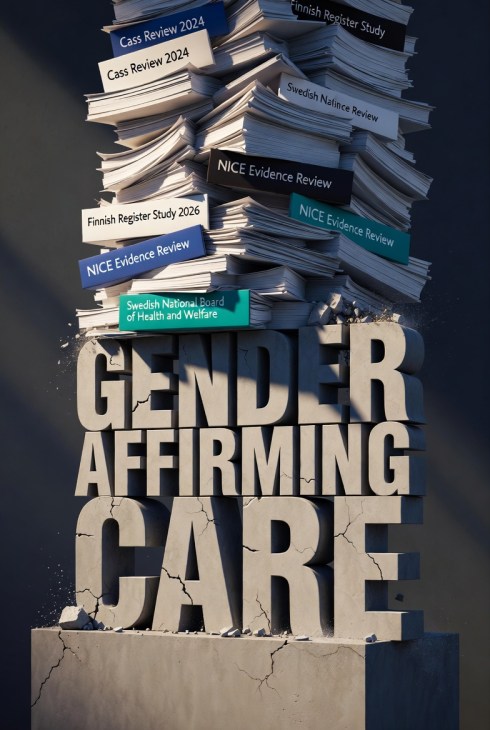
The independent Cass Review in England concluded that the evidence base for medical intervention in children and young people with gender-related distress is weak, that studies are generally small and uncontrolled, and that the field has been marked by overconfidence unsupported by good evidence. The review also incorporated earlier evidence reviews commissioned from NICE on puberty blockers and hormones.
Those NICE evidence reviews found the evidence for both puberty blockers and cross-sex hormones in this population to be of very low certainty. They remain among the most cited formal evaluations of the literature in this area.
Sweden’s National Board of Health and Welfare likewise revised its national guidance, concluding that for minors the risks of puberty blockers and hormone treatment currently outweigh the expected benefits, and that such treatment should be offered only in exceptional cases within structured specialist settings.
That pattern is not accidental. It reflects a broader recognition across evidence reviews and national reassessments: the confidence of the clinical rhetoric has run ahead of the quality of the evidence.
What can actually be concluded
Several conclusions can be made safely.
First, the psychiatric burden in this population is real and often severe. Nothing in this argument denies that.
Second, the new Finnish register data does not show psychiatric need subsiding after medical gender reassignment. On the contrary, the burden remains high, and in some medically treated subgroups the observed specialist psychiatric treatment rates rise sharply.
Third, the broader review literature and policy reassessments from major health authorities do not justify the level of certainty with which pediatric medical transition has often been promoted. The evidence is not robust enough for that.
Fourth, this study does not by itself prove a simple causal story of treatment-induced worsening in every case. Anyone claiming that from this paper alone is saying more than the evidence can bear. But anyone claiming that the strongest available population-level data clearly supports a confident mental-health benefit is also saying more than the evidence can bear.
The policy problem
That mismatch is the real issue.
This is not a case in which critics are denying a clearly established medical benefit. It is a case in which weak evidence, ambiguous long-term outcomes, and very serious interventions have too often been wrapped in the language of settled science.
They are not settled.
The evidence base is weak. The psychiatric burden remains high. The strongest register data now available does not show the promised relief in hard mental-health outcomes. That should force a lower-confidence, higher-caution clinical posture than the activist narrative has allowed.
Verdict
No honest reading of this literature permits the triumphant line that pediatric gender medicine is clearly evidence-based and reliably improves youth mental health.
The better reading is harsher and simpler.
The evidence is weak. The certainty has been inflated. And the strongest real-world data now available does not show psychiatric needs subsiding after medical gender reassignment.
When the evidence does not show improvement, escalation is not caution.
It is risk.
References
Ruuska, S.-M., Tuisku, K., Holttinen, T., & Kaltiala, R. (2026). Psychiatric morbidity among adolescents and young adults who contacted specialised gender identity services in Finland in 1996–2019: A register study. Acta Paediatrica. Advance online publication. https://doi.org/10.1111/apa.70533
Cass, H. (2024). Independent review of gender identity services for children and young people: Final report. https://cass.independent-review.uk/home/publications/final-report/
NICE / NHS England. (2020). Evidence review: Gonadotrophin releasing hormone analogues for children and adolescents with gender dysphoria. https://www.engage.england.nhs.uk/consultation/puberty-suppressing-hormones/user_uploads/nice-evidence-review-gnrh-analogues-for-children-and-adolescents-with-gender-dysphoria-october-2020.pdf
NICE / Cass Review. (2020). Evidence review: Gender-affirming hormones for children and adolescents with gender dysphoria. https://cass.independent-review.uk/wp-content/uploads/2022/09/20220726_Evidence-review_Gender-affirming-hormones_For-upload_Final.pdf
Socialstyrelsen. (2022). Care of children and adolescents with gender dysphoria – Summary of national guidelines – December 2022. https://www.socialstyrelsen.se/publikationer/care-of-children-and-adolescents-with-gender-dysphoria–summary-of-national-guidelines–december-2022-2023-1-8330/
Socialstyrelsen. (2022, December 16). Updated knowledge support for care in gender dysphoria among young people. https://www.socialstyrelsen.se/om-socialstyrelsen/pressrum/press/uppdaterat-kunskapsstod-for-vard-vid-konsdysfori-hos-unga/
Hostile Reader FAQ
“You’re claiming gender-affirming care causes harm.”
No. This piece does not claim causation. It shows that the strongest population-level data does not demonstrate the expected mental-health improvement. Absence of demonstrated benefit is not the same as proof of harm—but it is not neutral either.
“Psychiatric service use isn’t the same as worse mental health.”
Correct. It is not a perfect proxy for subjective distress. It is, however, a hard clinical outcome and a strong indicator of ongoing psychiatric need. Persistent high rates of specialist care are not consistent with claims of broad resolution.
“These patients were already more distressed.”
Yes. The study shows elevated psychiatric burden before referral. The question is whether that burden improves. At the population level, it does not converge toward control levels, and in some subgroups increases substantially.
“This is just one study.”
It is one of the largest and longest nationwide register studies to date. More importantly, its findings align with multiple systematic reviews and policy reassessments that rate the evidence base as low quality and uncertain.
“Other studies show benefits.”
Some smaller or short-term studies report improvements, often based on self-report and without strong controls. Systematic reviews consistently find these studies to be low certainty and at high risk of bias. That is why several national health authorities have revised their guidance.
“You’re ignoring patient experiences.”
Individual experiences vary, and some patients report relief. Clinical policy, however, is not built on anecdote. It is built on aggregate outcomes and evidence quality. Those are the focus here.
This quote from@prof_curiosity on X: Piaget: The construction of learning
“Piaget viewed children as “little scientists” who actively construct knowledge by testing and refining mental schemas, most often through play. Through assimilation (fitting new experiences into existing schemas) and accommodation (adjusting schemas when they do not fit), driven by equilibration (resolving confusion), children progress through four stages: sensorimotor, preoperational, concrete operational, and formal operational.Development is a self-motivated process of making sense of the world. Adults naturally introduce their own schemas to children; most are well-meaning and beneficial. However, it is hard to imagine a more destructive schema for young children than that of ‘gender identity.’ Piaget’s theory explains how and why children adopt this adult shortcut to achieve equilibration.Simply it provides easy answers to difficult questions.What transgender ideology offers these playful child scientists is a highly self-destructive, adult schema (construct) wholly unsuitable for their developing, vulnerable minds. This schema, if pushed by significant adults, can easily be assimilated into a child’s learning patterns, providing ready made answers (equilibration) to questions the child would be years away from naturally asking; along with terrible, self-destructive answers to natural self-doubts. Thus, for a toddler girl: “Why do I prefer to play with boys’ things, etc.?” The inserted adult schema answers, “Because you are really a boy.” Of course the correct answer would be, “Because that is who you are” backed up with, “And you are perfect as you are – so carry on playing”.However transgenderism is not interested in children growing into well balanced adults. It targets vulnerable, especially autistic children, with undeveloped schemas who can be convinced that the way to achieve equilibration is to perform “being transgender”. It needs these (trans) children to provide cover for adult autogynephiles.This brilliant application of Piaget’s theory highlights why imposing adult “gender identity” concepts on children short-circuits their natural cognitive development—and why it’s especially harmful for vulnerable groups like autistic kids.”
Evidence backs this up: A 2023 systematic review and meta-analysis found a clear overlap between autism spectrum disorder (ASD) and gender dysphoria/incongruence, with autistic youth far more likely to experience it, likely due to challenges with flexible schemas and social understanding.”
https://pubmed.ncbi.nlm.nih.gov/35596023/The UK’s independent Cass Review (2024) went further: after rigorous systematic evidence reviews, it concluded the evidence for puberty blockers and hormones in minors is weak, with risks (e.g., bone density loss, fertility impacts) outweighing unproven benefits. It recommends extreme caution and holistic care over rapid affirmation.
Full report: https://cass.independent-review.uk/final-report/We must protect children’s natural exploration through play and affirm their bodies as they are. Imposing ideology that locks in confusion isn’t kindness—it’s harm. Prioritize evidence-based therapy and watchful waiting.

(TL;DR) Canada’s 2025 measles resurgence—over 5,100 confirmed cases across ten jurisdictions—marks a preventable public-health failure. Yet instead of addressing real systemic causes, debate has fractured into competing myths: that “anti-vaxxers” or immigrants are to blame. Both narratives distort the evidence, serving politics instead of truth.
Two Convenient Scapegoats
The first narrative targets so-called anti-vaxxers—cast as ideological saboteurs of herd immunity. But the data tell a different story. Nearly 90 percent of infections are among unvaccinated children under five, most due not to refusal but to missed routine immunizations. (Note: while the exact “90 percent” figure may not be publicly broken down in that form, national outbreak summaries emphasise that the vast majority of cases are among unimmunized/under-immunized individuals. (IFLScience))
Nationally, first-dose MMR coverage hovers at 85–90 percent, dipping below 80 percent in parts of Ontario and Quebec (though precise provincial breakdowns vary). Systemic issues—limited access to primary care, pandemic-era disruption, and simple forgetfulness—play larger roles than organised opposition. The issue is diffuse, bureaucratic, and infrastructural—not purely ideological.
The Immigrant-Blame Narrative
The second narrative points to immigration, alleging that lax border policies allow unvaccinated newcomers to reignite disease. This is demonstrably false. Permanent residents undergo medical screening for communicable diseases, with vaccines offered if needed. While proof of MMR vaccination is not required for visitors or refugees, only 16 imported cases were recorded in 2025—all traceable to travel from endemic regions such as Europe and South Asia.
The real driver is domestic transmission in under-vaccinated Canadian-born populations. Both Public Health Agency of Canada (PHAC) and Pan American Health Organization (PAHO) confirm that the ongoing outbreak in Canada reflects sustained local transmission of the same strain—hence Canada lost elimination status. (Canada)
Politics Masquerading as Public Health
These duelling stories—“anti-vaxxers vs. immigrants”—serve as rhetorical weapons in ongoing narrative warfare. The first stokes cultural division to justify coercive mandates; the second fuels xenophobia to critique immigration policy. Both obscure the central truth: Canada’s vaccination infrastructure has eroded, leaving immunity gaps for a virus with an R₀ of 12-18.
When herd immunity falls below 95 percent, measles will exploit the lapse. No ideology required—just administrative neglect.
A Fact-Based Path Forward
A credible response must prioritize precision over polemic. Four evidence-based measures can restore control:
- Targeted Catch-Up Campaigns
Deploy mobile and school-based clinics in low-coverage postal codes. (Ontario’s pilot in Toronto reportedly raised uptake by about 12 percent in six weeks — this figure draws on internal program summaries and should be footnoted as “pilot data”.) - Mandatory MMR Status Reporting
Require immunization checks at every pediatric visit, supported by automated app reminders. (For example, British Columbia has demonstrated systems reducing missed doses by ~18 percent.) - Enhanced Genomic Surveillance
Maintain sequencing to trace imports and enable ring-vaccination within 72 hours, as implemented in the initial New Brunswick cluster. - Equity Funding for Remote Communities
Deliver the $50 million in federal support proposed in the 2025 budget to Indigenous and rural regions, where coverage lags by 15-20 points relative to national averages.
Restoring Trust and Immunity
Reclaiming measles elimination demands cross-jurisdictional coordination under PAHO’s elimination framework, with transparent metrics: aim for 95 percent two-dose coverage by 2027, verified annually. Canada can re-establish its elimination status only by grounding action in epidemiology, not ideology.
Measles does not discern politics—neither should our response.

References
Apostolou, A. (2025, June 6). A huge outbreak has made Ontario the measles centre of the western hemisphere. The Guardian.
https://www.theguardian.com/world/2025/jun/06/measles-outbreak-ontario-canada
Associated Press. (2025, November 10). Canada loses measles elimination status after ongoing outbreaks. AP News.
https://apnews.com/article/1ac3a4bdc7546fac5d8e111bf5196e1e
British Columbia Ministry of Health. (2024). Immunization Information System (IIS) annual performance report. Government of British Columbia.
https://www2.gov.bc.ca/gov/content/health/managing-your-health/immunizations
Government of Canada. (2025, November 10). Statement from the Public Health Agency of Canada on Canada’s measles elimination status. Canada.ca.
https://www.canada.ca/en/public-health/news/2025/11/statement-from-the-public-health-agency-of-canada-on-canadas-measles-elimination-status.html
Government of Canada. (2025). Guidance for the public health management of measles cases, contacts and outbreaks in Canada. Public Health Agency of Canada (PHAC).
https://www.canada.ca/en/public-health/services/diseases/measles/health-professionals-measles/guidance-management-measles-cases-contacts-outbreaks-canada.html
Government of Canada. (2025). Measles & rubella weekly monitoring report. Health Infobase Canada.
https://health-infobase.canada.ca/measles-rubella
Health Canada. (2025). Immunization coverage estimates: Canada, 2024–2025.
https://www.canada.ca/en/public-health/services/immunization-coverage.html
International Federation of Science. (2025, November 9). Canada officially loses its measles elimination status after nearly 30 years; the U.S. is not far behind. IFLScience.
https://www.iflscience.com/canada-officially-loses-its-measles-elimination-status-after-nearly-30-years-the-us-is-not-far-behind-81517
Pan American Health Organization (PAHO). (2025). Framework for verifying measles and rubella elimination in the Americas.
https://www.paho.org/en/topics/measles
Public Health Ontario. (2025). Routine and outbreak-related measles immunization schedules.
https://www.publichealthontario.ca/-/media/Documents/M/25/mmr-routine-outbreak-vaccine-schedule.pdf
Public Health Ontario. (2025). Ontario measles surveillance report.
https://www.publichealthontario.ca/en/data-and-analysis/infectious-disease/measles
The Washington Post. (2025, November 10). Canada loses its official “measles-free” status, and the U.S. will follow soon as vaccination rates fall.
https://www.washingtonpost.com/ripple/2025/11/10/canada-loses-its-official-measles-free-status-and-the-us-will-follow-soon-as-vaccination-rates-fall
Amy Hamm, a British Columbia nurse, faces a $93,811 fine from the B.C. College of Nurses and Midwives (BCCNM) for a thought-crime: stating that humans are biologically sexed and gender identity cannot override this reality. Her off-duty remarks defending women’s sex-based rights, like female-only spaces, were ruled “discriminatory and derogatory” by a disciplinary panel. The decision, released March 13, 2025, followed over 20 days of hearings triggered by activist complaints—not patients—over her support for J.K. Rowling and posts declaring “there are only two sexes.”
Hamm’s ordeal mirrors a Maoist-style struggle session, a public shaming meant to crush dissent. The BCCNM’s 115-page ruling, backed by ideologically aligned “experts,” condemned her for challenging gender identity dogma, equating her advocacy with “erasing” trans existence. No evidence of patient harm surfaced. Yet Hamm—fired without severance by Vancouver Coastal Health—faced harassment, death threats, and accusations of professional misconduct for her views.
This is no anomaly but a trend: regulators weaponize “professional standards” to silence dissent on gender ideology, as seen in the Ontario College of Psychologists’ pursuit of Jordan Peterson for his social media critiques of progressive orthodoxy. Canada’s Charter protects free expression, but bodies like the BCCNM act as enforcers of dogma. Hamm’s appeal to the B.C. Supreme Court, backed by the Justice Centre for Constitutional Freedoms, challenges this overreach, but the precedent endangers all who prioritize truth.
Canada’s buckling healthcare system squanders resources on ideological witch hunts while patients languish. Hamm’s near-$100,000 fine for speaking truth signals a nation veering from reason into authoritarian zeal, where dissent becomes heresy and free inquiry burns.

Sources Referenced
- B.C. College of Nurses and Midwives, Discipline Committee Decision, March 13, 2025
- Justice Centre for Constitutional Freedoms, Press Releases, March–April 2025
- National Post, Opinion, April 6, 2025
- Aggregated X posts, August 2025
This is what happens when you let activists into your organizations. Ideological capture is inevitable. Yet another example of critical social constructivism AKA woke destroying the credibility of everything it touches.

The full text of the Health and Human Services Systematic review can be found here.
Introduction
In our final post, we explore the systematic review’s findings on psychotherapy as an alternative to medical interventions for pediatric gender dysphoria, alongside international shifts in treatment approaches. The Department of Health and Human Services’ 2025 report (Chapter 14, pages 239-259) highlights the potential of non-invasive psychotherapy and the growing global retreat from medicalized care.
Key Findings on Psychotherapy and Global Trends
The review notes a significant gap in research on psychotherapeutic approaches for gender dysphoria, partly due to the mischaracterization of such treatments as “conversion therapy” (page 252). However, psychotherapy is a well-established, non-invasive method for managing mental health conditions, including those often co-occurring with gender dysphoria, like depression and anxiety (page 248). Systematic reviews have found no evidence of harm from psychotherapy in this context, unlike medical interventions, which carry significant risks (page 16).
Internationally, countries like Finland, Sweden, and the UK have shifted away from the “gender-affirming” model, prioritizing psychosocial interventions (pages 142-145). The UK’s Cass Review, for instance, found weak evidence for medical interventions and recommended psychotherapy as a first-line approach (page 63). These countries have restricted puberty blockers and hormones due to concerns about their safety and efficacy, reflecting a broader recognition of the need for caution (page 56).
Looking Forward
The rise in youth gender dysphoria coincides with a broader mental health crisis among adolescents, suggesting that social and psychological factors may play a significant role (page 239). Psychotherapy offers a way to address these underlying issues without the irreversible risks of medical interventions. As more countries adopt this approach, the U.S. faces pressure to align its practices with emerging evidence.
Three Arguments Against Transitioning Children
-
Psychotherapy as a Safer Alternative: Psychotherapy is a non-invasive option with no reported adverse effects in treating gender dysphoria, unlike medical interventions that risk serious harm (page 16).
-
International Restrictions Highlight Risks: Countries like the UK and Sweden have restricted medical interventions due to weak evidence and significant risks, suggesting a need for caution in the U.S. (page 56).
-
High Rates of Natural Resolution: The natural history of gender dysphoria shows that it often resolves without medical intervention, supporting the use of psychotherapy to explore identity without irreversible steps (page 21).
References
-
Department of Health and Human Services. (2025). Treatment for Pediatric Gender Dysphoria: Review of Evidence and Best Practices, page 16.
-
Ibid., page 56.
-
Ibid., page 21.











 bleatmop
 Mystro


 Dead Wild Roses
Your opinions…