
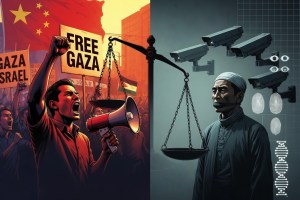
 Governments and institutions that claim to speak for the Muslim world regularly invoke the ummah—the global Muslim community—as a source of political and moral authority. They demand solidarity across borders when Muslims suffer in Palestine, Kashmir or Myanmar.
When China constructed a police state around the Uyghurs, however, many of those governments did more than remain quiet. They defended Beijing, repeated its language and helped prevent international scrutiny.
That is the disparity worth examining. The charge is not that Muslims as a population have ignored the Uyghurs. Uyghur activists, dissidents and sympathetic Muslim organizations have worked for years to expose what is happening. The indictment belongs to the governments and institutions possessing the influence, diplomatic machinery and declared religious authority to act, but which chose accommodation with China instead.
The Muslims China decided to remake
In the Xinjiang Uyghur Autonomous Region, China has subjected Uyghurs and other predominantly Muslim peoples to mass surveillance, arbitrary detention, political indoctrination, coercive labour programs and severe restrictions on religious and cultural life.
The Office of the United Nations High Commissioner for Human Rights found credible allegations of torture, forced medical treatment, sexual violence and family separation. It concluded that China’s arbitrary and discriminatory detention of Uyghurs may constitute international crimes, particularly crimes against humanity. Beijing rejects those findings and describes the detention system as a counterterrorism and vocational-education program.
The repression extends beyond prisons and camps. Religious observance has been treated as evidence of extremism; families have been divided; children have been separated from parents; mosques, shrines and cemeteries have been altered or destroyed. Hundreds of Uyghur village names containing religious or historical references have reportedly been replaced with language reflecting Communist Party ideology and national unity. (Associated Press)
China is not negotiating how Islam should be accommodated in public life. It is deciding which portions of Uyghur identity may survive, and in what form.
The institutions that chose Beijing
The Organisation of Islamic Cooperation describes itself as the collective voice of the Muslim world. Yet in 2019, rather than confront China over Xinjiang, the OIC praised Beijing for “providing care to its Muslim citizens.” It accepted the language China used to describe political re-education and mass detention as social development and counter-extremism. (Organisation of Islamic Cooperation)
Individual governments made similar choices. Saudi Arabia, Pakistan, Egypt, the United Arab Emirates and Algeria were among the Muslim-majority states that supported statements commending China’s Xinjiang policies and its supposed achievements in counterterrorism and deradicalization. Qatar initially joined that defence before later withdrawing its support. (United Nations Human Rights Council)
The failure became even clearer after the UN human-rights office released its assessment in 2022. The Human Rights Council was asked only to hold a debate on the findings. The proposal failed by 19 votes to 17, with 11 abstentions. Pakistan, Indonesia, Qatar and the UAE voted against discussion, while Somalia was the rare Muslim-majority state that supported scrutiny. (Axios)
These governments were not working from rumours or social-media fragments. They had embassies, intelligence services, diplomatic missions and direct access to the UN report. Some of them claimed a special responsibility to defend Muslim interests while helping Beijing avoid even a formal debate about possible crimes against humanity.
Their conduct was not uniform, and it should not be treated as such. Somalia acted differently. Qatar withdrew from the earlier letter. Uyghur advocates have found allies in parts of the Muslim world.
The pattern among several of its most powerful governments remains unmistakable: when strategic and economic interests collided with proclaimed Muslim solidarity, solidarity gave way.
In some cases, the cooperation went further than diplomatic support. Researchers have documented Uyghurs being detained or returned from Arab states, including Egypt, Morocco, Saudi Arabia, Syria and the UAE, despite the danger of imprisonment upon return to China. (TIME)
The ummah, it seems, has boundaries set not only by faith but by Chinese investment, security relationships and diplomatic convenience.
Why Palestine mobilizes and Xinjiang does not
The contrast with Palestine-related activism is obvious, but it cannot be explained by hypocrisy alone.
Gaza is an active war covered daily through graphic footage, international reporting and social media. The Palestinian cause has decades of established institutions, political language, donor networks and diaspora organization behind it. Protesters can respond to events almost as they happen, and the adversaries they confront—Israel, Canada, the United States and European governments—are visible and accessible.
Xinjiang is a closed system. China restricts independent access, controls information and intimidates witnesses. Uyghurs abroad must consider whether public criticism will bring retaliation against relatives still inside China. The diaspora is smaller, its institutional reach is weaker, and the repression produces fewer fresh images capable of driving an attention economy built around immediacy.
Those differences matter. They help explain why one cause can mobilize vast numbers while another struggles for sustained attention.
China’s power matters even more. Beijing can threaten trade, investment and diplomatic relationships. It can pressure foreign governments to detain or repatriate Uyghurs, and it has demonstrated that criticism may carry consequences beyond the person speaking.
Liberal democracies are easier to confront because they tolerate confrontation. Activists can accuse Western governments of racism, colonialism or complicity without disappearing into a re-education system. China makes dissent expensive.
That is a real explanation for the disparity, but it is not an excuse for governments and institutions that claim leadership of the Muslim world. They possess resources individual dissidents do not. They do not need viral footage to understand a UN report, and they cannot plausibly invoke universal solidarity only when the political cost is manageable.
A principle proves very little when following it requires nothing.
The wrong kind of Muslim victim
The Uyghurs present an ideological inconvenience because their persecutor does not fit the political narratives that dominate much international activism.
China is not Israel, a Western democracy or a former European colonial power. It presents itself as an opponent of Western dominance, invests heavily across Muslim-majority countries and offers authoritarian governments a model of economic partnership without demands for democratic reform.
The victims therefore receive less political value. Their suffering cannot easily be attached to Western guilt, anti-colonial mythology or opposition to Israel. Beijing is remote, resistant to protest and willing to punish anyone who interferes.
This does not mean that Palestine activism exists only because Israel is Jewish, nor does it diminish the suffering of Palestinians. It does reveal an institutional hierarchy in which some Muslim victims become central symbols while others are subordinated to alliances, investments and ideological convenience.
The problem is not that Gaza receives too much concern. It is that governments claiming to represent global Muslim interests defended China while it suppressed Muslim life.
The Uyghur test
A serious commitment to Muslim solidarity would require the OIC to repudiate its praise of Beijing and demand independent access to Xinjiang. Muslim-majority governments would stop returning Uyghurs to Chinese custody, support international investigation and use their economic relationships with China as leverage rather than treating those relationships as reasons for silence.
Islamic institutions and advocacy networks in the West could place Xinjiang on their agendas without abandoning Palestine. They could campaign against forced-labour supply chains, support Uyghur refugees and organize sustained pressure outside Chinese diplomatic missions. Medical organizations could demand verifiable proof that organs transplanted in China come from genuinely consenting donors.
China’s secrecy explains why evidence emerges slowly. Its economic and political power explains why governments hesitate. Neither absolves institutions that claim moral authority precisely on the basis of a borderless Muslim community.
Solidarity that flourishes against accessible adversaries but recedes when Beijing threatens consequences is not a universal moral commitment. It is foreign policy and political fashion wearing the language of religious principle.
The Uyghurs have made that distinction impossible to ignore.











 bleatmop
 Mystro
 The Arbourist


 Dead Wild Roses
Leave a comment
Comments feed for this article