
For decades, the political Left told women it alone could be trusted to defend their rights.
But the promise was narrower than advertised. In practice, women’s rights often meant abortion access, workplace rhetoric, and the expectation that women would keep voting for the party that claimed ownership over “women’s issues.”
Then a harder test arrived.
What happens when women ask for boundaries? What happens when girls say they do not want males in their changing rooms? What happens when female athletes say their category exists for a reason? What happens when women insist that privacy, dignity, safety, and fair competition are not bigotry?
The institutional Left’s answer has been revealing.
It did not defend women’s boundaries. It explained them away. It did not defend sex-based language. It tried to make it unspeakable. It did not defend the female category in law, sport, prisons, shelters, or public policy. It subordinated that category to gender identity and then demanded that women pretend nothing meaningful had changed.
That is the betrayal.
To be clear, no decent society should delight in the distress of young people struggling with identity. Even the Supreme Court majority in West Virginia v. B. P. J. emphasized that student-athletes on both sides deserve respect and should not be ostracized or vilified. (Supreme Court)
But respect is not the same thing as surrendering reality.
The question before the Court was whether schools may maintain women’s and girls’ sports teams for biological females under Title IX and the Equal Protection Clause. (Supreme Court) The Court reversed the lower-court rulings, holding that states may preserve sex-separated athletic categories. Sotomayor, joined by Kagan and Jackson, concurred in part and dissented in part. (Supreme Court)
That legal result matters because it cuts through the fog.
Female bodies are not symbolic. Women’s spaces are not symbolic. Girls’ sports are not a therapeutic exercise for male validation. They are material institutions built around material differences.
The Left used to understand power when women named it. It used to understand boundaries when women asserted them. It used to understand that “no” is a complete sentence.
Now, too often, women are told that saying no is hateful. That naming sex is cruel. That defending female-only spaces is exclusionary. That fairness for girls must yield to affirmation for males.
A movement that cannot respect women’s boundaries cannot credibly claim to protect women.
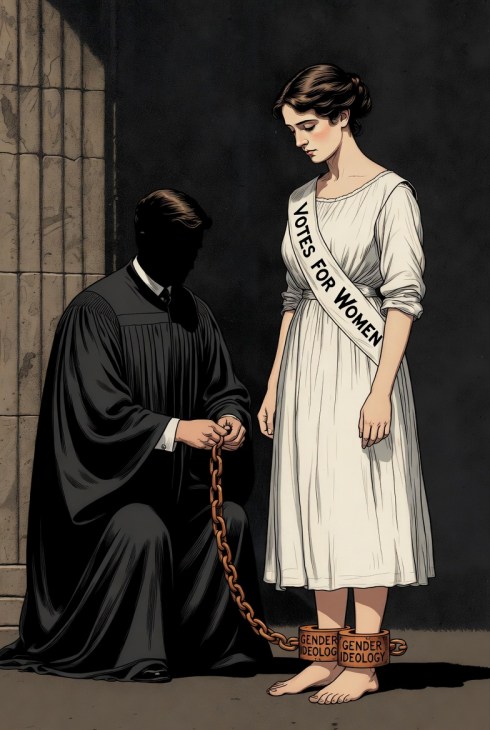
The Left did not merely lose a court case.
It exposed the limits of its feminism.











 bleatmop
 Mystro
 The Arbourist


 Dead Wild Roses
1 comment
Comments feed for this article
July 11, 2026 at 7:18 am
tildeb
The institutional Left – once the bastion of women’s rights – now demonstrates everywhere all the time they don’t believe women deserve rights, that women who believe they do are bigots and ‘anti-rights’. The institutional Left has developed and now uses language to insist all women are second class to any male in any role who decides wearing a dress and makeup makes them first class ‘women’ to whom all second class females must yield place and rank.
One might assume female voters would notice, condemn, and withdraw funding those who supported this inversion and perversion of reality and loss of legal respect for an entire biological class. In fact, many do. But far too many still go along and defend and continue to vote for the same institutional response to insist dresses and makeup and the right language determines biological reality at the direct cost of all women in favour of the males who demand it.
So the betrayal of women and their rights by women is and should be just as widely condemned as the institutional Left who imposes this inversion of reality on everyone by capturing and then abusing law to become an anti-female state.
LikeLike