
You are currently browsing the tag archive for the ‘Uyghurs’ tag.
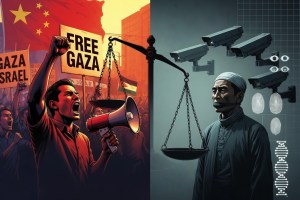 Governments and institutions that claim to speak for the Muslim world regularly invoke the ummah—the global Muslim community—as a source of political and moral authority. They demand solidarity across borders when Muslims suffer in Palestine, Kashmir or Myanmar.
When China constructed a police state around the Uyghurs, however, many of those governments did more than remain quiet. They defended Beijing, repeated its language and helped prevent international scrutiny.
That is the disparity worth examining. The charge is not that Muslims as a population have ignored the Uyghurs. Uyghur activists, dissidents and sympathetic Muslim organizations have worked for years to expose what is happening. The indictment belongs to the governments and institutions possessing the influence, diplomatic machinery and declared religious authority to act, but which chose accommodation with China instead.
The Muslims China decided to remake
In the Xinjiang Uyghur Autonomous Region, China has subjected Uyghurs and other predominantly Muslim peoples to mass surveillance, arbitrary detention, political indoctrination, coercive labour programs and severe restrictions on religious and cultural life.
The Office of the United Nations High Commissioner for Human Rights found credible allegations of torture, forced medical treatment, sexual violence and family separation. It concluded that China’s arbitrary and discriminatory detention of Uyghurs may constitute international crimes, particularly crimes against humanity. Beijing rejects those findings and describes the detention system as a counterterrorism and vocational-education program.
The repression extends beyond prisons and camps. Religious observance has been treated as evidence of extremism; families have been divided; children have been separated from parents; mosques, shrines and cemeteries have been altered or destroyed. Hundreds of Uyghur village names containing religious or historical references have reportedly been replaced with language reflecting Communist Party ideology and national unity. (Associated Press)
China is not negotiating how Islam should be accommodated in public life. It is deciding which portions of Uyghur identity may survive, and in what form.
The institutions that chose Beijing
The Organisation of Islamic Cooperation describes itself as the collective voice of the Muslim world. Yet in 2019, rather than confront China over Xinjiang, the OIC praised Beijing for “providing care to its Muslim citizens.” It accepted the language China used to describe political re-education and mass detention as social development and counter-extremism. (Organisation of Islamic Cooperation)
Individual governments made similar choices. Saudi Arabia, Pakistan, Egypt, the United Arab Emirates and Algeria were among the Muslim-majority states that supported statements commending China’s Xinjiang policies and its supposed achievements in counterterrorism and deradicalization. Qatar initially joined that defence before later withdrawing its support. (United Nations Human Rights Council)
The failure became even clearer after the UN human-rights office released its assessment in 2022. The Human Rights Council was asked only to hold a debate on the findings. The proposal failed by 19 votes to 17, with 11 abstentions. Pakistan, Indonesia, Qatar and the UAE voted against discussion, while Somalia was the rare Muslim-majority state that supported scrutiny. (Axios)
These governments were not working from rumours or social-media fragments. They had embassies, intelligence services, diplomatic missions and direct access to the UN report. Some of them claimed a special responsibility to defend Muslim interests while helping Beijing avoid even a formal debate about possible crimes against humanity.
Their conduct was not uniform, and it should not be treated as such. Somalia acted differently. Qatar withdrew from the earlier letter. Uyghur advocates have found allies in parts of the Muslim world.
The pattern among several of its most powerful governments remains unmistakable: when strategic and economic interests collided with proclaimed Muslim solidarity, solidarity gave way.
In some cases, the cooperation went further than diplomatic support. Researchers have documented Uyghurs being detained or returned from Arab states, including Egypt, Morocco, Saudi Arabia, Syria and the UAE, despite the danger of imprisonment upon return to China. (TIME)
The ummah, it seems, has boundaries set not only by faith but by Chinese investment, security relationships and diplomatic convenience.
Why Palestine mobilizes and Xinjiang does not
The contrast with Palestine-related activism is obvious, but it cannot be explained by hypocrisy alone.
Gaza is an active war covered daily through graphic footage, international reporting and social media. The Palestinian cause has decades of established institutions, political language, donor networks and diaspora organization behind it. Protesters can respond to events almost as they happen, and the adversaries they confront—Israel, Canada, the United States and European governments—are visible and accessible.
Xinjiang is a closed system. China restricts independent access, controls information and intimidates witnesses. Uyghurs abroad must consider whether public criticism will bring retaliation against relatives still inside China. The diaspora is smaller, its institutional reach is weaker, and the repression produces fewer fresh images capable of driving an attention economy built around immediacy.
Those differences matter. They help explain why one cause can mobilize vast numbers while another struggles for sustained attention.
China’s power matters even more. Beijing can threaten trade, investment and diplomatic relationships. It can pressure foreign governments to detain or repatriate Uyghurs, and it has demonstrated that criticism may carry consequences beyond the person speaking.
Liberal democracies are easier to confront because they tolerate confrontation. Activists can accuse Western governments of racism, colonialism or complicity without disappearing into a re-education system. China makes dissent expensive.
That is a real explanation for the disparity, but it is not an excuse for governments and institutions that claim leadership of the Muslim world. They possess resources individual dissidents do not. They do not need viral footage to understand a UN report, and they cannot plausibly invoke universal solidarity only when the political cost is manageable.
A principle proves very little when following it requires nothing.
The wrong kind of Muslim victim
The Uyghurs present an ideological inconvenience because their persecutor does not fit the political narratives that dominate much international activism.
China is not Israel, a Western democracy or a former European colonial power. It presents itself as an opponent of Western dominance, invests heavily across Muslim-majority countries and offers authoritarian governments a model of economic partnership without demands for democratic reform.
The victims therefore receive less political value. Their suffering cannot easily be attached to Western guilt, anti-colonial mythology or opposition to Israel. Beijing is remote, resistant to protest and willing to punish anyone who interferes.
This does not mean that Palestine activism exists only because Israel is Jewish, nor does it diminish the suffering of Palestinians. It does reveal an institutional hierarchy in which some Muslim victims become central symbols while others are subordinated to alliances, investments and ideological convenience.
The problem is not that Gaza receives too much concern. It is that governments claiming to represent global Muslim interests defended China while it suppressed Muslim life.
The Uyghur test
A serious commitment to Muslim solidarity would require the OIC to repudiate its praise of Beijing and demand independent access to Xinjiang. Muslim-majority governments would stop returning Uyghurs to Chinese custody, support international investigation and use their economic relationships with China as leverage rather than treating those relationships as reasons for silence.
Islamic institutions and advocacy networks in the West could place Xinjiang on their agendas without abandoning Palestine. They could campaign against forced-labour supply chains, support Uyghur refugees and organize sustained pressure outside Chinese diplomatic missions. Medical organizations could demand verifiable proof that organs transplanted in China come from genuinely consenting donors.
China’s secrecy explains why evidence emerges slowly. Its economic and political power explains why governments hesitate. Neither absolves institutions that claim moral authority precisely on the basis of a borderless Muslim community.
Solidarity that flourishes against accessible adversaries but recedes when Beijing threatens consequences is not a universal moral commitment. It is foreign policy and political fashion wearing the language of religious principle.
The Uyghurs have made that distinction impossible to ignore.
Before a government can persecute large numbers of people, it has to solve a political problem.
It must persuade everyone else that the victims are not quite ordinary citizens—that their suffering is acceptable, deserved or simply too dangerous to oppose.
Maoist China developed a brutally effective method for doing this. Society was divided into politically approved and politically contaminated identities.
The favoured populations belonged to the Red Categories: workers, poor peasants, revolutionary soldiers, Party cadres and the families of revolutionary martyrs. Landlords, rich peasants, counter-revolutionaries, “bad elements” and rightists belonged to the Black Categories.
Red meant politically reliable; black meant politically suspect.
These categories were not merely descriptions of class or occupation. They distributed safety, status and opportunity. Being recognized as red could open doors, while being classified as black could close them—sometimes for an entire family.
More importantly, the system told every Chinese citizen how to behave toward the people the Party had marked.
Friendship with the wrong person could become evidence of disloyalty. Defending a black-category neighbour might endanger a career. Denunciation could demonstrate revolutionary commitment. Silence was safer than sympathy, while visible hostility could be rewarded.
The Party did not need everyone to become a committed revolutionary. It needed ordinary self-interest to reinforce the political category.
That is the process at the centre of this essay. The state identifies a troublesome population, assigns it a contaminated identity, isolates its members from ordinary society and removes the protections attached to citizenship. Once that work is complete, exploitation becomes easier—and resistance becomes more costly.
The original Black Categories belonged to Mao’s political campaigns. The labels have changed, but the method remains visible in the treatment of Falun Gong practitioners and Uyghurs.
The category is the weapon
In a system based on individual responsibility, the state begins with an act. It gathers evidence, identifies the person responsible and attempts to prove guilt.
Political classification reverses that order.
The state begins with a kind of person. Membership in the category becomes evidence of danger before any particular wrongdoing has been established.
A landlord was presumed exploitative because he belonged to the landlord class. A rightist was presumed hostile because the Party had named him a rightist. The label did not merely summarize an accusation; it reduced the need to prove one.
Once imposed, black status could follow a person long after the original circumstances had disappeared. Land had been confiscated, businesses nationalized and social relationships transformed, yet the former landlord or rich peasant remained politically stained.
Children could inherit the consequences of identities assigned to their parents. Education, employment, political participation, friendships and marriage prospects could all be affected by family background.
The supposed class category had become a moral caste.
Its power depended upon incentives. People wanted to be recognized as red because red status brought security and belonging. They avoided black-category families because association carried risk.
This transformed political persecution into social coercion. The state imposed the label, but neighbours, colleagues, teachers and relatives helped enforce it. By the time the police arrived, the condemned person could already be isolated.
Redemption through surrender
The black-category system did not always require physical destruction. Often, it demanded ideological submission.
The accused could confess, undergo self-criticism, denounce former beliefs and demonstrate that Party education had corrected the defective self.
This offered the appearance of a way out, but the price was significant. The person had to accept the state’s description of him.
A man classified as a class enemy was expected to acknowledge his guilt. A religious believer had to recognize faith as superstition or political manipulation. A dissident had to admit that disagreement revealed hostility rather than judgment.
The state converted an identity into an offence, assigned collective guilt and then demanded gratitude for providing the cure.
Refusal carried its own penalty. If someone would not confess, the Party could treat that resistance as proof that the person remained dangerous, stubborn or insufficiently transformed.
Disagreement therefore became self-confirming: submission proved that re-education had been necessary, while resistance proved that more coercion was required.
Falun Gong becomes a suspect population
The campaign against Falun Gong shows how readily this method could be transferred to a population that had nothing to do with Mao’s original class structure.
Falun Gong spread rapidly during the 1990s as a decentralized spiritual discipline involving meditation, physical exercises and moral teachings. The Chinese Communist Party banned it in 1999 and began a national campaign to eradicate the practice.
The Party did not limit its response to prosecuting people who had committed identifiable crimes. It classified Falun Gong itself as an “evil cult” and treated continued adherence as evidence of danger, irrationality or political disloyalty.
That designation compressed millions of individuals into a single suspect identity.
Practising publicly, possessing literature, distributing information or refusing to renounce the movement could expose a person to detention and coercive re-education. Human Rights Watch documented the use of labour camps and “transformation” facilities where practitioners were pressured to abandon their beliefs. Officials established transformation targets, while former detainees described physical and psychological abuse intended to produce recantation.
The Party first identified a population it could not fully control, then assigned it a category that carried its own accusation. Ordinary citizens were taught to regard practitioners as dangerous or deluded, while employers, schools, families and neighbourhood authorities were drawn into enforcing the distinction.
A practitioner could recover a measure of safety, but only by accepting the Party’s judgment and repudiating the identity that had made him suspect.
Falun Gong practitioners were never formally added to Mao’s Five Black Categories. They did not need to be.
They had been placed in the same political position: outside the circle of people whose conscience, liberty and bodily integrity commanded ordinary protection.
Uyghur identity becomes evidence
The Party has used a related process against Uyghurs and other predominantly Muslim peoples in Xinjiang.
China has faced real acts of separatist and terrorist violence. The state has a legitimate responsibility to investigate attacks and prosecute the individuals who organize or commit them.
The abuse begins when suspicion moves from perpetrators to a population.
Under the campaign against religious extremism, ordinary conduct has been treated as evidence that someone requires surveillance, detention or ideological correction. The UN human-rights assessment of Xinjiang found that people could be referred to so-called vocational education and training centres for reasons including wearing a veil or beard, applying for a passport, possessing certain communications software, maintaining foreign contacts or having more children than state policy permitted.
These are not findings that a particular individual planned an attack. They are identity markers.
Religious practice, family life, cultural difference and contact with the outside world become entries in a political risk profile. Once Uyghur identity is associated with extremism, officials no longer need to demonstrate that each person poses a threat. The classification supplies the suspicion.
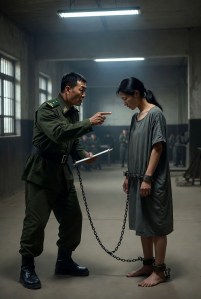
Former detainees described being required to confess, repent and accept political instruction even when they did not understand what offence they had committed. The centres combined language and vocational programs with ideological “transformation,” while operating outside the ordinary safeguards of criminal justice.
The terminology is modern and technocratic, but the logic is older. The Party defines the acceptable identity, identifies deviations from it and offers restoration through surrender.
The Han-nationalist reversal
There is a particular irony in the treatment of Uyghurs.
Maoist doctrine officially condemned Han chauvinism. The Communist Party presented itself as the guardian of a multinational revolutionary state, not an instrument of ethnic domination by the Han majority.
That promise was never consistently honoured. Minority religion and culture were attacked during Maoist campaigns whenever they conflicted with revolutionary conformity.
Even so, the Party formally treated Han chauvinism as a political danger.
Today, Uyghur religious, linguistic and cultural difference is increasingly subordinated to a standardized national identity built around Party loyalty, Mandarin and cultural norms drawn largely from the Han majority.
The Party that once denounced Han chauvinism now pressures minorities to demonstrate their legitimacy by becoming less distinct from the Han-centred national mainstream.
The preferred identity has changed—from revolutionary class identity to national and civilizational unity—but the coercive authority remains the same. The Party still decides which identities are politically healthy and which require transformation.
From political unperson to biological inventory
This process helps explain how the conditions necessary for forced organ harvesting could be created.
Political classification does not prove that every person placed inside a suspect category will be killed for organs. Most people targeted by Maoist categories were not executed, and not every Falun Gong practitioner or Uyghur detainee has been subjected to the same treatment.
The category serves a broader purpose. It removes the expectation that each person must be treated as an individual citizen whose detention, injury or disappearance requires explanation.
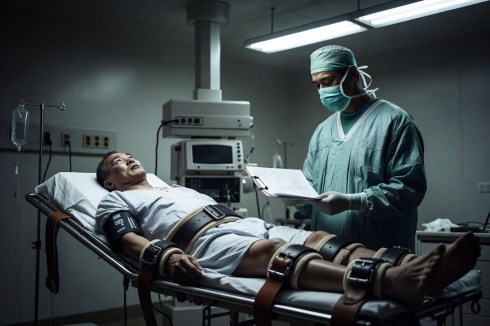
A forced-organ procurement system would need more than corrupt surgeons and wealthy recipients. It would need captive populations that could be medically examined without meaningful consent, records hidden from public inspection, families unable to demand answers and officials confident that the disappearance of a politically contaminated person would not provoke the same response as the disappearance of someone considered respectable.
That infrastructure begins outside the hospital.
The process starts by identifying a problem group and assigning it a category associated with danger, sickness or moral contamination. Society is encouraged to withdraw sympathy—and to punish those who refuse—until the categorized population can be deprived of freedom, legal protection and bodily autonomy with little political cost.
Once that has been accomplished, human beings can be handled as state resources. Labour can be extracted from them. Confessions can be extracted from them. In the most extreme form of the system, organs can be extracted from them.
The hospital is the final stage, not the first.
Who dies?
The question is not answered simply by asking who has committed the most serious offence.
In a system governed by political categories, those most at risk are the people whom the state has successfully moved outside the moral community.
Mao’s Black Categories taught Chinese society that some identities carried guilt before an act had been proved. They gave citizens strong incentives to distance themselves from the condemned and stronger incentives to display loyalty to the favoured red identity.
Falun Gong practitioners and Uyghurs are not interchangeable with Maoist landlords or rightists. Their beliefs, histories and circumstances differ.
The continuity lies with the Party, which still identifies populations that resist or complicate complete political control, compresses individuals into suspect identities and demands confession, transformation and submission as the price of restored acceptance.
Most importantly, it still uses political classification to determine whose suffering can be ignored.
Before bodies can be farmed for organs, the people inside them must first be made into political unpeople.
The Black Categories provided the method.
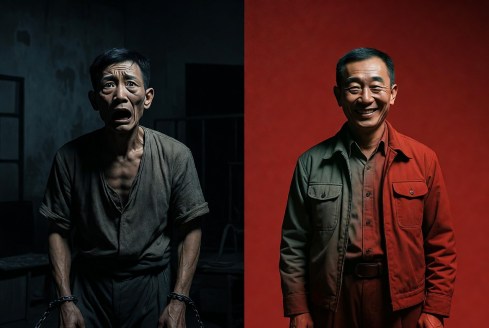
“Divided by Category: Red (favored, content) and Black (suspect, under duress) — the Maoist tool that made persecution socially acceptable.”
References and Further Reading
Maoist classifications and the Cultural Revolution
Guo Jian, Song Yongyi and Yuan Zhou, Historical Dictionary of the Chinese Cultural Revolution, Scarecrow Press, 2006.
A scholarly reference work covering the Five Black Categories, the favoured Red Categories, political campaigns, struggle sessions and other institutions of the Cultural Revolution.
https://books.google.com/books?id=T5-4zOdHKOIC&q=Five+Black+Categories
Song Yongyi, “Chronology of Mass Killings During the Chinese Cultural Revolution (1966–1976),” Sciences Po Mass Violence and Resistance Research Network, August 25, 2011.
An academic chronology of Cultural Revolution violence. It describes the Five Black Categories—landlords, rich peasants, counter-revolutionaries, bad elements and rightists—and documents how political classifications exposed individuals and their families to confiscation, expulsion, persecution and killing.
https://www.sciencespo.fr/mass-violence-war-massacre-resistance/en/document/chronology-mass-killings-during-chinese-cultural-revolution-1966-1976
Evan Osnos, “Born Red,” The New Yorker, March 30, 2015.
A profile of Xi Jinping that also describes the status attached to revolutionary family background during the Cultural Revolution. It includes the “born red” culture, inherited political prestige and the stigma imposed upon children of people classified as reactionaries.
https://www.newyorker.com/magazine/2015/04/06/born-red
Mao on ethnicity and Han chauvinism
Mao Zedong, “On the Ten Major Relationships,” April 25, 1956.
English text of Mao’s speech addressing relations between the Han majority and China’s minority nationalities. Mao formally identified Han chauvinism as a danger and argued that the Party should oppose discrimination by the Han majority.
https://www.marxists.org/reference/archive/mao/selected-works/volume-5/mswv5_51.htm
Falun Gong persecution and “transformation”
Human Rights Watch, “Falungong in Custody: Competing Accounts,” in Dangerous Meditation: China’s Campaign Against Falungong, January 2002.
Human Rights Watch’s examination of detention, re-education through labour, extrajudicial transformation centres and coercive attempts to force practitioners to renounce their beliefs. The report also discusses the difficulty of verifying claims because China prevented independent monitoring of prisons and labour camps.
The report documents official transformation targets and evidence of severe physical and psychological pressure, including torture and extreme pressure to recant.
https://www.hrw.org/reports/2002/china/China0102-04.htm
Uyghurs and the Xinjiang detention system
Office of the United Nations High Commissioner for Human Rights, Assessment of Human Rights Concerns in the Xinjiang Uyghur Autonomous Region, People’s Republic of China, August 31, 2022.
The principal UN assessment of China’s counter-extremism policies, methods for identifying “at risk” people, detention in vocational education and training centres, treatment in custody and restrictions upon religious, linguistic and cultural identity.
Permanent Mission of the People’s Republic of China to the United Nations Office at Geneva, “Response to the OHCHR Assessment,” August 2022.
China’s formal rebuttal to the UN assessment. The government rejects the allegations, describes the centres as lawful counterterrorism and vocational programs, and argues that the UN assessment relied upon politicized or unreliable sources.
https://www.ohchr.org/sites/default/files/documents/countries/2022-08-31/ANNEX_A.pdf
Organ profiling and the connection to the first essay
United Nations Office of the High Commissioner for Human Rights, “China: UN Human Rights Experts Alarmed by ‘Organ Harvesting’ Allegations,” June 14, 2021.
A statement by UN human-rights experts concerning reports that detained Falun Gong practitioners, Uyghurs, Tibetans, Muslims and Christians were subjected to blood tests and examinations of the heart, liver, kidneys and other organs without informed consent.
Organ transplantation is one of medicine’s genuine miracles.
A failing heart can be replaced. A patient whose kidneys no longer function can be freed from dialysis. An organ donated at the end of one life can preserve another for decades.
Yet the legitimacy of transplantation depends upon a boundary that cannot be negotiated away. The person providing the organ is a human being, not a supply of biological material. Consent must be genuine, death must be independently determined, and the physician’s duty to the donor cannot be subordinated to the needs of the recipient.
China’s transplant system has a documented history of crossing those boundaries. Its government has admitted that organs were taken from executed prisoners, although it now says that this practice ended in 2015 and that voluntary civilian donation supplies the country’s transplant hospitals.
That defence cannot simply be dismissed, but neither can it be accepted on trust.
China’s official donation statistics show signs of systematic manipulation. Its transplant registries are not publicly accessible. Chinese medical papers have described organ removals in which the procurement itself appears to have caused the donor’s death. Investigators have also assembled evidence that prisoners of conscience, particularly Falun Gong practitioners, have been medically tested and killed for their organs.
The exact number of victims remains uncertain. The evidence that China has not provided a credible account of its transplant system does not.
What China has admitted
For years, Chinese officials denied that prisoners supplied the country’s transplant industry. That position eventually became impossible to maintain, and in late 2005 officials publicly acknowledged that organs from executed prisoners had been used.
The historical numbers show how dependent the transplant system had become upon state custody. Chinese officials reported roughly 120,000 organ transplants between 1977 and 2009, but only 130 voluntary donors had been identified by the end of that period. The country did not yet possess a voluntary donation system remotely capable of supplying the number of organs being transplanted.
Calling these donors convicted criminals does not resolve the ethical problem. A prisoner awaiting execution exists under the absolute power of the state. Consent given under those conditions cannot safely be treated as free, especially when the organs have substantial financial value and hospitals benefit from their availability.
The relationship also creates a dangerous incentive. Once the justice system becomes a supplier to the medical system, a prisoner’s body acquires value that may influence the timing and purpose of the execution.
China announced that, beginning on January 1, 2015, hospital-based voluntary donors would become the sole lawful source of transplant organs. It established a national allocation system known as COTRS, developed hospital-based procurement organizations and said that donation would be voluntary, unpaid, transparent and traceable.
That is Beijing’s strongest answer to the allegations: whatever happened before 2015 belongs to an earlier system that has since been reformed.
There is evidence that genuine voluntary donation has grown in China, and it would be irresponsible to assume that every transplant performed there today involves an unwilling donor. The central question is whether the new system has replaced the old one or partly concealed it.
China has not permitted the independent access needed to settle that question.
Its official registries are not publicly available, and the limited figures released by officials are difficult to corroborate against hospital-level activity. Nor did the 2015 announcement begin cleanly. Shortly after it took effect, former vice-minister of health Huang Jiefu suggested that condemned prisoners could still “donate” by entering the civilian allocation system because they remained citizens. He later said those remarks had been philosophical rather than a description of actual practice.
If prisoner organs can be reclassified as civilian donations, a change in terminology may disguise continuity rather than establish reform.
Numbers that look designed
China reported extraordinary growth in its new voluntary system. According to official figures, annual deceased donors increased from 34 in 2010 to 6,316 in 2018. Reported kidney and liver transplants also rose rapidly.
Researchers Matthew Robertson, Raymond Hinde and Jacob Lavee examined those figures using forensic statistical methods. They compared national data from COTRS and the Chinese Red Cross, provincial reports, hospital records and donation patterns from 50 other countries.
They found that China’s official donor, kidney and liver totals followed simple mathematical curves with remarkable precision. The R-squared values were 0.9993, 0.9995 and 0.9989 respectively, approaching a perfect fit with a predetermined quadratic formula.
Actual organ donation depends upon accidents, illness, family consent, failed procurements, regional differences, hospital capacity and countless other unpredictable events. Even rapidly growing systems contain irregularity. The equivalent figures from the other 50 countries did not display anything close to China’s mathematical smoothness.
The researchers also identified contradictory provincial data, suspicious conformity with central quotas and apparent cases in which non-voluntary donors were classified as voluntary. They concluded that systematic manufacture and manipulation were the most plausible explanation for significant parts of the official record.
Their backgrounds should also be disclosed. Robertson has worked with the Victims of Communism Memorial Foundation, the Human Rights Law Foundation and End Transplant Abuse in China, and was formerly an editor at The Epoch Times. Lavee has served with Doctors Against Forced Organ Harvesting. Both had publicly opposed Chinese transplant abuses before publishing the study.
Those affiliations justify careful scrutiny of their assumptions and methods. They do not, by themselves, answer the statistical evidence. The paper was peer-reviewed, its methodology was published, its data sources were identified, and the international comparison can be examined independently.
The authors also did not claim that every voluntary donor was fictitious. They expressly acknowledged genuine voluntary transplant activity alongside the apparent manipulation.
Their conclusion was narrower: China’s official numbers cannot reliably demonstrate that voluntary donors account for its transplant activity.
That leaves the original question unanswered. If the published donor figures were manufactured or padded with non-voluntary cases, where did the actual organs come from?
When procurement becomes execution
Transplant medicine is governed by what is commonly called the dead donor rule.
Vital organs must not be removed from a living person in a way that causes death. The determination of death must be independent of the desire to obtain the organs. A physician cannot become an executioner because another patient needs a heart.
In 2022, Robertson and Lavee examined more than 120,000 Chinese-language medical publications and identified 71 papers, published between 1980 and 2015, in which the reported procedures failed to establish that the donors were properly dead before their hearts or lungs were removed.
The descriptions indicated that accepted tests for brain death had not been performed or could not have produced a valid declaration of death. The researchers concluded that, in these cases, removing the organs probably caused the donor’s death.
This dismantles a comforting distinction.
It is one thing to imagine doctors receiving organs after a prisoner has been executed. That would still involve coercion and serious medical abuse, but the transplant team could claim that it arrived after the killing.
It is another thing for organ removal to complete the execution. In that system, medicine does not merely benefit from state violence. The surgical procedure becomes part of it.
The order is reversed
In an ethical donation system, the donor appears first.
Someone dies under circumstances that allow donation. Consent is confirmed. Medical teams determine which organs remain viable, and allocation rules identify compatible recipients according to blood type, tissue compatibility, body size, urgency and time spent waiting.
The recipient waits because no hospital can promise when a compatible stranger will die.
Some of the most disturbing evidence from China describes that order being reversed.
Israeli transplant surgeon Jacob Lavee became concerned after one of his patients said that he had arranged a heart transplant in China approximately two weeks in advance. A heart cannot ordinarily be promised for a particular date through a system dependent upon unpredictable voluntary deaths.
A scheduled heart implies control over more than hospital availability. It implies that the system can locate a compatible donor and control when that person dies.
This is the logic behind the phrase “killed to order.” The recipient appears first, and a compatible person is then selected from a medically classified population.
The recipient may not understand how the organ was obtained. A gravely ill patient may be told only that China has an unusually efficient transplant system or a large donor pool.
But administrative efficiency cannot explain how a heart becomes available by appointment.
Prisoners of conscience
The most serious allegation is that China expanded its supply beyond condemned criminals to include people imprisoned for their religion, beliefs or political identity.
The largest body of evidence concerns Falun Gong practitioners.
Falun Gong is a spiritual discipline combining meditative exercises with moral teachings. After it grew rapidly during the 1990s, the Chinese Communist Party banned the practice in 1999 and subjected its followers to mass detention, imprisonment and ideological “transformation.”
Former detainees have described blood tests, X-rays, ultrasounds and organ examinations that bore little relationship to their medical welfare. Such tests would, however, be useful for determining blood type, tissue compatibility and organ condition.
In 2019, an independent people’s tribunal chaired by British barrister Sir Geoffrey Nice examined the allegations. The China Tribunal was not an international court and possessed no power to convict or punish anyone. It had been established by the International Coalition to End Transplant Abuse in China, an advocacy organization already committed to the issue.
Those limitations should be stated plainly.
The tribunal nevertheless heard more than 50 witnesses and experts and examined medical publications, hospital capacity, waiting times, recorded telephone calls, former-prisoner testimony and the official donor figures. It also considered material favourable to China and invited the Chinese government to participate. Beijing declined.
The tribunal concluded that forced organ harvesting had occurred for years on a significant scale and that Falun Gong practitioners had probably been the principal source. It also concluded that it had seen no evidence establishing that the practice had stopped.
That judgment does not carry the authority of a national or international court. It remains the finding of a privately convened inquiry, and readers are entitled to examine its evidence and institutional origins critically.
But the evidence does not vanish because the body examining it lacked formal jurisdiction.
Some investigators associated with the tribunal have estimated that China may perform between 60,000 and 100,000 transplant operations annually, far above the official totals. That figure is not a confirmed count of illicit procedures or identified victims. It was reconstructed from hospital beds, transplant wards, surgeon activity, hospital revenues and publicly stated capacity.
The essay does not need the upper estimate to be true.
China’s admitted reliance on prisoners, the statistical manipulation, the medical descriptions of execution by procurement, the short waiting periods and the testing of persecuted detainees already demand an explanation.
The warning from Xinjiang
Concern has also extended to Uyghurs and other religious minorities.
In June 2021, United Nations human-rights experts reported receiving credible information that detained Falun Gong practitioners, Uyghurs, Tibetans, Muslims and Christians were being subjected without informed consent to blood tests, ultrasounds, X-rays and examinations of organs such as the heart, liver and kidneys. Other prisoners were reportedly not subjected to the same testing.
The experts expressed extreme alarm and called upon China to permit independent international monitoring.
Their statement did not establish that every medically examined detainee had been entered into an organ database. Nor did it prove that Uyghurs had already been harvested on the same scale alleged for Falun Gong practitioners.
It identified selective organ-focused testing within populations already deprived of liberty and legal protection.
The distinction matters because evidence should not be stretched beyond what it demonstrates. Yet an authoritarian state cannot reasonably expect unexplained medical profiling to be interpreted in isolation from its admitted history of prisoner procurement and its refusal to open the transplant system to independent inspection.
Under those conditions, suspicion is not a substitute for evidence. It is a conclusion drawn from the evidence that is available.
What we know
The case can be stated without pretending that every uncertainty has been resolved.
China used organs from executed prisoners and denied doing so before eventually admitting the practice.
Its authorities say that prisoner procurement ended in 2015 and that voluntary civilian donation now supplies the transplant system.
A peer-reviewed statistical study found strong evidence that important official datasets had been manufactured or manipulated and that some non-voluntary donors may have been misclassified.
A second peer-reviewed investigation found Chinese medical reports in which doctors appear to have caused prisoners’ deaths by removing their organs before a valid determination of death.
Former detainees have reported selective medical testing, and UN experts have received similar allegations concerning several persecuted populations.
An independent but non-judicial tribunal concluded that prisoners of conscience, particularly Falun Gong practitioners, had been killed for their organs on a significant scale.
What remains uncertain is the full number of victims, the present annual volume, the proportion of organs supplied by each source and the degree to which particular hospitals continue illicit procurement today.
Those uncertainties should govern the language used to describe the system. They should not erase what is already known.
This is not a criminal trial, and secrecy alone cannot prove every allegation. But medical cooperation does not require proof beyond a reasonable doubt before ethical safeguards apply.
A transplant system seeking international legitimacy bears the responsibility of demonstrating that its donors consented, that their deaths were independently determined and that the organs did not come from prisoners or persecuted detainees.
China cannot withhold the records needed to verify those conditions and then demand that foreign institutions presume the system ethical.
The responsibility of the West
Western governments cannot force China to disclose every detention record or open every transplant hospital, but they can refuse to confer legitimacy upon a system that cannot demonstrate ethical sourcing.
Medical journals can reject research that does not identify donor sources or document valid consent. Universities and hospitals can suspend transplant training and institutional partnerships where records cannot be audited. Governments can prohibit their citizens from purchasing organs obtained without consent and deny entry to people involved in the trade.
Canada took an important step in December 2022 when Bill S-223 received royal assent. The law created offences for obtaining, removing or facilitating the removal of an organ without informed consent, including certain conduct committed abroad by Canadian citizens and permanent residents. It also made participation in organ trafficking grounds for inadmissibility to Canada.
The principle should extend beyond criminal prosecution. Where consent and donor identity cannot be independently verified, cooperation should stop.
That standard is not hostility toward Chinese physicians or Chinese people. Many of those raising the alarm are Chinese survivors, dissidents, families and medical professionals who understand what Party secrecy can conceal.
Nor does the case depend upon approving of Falun Gong, accepting its teachings or supporting the politics of organizations associated with it. Human rights are not rewards distributed to groups we find familiar or fashionable.
A person’s body does not become state property because the government has classified that person as dangerous, irrational or politically disobedient.
China has offered laws, announcements and aggregate numbers as evidence that its transplant system has changed. What it has not offered is the independent access required to verify the identity, consent and cause of death of the people whose organs supply its hospitals.
Until it does, the moral cloud over that system remains, along with the question Beijing has never credibly answered: where did the organs come from?
References and Further Reading
Primary research and official documents
Matthew P. Robertson, Raymond L. Hinde and Jacob Lavee, “Analysis of Official Deceased Organ Donation Data Casts Doubt on the Credibility of China’s Organ Transplant Reform,” BMC Medical Ethics, November 14, 2019.
Peer-reviewed statistical examination of China’s official donation and transplantation data. The authors found evidence of systematic data manufacture, manipulation and the apparent classification of some non-voluntary donors as voluntary donors.
https://link.springer.com/article/10.1186/s12910-019-0406-6
Matthew P. Robertson and Jacob Lavee, “Execution by Organ Procurement: Breaching the Dead Donor Rule in China,” American Journal of Transplantation, July 2022.
Peer-reviewed analysis of Chinese medical publications describing heart and lung procurement. The authors identified 71 papers in which the reported procedures indicated that organ removal probably caused the donor’s death.
https://doi.org/10.1111/ajt.16969
China Tribunal, Judgment, March 1, 2020.
The complete judgment of the independent people’s tribunal chaired by Sir Geoffrey Nice. It includes the tribunal’s methods, evidence, qualifications and conclusions regarding forced organ harvesting from prisoners of conscience.
https://chinatribunal.com/wp-content/uploads/2020/03/ChinaTribunal_JUDGMENT_1stMarch_2020.pdf
The tribunal was privately convened and possessed no formal judicial authority. Its institutional status and advocacy origins should be considered alongside the evidence it examined.
United Nations Office of the High Commissioner for Human Rights, “China: UN Human Rights Experts Alarmed by ‘Organ Harvesting’ Allegations,” June 14, 2021.
Official statement concerning credible information received by UN experts about non-consensual blood tests, ultrasounds, X-rays and organ examinations performed on detained religious and ethnic minorities.
Parliament of Canada, Bill S-223: An Act to Amend the Criminal Code and the Immigration and Refugee Protection Act (Trafficking in Human Organs), Royal Assent, December 15, 2022.
The complete text of the Canadian law criminalizing participation in organ removal without informed consent, including specified conduct committed outside Canada.
https://www.parl.ca/DocumentViewer/en/44-1/bill/S-223/royal-assent
Accessible reporting and summaries
Bethany Allen-Ebrahimian, “Study: Transplants in China Performed Before Proving Donor Brain Death,” Axios, April 4, 2022.
An accessible summary of Robertson and Lavee’s research into execution by organ procurement, including the case of a heart transplant reportedly scheduled in China approximately two weeks in advance.
https://www.axios.com/2022/04/04/study-transplants-china-donor-brain-death
Reuters, “China Is Harvesting Organs from Falun Gong Members, Finds Expert Panel,” June 17, 2019.
Contemporary reporting on the China Tribunal’s initial findings, China’s denial of the allegations and the persecution of Falun Gong practitioners.
There are debates where reasonable people can disagree but China’s human rights record is not one of them.
Over the past decade, a substantial body of reporting—by journalists, satellite analysis, leaked documents, and international organizations—has converged on a set of findings that are no longer seriously contested outside official denials.
Start with Xinjiang.
Evidence indicates that over a million Uyghurs and other Muslim minorities have been detained in a network of facilities described by the Chinese government as “vocational training centres.” Satellite imagery, survivor testimony, and leaked directives point to something else: mass internment, political indoctrination, and coercive control over religious and cultural life.
Accounts from former detainees describe:
- forced renunciation of religious beliefs
- constant surveillance
- psychological pressure and, in some cases, physical abuse
Separate investigations have also documented:
- forced labour programs linked to global supply chains
- coercive birth control measures, including sterilization and IUD placement
These are not isolated allegations. They appear across multiple independent sources.
Move to Hong Kong.
Following the 2020 National Security Law, political dissent has been sharply curtailed:
- pro-democracy figures arrested
- independent media outlets shuttered
- public protest effectively eliminated
The framework of “one country, two systems” remains in name, but its substance has been significantly reduced.
Then there is the broader system.
China operates one of the most sophisticated internal surveillance states in the world:
- extensive camera networks
- digital monitoring of speech and association
- censorship regimes that restrict information flow
Criticism of the government can carry professional, legal, and personal consequences that extend beyond the individual.
None of this requires speculation. It requires attention.
What complicates the situation is not uncertainty about the facts, but the global context in which they exist. China is economically central, diplomatically influential, and deeply integrated into international systems. That creates incentives to soften language, delay responses, or treat clear abuses as matters of interpretation.
They are not.
There is room to debate how to respond—sanctions, engagement, decoupling, or something in between. There is less room to debate what is happening.
The record is already there and the question is whether we are willing to look at it directly.
Reference List
Xinjiang / Uyghur Detention & Abuses
- Office of the United Nations High Commissioner for Human Rights. Assessment of human rights concerns in Xinjiang (2022)
https://www.ohchr.org/en/documents/country-reports/ohchr-assessment-human-rights-concerns-xinjiang-uyghur-autonomous - The New York Times. ‘Absolutely No Mercy’: Leaked Files Expose Mass Detentions (2019)
https://www.nytimes.com/interactive/2019/11/16/world/asia/china-xinjiang-documents.html - Associated Press. China cuts Uyghur births with IUDs, sterilization (2020)
https://apnews.com/article/269b3de1af34e17c1941a514f78d764c
Hong Kong Crackdown
- Amnesty International. Hong Kong National Security Law analysis
https://www.amnesty.org/en/latest/news/2020/06/hong-kong-national-security-law/
Surveillance / System-Level Control
- Freedom House. Freedom in the World – China
https://freedomhouse.org/country/china/freedom-world











 bleatmop
 Mystro


 Dead Wild Roses
Your opinions…