
You are currently browsing the tag archive for the ‘Dehumanization’ tag.
Before a government can persecute large numbers of people, it has to solve a political problem.
It must persuade everyone else that the victims are not quite ordinary citizens—that their suffering is acceptable, deserved or simply too dangerous to oppose.
Maoist China developed a brutally effective method for doing this. Society was divided into politically approved and politically contaminated identities.
The favoured populations belonged to the Red Categories: workers, poor peasants, revolutionary soldiers, Party cadres and the families of revolutionary martyrs. Landlords, rich peasants, counter-revolutionaries, “bad elements” and rightists belonged to the Black Categories.
Red meant politically reliable; black meant politically suspect.
These categories were not merely descriptions of class or occupation. They distributed safety, status and opportunity. Being recognized as red could open doors, while being classified as black could close them—sometimes for an entire family.
More importantly, the system told every Chinese citizen how to behave toward the people the Party had marked.
Friendship with the wrong person could become evidence of disloyalty. Defending a black-category neighbour might endanger a career. Denunciation could demonstrate revolutionary commitment. Silence was safer than sympathy, while visible hostility could be rewarded.
The Party did not need everyone to become a committed revolutionary. It needed ordinary self-interest to reinforce the political category.
That is the process at the centre of this essay. The state identifies a troublesome population, assigns it a contaminated identity, isolates its members from ordinary society and removes the protections attached to citizenship. Once that work is complete, exploitation becomes easier—and resistance becomes more costly.
The original Black Categories belonged to Mao’s political campaigns. The labels have changed, but the method remains visible in the treatment of Falun Gong practitioners and Uyghurs.
The category is the weapon
In a system based on individual responsibility, the state begins with an act. It gathers evidence, identifies the person responsible and attempts to prove guilt.
Political classification reverses that order.
The state begins with a kind of person. Membership in the category becomes evidence of danger before any particular wrongdoing has been established.
A landlord was presumed exploitative because he belonged to the landlord class. A rightist was presumed hostile because the Party had named him a rightist. The label did not merely summarize an accusation; it reduced the need to prove one.
Once imposed, black status could follow a person long after the original circumstances had disappeared. Land had been confiscated, businesses nationalized and social relationships transformed, yet the former landlord or rich peasant remained politically stained.
Children could inherit the consequences of identities assigned to their parents. Education, employment, political participation, friendships and marriage prospects could all be affected by family background.
The supposed class category had become a moral caste.
Its power depended upon incentives. People wanted to be recognized as red because red status brought security and belonging. They avoided black-category families because association carried risk.
This transformed political persecution into social coercion. The state imposed the label, but neighbours, colleagues, teachers and relatives helped enforce it. By the time the police arrived, the condemned person could already be isolated.
Redemption through surrender
The black-category system did not always require physical destruction. Often, it demanded ideological submission.
The accused could confess, undergo self-criticism, denounce former beliefs and demonstrate that Party education had corrected the defective self.
This offered the appearance of a way out, but the price was significant. The person had to accept the state’s description of him.
A man classified as a class enemy was expected to acknowledge his guilt. A religious believer had to recognize faith as superstition or political manipulation. A dissident had to admit that disagreement revealed hostility rather than judgment.
The state converted an identity into an offence, assigned collective guilt and then demanded gratitude for providing the cure.
Refusal carried its own penalty. If someone would not confess, the Party could treat that resistance as proof that the person remained dangerous, stubborn or insufficiently transformed.
Disagreement therefore became self-confirming: submission proved that re-education had been necessary, while resistance proved that more coercion was required.
Falun Gong becomes a suspect population
The campaign against Falun Gong shows how readily this method could be transferred to a population that had nothing to do with Mao’s original class structure.
Falun Gong spread rapidly during the 1990s as a decentralized spiritual discipline involving meditation, physical exercises and moral teachings. The Chinese Communist Party banned it in 1999 and began a national campaign to eradicate the practice.
The Party did not limit its response to prosecuting people who had committed identifiable crimes. It classified Falun Gong itself as an “evil cult” and treated continued adherence as evidence of danger, irrationality or political disloyalty.
That designation compressed millions of individuals into a single suspect identity.
Practising publicly, possessing literature, distributing information or refusing to renounce the movement could expose a person to detention and coercive re-education. Human Rights Watch documented the use of labour camps and “transformation” facilities where practitioners were pressured to abandon their beliefs. Officials established transformation targets, while former detainees described physical and psychological abuse intended to produce recantation.
The Party first identified a population it could not fully control, then assigned it a category that carried its own accusation. Ordinary citizens were taught to regard practitioners as dangerous or deluded, while employers, schools, families and neighbourhood authorities were drawn into enforcing the distinction.
A practitioner could recover a measure of safety, but only by accepting the Party’s judgment and repudiating the identity that had made him suspect.
Falun Gong practitioners were never formally added to Mao’s Five Black Categories. They did not need to be.
They had been placed in the same political position: outside the circle of people whose conscience, liberty and bodily integrity commanded ordinary protection.
Uyghur identity becomes evidence
The Party has used a related process against Uyghurs and other predominantly Muslim peoples in Xinjiang.
China has faced real acts of separatist and terrorist violence. The state has a legitimate responsibility to investigate attacks and prosecute the individuals who organize or commit them.
The abuse begins when suspicion moves from perpetrators to a population.
Under the campaign against religious extremism, ordinary conduct has been treated as evidence that someone requires surveillance, detention or ideological correction. The UN human-rights assessment of Xinjiang found that people could be referred to so-called vocational education and training centres for reasons including wearing a veil or beard, applying for a passport, possessing certain communications software, maintaining foreign contacts or having more children than state policy permitted.
These are not findings that a particular individual planned an attack. They are identity markers.
Religious practice, family life, cultural difference and contact with the outside world become entries in a political risk profile. Once Uyghur identity is associated with extremism, officials no longer need to demonstrate that each person poses a threat. The classification supplies the suspicion.
Former detainees described being required to confess, repent and accept political instruction even when they did not understand what offence they had committed. The centres combined language and vocational programs with ideological “transformation,” while operating outside the ordinary safeguards of criminal justice.
The terminology is modern and technocratic, but the logic is older. The Party defines the acceptable identity, identifies deviations from it and offers restoration through surrender.
The Han-nationalist reversal
There is a particular irony in the treatment of Uyghurs.
Maoist doctrine officially condemned Han chauvinism. The Communist Party presented itself as the guardian of a multinational revolutionary state, not an instrument of ethnic domination by the Han majority.
That promise was never consistently honoured. Minority religion and culture were attacked during Maoist campaigns whenever they conflicted with revolutionary conformity.
Even so, the Party formally treated Han chauvinism as a political danger.
Today, Uyghur religious, linguistic and cultural difference is increasingly subordinated to a standardized national identity built around Party loyalty, Mandarin and cultural norms drawn largely from the Han majority.
The Party that once denounced Han chauvinism now pressures minorities to demonstrate their legitimacy by becoming less distinct from the Han-centred national mainstream.
The preferred identity has changed—from revolutionary class identity to national and civilizational unity—but the coercive authority remains the same. The Party still decides which identities are politically healthy and which require transformation.
From political unperson to biological inventory
This process helps explain how the conditions necessary for forced organ harvesting could be created.
Political classification does not prove that every person placed inside a suspect category will be killed for organs. Most people targeted by Maoist categories were not executed, and not every Falun Gong practitioner or Uyghur detainee has been subjected to the same treatment.
The category serves a broader purpose. It removes the expectation that each person must be treated as an individual citizen whose detention, injury or disappearance requires explanation.
A forced-organ procurement system would need more than corrupt surgeons and wealthy recipients. It would need captive populations that could be medically examined without meaningful consent, records hidden from public inspection, families unable to demand answers and officials confident that the disappearance of a politically contaminated person would not provoke the same response as the disappearance of someone considered respectable.
That infrastructure begins outside the hospital.
The process starts by identifying a problem group and assigning it a category associated with danger, sickness or moral contamination. Society is encouraged to withdraw sympathy—and to punish those who refuse—until the categorized population can be deprived of freedom, legal protection and bodily autonomy with little political cost.
Once that has been accomplished, human beings can be handled as state resources. Labour can be extracted from them. Confessions can be extracted from them. In the most extreme form of the system, organs can be extracted from them.
The hospital is the final stage, not the first.
Who dies?
The question is not answered simply by asking who has committed the most serious offence.
In a system governed by political categories, those most at risk are the people whom the state has successfully moved outside the moral community.
Mao’s Black Categories taught Chinese society that some identities carried guilt before an act had been proved. They gave citizens strong incentives to distance themselves from the condemned and stronger incentives to display loyalty to the favoured red identity.
Falun Gong practitioners and Uyghurs are not interchangeable with Maoist landlords or rightists. Their beliefs, histories and circumstances differ.
The continuity lies with the Party, which still identifies populations that resist or complicate complete political control, compresses individuals into suspect identities and demands confession, transformation and submission as the price of restored acceptance.
Most importantly, it still uses political classification to determine whose suffering can be ignored.
Before bodies can be farmed for organs, the people inside them must first be made into political unpeople.
The Black Categories provided the method.
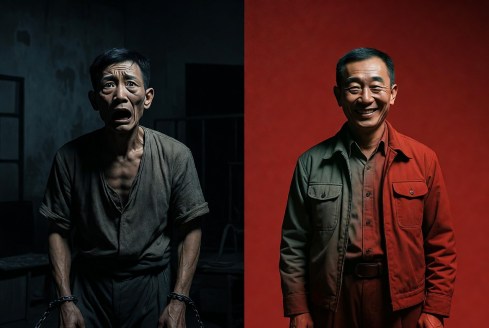
“Divided by Category: Red (favored, content) and Black (suspect, under duress) — the Maoist tool that made persecution socially acceptable.”
References and Further Reading
Maoist classifications and the Cultural Revolution
Guo Jian, Song Yongyi and Yuan Zhou, Historical Dictionary of the Chinese Cultural Revolution, Scarecrow Press, 2006.
A scholarly reference work covering the Five Black Categories, the favoured Red Categories, political campaigns, struggle sessions and other institutions of the Cultural Revolution.
https://books.google.com/books?id=T5-4zOdHKOIC&q=Five+Black+Categories
Song Yongyi, “Chronology of Mass Killings During the Chinese Cultural Revolution (1966–1976),” Sciences Po Mass Violence and Resistance Research Network, August 25, 2011.
An academic chronology of Cultural Revolution violence. It describes the Five Black Categories—landlords, rich peasants, counter-revolutionaries, bad elements and rightists—and documents how political classifications exposed individuals and their families to confiscation, expulsion, persecution and killing.
https://www.sciencespo.fr/mass-violence-war-massacre-resistance/en/document/chronology-mass-killings-during-chinese-cultural-revolution-1966-1976
Evan Osnos, “Born Red,” The New Yorker, March 30, 2015.
A profile of Xi Jinping that also describes the status attached to revolutionary family background during the Cultural Revolution. It includes the “born red” culture, inherited political prestige and the stigma imposed upon children of people classified as reactionaries.
https://www.newyorker.com/magazine/2015/04/06/born-red
Mao on ethnicity and Han chauvinism
Mao Zedong, “On the Ten Major Relationships,” April 25, 1956.
English text of Mao’s speech addressing relations between the Han majority and China’s minority nationalities. Mao formally identified Han chauvinism as a danger and argued that the Party should oppose discrimination by the Han majority.
https://www.marxists.org/reference/archive/mao/selected-works/volume-5/mswv5_51.htm
Falun Gong persecution and “transformation”
Human Rights Watch, “Falungong in Custody: Competing Accounts,” in Dangerous Meditation: China’s Campaign Against Falungong, January 2002.
Human Rights Watch’s examination of detention, re-education through labour, extrajudicial transformation centres and coercive attempts to force practitioners to renounce their beliefs. The report also discusses the difficulty of verifying claims because China prevented independent monitoring of prisons and labour camps.
The report documents official transformation targets and evidence of severe physical and psychological pressure, including torture and extreme pressure to recant.
https://www.hrw.org/reports/2002/china/China0102-04.htm
Uyghurs and the Xinjiang detention system
Office of the United Nations High Commissioner for Human Rights, Assessment of Human Rights Concerns in the Xinjiang Uyghur Autonomous Region, People’s Republic of China, August 31, 2022.
The principal UN assessment of China’s counter-extremism policies, methods for identifying “at risk” people, detention in vocational education and training centres, treatment in custody and restrictions upon religious, linguistic and cultural identity.
Permanent Mission of the People’s Republic of China to the United Nations Office at Geneva, “Response to the OHCHR Assessment,” August 2022.
China’s formal rebuttal to the UN assessment. The government rejects the allegations, describes the centres as lawful counterterrorism and vocational programs, and argues that the UN assessment relied upon politicized or unreliable sources.
https://www.ohchr.org/sites/default/files/documents/countries/2022-08-31/ANNEX_A.pdf
Organ profiling and the connection to the first essay
United Nations Office of the High Commissioner for Human Rights, “China: UN Human Rights Experts Alarmed by ‘Organ Harvesting’ Allegations,” June 14, 2021.
A statement by UN human-rights experts concerning reports that detained Falun Gong practitioners, Uyghurs, Tibetans, Muslims and Christians were subjected to blood tests and examinations of the heart, liver, kidneys and other organs without informed consent.











 bleatmop
 Mystro
 The Arbourist


 Dead Wild Roses
Your opinions…