
You are currently browsing the tag archive for the ‘Freedom of Movement’ tag.
A fictional composite in three vignettes about a girl coming of age under Taliban rule.
II. The Road That Needed A Boy
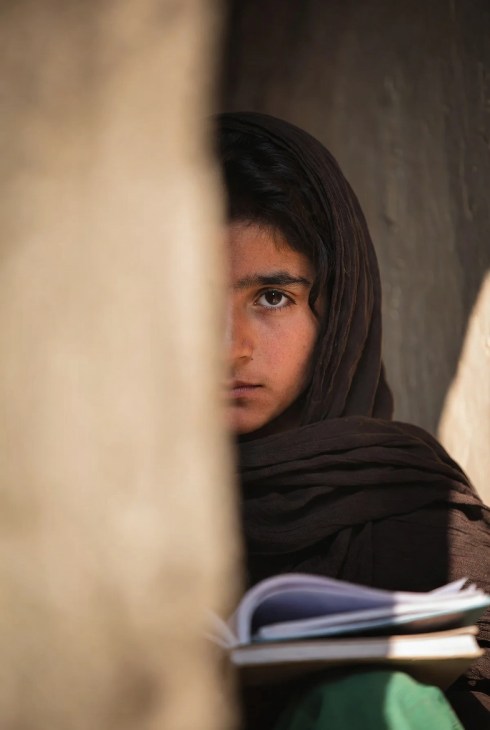
My mother woke with one hand pressed beneath her ribs.
She did not make a sound. I watched from my mat as the room brightened by slow degrees and my brother scratched himself awake for school. When he kicked off his blanket, his foot struck my ankle.
“Move,” he said.
I moved.
My mother closed her eyes.
At breakfast she broke the bread but did not eat it. My father had already gone to see a man about flour, and my brother was late and angry because his book was missing. It was under his own blanket. I saw the corner before he did, but waited while he lifted the cushion, cursed softly, and accused me of moving it.
“It is there,” I said, pointing.
He snatched it up.
“You should have said.”
My mother’s hand tightened under the table, only a little, only enough for me to see.
I lowered my eyes to the bread.
My brother left with crumbs on his sleeve and his bag half open. The gate knocked against the wall when he kicked it wide. A moment later his voice joined the other boys in the lane, careless and rising, already beyond the house.
My mother stood when he was gone, took two steps toward the stove, and stopped.
I reached her before she touched the wall. She leaned against me with only part of her weight, the way women lean when they are trying not to admit they have leaned at all.
“Sit,” I whispered.
She shook her head.
“Water first.”
I brought it. She drank and pressed the cup back into my hands without looking at me. The skin around her mouth had gone grey.
“We should go to the clinic,” I said.
She looked toward the gate.
My father was gone. My brother was gone. My uncle lived across the old road but might already be at the market. My cousin Farid sometimes came in the mornings, though he came when he wished and left when he wished, being fifteen and male and therefore important in ways no one had asked him to earn.
The clinic was not far. I could walk there with my mother before the sun cleared the neighbour’s roof. I knew the route better than Farid did: past the broken drain, left at the green door, around the corner where boys played football with a cloth ball, then straight until the road widened near the pharmacy.
I could have gone.
I did not move toward the gate.
My mother saw that too.
“Maybe it will pass,” she said.
She tried to stand straighter and failed.
I helped her to the cushion near the wall, then went to the shelf where she kept the old medicine paper folded inside a tin. I knew which one it was because she had taken the same tablets before, when the pain came after carrying water in winter. The writing had faded, but I could still read enough of it.
I had always been good at reading.
Outside, a cart rolled past. Men spoke near the corner. One laughed, and the laugh came through the gate as if the wood were thinner than before.
I folded the paper smaller and placed it beside the cup.
“We need someone to take us,” my mother said.
Us.
The word sat between us with its little insult folded inside it. She needed medicine; what we needed first was a boy.
By midmorning the room had grown warm. My mother sat with her back to the wall, eyes half closed, lips moving without sound. I swept the courtyard because I could not sit, then swept it again though the dust only moved from one side to another. When I bent near the gate, I heard girls laughing somewhere beyond the lane.
Not girls my age.
Small ones.
They passed like a handful of birds thrown into the morning, schoolbags bumping against their sides, shoes striking the road in quick uneven taps. One of them sang the first line of a lesson and forgot the rest. Another corrected her. They argued and kept walking.
I held the broom still until their voices were gone.
Then I swept the same clean place a third time.
Farid came near midday.
He did not knock properly, only called from outside as if our door owed him an answer. My mother straightened before I opened it. She wiped her face with the edge of her scarf and told me to bring the outer covering.
The cloth hung on a peg near the door.
I had worn it many times by then, but each time there was a moment — small, almost nothing — when my body remembered air on my face. The pause was brief. No one would have noticed it unless they were watching for rebellion.
I noticed it.
I put the covering on.
The room changed at once. The edges of things dulled; the door became a shape, the floor a dim path, my own hands something I had to lift close to see clearly. I adjusted the cloth where it fell near my eyes, then lowered it because Farid’s shadow had crossed the threshold.
He did not look sick. He looked bored.
“What is wrong with her?” he asked.
“With my mother?”
He shrugged, already glancing back toward the lane.
I handed him the folded medicine paper.
He looked at it, turned it once, then handed it back.
“You tell them.”
I kept my hand closed around the paper.
At the gate my mother paused, not from modesty but pain. Farid sighed, wanting us to know he had somewhere else to be.
I wanted to tell him she had waited half the morning for his permission to be ill.
Instead I stepped behind my mother and made sure the cloth did not catch in the latch.
The lane was brighter than I expected.
It always is, after days inside. The first glare made me blink, and for a moment the world disappeared; there was only cloth, footsteps, and the knowledge of where the road should be. My feet found the dip near the drain, the flat stone by the neighbour’s door, the place where rain had eaten a channel along the edge of the lane.
Farid walked ahead.
He took the wrong turn.
My mother did not notice. Her breath had shortened, and she was watching the ground in front of her feet. I stopped at the corner, then caught myself and stepped after him.
“Farid,” I said.
He kept walking.
“Farid.”
He turned, annoyed.
“That way,” I said, pointing with two fingers low at my side.
He looked at the road, then at me, then back at the road.
“I know.”
He came past us without hurrying.
We followed.
Near the football corner, three boys had drawn lines in the dust with a stick. They stopped playing when we passed. One of them was younger than me and stared because boys learn early that looking costs them nothing. Farid told them to move, and they did, slowly, dragging their feet through the lines they had made.
My mother’s sleeve brushed mine. I matched her pace.
At the wider road, a truck passed carrying men in the back. One held a rifle across his knees. Another tapped a stick against the metal side in a steady, bored rhythm. They were not looking at us, and still my mother shifted closer to the wall until her shoulder nearly touched the mud brick.
I shifted with her.
The wall was warm from the sun, though none of its warmth reached inside the cloth.
A woman ahead of us did the same thing, turning half-sideways with a child tucked behind her. When the truck moved on, no one spoke. The woman waited three breaths before stepping away from the wall, as if the road had to become safe again by itself.
At the pharmacy, the man behind the counter knew Farid’s name but not ours.
“What do you need?” he asked him.
Farid looked at me.
I held out the paper.
The pharmacist took it, squinting at the old writing. “Who is this for?”
“My aunt,” Farid said.
The man looked past him, toward my mother, then away. “Pain here?” He touched his own side.
My mother nodded.
“Fever?”
She opened her mouth.
Nothing came out.
Her eyes flicked to Farid, who was looking at a box of sweets near the counter.
“Yes,” I said softly.
The pharmacist’s eyes moved to me. Not sharply, not kindly either, only enough that I remembered where a girl’s voice was meant to stay.
My mother answered then, barely louder than the rustle of cloth. “No fever.”
The pharmacist took down a small packet and began explaining the tablets to Farid, who listened with the solemn face of someone trusted with knowledge he did not intend to carry far.
“After food,” the man said.
Farid nodded.
“Not too many.”
Farid nodded again.
“Morning and night.”
Farid looked toward the door.
I counted each instruction on my fingers inside the cloth where no one could see.
Morning.
Night.
Food.
Not too many.
When the pharmacist wrapped the packet, Farid reached for it before I could. My mother paid. The coins shook once in her hand, and I moved closer so my sleeve hid it.
Outside, Farid gave me the medicine only after we had turned away from the shop.
“You heard?” he asked.
I nodded.
“Good. I forgot.”
He laughed a little, as if this were charming.
On the way home, we passed the old beauty shop.
The sign was still there, though someone had scraped the painted face until only the mouth remained. Dust clouded the windows. A notice had been pasted to the door months ago and was peeling at one corner.
My cousin had gone there before her wedding.
I remembered her holding out her hands for us to admire, palms painted red, fingers curled as if she were carrying water she did not want to spill. Everyone had laughed because she would not touch anything until the colour dried. For one afternoon she had moved through the rooms slowly and grandly, pleased with herself, letting the younger girls look.
Now the shop stood with its mouth scratched away.
Farid saw me looking.
“Places like that made women foolish,” he said.
My mother kept walking.
I lowered my eyes, but not before I caught my reflection in the dusty window: cloth, shadow, the suggestion of a face that no longer belonged fully to the street.
At home, Farid did not come inside. He had done his duty and was already late for whatever boys do when no one is measuring their steps. My mother thanked him. He shrugged and went down the lane, kicking a stone ahead of him until it bounced into the drain.
I closed the gate.
The latch stuck, so I lifted it and tried again.
Inside, the house received us without interest: stove, wall, water jar, folded quilts, the chest beneath them. My mother sat slowly, one hand under her ribs, and I gave her the tablets after tearing the packet carefully along the edge.
“Morning and night,” I said. “After food. Not too many.”
She looked at me for a moment.
Then she nodded.
I poured water. She swallowed the first tablet and leaned back with her eyes closed. The covering had left a red line across her forehead. I wanted to touch it, but she looked too tired to be comforted.
In the courtyard, I shook dust from my covering.
Before I lifted it from my shoulders, I checked the gate.
Closed.
Then the windows.
Empty.
Then the roofline.
No one.
Only then did I pull the cloth back from my face.
Air touched my skin.
I stood with the covering gathered in both hands, breathing as quietly as I could. The courtyard wall rose above me, sun on the top half, shadow on the lower. A crack ran through one corner where last winter’s rain had softened the mud brick. I had watched that crack widen for months.
A small brown bird landed on the wall.
It hopped once, turned its head, and looked down into the courtyard with one bright eye. Nothing about it was beautiful. It was dusty and ordinary, the colour of road and seed husks. It opened its beak and gave a quick, careless sound.
I did not move.
The bird hopped again, closer to the edge. Its feet gripped the wall without asking whether the wall permitted it. Then it lifted itself into the air and crossed into the neighbour’s courtyard, where I could not see it anymore.
I stood there until my mother called my name.
The sound came through the house, tired and small.
I folded the covering carefully: outside from inside, dusty from clean, seen from unseen. By the door, my school shoes waited behind the water jar, still angled toward the gate.
I almost moved them back.
Then footsteps passed outside, and I carried the covering inside.











 bleatmop
 Mystro


 Dead Wild Roses
Your opinions…