
You are currently browsing the tag archive for the ‘Religious Oppression’ tag.
This is a fictional composite, told through three brief vignettes, about a girl coming of age under Taliban rule in Afghanistan.
Her name is Zahra. She is not one real girl, but she stands in for many: girls whose schools were closed, whose movements were restricted, whose voices were lowered, whose futures were discussed by others before they were old enough to understand what was being taken.
The purpose is not to sensationalize suffering. It is to show, quietly and plainly, what theocratic power does when it reaches into the daily life of a girl: the books hidden away, the gate closed, the words swallowed, the future made smaller one obedience at a time.
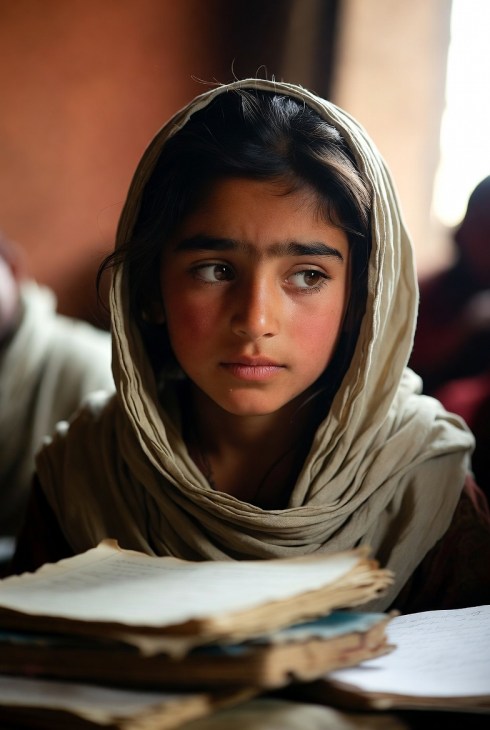
I. The Day School Ended
My name is Zahra, and last year I still ran to school.
Mariam and I used to race from the corner where the road dipped, skirts catching dust, scarves slipping. She would say the teacher was going to scold us; I would tell her she would be scolded first because her scarf made her look like a goat tangled in laundry. By the time we reached the green gate, we were holding our sides, trying to breathe quietly and failing, already guilty and already happy.
This morning, before prayer, my brother kicked the wall in his sleep and knocked dust from the mud brick.
He slept with one arm flung out from the blanket, mouth open, hair flattened on one side, as if sleep itself gave boys more room than it gave girls. When my mother bent over him and shook his shoulder, he dragged the quilt over his head and made a low miserable sound, the kind boys make when the world asks them to rise and they believe the request itself is an injury.
“Get up,” she whispered.
He did not move until she said, “Your father will hear.” Then he sat up slowly, face swollen with sleep, scratching at his stomach while the house gathered itself around morning: the kettle lid clicking on the stove, my father coughing once from the other room, someone outside sweeping a courtyard in long dry pulls.
“I don’t want to go,” my brother said.
My mother picked up his shirt from the floor and shook it once. “Then go unwilling.”
He looked at me as if I might laugh, so I lowered my eyes to the blanket before he could see anything cross my face.
His slate lay near my foot, its corner chipped, one side clouded with old sums half-wiped away. He had left it there the night before, careless as always, and I moved my toes back so I would not touch it by accident.
My own shoes waited beside the door, dusty at the toes, the right lace still shorter than the left because I had tied it too quickly on the last morning I went to school. Mariam had been calling for me from the lane, impatient and bright, and I had bent over the knot with one hand on the doorframe, laughing because she was always early when she claimed to be late.
They still fit.
I knew because two nights ago, after everyone slept, I had put them on and stood beside the door long enough to feel the shape of the old morning rise through my feet.
My brother complained that his shoes were tight, and my mother told him to bring them closer. She pressed the leather with her thumb, frowned, and said he was growing again. When he suggested he might stay home, my father coughed from the other room, and my brother reached for the shoes without another word.
The chest was beneath the folded quilts, not hidden exactly, but not offered to the room either. I waited until my mother turned back toward the stove before lifting the lid. It gave a small wooden complaint, and I paused with one hand still on the edge, listening to see whether the sound had reached anyone.
No one looked at me, so I opened it the rest of the way.
The books were wrapped in my aunt’s old scarf: mathematics, Dari, science with the corner chewed by a mouse, and my English reader, thin and soft from use. When I rested my hand on it, the classroom came back so suddenly that I had to press my fingers flat against the cover: chalk dust, damp wool in winter, the cheap orange soap our teacher used, the warmth near the stove where all of us pretended not to shiver.
Then my brother knocked over a cup.
The sound closed the chest for me before I had decided to close it.
Tea spread across the floor. My mother said his name sharply, and he grabbed a cloth only to push the spill wider. I went to help, stopped because he had hands and could wipe his own mess, then saw my mother look at me.
I took the cloth from him.
By the time he was ready, the sun had reached the top of the courtyard wall. He shoved bread into his mouth, tucked his slate under one arm, forgot his book, cursed softly when my mother sent him back for it, and then kicked the gate open with his heel because both hands were full.
“Do not kick the gate,” my mother called, but he was already outside, where the other boys waited in the lane.
Their voices came through the open gate in pieces: a joke, a shove, someone laughing too loudly, someone calling for my brother to hurry. He ran to meet them with his bag slapping against his back, his own voice rising to join theirs before he reached the corner.
The gate swung half shut behind him, and I moved toward it before I knew I had moved, only one step, small enough to deny if anyone asked.
My mother’s hand touched my sleeve.
She did not pull, because she did not need to. I stepped back, and she went to the gate and closed it with her hip. The latch fell into place while I stood there holding the wet cloth in both hands.
After breakfast I rinsed the cups, swept the courtyard, shook crumbs from the bread cloth, and folded my brother’s shirt from yesterday. There was ink on one sleeve, and I rubbed at it with water until the fabric darkened under my fingers, though the stain only spread and made a larger shadow. Near the back wall, my father’s coat hung from a peg with burrs clinging to the hem, so I picked them out one by one and set them in a little pile on the floor.
My mother kneaded dough beside me, pressing, folding, turning, and I matched her rhythm without meaning to: pick and drop, pick and drop, pick and—
From somewhere beyond the houses came the sound of boys reciting.
I knew the shape of it at once, even before I could hear the words. The teacher asked; the class answered, not together exactly, because boys never answered together properly. One voice rushed ahead, two lagged behind, and one shouted because he liked the sound of himself.
My hand closed around a burr, and the point went into my thumb.
I put it in my mouth before the blood could show where my mother might see.
The recitation came again, louder this time, lifted by the wind and broken against the courtyard wall, and I picked up the coat and shook it hard, though there was nothing left to shake out.
In the afternoon, my aunt came with Mariam, who is seven and still small enough for school.
She entered with dust on her hem and a notebook clutched against her chest. Her cheeks were red from the cold, and she smelled of outside air. Before she had even greeted my mother properly, she climbed beside me and pushed the notebook into my lap.
“Zahra, look.”
Her letters leaned across the page, some too fat, some too thin, some collapsing into the next as if they were tired. She had pressed too hard with the pencil, denting the paper beneath each line, and I reached for her hand before remembering myself. I folded my hands together instead.
“Very good,” I said.
She smiled as if I had given her something precious.
The pencil was still behind her ear, the yellow paint bitten at the end. I could see exactly what she was doing wrong, how she held it too high and forced the letters from the shoulder instead of letting the wrist guide them. The correction rose into my mouth so naturally that I nearly spoke it, but my aunt was sitting across from us, and my mother had gone still near the stove.
I swallowed the words.
Mariam turned the page and showed me more. The second page was worse, one letter even facing the wrong direction, and I smoothed the curled corner with my thumb while looking long enough for the urge to fix it to pass.
“Will you come back to school when they let big girls come?” she asked.
My aunt adjusted the edge of her scarf. My mother wiped flour from her wrist though her hands were already clean. Outside, a cart rolled past and one wheel struck a stone.
The silence answered for us.
Mariam looked from face to face, still expecting one of the grown women to make the world make sense again. When no one did, I smiled because she was little, and because little girls should be allowed to keep foolish hopes a little longer.
“Show me the next page,” I said.
After they left, I found an old pencil under the chest. It was short, bitten at one end, split near the point, the kind of pencil no one would think important enough to take. I held it in my palm while my mother and aunt spoke near the door in voices that were not secret, only low, which is different.
When my aunt finally went home, I rolled the pencil once between my fingers and slipped it into my sleeve before I had decided what I was hiding it from.
At evening, my brother lay on his stomach near the lamp, schoolbook open, feet moving lazily in the air. He had ink on his sleeve again. The stain I had rubbed earlier was still there, only wider now.
He frowned at a word and said my name.
I looked up from the onions.
“How do you spell this?”
He pushed the book toward me without moving from his stomach. I wiped my hands on my dress and leaned close enough to see, though the answer came before my eyes had finished reaching the page. My finger rose automatically, the way it had for years in class.
I pulled it back as if the page had burned me.
He waited.
I told him the letters slowly, and he wrote them badly, with the second one crooked and wrong. For a moment I watched the mistake settle on the page, black and permanent, while the lamp flame bent sideways and recovered.
“Is that right?” he asked.
“Yes,” I said.
He shrugged and turned the page, and I went back to the onions. The knife slipped once against my finger, barely touching skin, not enough to bleed.
After everyone slept, I opened the chest again.
This time I moved slowly, because the hinge complained near the top, and I knew how far I could lift the lid before the sound carried. I reached inside by feel: cloth, book edge, notebook. The pencil in my sleeve had left a grey mark against my wrist.
I sat with my back to the wall while the house breathed around me: my brother’s uneven sleep, my father’s heavier one, my mother turning once on her mat. Somewhere outside, a dog barked and stopped.
The notebook opened to a blank page. The lines were faint but still there, and I wrote the date carefully because my teacher had once said careless dates made careless minds. Then I held the pencil above the next line and tried to picture my classroom: the green gate, the cracked step near the door, the teacher’s blue scarf, my place beside the window.
I could see all of it.
When I tried to remember what grade I would be in now, my hand began to shake, so I placed it flat against the page until it stopped.
On the first line beneath the date, I wrote:
Future
The pencil point broke on the last letter, making a sound so small I looked toward my mother to see whether she had heard it.
She had not.
I sat for a long time with the broken pencil in my hand, feeling the rough edge of the wood with my thumb. Then I wrapped the notebook again and slid it beneath the books, not on top where it had been before. When I closed the chest, the latch did not catch, so I opened it again, lifted the cloth, tucked one corner of the scarf out of sight, and closed it properly.
In the dark, I took my school shoes from beside the door and placed them behind the water jar.
Not hidden.
Not exactly.
Just somewhere no one would ask why they were still waiting.











 bleatmop
 Mystro


 Dead Wild Roses
Your opinions…