
You are currently browsing the tag archive for the ‘California’ tag.
A recent post from a Women’s Liberation Front activist should be read less as a complaint than as a warning about how institutions train dissenters to accept contempt as normal.
She describes years of opposing gender-identity legislation in California: travelling to Sacramento, meeting legislative offices, testifying at hearings, and trying to explain to ordinary people what the policies actually mean. Female locker rooms become mixed-sex spaces by administrative decree. Girls’ sports and girls’ boundaries become conditional. Distressed young women are placed on medical pathways that can permanently alter healthy bodies.
The remarkable part is not merely that lawmakers disagree with her. Disagreement is expected in politics. What stands out is the air of pre-judgment around the process. She writes that legislators’ offices treat these women with “barely contained disdain.” Public hearings fill with activists who regard any defence of female boundaries as proof of bigotry. The women objecting are not received as citizens raising serious concerns about privacy, safeguarding, fairness, or medical ethics. They are treated as a nuisance class: managed, endured, and socially disqualified before the argument begins.
A functioning democracy does not require lawmakers to agree with every citizen. It does require them to hear citizens as citizens. When women raise concerns about intimate spaces, parental knowledge, fair competition, or irreversible interventions on minors, the answer cannot simply be a sneer and a label. “Bigot” is not an argument. “Hate” is not a policy analysis. “Inclusion” does not magically settle every conflict between competing rights.
Institutional capture often works this way. It does not begin by winning every argument in public. It begins by deciding which arguments are permitted to count. After that, the ordinary political process becomes strangely theatrical. Hearings still happen. Citizens still line up to speak. Legislators still nod along with the solemn expressions of people performing democratic patience. But the conclusion has already been filed away. These women are not constituents with claims on representation. They are obstacles to be routed around.
“A functioning democracy does not require lawmakers to agree with every citizen. It does require them to hear citizens as citizens.”
California is an especially sharp example because its political culture is so one-sided on this issue. The institutions are not neutral referees; they have chosen a side, and women who object are expected to absorb that fact politely. Over time, this wears people down. The WoLF activist’s most revealing line is not the one about crazy legislation. It is the moment of recognition: going to Washington, D.C. reminded her how badly she had become accustomed to being treated in California.
That is what contempt does over time. It lowers your expectations. It trains you to think basic respect is a luxury. It teaches you that being ignored is normal, that being caricatured is normal, that being called hateful for stating sex-based concerns is the price of admission.
This is especially perverse when the dissenters are women defending women’s boundaries. Feminism once insisted that female privacy, bodily integrity, and protection from male entitlement mattered. Now women who make those arguments are often treated as embarrassing relics, reactionaries, or moral contaminants. The old feminist vocabulary survives, but the sex class it was built to defend has been quietly replaced by a more fashionable abstraction.
The inversion should be obvious by now. Women are told they must be compassionate while their own concerns are dismissed. Girls are told inclusion matters while fairness and privacy are negotiated away on their behalf. Parents are told to trust institutions that increasingly treat hesitation as a threat. Citizens are told democracy is sacred while lawmakers learn to ignore the public on issues where the public is far less progressive than the activist class.
“The hearings still happen. Citizens still line up to speak. But the conclusion has already been filed away.”
This is why the fight matters even when a particular bill is lost. Public opposition creates a record. It denies consensus. It tells other women they are not alone. It forces legislators to own what they are doing rather than hiding behind bureaucratic language and moral fog.
Eventually, legislators need to pay a political price for treating women this way. Not because disagreement is forbidden. Not because every feminist objection should automatically prevail. But because a political class that can dismiss women’s sex-based concerns with contempt has learned something dangerous about power: the right moral vocabulary can make ordinary citizens disappear.
Women cannot win a fight they are shamed out of entering. They cannot defend boundaries they are not allowed to name. They cannot rely on institutions that have already decided their objections are evidence of guilt.
The point is not that every battle will be won in Sacramento. Some will be lost. Maybe many. But silence is how capture becomes permanent. Visibility is how it starts to crack.

Institutional capture rarely arrives breathing fire. More often, it brings a binder, a microphone, and a schedule.
When you loosen the laws around statutory rape and prostitution – more of those things happen. But apparently it is “okay” if you are fighting or LGBTQ+ equality.
Of course, it is utter bullshit, as most legislation/rhetoric that emanates from the post-modern queer left. This excerpt from an essay by titled a Predators’s Paradise.
“But who exactly are these “queer kids” and “gay kids” he’s talking about? He can’t be referring to the young gay teens who are the victims of felony statutory rape; those minors weren’t being discriminated against by the law—they were being protected by its bright-line insistence that they were sexually off-limits to predatory adults. When he refers to discrimination against “queer kids,” Wiener seems actually to be concerned with the law’s unfairness to the perpetrators of felony statutory rape. That is, he worries about a twentysomething adult—a “kid,” in his turn of phrase—who has sex with a minor.
Many of us would reasonably oppose the prosecution of, say, an 18-year-old high school senior arrested for a consensual sexual encounter with his 16-year-old boyfriend or girlfriend. But in California, that scenario doesn’t describe a felony, and does not require anyone to register as a sex offender. Wiener’s bill deals with older offenders who have sexual relations with 14- or 15-year-old kids. I asked him why those young teens shouldn’t deserve the protection of the law. “Then why aren’t you asking this of any other legislator?” he replied. “I mean, honestly, what you’re doing is you’re saying to the gay people who are just asking to be treated equally: Why don’t you change everything for everyone? And no one’s asking that of any straight legislator.”
The equality argument is Wiener’s classic sleight of hand, and he’s practiced it many times. When he authored the bill to eliminate the felony penalty enhancement for knowingly exposing a sexual partner to HIV, for example, he claimed the mantle of fighting the “discrimination” against those living with the disease. But, as a consequence of the bill, there is now no justice for a gay man infected with HIV by a sex partner who lied about it. The violation of his consent and bodily integrity now go unvindicated. Similarly, the violent reality of today’s pimp-dominated sex trade seems to have escaped Wiener’s legislative pen. As we have seen, the repeal of the anti-loitering statute is a boon to human traffickers, not their victims.”
[…]
“In 2019, Wiener cosponsored the “LGBTQ Foster Youth Bill of Rights,” another law with disturbing implications. The bill granted LGBTQ-identified foster kids the rights, among other things, to abortions, contraception, and medical treatment for sexual assault, “without the knowledge or consent of any adult.” Included in this bill of new “rights” was this one: “the right to ‘access to computer technology and the internet.’” Suddenly, foster parents found it impossible to police the Internet activity of their foster kids.
The bill’s supporters claim that Internet access allows LGBTQ foster youth to obtain the peer support they need. Such support is necessary, they say, since so many of these kids are extremely vulnerable, lacking intact family. But that same vulnerability should make us extraordinarily wary of government handing numberless adults what amounts to a right of Internet access to these children. After all, so much harm comes to adolescents via fiber-optic cables. Why prevent foster parents—adults the state has at least vetted—from regulating foster kids’ communication with unvetted adults?
As a result of this law, adult sexual predators of all orientations in California gained greater access to child victims. The Internet has become a major tool of traffickers—particularly of boys, Ugarte told me. “Sextortion is the new trend, where there’s an avatar girl, and they befriend a boy, then send them to a chat room. And say: ‘Hey, you know, I like you. Why don’t you let me see your body? I want to see what you look like because you’re so handsome.’ He gets naked. And then once they do that, they go and tell him: ‘If you do not give us $5,000, we’re going to expose you in all the Internet. Meaning, in every single social media.’”
This is why Gender Ideology and transactivism needs to be fought. It is the erasure of females and their rights from society.
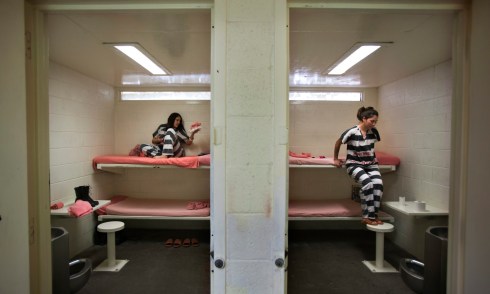
“We are working with a woman who was punched in the face so hard by a new transfer that she couldn’t chew for three days. He was taken away and released back in a different yard with no restrictions,” Adams said. “He was her cellmate. She had to sleep with him.”
Other women have been sexually abused in the past and must now contend with nude men sharing communal showers, Adams said.
“One woman went in there with two naked men showering who still had penises,” Adams added. “It was incredibly traumatic and scary, to know for, [possibly], the rest of their lives they are going to be subjected to this.”
The state currently has 273 transfer requests; 266 are from people housed at male institutions requesting to be transferred to a female institution, and seven are from people at female institutions requesting to be transferred to a male institution, according to the Department of Corrections and Rehabilitation. California has 1,286 inmates identified as transgender or nonbinary.
Currently, 24 male prisoners have been transferred to female institutions. WoLF theorizes that many men transferring into women’s prisons are not transgender but are just trying to escape their current living situation.
“A lot of these men checking the box and trying to get transfers are probably trying to save their lives. I wouldn’t want to be in the men’s prison,” Adams said. “You are giving them a way to get out of that, but now it’s the women who are in danger.”
Most women in state prison have been abused at some point in their lives, and many have endured sexual assaults. Having to sleep in a cell with a man or shower with them is traumatic, Adams said.
State law requires a committee to vet the transfers, but a large number of men who got through have violent pasts. For example, one male transfer was convicted of assaulting two boys aged 6 and 8. Another had multiple counts of forcible rape, and he still had his penis, Adams said.
A CDCR spokesperson told the Washington Examiner the transfer process includes “a thorough review of the incarcerated person’s history prior to and during incarceration, their crime, arrest and criminal history, trial and sentencing documentation, medical and mental health needs …”
[…]
WoLF is asking the governor to halt all new transfers and remove the inmates who have already transferred until a safety assessment can be made.
CDCR did not respond to a request for comment as of press time.
It’s nice to see a little Sun everyone once and awhile in the toxic soup that is comprises much of the Media in the the US.
Liberal Viewer does a masterful job of bringing to light the waste involved in killing our fellow human beings.











 bleatmop
 Mystro


 Dead Wild Roses
Your opinions…