
You are currently browsing the tag archive for the ‘Progressive Politics’ tag.
One key idea behind activist-left identity politics is the ladder of oppression: the more marginalized identity categories a person can claim, the more moral and political weight their speech is assumed to carry.
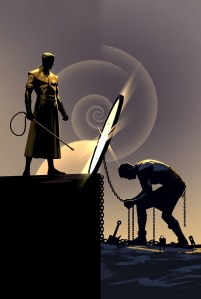 The theory has an old philosophical root. In the master/slave dialectic, the subordinate person is said to understand both worlds: his own condition and the world of the master who rules over him. The master, by contrast, often knows only his own comfort, his own assumptions, and the social order that flatters him. From this comes the later activist claim that oppressed people possess a clearer or “truer” insight into reality because they see power from below.
There is a partial truth here. People who live under a system often notice things the comfortable miss. A disabled person may see barriers others walk past. A woman may notice male behaviour men excuse or ignore. A racial minority may recognize social patterns the majority experiences only as normal background noise. Lived experience can expose blind spots.
The problem comes when this insight hardens into hierarchy.
Instead of treating experience as evidence to consider, activist politics often treats identity as authority. The more oppression factors a person can claim — race, sex, gender identity, sexuality, disability, poverty, colonial history — the higher they stand on the moral ladder. Their narrative is then “centred,” while those lower on the ladder are expected to listen, defer, apologize, or stay quiet.
At that point, argument has been replaced by ranking. A weak claim from the approved identity can be protected from criticism, while a strong claim from the wrong identity can be dismissed as privilege, fragility, or harm.
Lived experience matters, but it does not make someone automatically right. Suffering can reveal truths, but it can also narrow vision, sharpen resentment, or turn personal pain into bad policy.
A serious society listens to experience without making identity a substitute for reason. The question still has to be: is the claim true?
It’s nice to see a little Sun everyone once and awhile in the toxic soup that is comprises much of the Media in the the US.
Chris rock makes a point about how to think about “progressive politics” and what it means to people. It is almost always informative to hear the story of those who regularly receive the short end of history’s stick.
Shamelessly plagiarized from Wikipedia:
The Second Bill of Rights was a proposal made by United States President Franklin D. Roosevelt during his State of the Union Address on January 11, 1944 to suggest that the nation had come to recognize, and should now implement, a second bill of rights. Roosevelt did not argue for any change to the United States Constitution; he argued that the second bill of rights was to be implemented politically, not by federal judges. Roosevelt’s stated justification was that the “political rights” guaranteed by the Constitution and the Bill of Rights had “proved inadequate to assure us equality in the pursuit of happiness.” Roosevelt’s remedy was to create an “economic bill of rights” which would guarantee:
- A job with a living wage
- Freedom from unfair competition and monopolies
- A home
- Medical care
- Education
- Recreation
Roosevelt stated that having these rights would guarantee American security, and that America’s place in the world depended upon how far these and similar rights had been carried into practice.
How different a political landscape we would be faced with today if FDR has lived. Would we see the Plutocracy that is in full bloom currently in the US? Perhaps, but I think that the enormous divisions that exist in American society would be significantly less and more people would feel like they were part of the system rather then victims of it.
President Obama should take heed of FDR’s words and make them his second term platform. Adopting such a progressive goal, I think, would take the bitter taste out of so many progressive’s mouths.
The Second Bill of Rights TV address to the American people in case you missed it.











 bleatmop
 Mystro
 The Arbourist


 Dead Wild Roses
Your opinions…