
You are currently browsing the tag archive for the ‘Standpoint Epistemology’ tag.
One key idea behind activist-left identity politics is the ladder of oppression: the more marginalized identity categories a person can claim, the more moral and political weight their speech is assumed to carry.
 The theory has an old philosophical root. In the master/slave dialectic, the subordinate person is said to understand both worlds: his own condition and the world of the master who rules over him. The master, by contrast, often knows only his own comfort, his own assumptions, and the social order that flatters him. From this comes the later activist claim that oppressed people possess a clearer or “truer” insight into reality because they see power from below.
There is a partial truth here. People who live under a system often notice things the comfortable miss. A disabled person may see barriers others walk past. A woman may notice male behaviour men excuse or ignore. A racial minority may recognize social patterns the majority experiences only as normal background noise. Lived experience can expose blind spots.
The problem comes when this insight hardens into hierarchy.
Instead of treating experience as evidence to consider, activist politics often treats identity as authority. The more oppression factors a person can claim — race, sex, gender identity, sexuality, disability, poverty, colonial history — the higher they stand on the moral ladder. Their narrative is then “centred,” while those lower on the ladder are expected to listen, defer, apologize, or stay quiet.
At that point, argument has been replaced by ranking. A weak claim from the approved identity can be protected from criticism, while a strong claim from the wrong identity can be dismissed as privilege, fragility, or harm.
Lived experience matters, but it does not make someone automatically right. Suffering can reveal truths, but it can also narrow vision, sharpen resentment, or turn personal pain into bad policy.
A serious society listens to experience without making identity a substitute for reason. The question still has to be: is the claim true?
“White people don’t get to decide what’s racist.”
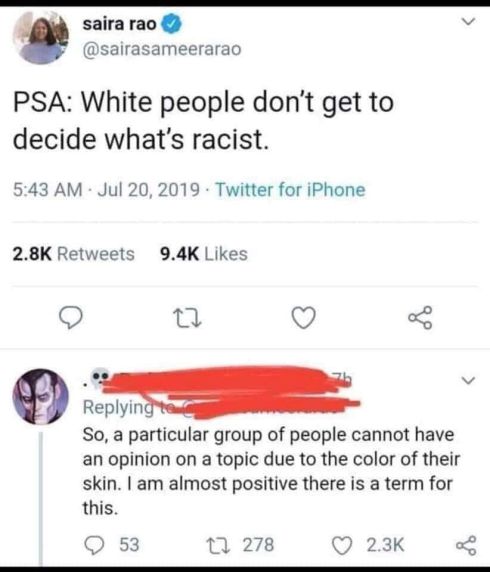
At first glance, this sounds like a demand for humility. And humility is not a bad thing. People can miss harms they do not personally experience. They can mistake comfort for neutrality. They can ignore patterns because those patterns do not touch them directly. Any honest account of racism has to leave room for that.
But the sentence does more than ask for humility. It draws a racial boundary around moral reasoning. It says that one group of people is not merely fallible, not merely prone to blind spots, but disqualified from judgment by birth.
That is where the sentence stops being a plea for listening and becomes something else. It becomes racial gatekeeping presented as moral expertise.
The screenshot is useful because it shows several aspects of critical theory coming into contact with the real world. Not in a seminar room. Not in a carefully footnoted academic paper. In the wild, where theory has been stripped of caveats, flattened into slogans, and handed to people who often have no idea where their fractured knowledge comes from or how badly it is being misused.
Most people who make these arguments are not theorists. They are downstream consumers of theory. They have inherited conclusions without the arguments, moral reflexes without the limits, and social weapons without the instruction manual. What reaches them is not a coherent philosophy but a cluster of habits: centre marginalized voices, listen and learn, impact matters more than intent, racism equals power plus prejudice, disagreement is fragility, demands for evidence are suspect, and dominant groups must defer.
Each of those claims contains a partial truth. That is why the machinery works.
People do have blind spots. Power does matter. Lived experience can reveal things outsiders miss. Social systems can produce unequal outcomes without anyone needing to wear a cartoon villain costume. A liberal society that cannot admit any of that becomes shallow and self-protective.
The problem begins when those partial truths become untouchable rules.
How the Move Works
The first assumption smuggled into the sentence is that racism is not primarily a judgment, action, belief, policy, habit, or pattern of unfair treatment. It is treated as an invisible mechanism operating beneath society. In this case, the mechanism is systemic racism: a hidden structure said to explain disparities, conflicts, speech, institutions, motives, and disagreement before any particular claim has been examined.
Again, systems are real. Institutions can produce patterns. History does not disappear because someone wants the conversation to be more comfortable. But in popular use, the mechanism often becomes unfalsifiable. If a disparity appears, the system explains it. If someone questions the explanation, the questioning becomes further evidence of the system. If a member of the alleged oppressor class objects, the objection is interpreted as fragility, denial, privilege, or complicity.
The claim no longer has to survive ordinary examination. The theory has already decided what resistance means.
“Unfalsifiable: a claim that cannot be proven wrong because every objection is reinterpreted as proof of the claim.”
The second assumption is that this mechanism can only work in one direction. This is where the “racism equals power plus prejudice” formula enters the bloodstream. In ordinary moral language, racism means judging, mistreating, excluding, or degrading people because of race. But under the power-plus-prejudice formula, racism is redefined so that only groups with systemic power can commit it. Members of designated oppressor classes can be mocked, stereotyped, excluded, insulted, or judged by race, but the framework classifies this as something other than racism because they occupy the wrong place in the hierarchy.
That is why “white people don’t get to decide what’s racist” can be treated as anti-racist rather than racial. The rule has already been made unequal.
The third assumption is epistemic. The oppressed are said to possess a kind of dual insight into how the system works. They understand their own experience from below, but they also understand the dominant group because they are forced to navigate its rules. The dominant group, by contrast, is presumed to be trapped inside its own power. It cannot see clearly because its comfort depends on not seeing.
There is a reasonable insight here. People lower in a hierarchy may notice pressures and hypocrisies that people higher up never have to think about. A worker may understand the boss’s rules better than the boss understands the worker’s life. A minority may notice social frictions the majority can glide past without naming.
But once that insight hardens into authority, the conversation changes. Standpoint stops being evidence offered into a common search for truth and becomes a credential. The person assigned to the oppressed position is treated as uniquely insightful. The person assigned to the oppressor position is treated as morally and intellectually compromised. At that point, argument no longer proceeds by shared standards. It proceeds by status.
You are no longer in a discussion. You are in a permission system.
“Permission system: a social rule where some people are allowed to define the issue, while others are expected only to listen, confess, or defer because of identity.”
This is the part ordinary people often sense but struggle to name. They think they are being invited into a moral conversation. In reality, every normal question has already been assigned a guilty interpretation.
They ask, “Isn’t it wrong to judge someone by skin colour?”
The answer comes back: “You do not get to decide that.”
They ask, “Shouldn’t the same rule apply to everyone?”
The answer comes back: “Equality language protects privilege.”
They ask, “Can we examine the evidence?”
The answer comes back: “Your demand for evidence is part of the problem.”
They ask, “How would this claim be proven wrong?”
The answer comes back: “That question itself shows your investment in domination.”
 Once this frame is accepted, the target cannot really answer. Refusal confirms guilt. Confession confirms guilt. Silence confirms guilt. Disagreement confirms guilt. The accusation is insulated from ordinary scrutiny because the mechanism is said to operate invisibly in the background, and only the approved interpreters are permitted to describe it.
That is why these encounters feel so maddening to normal people. They think they are dealing with a claim. Instead, they are dealing with a closed interpretive loop. Every exit has been marked as another entrance.
This is not an honest epistemology. It is a social technology for producing compliance.
The uglier part is that most people using it do not understand the machine they are operating. They have picked up fragments from universities, HR seminars, DEI training, social media, activist language, institutional statements, and moral peer pressure. They know the moves, not the machinery. They know which phrases confer status and which phrases mark someone as suspect. They may sincerely believe they are being compassionate, educated, and morally brave.
But sincerity does not rescue bad reasoning.
How to Recognize the Trap
A liberal society cannot function when moral claims are sorted by identity before they are examined. It depends on the possibility that anyone can ask whether a claim is true, fair, coherent, and consistently applied. It depends on open criticism, equal moral standing, and the right to question even claims made in the name of justice.
That does not mean every speaker is equally informed. It does not mean history is irrelevant. It does not mean racism only exists when someone says an obvious slur. It does not mean people with direct experience have nothing important to teach the rest of us.
It means no person’s race should grant immunity from scrutiny, and no person’s race should disqualify them from moral reasoning.
You do not need a PhD to notice when the rules have stopped applying equally. A few simple questions are often enough.
The first is the reciprocity test: would this rule be acceptable if the races were reversed? If the answer is no, then the rule is not a principle. It is a permission structure.
The second is the individual test: are we judging this person’s actual words and actions, or are we assigning moral status to an entire race? A society that cannot tell the difference between individual responsibility and racial status is not overcoming racism. It is reorganizing it.
The third is the evidence test: what would prove this claim wrong? Honest explanations can be examined. Bad explanations protect themselves by treating examination as aggression.
The fourth is the equal-rule test: does this standard apply to everyone, or only to approved groups? If one race may generalize, accuse, mock, or define the terms while another may only listen and confess, then we are not dealing with fairness.
The fifth is the liberal-society test: does this help people reason together, or does it sort them into racial teams? That question matters because liberal society depends on shared standards. Without them, public life becomes a contest over who gets to define reality and who is expected to submit.
These questions do not solve every hard case. They are not meant to. Racism can be subtle. Power can matter. History can shape the present in ways that are not obvious at first glance. But if a moral framework cannot survive these basic questions, the problem is not the questions.
The problem is the framework.
That is what makes a small sentence like “white people don’t get to decide what’s racist” worth examining. It is not merely rude. It is not merely hypocritical. It is a compressed example of a larger ideological move: convert a universal moral question into an identity-jurisdiction question.
Who may speak? Who must listen? Who is presumed insightful? Who is presumed guilty? Who gets to define the harm? Who is allowed to ask for evidence?
Once those roles are assigned by race, the conversation is no longer about racism in any honest moral sense. It is about power over the terms of reality.
A genuinely anti-racist society should reject that move.
Not because racism is unreal. Not because power is irrelevant. Not because lived experience does not matter. But because the cure for racial injustice cannot be a new racial priesthood deciding who is allowed to reason, who is allowed to question, and who must sit quietly while their moral standing is revoked.
Shared truth has to remain possible. So does shared criticism.
Otherwise, anti-racism becomes just another way to smuggle racial hierarchy back into public life, this time with better slogans and institutional approval.
—–
Glossary
Critical theory
A broad family of ideas that examines society through power, hierarchy, and oppression. It can reveal real blind spots, but in popular use it often turns into a habit of treating every disagreement as proof of hidden domination.
Systemic racism
The idea that racism can operate through institutions, patterns, incentives, and social habits, not only through individual prejudice. The problem comes when “systemic racism” is used as an all-purpose explanation that cannot be questioned or tested.
Power plus prejudice
A redefinition of racism that says racism is not simply racial prejudice or unfair treatment, but prejudice backed by social power. In practice, this often means racism is treated as something only dominant groups can commit.
Standpoint epistemology
The idea that people may notice different truths depending on their social position. Someone lower in a hierarchy may see pressures that someone higher up misses. The danger comes when perspective is treated as automatic authority.
Epistemology
A theory of knowledge: how we know what is true, what counts as evidence, and how claims should be tested.
Epistemic hygiene
The habits that keep our thinking clean: asking for evidence, checking assumptions, allowing disagreement, correcting errors, and refusing to protect favourite ideas from scrutiny.
Unfalsifiable
A claim that cannot be proven wrong because every objection is reinterpreted as proof of the claim. For example: “If you disagree, that only proves you are in denial.”
Lived experience
Knowledge gained from personal experience. It can be important evidence, but it should not become a veto over questions, criticism, or shared standards.
Identity-jurisdiction question
A shift from asking “Is this claim true?” to asking “Who is allowed to speak about this?” The issue becomes identity status rather than evidence or reasoning.
Permission system
A social rule where some people are allowed to define the issue, while others are expected only to listen, confess, or defer because of their identity.
Liberal society
A society built around equal moral standing, open debate, individual rights, shared standards, and the ability to criticize ideas without being treated as morally disqualified.
Racial gatekeeping
Using race to decide who is allowed to speak, judge, question, or define moral terms.
Closed interpretive loop
A pattern where every possible response confirms the accusation. Denial, silence, disagreement, or requests for evidence are all treated as further proof of guilt.
Moral reasoning
The process of deciding what is right or wrong using evidence, consistency, fairness, context, and principles that can be applied beyond one group.
Racial essentialism
Treating people as if their race determines their moral status, knowledge, guilt, innocence, or authority.
Gender ideology did not arise because women demanded equality. That charge is lazy, and more importantly, false.
Women wanting legal equality, bodily safety, political representation, equal pay, and freedom from male coercion did not cause male people to be admitted into women’s sports, prisons, shelters, changing rooms, or lesbian dating spaces. Ordinary feminism is not responsible for male opportunism. Men who exploit weak boundaries do not need a seminar in feminist theory before trying the door.
But institutions are different. They often need language, policy frameworks, and moral justifications before they surrender boundaries they once understood perfectly well.
That is where the harder question begins.
Some ideas developed inside feminist theory helped create vulnerabilities that gender ideology later exploited. This is not the same as saying feminism “caused” the problem. It is saying that ideas have consequences, including unintended ones. A concept built for one purpose can be repurposed for another; a tool designed to loosen an unjust constraint can also be used to dissolve a necessary distinction.
That is the part many people would rather not examine.
One side wants to say feminism caused the whole mess. Too crude. The other wants to say feminism had nothing whatsoever to do with it. Too convenient. The truth is less satisfying, and probably closer because of it.
Feminist credentials are not the issue here. Truth is.
Feminism makes public claims about sex, power, language, law, institutions, rights, and the body. Those claims do not become immune to scrutiny because they are made in the name of women, and criticisms do not become invalid because of who makes them. A serious movement should want its ideas tested. If an argument is wrong, answer it: show the missing evidence, the bad inference, the false premise.
Dismissing criticism through identity-checking is not analysis. It is a way of avoiding analysis.
Oddly enough, that should be a feminist point. If feminism rejects reducing people’s minds to their sex, then sex cannot become a veto when the argument becomes inconvenient.
The first mechanism was the separation of sex from gender.
At its best, this distinction did useful work. Being female does not require liking pink, wanting babies, wearing dresses, being passive, or arranging your personality around male approval. Feminists were right to attack those scripts. Biology is real, but sex roles are not destiny.
The danger was not the distinction itself. The danger came when gender stopped meaning “social expectations imposed on sex” and started meaning an inner truth separable from sex. Once that shift happened, the old feminist critique became available for a very different project. What began as an attack on stereotypes could now be used as a theory of identity overriding the body.
The second mechanism was social constructionism.
There was a legitimate insight here too. “Womanhood” has always carried social meanings layered on top of female biology. Societies attach expectations to women’s bodies, labour, sexuality, motherhood, modesty, obedience, beauty, and public authority. Feminism needed language for that. It needed to be able to say: these rules are not nature. They are social arrangements, and they can be challenged.
Fair enough.
The problem came when the analysis slid from “many meanings attached to sex are constructed” into “sexed categories themselves are political constructs.” That is a very different claim. If womanhood is primarily a social role, discourse, or identity, then why can’t a male person enter it by declaration?
That question did not appear from nowhere. The ground had been softened.
The third mechanism was suspicion of biology.
Feminists had good historical reasons to distrust biological arguments. “Nature” has been used to deny women education, property rights, professional status, sexual autonomy, and political authority. Biology was often weaponized as destiny, so the suspicion was not irrational.
But rejecting biological determinism is not the same thing as rejecting biological reality.
Women are not oppressed because they like dolls, fail to “lean in” properly, or possess some mystical feminine essence. Women are vulnerable as a class because female bodies matter materially. Pregnancy, birth, lactation, menstruation, physical vulnerability, reproductive control, and male sexual access are not floating social metaphors; they are part of the material reality around which women’s oppression has historically been organized.
A feminism that cannot say “female” without flinching cannot defend women.
The fourth mechanism was standpoint hardening.
“Listen to women” is good advice. Women know things about harassment, fear, pregnancy, exclusion, motherhood, male violence, and sex-based vulnerability that cannot be captured from a distance. Lived experience matters because it can reveal what abstract theory misses.
But experience is evidence, not sovereignty.
A useful corrective hardens into a veto when “listen to women” becomes “you cannot question this because you are not one of us.” At that point, the claim is no longer being tested. The speaker’s credentials are checked, the conclusion is presumed, and the disagreement is treated as a social violation.
This is also where the overlap with gender activism becomes hard to miss.
Gender activists often do not answer objections; they rename them. “Bigotry,” “erasure,” “literal violence,” “no debate,” and “trans women are women” can all describe real things in some contexts. The issue is not whether the words are always false. The issue is what happens when they are used as substitutes for argument.
Then they do not test a claim. They quarantine it. The person raising the objection is not answered; they are placed outside the moral community.
The same habit appears whenever feminist criticism is rejected because of who made it rather than what was said. Maybe the argument is wrong. Then show where. But identity does not settle the question. Evidence does.
The fifth mechanism was coalition loyalty.
Many feminist institutions embedded themselves inside broader progressive coalitions. That brought energy, money, institutional access, and moral prestige, but it also created a loyalty problem. Once gender identity became a sacred progressive cause, dissent became dangerous.
Women who objected were not answered. They were branded as bigots, fascists, transphobes, unsafe women, right-wing collaborators, or whatever label was most useful that week.
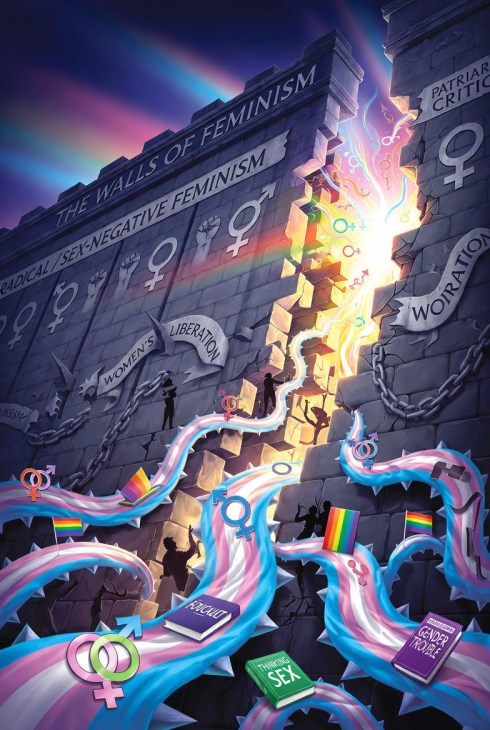
That is how organizations founded to defend women ended up defending males in women’s spaces while calling it liberation. They had trained themselves to treat coalition belonging as moral proof, so when the coalition turned against sex-based rights, too many lacked either the nerve or the language to resist.
This matters because gender ideology did not win by argument alone. It won through institutions. HR departments, schools, medical bodies, activist organizations, media outlets, professional regulators, and law all played their parts. Queer theory supplied much of the more radical conceptual machinery. Bureaucracy turned it into policy. Social media turned dissent into reputational danger.
But some feminist concepts weakened the walls before the push came.
That is the uncomfortable part.
The tragedy is that many women saw the danger early and were told to shut up by institutions claiming to speak for them. They were not confused, hysterical, or hateful for noticing that sex-based rights require sex-based categories. They were pointing at the load-bearing wall while the renovation crew was already swinging hammers.
The repair begins with honesty.
Women are female humans. Sex is real. Sex roles are not destiny. Biology is not oppression. Lived experience matters, but it does not outrank evidence. Coalitions are useful only while they remain answerable to reality.
This is not an argument against women’s rights. It is an argument against refusing to audit the theories that claimed to speak for women.
Feminism does not have to accept hostile caricatures of itself. But it does have to face the places where its own language, assumptions, and institutional loyalties were turned against its central subject.
Test the claim. Follow the mechanism. Face the consequences.
This is what we are going up against. The primacy of stand-point epistemology(1) versus the common reality we all share is huge barrier to overcome as any sort of argument of discussion can be had. I think this is the situation that we have to prepare for when dealing with people who have been knowingly or unknowingly indoctrinated into a Critical Theory (2) mind-set.
The ‘social workers’ failed on every level to even engage in a substantive dialogue with Peter Boghossian. What was demonstrated in their failure to engage with Dr.Boghossian was an unwillingness to think outside their ideological box – they had the right answers – just count how many times the words “triggered” was used. These are proto-professionals who cannot engage with ideas that do not match their own. It’s completely fucking scary.
(1) – In summary, standpoint epistemology (and related identity-based epistemologies) are a complicated and widely discredited way to create and justify a kind of gnosticism around critical conceptions of identity and the relevant power dynamics in society. In practice, this typically means it is yet another justification within Theory for only people who agree with Theory to be considered knowledgeable authorities, which is then used to silence opposition and install “professionals” in positions of authority and power based on group identity alone—or, almost alone, as such people tend to have to present a critical consciousness, i.e., be woke Critical Social Justice activists, as well (see also, diversity and inclusion).
(2) – Max Horkheimer defined a “Critical Theory” in direct opposition to a “Traditional Theory” in a 1937 piece called Traditional and Critical Theory. Whereas a Traditional Theory is meant to be descriptive of some phenomenon, usually social, and aims to understand how it works and why it works that way, a Critical Theory should proceed from a prescriptive normative moral vision for society, describe how the item being critiqued fails that vision (usually in a systemic sense), and prescribe activism to subvert, dismantle, disrupt, overthrow, or change it—that is, generally, to break and then remake society in accordance with the particular critical theory’s prescribed vision. This use of the word “critical” is drawn from Marx’s insistence that everything be “ruthlessly” criticized and from his admonition that the point of studying society is to change it. Of note, then, a Critical Theory is only tangentially concerned with understanding or truth and has, as Hume might have it, abandoned descriptions of what is in favor of pushing for what the particular critical theory holds ought to be. The critical methodology, then, is the central object of concern, and it is the tool by which Social Justice scholarship and activism proceed.











 bleatmop
 Mystro
 The Arbourist


 Dead Wild Roses
Your opinions…