
Gender ideology did not arise because women demanded equality. That charge is lazy, and more importantly, false.
Women wanting legal equality, bodily safety, political representation, equal pay, and freedom from male coercion did not cause male people to be admitted into women’s sports, prisons, shelters, changing rooms, or lesbian dating spaces. Ordinary feminism is not responsible for male opportunism. Men who exploit weak boundaries do not need a seminar in feminist theory before trying the door.
But institutions are different. They often need language, policy frameworks, and moral justifications before they surrender boundaries they once understood perfectly well.
That is where the harder question begins.
Some ideas developed inside feminist theory helped create vulnerabilities that gender ideology later exploited. This is not the same as saying feminism “caused” the problem. It is saying that ideas have consequences, including unintended ones. A concept built for one purpose can be repurposed for another; a tool designed to loosen an unjust constraint can also be used to dissolve a necessary distinction.
That is the part many people would rather not examine.
One side wants to say feminism caused the whole mess. Too crude. The other wants to say feminism had nothing whatsoever to do with it. Too convenient. The truth is less satisfying, and probably closer because of it.
Feminist credentials are not the issue here. Truth is.
Feminism makes public claims about sex, power, language, law, institutions, rights, and the body. Those claims do not become immune to scrutiny because they are made in the name of women, and criticisms do not become invalid because of who makes them. A serious movement should want its ideas tested. If an argument is wrong, answer it: show the missing evidence, the bad inference, the false premise.
Dismissing criticism through identity-checking is not analysis. It is a way of avoiding analysis.
Oddly enough, that should be a feminist point. If feminism rejects reducing people’s minds to their sex, then sex cannot become a veto when the argument becomes inconvenient.
The first mechanism was the separation of sex from gender.
At its best, this distinction did useful work. Being female does not require liking pink, wanting babies, wearing dresses, being passive, or arranging your personality around male approval. Feminists were right to attack those scripts. Biology is real, but sex roles are not destiny.
The danger was not the distinction itself. The danger came when gender stopped meaning “social expectations imposed on sex” and started meaning an inner truth separable from sex. Once that shift happened, the old feminist critique became available for a very different project. What began as an attack on stereotypes could now be used as a theory of identity overriding the body.
The second mechanism was social constructionism.
There was a legitimate insight here too. “Womanhood” has always carried social meanings layered on top of female biology. Societies attach expectations to women’s bodies, labour, sexuality, motherhood, modesty, obedience, beauty, and public authority. Feminism needed language for that. It needed to be able to say: these rules are not nature. They are social arrangements, and they can be challenged.
Fair enough.
The problem came when the analysis slid from “many meanings attached to sex are constructed” into “sexed categories themselves are political constructs.” That is a very different claim. If womanhood is primarily a social role, discourse, or identity, then why can’t a male person enter it by declaration?
That question did not appear from nowhere. The ground had been softened.
The third mechanism was suspicion of biology.
Feminists had good historical reasons to distrust biological arguments. “Nature” has been used to deny women education, property rights, professional status, sexual autonomy, and political authority. Biology was often weaponized as destiny, so the suspicion was not irrational.
But rejecting biological determinism is not the same thing as rejecting biological reality.
Women are not oppressed because they like dolls, fail to “lean in” properly, or possess some mystical feminine essence. Women are vulnerable as a class because female bodies matter materially. Pregnancy, birth, lactation, menstruation, physical vulnerability, reproductive control, and male sexual access are not floating social metaphors; they are part of the material reality around which women’s oppression has historically been organized.
A feminism that cannot say “female” without flinching cannot defend women.
The fourth mechanism was standpoint hardening.
“Listen to women” is good advice. Women know things about harassment, fear, pregnancy, exclusion, motherhood, male violence, and sex-based vulnerability that cannot be captured from a distance. Lived experience matters because it can reveal what abstract theory misses.
But experience is evidence, not sovereignty.
A useful corrective hardens into a veto when “listen to women” becomes “you cannot question this because you are not one of us.” At that point, the claim is no longer being tested. The speaker’s credentials are checked, the conclusion is presumed, and the disagreement is treated as a social violation.
This is also where the overlap with gender activism becomes hard to miss.
Gender activists often do not answer objections; they rename them. “Bigotry,” “erasure,” “literal violence,” “no debate,” and “trans women are women” can all describe real things in some contexts. The issue is not whether the words are always false. The issue is what happens when they are used as substitutes for argument.
Then they do not test a claim. They quarantine it. The person raising the objection is not answered; they are placed outside the moral community.
The same habit appears whenever feminist criticism is rejected because of who made it rather than what was said. Maybe the argument is wrong. Then show where. But identity does not settle the question. Evidence does.
The fifth mechanism was coalition loyalty.
Many feminist institutions embedded themselves inside broader progressive coalitions. That brought energy, money, institutional access, and moral prestige, but it also created a loyalty problem. Once gender identity became a sacred progressive cause, dissent became dangerous.
Women who objected were not answered. They were branded as bigots, fascists, transphobes, unsafe women, right-wing collaborators, or whatever label was most useful that week.
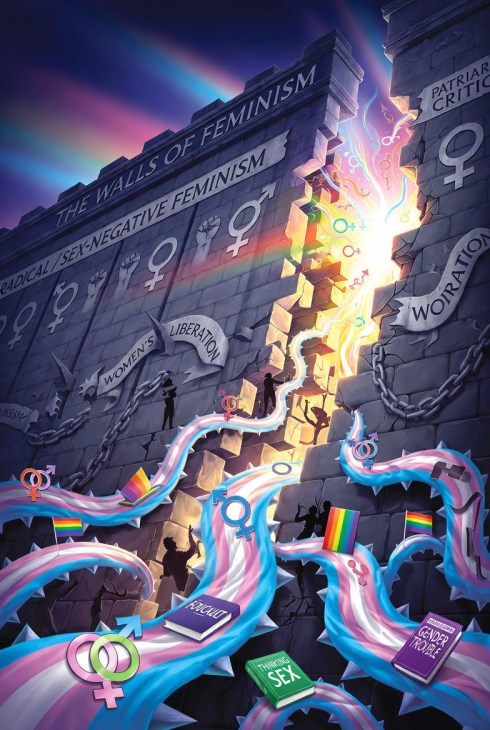
That is how organizations founded to defend women ended up defending males in women’s spaces while calling it liberation. They had trained themselves to treat coalition belonging as moral proof, so when the coalition turned against sex-based rights, too many lacked either the nerve or the language to resist.
This matters because gender ideology did not win by argument alone. It won through institutions. HR departments, schools, medical bodies, activist organizations, media outlets, professional regulators, and law all played their parts. Queer theory supplied much of the more radical conceptual machinery. Bureaucracy turned it into policy. Social media turned dissent into reputational danger.
But some feminist concepts weakened the walls before the push came.
That is the uncomfortable part.
The tragedy is that many women saw the danger early and were told to shut up by institutions claiming to speak for them. They were not confused, hysterical, or hateful for noticing that sex-based rights require sex-based categories. They were pointing at the load-bearing wall while the renovation crew was already swinging hammers.
The repair begins with honesty.
Women are female humans. Sex is real. Sex roles are not destiny. Biology is not oppression. Lived experience matters, but it does not outrank evidence. Coalitions are useful only while they remain answerable to reality.
This is not an argument against women’s rights. It is an argument against refusing to audit the theories that claimed to speak for women.
Feminism does not have to accept hostile caricatures of itself. But it does have to face the places where its own language, assumptions, and institutional loyalties were turned against its central subject.
Test the claim. Follow the mechanism. Face the consequences.











 bleatmop
 Mystro


 Dead Wild Roses
Leave a comment
Comments feed for this article