
You are currently browsing the tag archive for the ‘Mark Carney’ tag.
 If you supported Mark Carney because you believed Canada needed steady economic leadership, that was not an irrational choice.
He entered office during a serious trade conflict with the United States. Tariffs, threats and uncertainty weakened exports, discouraged investment and made long-term planning more difficult. Canada’s economic problems were not created by one prime minister, and they cannot be solved by one speech or budget.
Carney therefore deserves to be judged fairly.
But fairly does not mean uncritically.
A recent Nanos poll found that 60 per cent of Canadians believe Carney has done a good or very good job handling the economy, while only 24 per cent rate his performance as poor or very poor. That confidence exists despite real GDP shrinking by approximately 0.05 per cent during his first year—the weakest first-year result for a Canadian prime minister since comparable records began in 1963.
That historical comparison is striking, but it should not be treated as a final verdict.
Aggregate GDP has also been restrained by slower population growth. In the first quarter of 2026, total real GDP was unchanged, but real GDP per person rose by 0.2 per cent because Canada’s population declined. Comparing prime ministers who governed during very different rates of population growth is therefore not entirely apples to apples.
Nor does the poll necessarily prove that Liberal voters have been dazzled by Carney’s résumé.
Many may be judging him against the circumstances he inherited. They may believe he is managing a bad hand competently, even though the economy remains weak. That is a defensible position.
But the benefit of the doubt is not the same as a demonstrated economic record.
The record is mixed
Canada is not clearly in recession. The Bank of Canada has said so directly. More than half of industries were still growing, and recent data suggested that economic growth was beginning to resume. Consumer spending remained resilient, while some business surveys showed improving investment and hiring intentions.
Those facts matter. An honest assessment should include them.
But the broader picture remains weak. Real GDP was unchanged in the first quarter after declining 0.2 per cent in the final quarter of 2025. Final domestic demand edged down 0.1 per cent. Business capital investment fell another 0.7 per cent—its fifth consecutive quarterly decline—and residential investment fell by 2 per cent.
There were promising details beneath those numbers. Investment increased in machinery and equipment, software, mineral exploration and non-residential buildings. Those may be early signs of the more productive economy Carney says he wants to build.
But they are not yet evidence that the transformation has occurred.
The Bank of Canada’s own assessment is appropriately restrained: the economy remains weak, is operating below its potential and contains significant labour-market slack, even as some indicators begin to improve.
That is not an economic catastrophe.
It is also not an economic triumph.
Carney asked to be judged on delivery
Carney has presented his government as one that will attract investment, build major projects, diversify Canadian trade and make the country more economically independent.
Those goals are sensible. They may also take years to achieve.
But that makes it especially important to distinguish between a policy announcement and an economic result.
A project announced is not necessarily a project financed. A project approved is not necessarily a project built. Public spending is not automatically productive investment. A government can describe itself as ambitious without having changed the underlying economy.
Carney’s supporters should therefore ask clear questions.
Is total private investment rising over several quarters? Are major projects moving from consultation and approval into construction? Is productivity improving? Is real GDP per person recovering consistently rather than for a single quarter? Are Canadian businesses finding substantial new markets outside the United States? Are wages and disposable incomes rising after inflation?
Those are not Conservative questions.
They are the questions any economically serious government should be required to answer.
Support should remain conditional
Liberal voters do not need to abandon Carney simply because his first-year growth record is poor. They do not need to pretend that Donald Trump’s trade policies are irrelevant, or blame Ottawa for every economic difficulty.
Carney may be managing an extremely difficult situation competently. He may be laying foundations whose value will become visible only later.
But “may” is doing important work in those sentences.
A plausible strategy is not a completed achievement. A sophisticated explanation is not economic growth. Credentials can justify giving a leader responsibility; they cannot prove that he has used it successfully.
Carney has earned time to demonstrate that his plans can raise investment, productivity and Canadian living standards.
He has not yet earned a declaration of economic success.
Supporting a government should not mean protecting it from measurement. Serious support should be conditional: tied to clear standards, observable outcomes and a willingness to acknowledge when promises have not become reality.
Mark Carney may deserve the benefit of the doubt.
He does not deserve exemption from the burden of proof.
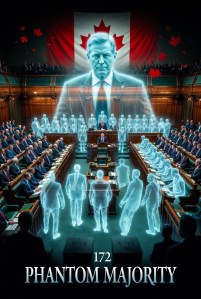
Mark Carney is on the verge of a majority government. Not through an election, but through parliamentary drift—floor crossings, seat math, timing.
There is nothing illegitimate about this. Canada’s system allows it. MPs are not bound to their parties, and governments rise or fall on confidence, not sentiment. This is how the machine is designed to work.
But design is not the same as meaning.
A majority government is not just a number. It is a signal—of public consent, of direction, of political momentum. When that signal comes from an election, it carries weight. When it emerges mid-cycle, assembled rather than won, it carries ambiguity. The risk is not how the majority is formed. The risk is how it is interpreted.
This is where mandate inflation creeps in.
A government that reaches majority status without facing voters may begin to act as though it has received a fresh endorsement. It hasn’t. It has acquired power within the rules, but without a reset of public consent. That distinction matters, especially when decisions carry long time horizons or high political cost.
None of this requires outrage. It requires discipline. A government in this position should govern with an awareness of how it arrived where it is—carefully, incrementally, and with an eye toward legitimacy, not just legality.
Because the test is not whether the system allows it.
The test is whether the public continues to accept what follows.











 bleatmop
 Mystro


 Dead Wild Roses
Your opinions…