
You are currently browsing the tag archive for the ‘Housing Crisis’ tag.
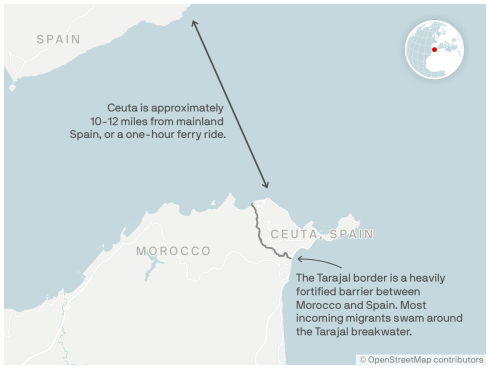
About 50,000 people crossed illegally from Morocco into the Spanish territory of Ceuta within two days. Most were young Moroccan men, although women, children and other nationalities were also present. At least 67 people died, while more than 48,000 returned after discovering that Ceuta did not provide an open route into mainland Europe.[1]
Whether one calls this an invasion, a migration crisis or a mass border breach, the underlying principle should not be controversial: a sovereign country must be able to decide who enters, in what numbers and under what conditions.
Immigration can be enormously beneficial. Canada’s traditional system was built around that recognition. It was not perfect, nor was every immigrant selected solely for economic potential, but it generally combined skilled immigration, family reunification and humanitarian obligations within controlled annual limits. Canada admitted approximately 260,000 permanent immigrants in 2014.[2]
By 2024, permanent admissions had risen to nearly 484,000. More consequentially, temporary residents had grown from 3.3 per cent of Canada’s population in 2018 to 7.5 per cent in 2024. Even the federal government eventually acknowledged that this unprecedented increase was placing pressure on housing, health care and schools.[3]
Most of these newcomers did not enter Canada illegally. That distinction matters. Canada’s failure was largely self-inflicted: governments expanded legal and temporary pathways without ensuring that housing, infrastructure and public services could absorb the resulting population growth. The Bank of Canada observed that vacancy rates began falling shortly after immigration increased in 2015 because housing construction failed to keep pace.[4]
That is not the fault of immigrants who accepted Canada’s invitation. It is the fault of governments that treated intake targets as statements of virtue rather than practical commitments requiring homes, doctors, classrooms and public consent.
A just immigration system must account for three parties: those hoping to immigrate, those who followed the rules and were admitted, and the citizens whose country is receiving them. Uncontrolled illegal entry cheats lawful applicants. Excessive legal intake strains communities and leaves newcomers competing for scarce housing and services. Refusing to discuss either problem eventually destroys public confidence in immigration itself.
Strong borders are therefore not contrary to compassion. Clear rules, enforceable limits and admissions kept within a country’s plausible capacity are what allow immigration to remain fair, beneficial and politically sustainable. Capacity can never be calculated perfectly, but uncertainty is not an excuse to ignore obvious strain.
A country that cannot—or will not—decide who may enter is not practising generosity. It is surrendering the conditions that make generosity possible.
References
- Reuters, “Spain installs floating barrier in Ceuta after calm night following border rush,” August 1, 2026.
https://www.reuters.com/world/europe/spain-installs-floating-barrier-ceuta-after-calm-night-following-border-rush-2026-08-01/ - Statistics Canada, “Permanent and temporary immigration to Canada from 2012 to 2014.”
https://www150.statcan.gc.ca/n1/pub/91-209-x/2016001/article/14615-eng.htm - Immigration, Refugees and Citizenship Canada, “2025 Annual Report to Parliament on Immigration.”
https://www.canada.ca/en/immigration-refugees-citizenship/corporate/publications-manuals/annual-report-parliament-immigration-2025.html - Bank of Canada, “Immigration, housing and the outlook for inflation,” December 7, 2023.
https://www.bankofcanada.ca/2023/12/economic-progress-report-immigration-housing-outlook-inflation/
Canada’s ruling class has become very good at sounding compassionate while making the country less livable.
That is not the same as saying compassion is the problem. It is not. A decent country should care about fairness, dignity, historical wrongs, clean air, decent schools, housing, wages, and whether ordinary people can build a stable life. The problem begins when the language of care becomes a substitute for competence.
The road does not get built, the house does not get approved and mysteriously the paycheque does not stretch.
But the statement was inclusive, the framework was equitable, and the branding was excellent.
This is the Canadian disease in its current form. We have become fluent in the language of public virtue while becoming strangely incompetent at the material tasks that make public virtue affordable. Productivity is weak. Housing is absurdly expensive. Infrastructure is strained. Governments borrow more to deliver less. Businesses hesitate to invest. Young people look at the cost of living and quietly revise their expectations downward.
None of this is caused by slogans alone. Canada’s problems are real and structural: regulatory drag, housing bottlenecks, capital trapped in real estate, public-sector risk aversion, interprovincial barriers, immigration levels that outran housing and infrastructure capacity, and a political class allergic to trade-offs. A land acknowledgement did not create all that. A diversity statement did not single-handedly break productivity.
But symbolic politics gave our institutions a prettier way to avoid the problem.
 Once a government, university, corporation, or bureaucracy learns to measure moral posture more eagerly than delivery, failure becomes easier to disguise. The meeting had the right language. The report had the right vocabulary. The procurement process had the right values. The strategy document had the right tone. Meanwhile, the project slipped, the costs climbed, the housing never arrived, and the public was asked to admire the intentions.
Serious societies argue about trade-offs. They ask what a policy costs, who pays, what it produces, and whether the promised benefits are worth the burden. Unserious societies turn every hard question into a morality play. If you ask whether immigration levels are matched to housing, schools, health care, and infrastructure, you are accused of cruelty. If you ask whether a project approval process has become impossible to navigate, you are accused of hating the environment. If you ask whether equity metrics are displacing competence, you are told the question itself is suspicious.
That trick works for a while. It flatters the people using it. It turns arithmetic into moral failure and makes practical objections look ugly. But reality is not impressed by compassionate branding.
A country cannot announce its way out of weak productivity. It cannot consult its way into affordable housing. It cannot regulate its way into abundance while making useful work slow, expensive, and politically hazardous. It cannot keep treating prosperity as an inheritance while sneering at the habits that created it.
Canada does not need to abandon moral language. It needs to demote moral theatre. Justice matters, but so does delivery. Compassion matters, but so does arithmetic. Environmental stewardship matters, but so does affordable energy. Inclusion matters, but so does the basic ability to build homes, roads, businesses, and lives.
The country does not need another sermon about who we are, but rather Canadians need evidence that we can still do useful things.
Prosperity is built, measured, maintained, and defended. A country that forgets this can still sound compassionate while becoming poorer, slower, more indebted, and harder to live in.

Seven-year-old Ferlin Iahtal lies in his home-made bunk bed in his home in Attawapiskat on Dec. 17. Twenty-one people live in the house that has plastic on the ceilings to stop water leaks.
Canada’s active neglect of the First Nations continues. Under the heavy mantle of the oppressive Harper regime minority groups and those concerned with justice should be prepared to take a pass until the current regime of plutocratic conservative troglodytes have been put out to pasture. Harper intends to meet with First Nations leaders again, to discuss land use, resource revenue and living conditions for Canada’s first peoples.
“More than 400 aboriginal chiefs will meet Stephen Harper, the Canadian prime minister, and government ministers at a summit known as the Crown-First Nations Gathering in Ottawa. It is the first official meeting of its kind since he took office in 2006. The aim is to improve the relationship between the Canadian government and what is known as Canada’s First Nations communities. That relationship stalled six years ago when the current Conservative government abandoned a five-year, $5bn plan known as the Kelowna Accord.”
Stalled is quite the understatement as First Nations concerns were unceremoniously kicked to the curb by the Conservative government.
“Resolving outstanding land claims is among the top priorities. Aboriginal leaders feel the current process of settling the claims unjustly favours the federal government.
Also high on the list of priorities is economic development. First Nation leaders want to secure a fair share of revenues from the exploitation of natural resources on aboriginal lands. And on health and education, most First Nation leaders will be pressing for a commitment to levels of funding and services comparable with those for non-aboriginal communities.”
Nothing unreasonable here, just people wanting to take part in the prosperous 1st world nation Canada is. A world that has, for the most part, been denied to First Nations people.
Meanwhile, the Canadian government is increasingly coming into conflict with the needs of First Nations communities as it promotes the extraction of oil and other natural resources. A diamond mine projected to become one of the richest in the world is just upstream from the poverty-stricken town of Attawapiskat on James Bay. The mine is on traditional lands, but the royalties flow to the province.

A puppy sits on the porch of a home in Attawapiskat. Inside, the home has no plumbing or sanitation facilities.
That town also made headlines recently over living conditions when it was found that people were living in tents, shacks and trailers in temperatures of minus 20 degrees Celsius. Charles Angus, a member of parliament representing James Bay, describes the conditions within several of the First Nation communities as an “international disgrace for our nation”. He[Charles Angus] tells Inside Story: “The Attawapiskat crisis certainly shook Canada. In a way it has been our Katrina moment because Canadians were shocked that people were living in such dire conditions but then also shocked that the government had no plan, no seeming interest to respond.”
Racism is alive and well in Canada as we continue to neglect our First Nations and keep them impoverished and on the margins of society.
“Canada not only created these reserves, they displaced First Nation’s laws with provincial child welfare, education and health laws that should apply to all Canadians. The result is most horribly experienced by children. One-in-six First Nations communities don’t even have the basics like water; some of them are using buckets for sewers. The list goes on and it is unacceptable in a wealthy country like ours, and completely preventable.”
-Cindy Blackstock from the First Nations Child and Family Caring Society of Canada
We still have far to go on improving our own imperialist record, mending decades of neglect is going to be a huge project, one that is unlikely to be undertaken by the current Conservative Government of Canada.











 bleatmop
 Mystro


 Dead Wild Roses
Your opinions…