
You are currently browsing the tag archive for the ‘Communication’ tag.
[Note: The listening/mirroring technique here is adapted from approaches outlined in How to Have Impossible Conversations.]
Most arguments don’t fail because one side is wrong.
They fail because neither side is actually listening.
What passes for debate is often parallel monologue: each person waiting for their turn to correct, reframe, or condemn. The collapse happens early—sometimes before the first real claim is even made. A label is applied, a motive is assigned, a conclusion is declared. The exchange ends before it begins.
If you can get past that—and sometimes you can—there is a simple discipline that changes the quality of the conversation.
It feels slow.
It feels like you’re giving something up.
It works.
The Three-Step Method
1. Listen Without Drafting Your Rebuttal
This is the constraint.
When you disagree, your mind races ahead. You start assembling the counter while the other person is still speaking. You catch fragments, miss structure, and fill the gaps with what you expect them to say.
That is how you end up arguing with a version of their position that exists mostly in your own head.
If you want a real exchange, you have to let the argument land in full before you touch it.
2. Mirror the Argument Back
Once they’ve finished, restate their position in your own words:
“If I’ve got you right, you’re saying…”
This is not a rhetorical move. It is a calibration step.
You’re trying to capture the claim, the mechanism, and the stakes as you understand them—not a weaker version, not a cleaner version, but the version you think they actually mean.
3. Ask for Confirmation
Then check it:
“Is that a fair representation?”
If they say yes, you now share a starting point.
If they say no, you’ve just prevented a wasted argument.
Either way, you’ve improved the conversation.
Why This Works
Most arguments fail at the level of misunderstanding, not disagreement.
People talk past each other, attack softened targets, and leave thinking they’ve won. What they’ve done is avoid contact.
Mirroring forces contact.
It aligns the map before you start fighting over the territory.
The Cost
It is slower than trading blows.
It feels like conceding ground.
And it requires a small act of restraint: you prioritize their clarity before your correction.
That runs against instinct, especially when you’re confident they’re wrong.
The Payoff
When you mirror someone accurately, two things happen:
- Their defensiveness drops because they’ve been understood
- Your criticism lands because it targets their actual position
Now the disagreement can do useful work.
Not louder. Not sharper.
Just accurate.
Verdict
Arguing is an art.
But listening—disciplined, deliberate, and verified—is the condition that makes the art possible.
Without it, you’re not debating.
You’re performing.

You can usually tell what kind of argument you’re about to hear before the argument is made.
It’s in the language.
Certain words don’t just describe reality—they quietly reframe it, often in ways that make disagreement harder before it even begins. They shift the ground you’re standing on, sometimes without you noticing.
Once you recognize them, the pattern becomes difficult to miss.
“By the time the argument begins, much of it has already been decided.”
Here are a few to listen for.
“Lived experience”
Often used to elevate subjective accounts above other forms of evidence.
Experience matters. But when it becomes the final authority, it can no longer be questioned or compared. At that point, it stops being evidence and becomes a conclusion.
“Social construct”
A useful concept in limited contexts. Overextended, it suggests that because something is shaped by society, it is therefore arbitrary or infinitely malleable.
The move is subtle: from influenced by culture to not anchored in reality at all.
“Harm”
A word that has expanded far beyond physical or material damage.
Disagreement, discomfort, or perceived invalidation can all be folded into it. Once that happens, ordinary debate starts to look like misconduct.
“Equity”
Not the same as equality.
It shifts the focus from equal rules to equal outcomes. That shift often justifies unequal treatment in the name of correcting disparities.
“Centering” / “Decentering”
Signals who is allowed to speak, and whose perspective is treated as primary.
Less about argument, more about managing whose voice carries authority.
“Problematic”
A soft accusation that avoids specificity.
It implies wrongdoing without clearly stating what the problem is, which makes it difficult to respond directly.
“Safe spaces”
Originally about protection from harassment. Now often used to limit exposure to challenging or opposing ideas.
The definition quietly expands from safety from harm to safety from disagreement.
None of these words are inherently illegitimate. The issue is how they are used. Individually, they can be useful. In combination, they tend to narrow the space for disagreement.
When they appear together, they often shift discussion away from evidence, elevate subjective claims beyond challenge, and quietly limit what can be said without consequence. By the time the argument begins, much of it has already been decided.
When you hear language like this, a simple question is usually enough: what claim is being made—and could I reasonably disagree with it? If the answer is no, you are no longer in a normal debate. You are being asked to accept a framework, not evaluate an argument.
This pattern isn’t unique to any one ideology. It appears wherever language is used to secure agreement before the argument begins. Language doesn’t just communicate ideas—it sets the terms under which those ideas can be questioned, and sometimes whether they can be questioned at all.

A lot of arguments don’t end because someone “lost.” They end because someone drops a category word: harmful, hateful, unsafe. The conversation gets reclassified as an emergency, and suddenly you are no longer debating a claim. You are defending your right to be in the room.
If you’ve felt this happening more often lately, you’re not imagining it. The move is simple: treat disagreement as injury, then treat your refusal to retract as more injury. It’s a neat little loop. You can’t disprove it, because your attempt to disprove it is counted as part of the harm.
So the goal here isn’t to “win” every exchange. The goal is to stay clear, stay calm, and avoid being dragged into fog.
Three rules help.
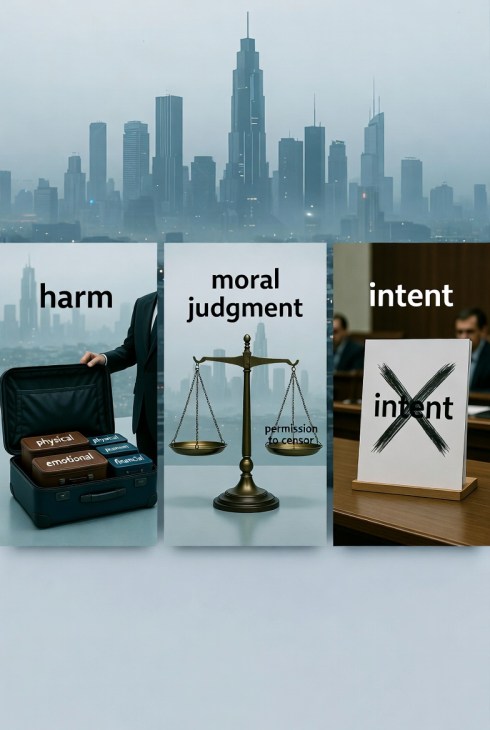
1) Ask what the harm is, mechanically
“Harm” is a suitcase word. People pack a dozen meanings into it, then wheel it around as if it’s one thing.
Don’t fight the suitcase. Open it.
Try:
-
“What kind of harm do you mean: emotional distress, social exclusion, incitement, discrimination, or something else?”
-
“What’s the actual path from my claim to the harm you’re naming?”
-
“Is the harm that you dislike the idea, or that you think it leads to a specific outcome?”
This isn’t a gotcha. It’s basic hygiene. If a person can’t tell you what they mean, you cannot respond intelligently. You’re shadowboxing.
A good rule of thumb: if they can’t name a mechanism, they aren’t making an argument. They’re placing a stop sign on the table and acting like the sign is evidence.
And notice the comfort “harm” provides. It allows someone to skip the hard part, the part where they explain why your claim is false, or why it leads to a concrete bad result. They can just announce: “That’s harmful,” and then expect you to retreat on cue.
Make them do the work. Not as punishment, but because without that work you are not in a debate. You are in a moral weather report.
2) Separate moral judgment from permission to censor
Even if a statement is rude, wrong, or ignorant, it does not automatically follow that it should be suppressed or punished.
That leap is the whole game.
You’ll notice how quickly some conversations smuggle in this assumption: if it’s harmful, it must be disallowed. But that premise is not neutral. It’s political. It’s also the premise that makes “harm” such a powerful word, because it offers a shortcut from “I condemn that” to “you don’t get to say that.”
Break the spell with a calm distinction:
-
“You’re free to think I’m wrong. That doesn’t mean you’re entitled to make me silent.”
Or softer:
-
“We can disagree strongly and still protect the right to say it.”
This forces a choice. Are they arguing that you are mistaken, or are they arguing that mistaken speech is illegitimate?
In a plural society, we tolerate a lot of speech precisely because we do not trust any faction, left or right, religious or secular, activist or corporate, to define “harm” without expanding it until it covers whatever irritates them this week.
Also: don’t let “consequences” do lazy work. Yes, speech can have consequences. So can silence. So can mandatory agreement. So can the habit of treating adults like fragile glassware.
You can live in a world where people criticize each other sharply. That’s normal. What you cannot do, without slowly breaking civic life, is turn moral condemnation into a veto.
Criticism is fair game. Coercion is not.
3) Don’t get trapped in intent court
When someone says “That’s hateful,” they often mean: “Your intent must be hateful.”
Now you’re in a trial about your inner motives, which is the safest place for them. It’s unfalsifiable. You can’t prove you don’t hate. They can’t prove you do. But they can keep you stuck there forever while the original claim remains untouched.
So: state your intent once, briefly, then return to the claim.
A template that works:
-
“My intent isn’t to attack anyone. The claim is X. If X is wrong, show me where.”
That’s it. One sentence of intent, then substance.
If they refuse and keep circling back to your hidden motives, set a boundary:
-
“If your position is that disagreement equals hate by definition, then there isn’t a debate to have.”
This is not escalation. It’s diagnosis. Because at that point the argument is no longer about facts, reasons, or tradeoffs. It’s about social control: the category word has been used to declare you out of bounds, and your only permitted move is submission.
The point of the exercise
The goal isn’t to dunk on people. It’s to keep the conversation from being hijacked by fog words and moral shortcuts.
So:
-
Define the harm (mechanism, not mood).
-
Separate judgment from censorship (criticism isn’t a veto).
-
Refuse the intent trap (claims, not soul-reading).
If they can engage those terms, you might actually have a discussion. If they can’t, you’ve learned something useful. You learned it without flailing, apologizing for existing, or agreeing to a vocabulary designed to make debate impossible.
And that, in 2026, is already a small victory.
A divorce lawyer is a relationship mechanic.
Wedding planners see shiny new cars. Divorce lawyers see the breakdowns—where things start to strain, where small ignored problems become system failures, where “it happened so suddenly” is almost never true.
In a recent conversation, divorce lawyer James Sexton (25+ years in the trenches) kept returning to one blunt idea:
Most marriages don’t end in a single explosion. They end by dehydration.
People stop paying attention. They stop doing what made their partner feel seen. Resentment piles up quietly. Then one day it looks “sudden,” but it wasn’t. It was slow… then all at once.
So the goal isn’t grand romance. It’s maintenance. And maintenance is unsexy—right up until it saves you.
Here are ten lessons worth stealing.
1) Pay attention like it’s alive
The fastest route to divorce isn’t one dramatic betrayal. It’s the belief that “we’re married now, so we’re good.”
Marriage isn’t a trophy you put on a shelf. It’s a living thing. If you stop tending it, it doesn’t stay “fine.” It withers.
Try this: do one small “I see you” action every day—thank you, a compliment, a quick note, a small touch, a check-in.
2) Keep doing the “dating behaviors”
Early on, you pursued. You were curious. You made effort. You were interested—and interesting.
Then life arrives: work, kids, exhaustion, routines. Couples treat courtship like a one-time entrance fee instead of the ongoing engine of closeness.
The boring truth is also the saving truth:
the behaviors that “won” your partner are the behaviors that keep your partner.
Try this: once a week, do something you would’ve done when you were trying to impress them—plan something, initiate, make it clear they’re still chosen.
3) Break the spiral before it becomes your normal
A lot of unhappy marriages get stuck in loops that feel logical from the inside:
- “You don’t want me.”
- “I don’t want you because you don’t seem to like me.”
- “I don’t seem to like you because we’re never close.”
- “We’re never close because life is chaos.”
Eventually you land in the worst place: both people feel justified, and both feel lonely.
The key insight: spirals can be reversed with the same simplicity that created them.
Not by “winning” an argument, but by shifting the emotional direction.
Try this: be the first person to do the generous thing—kindness, help, warmth—before you feel like you’ve “earned” it.
4) Talk when it’s smoke, not fire (“hit send now”)
A common divorce pattern is small grievances saved up until they become ammunition. Then one day you’re fighting about something ridiculous… and suddenly it’s about ten years of unresolved hurt.
Sexton’s advice is to speak early—before the issue becomes a story you tell yourself.
It doesn’t have to be a confrontation. It can be a calm check-in.
Try this:
“Small thing: when you said X, it sat weird with me. I might be misreading it, but I wanted to check.”
5) Frame complaints as longing, not prosecution
The same concern can either invite closeness or trigger defense.
- “We never have sex.”
vs - “I miss feeling close to you.”
One is a charge sheet. The other is a bid for connection.
People can fight accusations. It’s harder to fight honest longing.
Try this: translate “you never” into “I miss…” and “I want…”
6) Praise isn’t fluff—it’s preventative medicine
Many people treat compliments as optional. Then they wonder why warmth dries up.
Appreciation is not a “nice extra.” It’s lubrication for the whole machine. It’s how you stay emotionally fed in the middle of real life.
Try this: one specific compliment per day. Not “you’re great,” but:
“I loved how you handled that.”
“You looked amazing today.”
“I felt proud standing beside you.”
7) Treat money secrecy as a real betrayal
Sexton emphasizes that “financial betrayal” ends a lot of marriages: hidden debt, secret spending, stability that turns out to be a house of cards.
It’s not the dollars that destroy trust. It’s the deception—the feeling that you were not a teammate.
Try this: make money boring and routine: a monthly check-in on spending, debts, goals, and anxieties. No drama. Just truth.
8) Expect stress gates—and navigate them together
Relationships strain at predictable transition points:
- a new baby
- kids becoming less dependent
- career shifts
- bodies aging
- midlife “is this it?” questions
- empty nest
The failure mode is drift: two people building separate lives under one roof.
Try this: name the transition out loud:
“We’re entering a new phase. How do we protect us inside it?”
9) Social media can quietly poison gratitude
Sexton’s line is memorable: social media is often “everyone’s greatest hits while you live your gag reel.”
If you scroll passively, you absorb the message that everyone else’s life is easier, sexier, more exciting—and that your relationship is uniquely flawed.
This isn’t moral panic. It’s attention economics: what you stare at trains your desires and your dissatisfaction.
Try this: curate aggressively. Feed the content that strengthens your bond. Starve the content that erodes it. If you can’t do that, limit the exposure.
10) The hard thing and the right thing are usually the same
When people drift toward cheating or quitting, the clean move is not secrecy. It’s honesty while there’s still time.
Something like:
“We’re far apart. I’m lonely. I’m tempted. Can we fix this—together?”
That conversation is terrifying. It is also the one that keeps your integrity intact—and often saves the marriage before it crosses lines you can’t uncross.
Try this: don’t romanticize “the drift.” Name it early.
A simple weekly ritual (10 minutes)
If you want one habit instead of ten ideas, steal this:
- One appreciation: “This week I felt loved when you…”
- One repair: “This week I felt a sting when…”
- One desire: “This week I’d love more…”
- One plan: “This week, let’s protect time for us on…”
Short. Regular. Honest.

The quiet thesis
Most marriages don’t die from one villainous act. They die from inattention + unspoken resentment + unmanaged transition—and then, eventually, the predictable betrayals that follow disconnection.
The fix is not constant fireworks.
It’s steady proof—small, consistent proof—that your partner is still chosen.
Water the plant. Before it looks dead.











 bleatmop
 Mystro


 Dead Wild Roses
Your opinions…