
You are currently browsing the category archive for the ‘Politics’ category.
Canada’s ruling class has become very good at sounding compassionate while making the country less livable.
That is not the same as saying compassion is the problem. It is not. A decent country should care about fairness, dignity, historical wrongs, clean air, decent schools, housing, wages, and whether ordinary people can build a stable life. The problem begins when the language of care becomes a substitute for competence.
The road does not get built, the house does not get approved and mysteriously the paycheque does not stretch.
But the statement was inclusive, the framework was equitable, and the branding was excellent.
This is the Canadian disease in its current form. We have become fluent in the language of public virtue while becoming strangely incompetent at the material tasks that make public virtue affordable. Productivity is weak. Housing is absurdly expensive. Infrastructure is strained. Governments borrow more to deliver less. Businesses hesitate to invest. Young people look at the cost of living and quietly revise their expectations downward.
None of this is caused by slogans alone. Canada’s problems are real and structural: regulatory drag, housing bottlenecks, capital trapped in real estate, public-sector risk aversion, interprovincial barriers, immigration levels that outran housing and infrastructure capacity, and a political class allergic to trade-offs. A land acknowledgement did not create all that. A diversity statement did not single-handedly break productivity.
But symbolic politics gave our institutions a prettier way to avoid the problem.
 Once a government, university, corporation, or bureaucracy learns to measure moral posture more eagerly than delivery, failure becomes easier to disguise. The meeting had the right language. The report had the right vocabulary. The procurement process had the right values. The strategy document had the right tone. Meanwhile, the project slipped, the costs climbed, the housing never arrived, and the public was asked to admire the intentions.
Serious societies argue about trade-offs. They ask what a policy costs, who pays, what it produces, and whether the promised benefits are worth the burden. Unserious societies turn every hard question into a morality play. If you ask whether immigration levels are matched to housing, schools, health care, and infrastructure, you are accused of cruelty. If you ask whether a project approval process has become impossible to navigate, you are accused of hating the environment. If you ask whether equity metrics are displacing competence, you are told the question itself is suspicious.
That trick works for a while. It flatters the people using it. It turns arithmetic into moral failure and makes practical objections look ugly. But reality is not impressed by compassionate branding.
A country cannot announce its way out of weak productivity. It cannot consult its way into affordable housing. It cannot regulate its way into abundance while making useful work slow, expensive, and politically hazardous. It cannot keep treating prosperity as an inheritance while sneering at the habits that created it.
Canada does not need to abandon moral language. It needs to demote moral theatre. Justice matters, but so does delivery. Compassion matters, but so does arithmetic. Environmental stewardship matters, but so does affordable energy. Inclusion matters, but so does the basic ability to build homes, roads, businesses, and lives.
The country does not need another sermon about who we are, but rather Canadians need evidence that we can still do useful things.
Prosperity is built, measured, maintained, and defended. A country that forgets this can still sound compassionate while becoming poorer, slower, more indebted, and harder to live in.
Good intentions are not enough. That should be obvious, but much of our public life now behaves as if noble language can rescue bad thinking.
Before people declare what is compassionate, just, inclusive, hateful, dangerous, or necessary, they need some reliable way of knowing whether their factual claims are true. That order matters. If the tools used to find truth are broken, captured, or designed to protect a preferred belief from contradiction, then the moral conclusions built on top of those tools will inherit the damage.
This is not a left-wing or right-wing problem, though each side prefers noticing it in the other. The progressive version often begins with moral urgency. A policy is called compassionate, inclusive, or protective, and once that moral label is attached, factual objections start to look suspicious. Questions about consequences become “harm.” Questions about definitions become “erasure.” Questions about evidence become proof that the questioner is unsafe.
The conservative version has its own habits. A bad social trend gets folded too quickly into civilizational decline. One ugly example becomes proof of total collapse. A complicated institutional failure becomes evidence that the enemy planned the whole thing. The moral conclusion may contain some truth, but it arrives too early and then starts recruiting facts to serve it.
That is the trap. Once moral certainty arrives first, the mind stops investigating and starts defending.
You can see the pattern wherever institutions are rewarded for sounding virtuous before they are required to be accurate. A school board adopts fashionable language before asking whether the policy helps children. A medical system treats hesitation as cruelty before the long-term evidence is settled. A government describes economic pain in careful managerial terms while households are trying to make rent, groceries, debt, and wages fit inside the same month. The details differ, but the sequence is familiar: the moral frame arrives first, and the facts are invited in later as supporting cast.
A healthier public culture would ask plainer questions before the slogans begin. What is the claim? What evidence would show it is true? What evidence would weaken it? Who pays the cost if we are wrong? Are we counting those costs honestly, including the costs to people we do not like? Are we applying the same standard when the facts embarrass our own side?
Those questions are not glamorous. They do not fit neatly on a protest sign or a campaign graphic. They also do not offer the emotional satisfaction of instant righteousness. But they are the difference between thinking and performing.
This matters because moral language is powerful. It can move people to protect the vulnerable, correct injustice, and resist cruelty. But the same language can also be used to smuggle weak claims past scrutiny. Institutions have incentives to do this. Activists gain status from certainty. Bureaucracies protect themselves with approved vocabulary. Media outlets reward emotional clarity over careful qualification. Ordinary people learn, quickly enough, which questions are safe to ask in public and which ones are better saved for the parking lot.
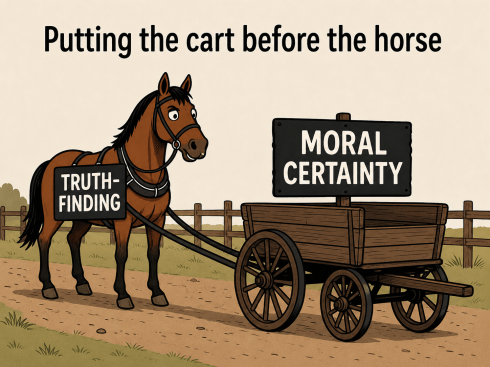
So they accept the conclusion first and hope the facts will catch up later.
They often do not.
Reality has a way of collecting unpaid debts. Bad premises eventually produce visible damage: failed policies, institutional distrust, medical scandals, economic denial, public cowardice, and citizens who no longer believe official language because they have watched it bend too many times.
The answer is not cynicism. Cynicism is often just laziness wearing a smarter jacket. The answer is better truth-finding: slower claims, clearer definitions, stronger evidence, real costs counted on both sides, and a willingness to notice when our preferred story stops matching the world.
That includes me. That includes you. That includes the people whose politics we find irritating, fashionable, smug, or deranged. Nobody gets a permanent exemption from reality because their intentions are good or their enemies are worse.
A decent society needs moral seriousness, but moral seriousness cannot mean protecting our favourite conclusions from examination. It has to mean caring enough about justice to ask whether our account of the world is actually true.
I do not especially care whether someone voted Liberal, Conservative, NDP, or something stranger from the pamphlet table. A democratic country still needs citizens who can look at reality without first asking whether the facts are useful to their team.
Canada is not in a healthy place. The economy has posted two straight quarters of contraction on an annualized basis, which is why the phrase “technical recession” has entered the conversation, even if analysts can argue over how much weight to give that label. Statistics Canada reported unemployment at 6.9% in April 2026, with youth unemployment at 14.3%. Food insecurity is harder to soften: PROOF reported that in 2024, 25.5% of people in the ten provinces lived in food-insecure households, about 10 million people, including 2.5 million children. These are not fringe complaints or partisan vibes. They are indicators of stress in the lives of ordinary people.
The point is not that every bad number belongs neatly to one party. Serious people should avoid that reflex. Some problems are inherited. Some are global. Some are structural. Some are provincial. Some are made worse by federal policy, and some are made worse by years of institutional delay, denial, or misplaced priorities. Canada’s productivity weakness, housing shortage, debt burden, immigration pressures, and affordability crisis did not arrive in one tidy partisan package. That is precisely why citizens need better habits of attention, not better excuses.
This is where media hygiene matters.

A lot of political coverage trains people to process public life through narrative before evidence. The right leader appears calm, credentialed, and respectable, so economic stress becomes “headwinds.” Stagnation becomes “uncertainty.” Failure becomes “transition.” Aggregate growth gets reported without enough attention to per-person decline. A press conference sounds adult and measured, while the household math keeps getting worse.
This problem is not confined to one side. Liberal-friendly media can soften failure when the right institutional language is being used. Conservative-friendly media can turn every bad number into proof that the apocalypse has already been scheduled. Social media rewards panic, resentment, and team loyalty. Legacy media rewards access, tone, and respectable framing. The result is a public conversation where facts often arrive already dressed for the argument someone wanted to make.
Voters participate in this too. Partisans learn to defend their side before checking the claim. Comfortable people mistake their own insulation for national health. Professionals who live inside institutional language can forget that ordinary Canadians live inside rent, groceries, wages, taxes, debt, and renewal notices, none of which become easier because the country’s managerial class found a more reassuring adjective.
A country needs some measure of optimism to function, so the answer is not theatrical despair. But optimism that cannot survive contact with the facts is closer to mood management than civic seriousness. Canadians should be able to say two things at once: yes, a leader may seem more competent than the alternative, and yes, the material indicators are still ugly. One does not cancel the other.
Political maturity begins when people stop treating bad news as betrayal. Reality does not care which party benefits from noticing it, which is precisely why noticing it remains one of the basic duties of citizenship.
A recent post from a Women’s Liberation Front activist should be read less as a complaint than as a warning about how institutions train dissenters to accept contempt as normal.
She describes years of opposing gender-identity legislation in California: travelling to Sacramento, meeting legislative offices, testifying at hearings, and trying to explain to ordinary people what the policies actually mean. Female locker rooms become mixed-sex spaces by administrative decree. Girls’ sports and girls’ boundaries become conditional. Distressed young women are placed on medical pathways that can permanently alter healthy bodies.
The remarkable part is not merely that lawmakers disagree with her. Disagreement is expected in politics. What stands out is the air of pre-judgment around the process. She writes that legislators’ offices treat these women with “barely contained disdain.” Public hearings fill with activists who regard any defence of female boundaries as proof of bigotry. The women objecting are not received as citizens raising serious concerns about privacy, safeguarding, fairness, or medical ethics. They are treated as a nuisance class: managed, endured, and socially disqualified before the argument begins.
A functioning democracy does not require lawmakers to agree with every citizen. It does require them to hear citizens as citizens. When women raise concerns about intimate spaces, parental knowledge, fair competition, or irreversible interventions on minors, the answer cannot simply be a sneer and a label. “Bigot” is not an argument. “Hate” is not a policy analysis. “Inclusion” does not magically settle every conflict between competing rights.
Institutional capture often works this way. It does not begin by winning every argument in public. It begins by deciding which arguments are permitted to count. After that, the ordinary political process becomes strangely theatrical. Hearings still happen. Citizens still line up to speak. Legislators still nod along with the solemn expressions of people performing democratic patience. But the conclusion has already been filed away. These women are not constituents with claims on representation. They are obstacles to be routed around.
“A functioning democracy does not require lawmakers to agree with every citizen. It does require them to hear citizens as citizens.”
California is an especially sharp example because its political culture is so one-sided on this issue. The institutions are not neutral referees; they have chosen a side, and women who object are expected to absorb that fact politely. Over time, this wears people down. The WoLF activist’s most revealing line is not the one about crazy legislation. It is the moment of recognition: going to Washington, D.C. reminded her how badly she had become accustomed to being treated in California.
That is what contempt does over time. It lowers your expectations. It trains you to think basic respect is a luxury. It teaches you that being ignored is normal, that being caricatured is normal, that being called hateful for stating sex-based concerns is the price of admission.
This is especially perverse when the dissenters are women defending women’s boundaries. Feminism once insisted that female privacy, bodily integrity, and protection from male entitlement mattered. Now women who make those arguments are often treated as embarrassing relics, reactionaries, or moral contaminants. The old feminist vocabulary survives, but the sex class it was built to defend has been quietly replaced by a more fashionable abstraction.
The inversion should be obvious by now. Women are told they must be compassionate while their own concerns are dismissed. Girls are told inclusion matters while fairness and privacy are negotiated away on their behalf. Parents are told to trust institutions that increasingly treat hesitation as a threat. Citizens are told democracy is sacred while lawmakers learn to ignore the public on issues where the public is far less progressive than the activist class.
“The hearings still happen. Citizens still line up to speak. But the conclusion has already been filed away.”
This is why the fight matters even when a particular bill is lost. Public opposition creates a record. It denies consensus. It tells other women they are not alone. It forces legislators to own what they are doing rather than hiding behind bureaucratic language and moral fog.
Eventually, legislators need to pay a political price for treating women this way. Not because disagreement is forbidden. Not because every feminist objection should automatically prevail. But because a political class that can dismiss women’s sex-based concerns with contempt has learned something dangerous about power: the right moral vocabulary can make ordinary citizens disappear.
Women cannot win a fight they are shamed out of entering. They cannot defend boundaries they are not allowed to name. They cannot rely on institutions that have already decided their objections are evidence of guilt.
The point is not that every battle will be won in Sacramento. Some will be lost. Maybe many. But silence is how capture becomes permanent. Visibility is how it starts to crack.

Institutional capture rarely arrives breathing fire. More often, it brings a binder, a microphone, and a schedule.
Truth is the lifeblood of any serious civilization. Not comfort, not ideological harmony, and not the temporary social peace that comes from teaching people to suppress what they can plainly see.
A society can survive mistakes. It can survive corruption. It can survive periods of confusion and even mass foolishness, provided enough people remain willing to describe reality honestly when the pressure arrives to do otherwise. What societies struggle to survive is organized dishonesty.
Reality is the brick wall waiting at the end of every false belief. You can postpone the collision for a while. You can build bureaucracies around the falsehood, invent softer language to cushion it, and punish people for pointing at the wall. The impact still comes.
That is why a recent quote from J. K. Rowling landed with such force:
“The West is currently divided between people who know he is a man and are prepared to say so and those who know this is a man but lie out of obedience to an ideology. There is no third option. Literally nobody on earth thinks ‘Roxanne Tickle’ is actually a woman.”
The quote unsettled people because it named something many Western institutions have spent years trying to blur: the widening gap between public language and private belief.
Large numbers of people now routinely say things in public that they would once have regarded as obviously false, not because the underlying biology changed, but because the social cost of dissent rose dramatically. That distinction matters, because this is not primarily a debate about kindness.
A decent society should discourage cruelty. It should not encourage humiliation, harassment, or needless malice toward people struggling with alienation, identity, or psychological distress. Most ordinary people understand this instinctively. But courtesy is not the same thing as compelled belief.
Calling someone by a preferred name is one thing. Demanding that citizens affirm propositions they do not believe to be true is something else entirely. The first is social grace. The second is ideological obedience.
 Nor is this an argument for replacing one rigid orthodoxy with another. Conservative traditions have their own temptations toward enforced piety, inherited blindness, and social punishment for inconvenient truths. Any worldview, religious or secular, progressive or reactionary, becomes dangerous when it starts protecting sacred assumptions from scrutiny. The standard cannot be nostalgia or novelty. The standard has to be reality itself: when a belief hits the brick wall, the belief must yield.
Modern Western institutions increasingly refuse to yield.
People learn quickly which observations are permitted and which ones carry risk. Teachers self-censor in classrooms. Employees rehearse approved language in HR seminars. Professionals choose silence over scrutiny. Friends whisper obvious opinions privately, then publicly perform uncertainty they do not actually feel. Entire bureaucracies now operate through euphemism, ritual language, and carefully managed ambiguity designed less to clarify reality than to avoid conflict with activist moral frameworks.
The social choreography becomes exhausting to watch because everyone notices the contradiction, while almost nobody wants to be the first person to say so aloud.
That atmosphere corrodes more than speech. It corrodes trust itself.
Once institutions begin demanding verbal loyalty to claims that large numbers of people privately reject, public language starts losing contact with reality. Words stop functioning primarily as descriptive tools and become signals of social compliance. The goal is no longer clarity. The goal is demonstrating moral alignment with the approved consensus.
History offers repeated warnings about where this habit leads. Not always to catastrophe on cinematic scales. Sometimes the damage is quieter and more banal than that. Institutions become incapable of self-correction because honest feedback becomes socially dangerous. Bad ideas survive longer than they should. Obvious failures remain unacknowledged. Citizens retreat into cynicism. Public trust declines because people can feel the gap between official language and observable reality widening in real time.
The lie does not even need to convince everyone to become destructive. It only needs to become socially mandatory.
That is the deeper danger here. A liberal society depends on the ability of ordinary people to speak plainly about reality without fear that disagreement itself will be treated as moral contamination. Once that principle collapses, coercion inevitably expands to fill the space left behind, not always through laws, but often through softer mechanisms: reputational pressure, professional risk, social isolation, algorithmic mobbing, institutional gatekeeping. The effect is similar either way. Silence becomes safer than honesty, and so more people stay silent.
The defenders of this system often insist they are merely asking for compassion. In many cases, I suspect some genuinely believe that. But compassion detached from truth eventually mutates into something harsher. If reality itself becomes negotiable, then social power determines what may be spoken. At that point the argument is no longer about tolerance. It becomes a struggle over who has authority to define reality for everyone else.
That is not progress. It is regression wrapped in therapeutic language.
None of this requires cruelty toward individuals or hatred. It requires only the willingness to say that observable reality still matters, even when saying so becomes socially uncomfortable. Reality does not disappear when institutions stop acknowledging it.
The brick wall remains where it always was, and civilizations that train themselves to look away rarely avoid the collision forever.
The recent Tickle v Giggle ruling exposes a widening gap between legal language and ordinary reality.
The court held that a female-only app unlawfully discriminated against a ‘transgender woman’ by excluding him from the platform. The legal mechanism matters: this was framed through gender-identity discrimination protections. But the practical result is hard to miss. A space created for women was told it could not draw its boundary around being female.
That has consequences beyond one app.
Women’s sex-based protections exist because sex is real. Pregnancy is real. Male-pattern violence is real. Privacy concerns in shelters, prisons, changing rooms, sports, and intimate female spaces are not imaginary. They are not bigotry dressed up as discomfort. They arise from material differences that law once had enough common sense to recognize.
A humane society can treat transgender people with dignity and still preserve female-only spaces. Those two duties are not enemies unless ideology makes them so.
The problem with this ruling is that it pushes women into the old subordinate role again: accommodate first, object later, and expect punishment if the objection sounds too firm. Female boundaries become negotiable. Female discomfort becomes suspect. Meanwhile, identity claims are treated as moral imperatives that everyone else must organize around.
That is not equality. It is a new hierarchy with better manners.
Ordinary people notice the coercion. They notice the pressure to say things publicly that they do not believe privately. They notice that everyone still understands what sex is when the issue is medical care, crime statistics, pregnancy, or athletics, but suddenly becomes confused when women try to maintain a boundary.
This is why the issue refuses to disappear. Reality keeps returning through the side door.
The law should protect every citizen from harassment and mistreatment. But it should not compel society to pretend that sex is meaningless. If women cannot define female-only spaces around biological sex, then “woman” has lost the legal coherence that made women’s rights possible in the first place.
This decision should be overturned, and the law should be clarified: sex means biological sex where single-sex spaces, services, sports, and protections are concerned.
Without that correction, women are being told to move aside in the name of inclusion.
They have heard that instruction before.

June is coming, which means the machinery will start again.
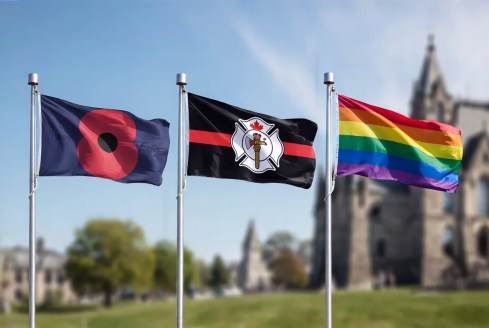
The flags. The emails. The school bulletin boards. The corporate logos. The municipal proclamations. The HR language. The social media badges. The rainbow email signatures. The familiar little suggestion that anyone who declines the ritual must be hiding some moral defect.
That is exactly why Pride needs civic proportion.
Not abolition. Not cruelty. Not some bitter campaign to drive gay and lesbian citizens back into silence. That would be wrong, and it would also miss the point. The question is not whether gay people should be treated with dignity. Of course they should. The question is whether equal citizenship requires a month of institutional performance, followed in Canada by what the federal government now openly calls Pride Season, running from June to September.
At some point, recognition became saturation.
That distinction matters. Visibility can have value. There are still young people who feel isolated, families that struggle to accept them, and countries where homosexuality remains criminalized. None of that is trivial. But a liberal society still has to distinguish between civic recognition and compulsory enthusiasm. It can protect minorities without turning public institutions into ideological billboards. It can permit parades, private celebration, voluntary corporate sponsorship, and public respect without making every workplace, school, and government office participate in a rolling moral pageant.
Veterans have Remembrance Day, with Veterans’ Week as a focused period of solemn national memory. Fallen firefighters are honoured through Firefighters’ National Memorial Day. Canadian peacekeepers are recognized on National Peacekeepers’ Day. These are not minor observances. They include people who served in wars, ran toward fire, responded to disaster, watched friends die, and carried burdens most citizens will never see.
Yet their recognition is bounded and it is not disrespect, but rather it is a demonstration of civic restraint.
Pride has not been restrained. It has expanded from a protest, to a celebration, to a month, to a season, to a branding cycle, to a school-calendar fixture, to a test of institutional obedience. The expansion is now so familiar that many people barely notice it. They only notice the consequences of objecting.
Decline the flag, and suspicion arrives. Question the school display, and someone starts measuring your moral temperature. Object to compelled language, and the labels come quickly: hateful, unsafe, bigoted, backward, not fit for polite company. This is how a movement that once asked for tolerance drifts into reputational discipline. Not by sending police to your door, but by making ordinary dissent socially expensive enough that most people decide silence is easier.
Surprisingly(?)this isn’t healthy pluralism or even good advocacy on a societal scale.
Every cause eventually faces a choice. It can keep expanding its demands forever, or it can settle into the ordinary dignity of citizenship. The first option keeps activists, consultants, committees, and bureaucracies busy. The second allows citizens to live together without every institution becoming a stage for moral performance.
And this critique does not apply only to one letter in the ever-expanding acronym. The problem is the machinery itself: the institutional expectation that citizens must affirm not only dignity and legal equality, but the whole ideological package attached to the celebration. That is where reasonable accommodation gives way to soft coercion.
The smarter move would be if the Pride organizations themselves stepped up and acknowledged their overreach.
“The better settlement is simple enough: one day of recognition, freely observed, and then the ordinary dignity of living together without a seasonal loyalty test.”
They could say: we have made our point. Gay and lesbian Canadians are not going anywhere. We are neighbours, friends, co-workers, artists, teachers, soldiers, parents, and citizens. We do not need four months of official reinforcement to prove we belong. Let Pride return to civic scale: a bounded public recognition, private celebration for those who want it, and no expectation that every institution must join the ritual.
That would be a sign of confidence, not retreat. A movement secure in its place does not need every bank logo recoloured, every school hallway decorated, or every employee nudged into public agreement. If the goal is equal citizenship, then the endgame cannot be permanent mobilization. It has to be ordinary civic life, with room for celebration, indifference, criticism, and refusal.
Let communities hold parades. Let businesses support Pride if they choose. Let citizens attend, ignore, criticize, or enjoy the day as free people. But public institutions should stop behaving as though full civic membership requires annual submission to a political liturgy.
The better settlement is simple enough: one day of recognition, freely observed, and then the ordinary dignity of living together without a seasonal loyalty test.











 bleatmop
 Mystro


 Dead Wild Roses
Your opinions…