
You are currently browsing the tag archive for the ‘Biological Reality’ tag.
Women do not need permission to define themselves.
The word woman already has a meaning. It is not hateful to say so, and it is not extremist to defend female boundaries, female privacy, female sports, or female-only spaces. Women are adult human females. That definition is not a slur. It is the basis on which women’s rights were built.
The public silence around this issue is starting to crack because too many people can now see where the trajectory leads. A society that cannot define women cannot reliably protect them. Rights tied to sex become fragile once sex itself is treated as optional language.
Enough of the intimidation. Enough of the compelled speech. Enough of the social blackmail that brands ordinary women as bigots for wanting boundaries previous generations understood as normal, necessary, and humane.
The next step is not private agreement. It is public resistance, steady enough that institutions can no longer pretend the objection belongs only to cranks and extremists.
Write to elected officials and demand that sex-based protections be clarified in law as applying to biological sex. Support groups defending women’s sports, shelters, prisons, and female-only services. Push back in schools, workplaces, unions, professional associations, and public consultations when policies dissolve female boundaries into identity claims. Refuse the language games that make reality harder to discuss. Speak plainly, calmly, and repeatedly.
Support the journalists, writers, academics, whistleblowers, parents, athletes, and ordinary women who are absorbing the punishment for saying what millions still believe. Do not leave them standing alone while quietly agreeing with them afterward in private.
That private agreement is one of the main things keeping this machine alive. Institutions interpret silence as consent. Bureaucracies advance until they meet resistance, and too many citizens have been trained to mistake politeness for surrender.
This resistance does not require rage or cruelty. It requires steadiness, numbers, and the willingness to stop pretending obvious things are unsayable.
The backlash already underway across the Western world is not driven by hatred. It is driven by exhaustion with the claim that female boundaries are negotiable, that biology is taboo, and that dissent itself is immoral.
Women have the right to their own spaces, language, associations, and political interests. No court ruling or policy document can erase that reality.

The recent Tickle v Giggle ruling exposes a widening gap between legal language and ordinary reality.
The court held that a female-only app unlawfully discriminated against a ‘transgender woman’ by excluding him from the platform. The legal mechanism matters: this was framed through gender-identity discrimination protections. But the practical result is hard to miss. A space created for women was told it could not draw its boundary around being female.
That has consequences beyond one app.
Women’s sex-based protections exist because sex is real. Pregnancy is real. Male-pattern violence is real. Privacy concerns in shelters, prisons, changing rooms, sports, and intimate female spaces are not imaginary. They are not bigotry dressed up as discomfort. They arise from material differences that law once had enough common sense to recognize.
A humane society can treat transgender people with dignity and still preserve female-only spaces. Those two duties are not enemies unless ideology makes them so.
The problem with this ruling is that it pushes women into the old subordinate role again: accommodate first, object later, and expect punishment if the objection sounds too firm. Female boundaries become negotiable. Female discomfort becomes suspect. Meanwhile, identity claims are treated as moral imperatives that everyone else must organize around.
That is not equality. It is a new hierarchy with better manners.
Ordinary people notice the coercion. They notice the pressure to say things publicly that they do not believe privately. They notice that everyone still understands what sex is when the issue is medical care, crime statistics, pregnancy, or athletics, but suddenly becomes confused when women try to maintain a boundary.
This is why the issue refuses to disappear. Reality keeps returning through the side door.
The law should protect every citizen from harassment and mistreatment. But it should not compel society to pretend that sex is meaningless. If women cannot define female-only spaces around biological sex, then “woman” has lost the legal coherence that made women’s rights possible in the first place.
This decision should be overturned, and the law should be clarified: sex means biological sex where single-sex spaces, services, sports, and protections are concerned.
Without that correction, women are being told to move aside in the name of inclusion.
They have heard that instruction before.

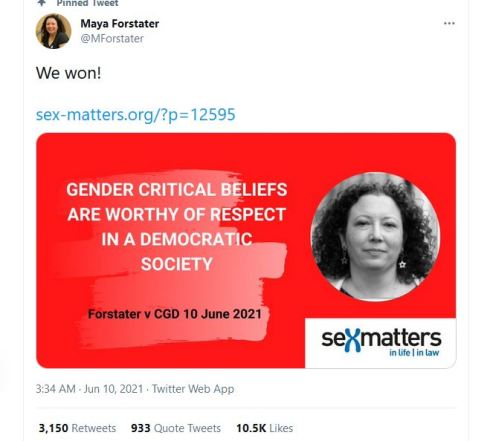
This ruling changes the environment. This UK ruling states that gender critical beliefs are also protected beliefs under law in the the UK. In other words, you can’t be fired from your job for stating the blindly obvious *FACT* that human beings cannot change their sex. This is a huge victory for women, free speech, and of course Ms. Forstater.
Thank you Ms. Forstater for having enough resilience and courage to stand up for women and their rights.
“Ms Forstater, from St Albans in Hertfordshire, did not have her contract renewed at the think tank Center for Global Development (CGD) in March 2019, after posting a series of tweets questioning government plans – which were later scrapped – to let people declare their own gender.
She claimed she was discriminated against because of her beliefs, which include “that sex is immutable and not to be conflated with gender identity”.
In the initial tribunal employment judge James Tayler said that her approach was “not worthy of respect in a democratic society”.
He concluded that Ms Forstater was “absolutist” in her view and said she was not entitled to ignore the rights of a transgender person and the “enormous pain that can be caused by misgendering”.
But the Honourable Mr Justice Choudhury said her “gender-critical beliefs” did fall under the Equalities Act as they “did not seek to destroy the rights of trans persons”.
Ms Forstater said she was “delighted to have been vindicated” but CGD said the decision was a “step backwards for inclusivity and equality for all”.
In a video statement, Ms Forstater said: “I’m proud of the role I’ve played in clarifying the law and encouraging more people to speak up”.
Visit and support women’s rights at sex-matters.org
The Dangerous Denial of Sex
Transgender ideology harms women, gays—and especially feminine boys and masculine girls.
By Colin M. Wright and
Emma N. Hilton
Feb. 13, 2020 6:54 pm ET
“Transgender ideology can take on a comical character, as in a recent American Civil Liberties Union commentary objecting to sales tax on tampons and similar products while pondering: “How can we recognize that barriers to menstrual access are a form of sex discrimination without erasing the lived experiences of trans men and non-binary people who menstruate, as well as women who don’t?”
Yet it’s one thing to claim that a man can “identify” as a woman or vice versa. Increasingly we see a dangerous and antiscientific trend toward the outright denial of biological sex.
“The idea of two sexes is simplistic,” an article in the scientific journal Nature declared in 2015. “Biologists now think there is a wider spectrum than that.” A 2018 Scientific American piece asserted that “biologists now think there is a larger spectrum than just binary female and male.” And an October 2018 New York Times headline promised to explain “Why Sex Is Not Binary.”
The argument is that because some people are intersex—they have developmental conditions resulting in ambiguous sex characteristics—the categories male and female exist on a “spectrum,” and are therefore no more than “social constructs.” If male and female are merely arbitrary groupings, it follows that everyone, regardless of genetics or anatomy should be free to choose to identify as male or female, or to reject sex entirely in favor of a new bespoke “gender identity.”
To characterize this line of reasoning as having no basis in reality would be an egregious understatement. It is false at every conceivable scale of resolution.
In humans, as in most animals or plants, an organism’s biological sex corresponds to one of two distinct types of reproductive anatomy that develop for the production of small or large sex cells—sperm and eggs, respectively—and associated biological functions in sexual reproduction. In humans, reproductive anatomy is unambiguously male or female at birth more than 99.98% of the time. The evolutionary function of these two anatomies is to aid in reproduction via the fusion of sperm and ova. No third type of sex cell exists in humans, and therefore there is no sex “spectrum” or additional sexes beyond male and female. Sex is binary.
There is a difference, however, between the statements that there are only two sexes (true) and that everyone can be neatly categorized as either male or female (false). The existence of only two sexes does not mean sex is never ambiguous. But intersex individuals are extremely rare, and they are neither a third sex nor proof that sex is a “spectrum” or a “social construct.” Not everyone needs to be discretely assignable to one or the other sex in order for biological sex to be functionally binary. To assume otherwise—to confuse secondary sexual traits with biological sex itself—is a category error.
Denying the reality of biological sex and supplanting it with subjective “gender identity” is not merely an eccentric academic theory. It raises serious human-rights concerns for vulnerable groups including women, homosexuals and children.
Women have fought hard for sex-based legal protections. Female-only spaces are necessary due to the pervasive threat of male violence and sexual assault. Separate sporting categories are also necessary to ensure that women and girls don’t have to face competitors who have acquired the irreversible performance-enhancing effects conferred by male puberty. The different reproductive roles of males and females require laws to safeguard women from discrimination in the workplace and elsewhere. The falsehood that sex is rooted in subjective identity instead of objective biology renders all these sex-based rights impossible to enforce.
The denial of biological sex also erases homosexuality, as same-sex attraction is meaningless without the distinction between the sexes. Many activists now define homosexuality as attraction to the “same gender identity” rather than the same sex. This view is at odds with the scientific understanding of human sexuality. Lesbians have been denounced as “bigots” for expressing a reluctance to date men who identify as women. The successful normalization of homosexuality could be undermined by miring it in an untenable ideology.
Those most vulnerable to sex denialism are children. When they’re taught that sex is grounded in identity instead of biology, sex categories can easily become conflated with regressive stereotypes of masculinity and femininity. Masculine girls and feminine boys may become confused about their own sex. The dramatic rise of “gender dysphoric” adolescents—especially young girls—in clinics likely reflects this new cultural confusion.
The large majority of gender-dysphoric youths eventually outgrow their feelings of dysphoria during puberty, and many end up identifying as homosexual adults. “Affirmation” therapies, which insist a child’s cross-sex identity should never be questioned, and puberty-blocking drugs, advertised as a way for children to “buy time” to sort out their identities, may only solidify feelings of dysphoria, setting them on a pathway to more invasive medical interventions and permanent infertility. This pathologizing of sex-atypical behavior is extremely worrying and regressive. It is similar to gay “conversion” therapy, except that it’s now bodies instead of minds that are being converted to bring children into “proper” alignment with themselves.
The time for politeness on this issue has passed. Biologists and medical professionals need to stand up for the empirical reality of biological sex. When authoritative scientific institutions ignore or deny empirical fact in the name of social accommodation, it is an egregious betrayal to the scientific community they represent. It undermines public trust in science, and it is dangerously harmful to those most vulnerable.
Mr. Wright is an evolutionary biologist at Penn State. Ms. Hilton is a developmental biologist at the University of Manchester.”











 bleatmop
 Mystro


 Dead Wild Roses
Your opinions…