
You are currently browsing the category archive for the ‘Culture’ category.
There’s a low-grade feeling in the background of a lot of conversations right now that something isn’t quite working the way it used to.
Not broken. Not collapsing. Just… off.
The rules still exist. The institutions still function. On paper, everything is in place. But the sense that things are moving in the direction they claim to be moving has started to thin, and people tend to notice that long before they can explain it.
It’s difficult to point to a single cause. That’s part of why the feeling lingers. When something breaks, you can name it. When something drifts, you feel it first and only understand it later.
That unease tends to show up when the quiet constraints that keep systems stable begin to weaken.
In law, it looks like uneven enforcement. In politics, it shows up when power stops feeling like something that will eventually change hands. More generally, it appears whenever positions begin to feel fixed rather than contingent.
Most of the time, these constraints operate in the background. They don’t need to be defended constantly because they are demonstrated often enough that people take them for granted. You see rules applied. You see consequences land. You see people leave positions they once held.
That’s usually enough.
When those patterns become less consistent, the system doesn’t collapse. It adjusts. Power becomes a little less exposed, a little more predictable, but not in a reassuring way. Access narrows, not through explicit barriers, but through familiarity and repetition.
You start to see the same outcomes, or at least the same kinds of outcomes, and they become easier to anticipate.
At first, most people adapt without thinking much about it. Systems can absorb a surprising amount of this kind of drift. But the adjustment isn’t free. It changes how people relate to the system itself.
They rely on it less. They work around it more. And eventually, they stop assuming that the rules being stated are the rules that actually matter.
That shift is quiet, but it matters.
This is not an argument that the past was fair, pure, or evenly experienced. Many people never experienced the old constraints as neutral. The point is narrower. When the public no longer believes the operative rules match the stated rules, trust begins to thin.
Analysts of collapse tend to focus on endpoints. Resource exhaustion. Rising complexity. External shock. Those accounts are valuable, and they explain why systems eventually fail.
What they describe less clearly is the phase that comes before that.
The point where the system still functions, but no longer feels like it is working as intended.
That phase is where most people live, and it is where most systems are decided.
Because once a system reaches the point where it requires constant effort to maintain the appearance of fairness, the cost of sustaining it begins to rise. Not just in money, but in attention, coordination, and trust.
More oversight gets added. More process. More intervention. Each change is meant to correct a small imbalance. Taken together, they make the system heavier and harder to move.
At some point, the question shifts. It’s no longer just whether the system is fair or efficient. It becomes whether it is worth maintaining in its current form.
That’s where drift turns into something else.
Not collapse in the dramatic sense, but simplification. People disengage. Participation drops. Compliance becomes selective. The system doesn’t explode. It contracts.
If that is the direction of travel, then the question is not how to prevent collapse entirely. No system avoids change indefinitely.
The question is how to restore the constraints that keep drift from becoming the default condition.
The answer is less dramatic than most people expect.
It doesn’t require perfect leaders, sweeping reform, or a complete redesign of institutions. It requires something more basic, and more difficult to sustain.
The system has to demonstrate, consistently and visibly, that its constraints still hold.
That demonstration has to be more than messaging.
It has to take the form of consequences that land where they should, including on allies, insiders, and institutions themselves. It means oversight with teeth, rules applied even when politically inconvenient, and positions that remain genuinely vulnerable to replacement rather than quietly secured over time.
These are not abstract principles. They are operational ones.
A system that enforces its rules selectively teaches people to look for exceptions. A system that allows power to settle teaches people that outcomes are predetermined. A system that avoids disruption teaches people that disruption is no longer possible.
Reversing that drift doesn’t happen through messaging. It happens through action, repeated often enough that people begin to believe what they are seeing again.
Trust is not restored by argument. It is restored by demonstration.
And that demonstration has to be visible enough that people can recognize it without being told what it means.
That is the path forward.
Not a guarantee of stability. Not a return to some idealized past. But a re-establishment of the conditions under which systems remain both legible and worth participating in.
Because the alternative is not immediate collapse, it is something a little more quieter and under the radar.
A system that continues to function, but no longer convinces.

Suggested Further Reading
If this line of thinking resonates, these works explore different parts of the same problem from complementary angles:
- The Collapse of Complex Societies — Joseph Tainter
A clear account of how increasing complexity yields diminishing returns, and why systems often simplify rather than fail dramatically. - Collapse — Jared Diamond
Examines how societies respond—successfully or not—to environmental, political, and economic pressures over time. - Guns, Germs, and Steel — Jared Diamond
A broader look at how geography and structural conditions shape long-term societal development and stability. - Rivers of Gold, Rivers of Blood — Anthony Quinn
Explores how wealth, empire, and resource flows influence power, expansion, and institutional behavior. - Altered Carbon — created by Laeta Kalogridis (based on the novel by Richard K. Morgan)
A speculative take on what happens when one of society’s most fundamental constraints—biological exit—is removed entirely.
You can usually tell what kind of argument you’re about to hear before the argument is made.
It’s in the language.
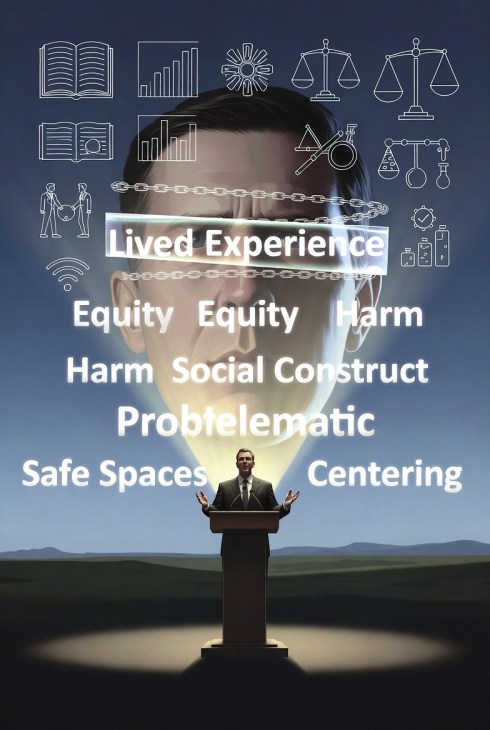
Certain words don’t just describe reality—they quietly reframe it, often in ways that make disagreement harder before it even begins. They shift the ground you’re standing on, sometimes without you noticing.
Once you recognize them, the pattern becomes difficult to miss.
“By the time the argument begins, much of it has already been decided.”
Here are a few to listen for.
“Lived experience”
Often used to elevate subjective accounts above other forms of evidence.
Experience matters. But when it becomes the final authority, it can no longer be questioned or compared. At that point, it stops being evidence and becomes a conclusion.
“Social construct”
A useful concept in limited contexts. Overextended, it suggests that because something is shaped by society, it is therefore arbitrary or infinitely malleable.
The move is subtle: from influenced by culture to not anchored in reality at all.
“Harm”
A word that has expanded far beyond physical or material damage.
Disagreement, discomfort, or perceived invalidation can all be folded into it. Once that happens, ordinary debate starts to look like misconduct.
“Equity”
Not the same as equality.
It shifts the focus from equal rules to equal outcomes. That shift often justifies unequal treatment in the name of correcting disparities.
“Centering” / “Decentering”
Signals who is allowed to speak, and whose perspective is treated as primary.
Less about argument, more about managing whose voice carries authority.
“Problematic”
A soft accusation that avoids specificity.
It implies wrongdoing without clearly stating what the problem is, which makes it difficult to respond directly.
“Safe spaces”
Originally about protection from harassment. Now often used to limit exposure to challenging or opposing ideas.
The definition quietly expands from safety from harm to safety from disagreement.
None of these words are inherently illegitimate. The issue is how they are used. Individually, they can be useful. In combination, they tend to narrow the space for disagreement.
When they appear together, they often shift discussion away from evidence, elevate subjective claims beyond challenge, and quietly limit what can be said without consequence. By the time the argument begins, much of it has already been decided.
When you hear language like this, a simple question is usually enough: what claim is being made—and could I reasonably disagree with it? If the answer is no, you are no longer in a normal debate. You are being asked to accept a framework, not evaluate an argument.
This pattern isn’t unique to any one ideology. It appears wherever language is used to secure agreement before the argument begins. Language doesn’t just communicate ideas—it sets the terms under which those ideas can be questioned, and sometimes whether they can be questioned at all.
Would people hold the views they do if they understood the first principles those views rest on?
I suspect many would at least pause. Not necessarily abandon their position, but slow down long enough to ask what exactly they are affirming. This is not a universal pattern, but it shows up often enough in public discourse to be worth paying attention to.
What I am describing is a kind of reverse percolation. Ideas that begin in highly abstract settings move downward into activism and identity, where they are simplified, moralized, and widely adopted. Something is lost in that movement. The underlying logic—the structure that gave the idea its shape in the first place—does not always make the trip.
Take a common example.
One influential strand of queer theory makes a striking claim: that identity need not be grounded in any stable essence, but instead takes shape in relation to what is considered normal or legitimate. At the level of theory, this is an attempt to examine how norms are constructed and how they operate, often in ways that are invisible to those who benefit from them.
But when that framework moves out of the seminar room and into everyday political identity, it tends to arrive in a thinner form. The scaffolding is gone. What remains is the posture.
“Ideas move downward into mass use, losing fidelity as they go, and return upward not as refinement, but as reinforcement—positions hardening around ideas that have already shed much of what made them coherent.”
That shift creates a tension that is easy to miss. If an identity is defined in relation to norms, then friction with those norms is not an accidental byproduct; it is part of the structure. Yet many who adopt the language of queer politics encounter that friction as if it were imposed entirely from the outside, rather than something partly generated by the logic they have taken on.
This is where the gap begins to open—between first principles and lived adoption.
What makes the dynamic more interesting is that it does not run in a single direction.
A similar distortion can be seen in conservative responses, where disparate strands of progressive thought are often folded together under the single label of “liberalism.” In doing so, distinctions that matter are blurred or lost altogether. Classical liberalism, with its emphasis on individual rights, pluralism, and limits on power, is not interchangeable with theoretical frameworks that aim to critique or unsettle those foundations.
Once those categories collapse into each other, critique starts to rest on unstable ground.
The result is less a clash of well-formed positions than a kind of mirrored simplification. On one side, ideas are adopted without much reference to their internal logic. On the other, they are opposed without being clearly identified. Whether the greater loss happens in adoption or in response is difficult to say, and in a sense it does not matter; each process feeds the other.
This is where the reverse percolation effect completes its cycle.
Ideas move downward from abstraction into mass use, losing fidelity as they pass through each layer. They are then taken up again, interpreted, resisted, or amplified by others working from similarly partial models. What comes back is not refinement. It is reinforcement—positions hardening around ideas that have already shed much of what made them coherent.
At that point, disagreement becomes inevitable, because the participants are no longer operating within the same conceptual frame. Understanding does not so much fail as it is quietly set aside.

Glossary
Queer Theory
A body of academic thought that examines how categories like sex, gender, and sexuality are constructed, regulated, and experienced. It often challenges the idea that these categories are fixed or natural, instead emphasizing their fluidity and relationship to social norms. The field is not monolithic, and different strands place different weight on these elements.
Classical Liberalism
A political philosophy centred on individual rights, equality before the law, freedom of expression, and limits on state power. It forms the foundation of many modern democratic systems and emphasizes pluralism within a shared legal framework.
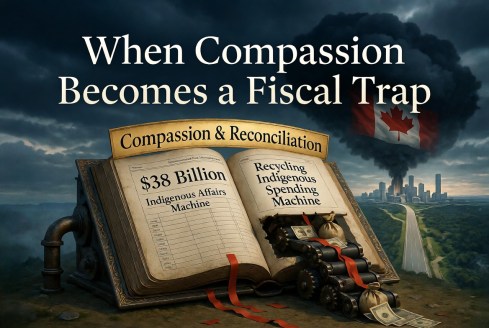
Canada’s Indigenous spending model has a problem it can no longer hide behind good intentions.
We are spending roughly $38 billion a year through core departments alone, after a decade of rapid expansion. The question is not whether that money is justified in principle. The question is whether it works.
On the outcomes that matter most—housing, child welfare, clean water reliability, and long-term economic independence—the answer is uneven at best and stagnant at worst. Progress exists. It is real. But it is not proportional to the scale of the spending. That gap between money spent and results achieved is the whole argument.
A system that cannot convert large, sustained spending into durable independence is not compassionate. It is failing.
The current model does not primarily produce independence. It manages dependency.
Spending has risen sharply, yet the Auditor General still found unsatisfactory progress on 53% of prior recommendations across core areas such as water, health access, emergency management, and socio-economic gaps. That is the mechanism in plain terms: more money flows, the system expands, compliance and administration thicken, and outcomes move slowly.
This is not just a funding shortage. It is a delivery failure.
And a delivery system that cannot convert major, repeated spending increases into reliable improvement is not neutral. It is misallocating resources at scale.
Canada is not bankrupt. But it is not insulated from fiscal reality either.
Federal spending is approaching half a trillion dollars. Debt-service costs are rising. Demographics are tightening the margin for error. You do not need a full sovereign-debt crisis for political choices to narrow. You just need pressure. A serious downturn, rising interest costs, or prolonged fiscal strain can force governments into reprioritization very quickly.
And when that happens, governments do not trim politely. They cut where they can.
That is where the current model becomes morally and fiscally dangerous at the same time. A system built on permanent federal transfers is stable only while those transfers keep flowing at politically tolerable levels. The moment that assumption weakens, those most dependent on the state become the most exposed to its limits.
That is the point too many sentimental arguments glide past. Dependency is not merely expensive. It is fragile.
A support model that only works while fiscal capacity keeps expanding is not a support model. It is a fair-weather dependency machine.
The present structure also rewards the wrong things. It rewards program expansion over completion, compliance over outcomes, announcements over maintenance, and federal management over local accountability. Money moves. Reports get written. Conditions improve, if they improve, far too slowly.
Look at drinking water. Ottawa rightly points to advisories lifted over the past decade. That progress matters. But Ottawa’s own figures also show that long-term advisories remain, and that many systems still require operational improvements before advisories can be lifted. That is not mainly a ribbon-cutting problem. It is a maintenance and systems problem. Building is politically photogenic. Sustaining is harder. The current model has often been better at funding capital headlines than at securing competent long-run operation.
The same broader pattern appears elsewhere. Indigenous children remain dramatically overrepresented in foster care. In 2021, Indigenous children made up 7.7% of children under 15, but 53.8% of children in foster care. A system that absorbs this much money and still leaves such ratios in place does not get to call itself successful because it can point to process, intent, or moral vocabulary.
If a model is expensive, underperforming, and fragile, it does not get preserved untouched. It gets triaged.
That means being willing to contemplate deep reductions—on the order of half to two-thirds over time—not as punishment, but as forced prioritization. The case is not for abandoning Indigenous communities. The case is for abandoning the fantasy that every current layer of spending is equally necessary, equally effective, or equally defensible.
Not everything should survive.
What should be protected is what is plainly essential: clean water systems with funded long-term maintenance, core health and emergency services, schooling, literacy, child protection, housing tied to credible upkeep plans, and communities that demonstrate effective local governance capacity.
What should be cut, compressed, or eliminated is the non-essential layer that accumulates in every morally protected spending regime: duplicative federal administration, consultant-driven program layers, pilot projects that never scale, compliance regimes that consume resources without clearly improving lives, and symbolic reconciliation spending detached from measurable outcomes.
If a program cannot show serious, durable improvement, it does not get to exist because it sounds compassionate in a press release.
This is where critics will predictably panic and moralize. They will say that Indigenous communities cost more to support because of historical injustice, geographic isolation, damaged infrastructure baselines, and the enduring effects of state misconduct. That is the strongest version of the opposing case, and parts of it are obviously true.
Historical injustice matters. Geographic isolation matters. Remote delivery costs are real. Weak starting conditions are real.
But that argument does not rescue the current model.
Historical injustice explains the starting line. It does not excuse a decade of rapidly expanding budgets with only partial and uneven progress. A moral claim to support is not the same thing as a proof that the delivery structure works. And after this much spending, defenders of the status quo still cannot point to outcome improvement proportionate to the scale of expenditure.
That matters because dependency wrapped in the language of reconciliation is still dependency. A model that leaves communities structurally tied to Ottawa’s fiscal condition is not empowering them. It is exposing them.
The answer, then, is not cuts for their own sake. It is reallocation.
Savings from the non-essential layer should be redirected in two directions. First, toward fiscal stabilization, because a state that loses control of its finances loses control of its choices. Second, toward connective infrastructure: roads, bridges, utilities, and other corridors that physically integrate isolated communities into provincial economies and reduce the permanent cost of remoteness.
Isolation is not an identity. It is, in significant part, an engineering and governance problem.
If you do not solve that problem, you will subsidize its consequences forever.
Historical injustice explains the starting line. It does not excuse ten years of bigger budgets with only marginal gap closure.
This is the part polite politics hates to say aloud. A country that refuses to discipline failing systems during periods of relative control increases the odds that future discipline will arrive under pressure instead. Markets impose limits. Debt-service costs impose limits. Fiscal stress imposes limits. In more extreme scenarios, countries lose the luxury of setting their own reform timetable and their own reform terms.
Better a hard reallocation now than a panicked contraction later.
Better to choose triage than to have it chosen for you.
The question is not whether Canada should support Indigenous communities. It should.
The question is whether Canada is willing to admit that the current model is not delivering enough, not fast enough, and not durably enough to justify its scale. Because the worst outcome is not reform. The worst outcome is drift: a system that consumes, reassures, and congratulates itself right up until the moment it cannot continue.
And then fails all at once.
References
- Indigenous Services Canada and Crown-Indigenous Relations and Northern Affairs Canada planned spending totals for 2025–26, approximately $38 billion combined.
- Office of the Auditor General of Canada follow-up finding that 53% of prior recommendations showed unsatisfactory progress.
- Indigenous Services Canada figures on long-term drinking water advisories, including advisories lifted and those still active.
- Statistics Canada figures showing Indigenous children as 7.7% of children under 15 but 53.8% of children in foster care in 2021.
- Federal spending and debt-pressure context from the budget and main estimates material summarized in the source text.
This is how activists frame their lies and misdirection.

Here is their bullshittery in full:
The introduction of new rules restricting participation in women’s sport categories to “biological females”, determined through mandatory genetic screening and testing, imposes exclusionary criteria. These measures not only bar transgender women from competition, but target and disqualify cisgender women with differences in sex development.
This policy will apply to the Los Angeles 2028 Olympic Games and beyond, despite the absence of clear evidence that any transgender women were poised to participate in those Games. The IOC’s approach aligns itself with the U.S. government’s 2025 executive order “Keeping Men Out of Women’s Sports” which threatened to withdraw funding from organizations that permit transgender athletes to compete and to deny visas to certain athletes seeking to participate in the Los Angeles Olympics. The convergence of international sport governance with exclusionary state policy raises serious concerns about the politicization of athletic participation and the erosion of independent, rights-respecting governance.
“While framed as a measure to ensure fairness, this policy imposes exclusionary criteria that will disproportionately harm transgender women and also place cisgender women at risk, particularly those with natural biological variations,” says Aaden Pearson, Trans Rights Legal Fellow at the Canadian Civil Liberties Association. “The policy authorizes intrusive scrutiny of women’s bodies and asserts authority over who gets to participate as a ‘real’ woman under the guise of regulation.”
This policy will have detrimental impact on Canadian athletes that may be barred from participating in the Olympics because of this policy who otherwise would qualify to represent Canada.
A rights-respecting approach to sport must be grounded in inclusion, evidence, and proportionality. Fairness and human dignity are not mutually exclusive. The legitimacy of sport depends on ensuring that all athletes are able to participate without discrimination.
The CCLA calls on the IOC and national sporting bodies to:
- Immediately reconsider the implementation of these eligibility rules;
- Ensure that any policies governing participation in sport are evidence-based, proportionate, and consistent with international human rights obligations; and
- Uphold the principle that sport must be accessible to all, without discrimination.
The legitimacy of sport depends not only on fairness in competition, but on fairness in access. Policies that exclude, surveil, and stigmatize athletes have no place in a rights-respecting sporting system.”
————————
When a civil liberties organization cannot define a category, it cannot defend a right.
That is the move.
The IOC’s policy does not abolish sport as a “human right.” It sets an eligibility rule for the female category: from LA 2028 onward, athletes in that category must pass a one-time SRY gene screen, using saliva, a cheek swab, or blood. Athletes who do not qualify are still eligible for male, mixed, or open categories. This is not exclusion from sport. It is boundary enforcement within sport.
That distinction is the entire argument, and the CCLA refuses to engage it.
Instead, it leans on the language of “inclusion” as though inclusion means entitlement to every category. But sport has never worked that way. Weight classes exclude. Age divisions exclude. Paralympic classifications exclude. Women’s sport exists because sex matters. Calling sex-based eligibility “exclusionary” does not answer that reality. It simply renames the boundary and hopes no one notices.
The claim that the policy “targets cisgender women with differences in sex development” is similarly evasive. The IOC framework uses SRY screening because it is strong evidence of male development. World Boxing’s policy is explicit: eligibility for the women’s category excludes athletes with Y-chromosome material or male androgenization. The relevant question is not whether someone identifies as a woman, but whether they have undergone male development. The CCLA substitutes sympathetic language for that question rather than answering it.
The argument about there being no “clear evidence” of transgender women poised to compete in LA 2028 is weaker still. Rules are not written only after a problem becomes numerically large. They are written to clarify the category before competition begins. “There aren’t many” is not an argument against having a rule. It is an admission that the rhetoric is disproportionate to the scale of the issue.
“It treats female sport as though it were an access program rather than a sex-based category.”
The claim of “intrusive scrutiny” is also inflated. The IOC’s first-line test is a one-time genetic screen using saliva, cheek swab, or blood. That is not the same thing as the mid-20th century abuses activists like to invoke. A serious civil-liberties analysis would distinguish between limited modern verification and historical excess. This statement deliberately blurs them.
And then there is the core contradiction. The CCLA says fairness and dignity are not mutually exclusive. That is true. But it follows that female athletes can be treated with dignity and retain a protected category that excludes males. The CCLA resolves this tension by dissolving the category instead. In practice, its position requires female athletes to absorb the cost: compromised fairness, weakened boundaries, and—in contact sports—elevated risk.
That is not a neutral rights framework.
It is a redefinition of rights in which access to the female category is prioritized, and the integrity of that category is treated as negotiable.
A civil liberties organization should be able to state the purpose of a category before it critiques its rules. The CCLA does not. It treats the female category as a site for validating identity claims rather than as a sporting class organized around sex.
Once that happens, the conclusion is pre-determined.
Female boundaries become suspect.
Enforcement becomes cruelty.
And reality becomes something to be managed with language.

I woke this morning to the sort of silence one usually associates with miracles or the CBC losing funding. It was not the usual Canadian silence of people muttering “well, that’s concerning” while being mugged by ideology in a Lululemon hoodie. No. It was the silence that comes after a fever breaks.
By breakfast, the first signs were impossible to miss. Gender ideology had finally been moved to its proper shelf: comparative religion. It now sat comfortably beside crystal healing, Gnostic sects, and the more enthusiastic forms of astrology. Canadians, with characteristic politeness, agreed that adults were free to believe in innate gender spirits if they wished. They were simply no longer allowed to drag those beliefs into schools, prisons, women’s shelters, human rights tribunals, or sports governing bodies and demand that everybody else call it science.
Female spaces reverted, almost overnight, to the radical old principle that women are female. Women’s prisons once again housed women. Women’s shelters once again served women. Women’s hospital wards, changing rooms, crisis centres, rape relief services, and athletic categories all quietly recovered their original function. The country did not collapse. No one burst into flames. The sun rose, the buses ran late, and Canadian women experienced the deeply unfamiliar sensation of not having to explain why privacy, fairness, and physical safety were not hate crimes.
“They were replaced by the revolutionary practice of getting on with things.”
Even the sports pages improved. Men were removed from women’s competitions with so little fuss one wondered why the insanity had been allowed to continue so long. Records began to mean something again. Girls stopped being told that getting flattened by male bodies was a teachable moment in inclusion.
Meanwhile, Canada seemed to have recovered from a long and embarrassing binge. DEI offices vanished like travelling carnivals after a municipal scandal. Land acknowledgements were quietly retired from every meeting and kindergarten graduation after the public noticed they had not, in fact, altered land title or improved anyone’s life. They were replaced by the revolutionary practice of getting on with things.
Freedom of speech also made an unexpected return. Not the decorative kind. The real kind. The kind where one could say true or unpopular things without being marched through a moral struggle session by people whose entire personality is a lanyard.
For several glorious hours, the country seemed almost curable.
Then I remembered the date.

Happy April Fool’s Day.
By now the pattern should be familiar. A movement begins with a grievance, often a real one. It then defines the good chiefly by what must be abolished: oppression, domination, impurity, exclusion, hierarchy, stigma. The ideal remains vague, but the stain is vividly named. Reality resists. Limits persist. Tradeoffs do not disappear. At that point the movement faces a choice. It can revise its ambitions in light of the world as it is, or it can moralize the gap between promise and outcome. When it chooses the second path, disappointment hardens into blame, blame hardens into sorting, and sorting prepares the way for coercion.
That is the political logic this series has traced. The danger does not lie in idealism as such. A society without ideals becomes cynical, managerial, and spiritually thin. The danger begins when an ideal cannot survive contact with limits. Then every obstacle looks illegitimate. Every compromise looks corrupt. Every dissenter looks stained. The world is no longer a difficult place to govern. It becomes a field of obstruction to be purified.
The question, then, is what politics looks like once that temptation is recognized. The answer is not indifference. It is not quietism. It is not a shrug in the face of genuine injustice. The answer is a recovery of political adulthood. That recovery begins with three recognitions that negative idealism resists at every stage: limits, tradeoffs, and tragedy.
First, politics must recover the category of limits. Human beings are finite. Institutions are blunt. Knowledge is partial. Incentives matter. Scarcity does not vanish because a cause is morally urgent. Conflict does not disappear because a slogan sounds redemptive. Not every social friction is evidence of oppression. Not every persistence of imperfection is proof of sabotage. A mature politics begins by asking what kind of order flawed people can actually sustain, not what kind of redeemed world can be imagined at emotional full stretch.
“The refusal to admit tradeoffs does not abolish them. It merely disguises them until one side is forced to absorb the cost in silence.”
Second, politics must recover the reality of tradeoffs. Goods collide. Inclusion can conflict with standards. Freedom can conflict with equality. Privacy can conflict with recognition. Safety can conflict with access. Truth can conflict with the social desire to avoid offense. This is not a defect in politics. It is politics. The refusal to admit tradeoffs does not abolish them. It merely disguises them until one side is forced to absorb the cost in silence.
That point matters especially where female boundaries are concerned. One of the clearest signs of political infantilism in our time is the demand that women treat sex-based boundaries as optional whenever they obstruct a moral narrative someone else wishes to impose. Privacy, fairness, vulnerability, and safety are not relics of prejudice. They are goods. They sometimes conflict with other claims. That conflict cannot be solved by euphemism or moral intimidation. It must be faced as a tradeoff and judged accordingly. A politics that cannot say this plainly has already surrendered reality to abstraction.
Third, politics must recover the category of tragedy. Some conflicts do not admit a clean moral victory. Some losses cannot be fully repaired. Some goods cannot be simultaneously maximized. There are wounds in social life that can be mitigated but not abolished, tensions that can be managed but not transcended. Tragedy is not a counsel of despair. It is a protection against fanaticism. Once tragedy is denied, every unhealed wound becomes someone’s crime.
These three recognitions do not solve politics. They civilize it. They narrow the space in which utopian movements can turn ordinary disappointment into moral accusation. They remind us that not every unresolved problem is evidence of bad faith, and not every limit is a betrayal. Most importantly, they restore the possibility of settlement.
Settlement is not a glamorous word. It lacks the heat of liberation, the purity of justice, the romance of revolution. But settlement is what makes free societies livable. It is the hard-won agreement to live together under conditions of disagreement, conflict, and imperfection without constantly converting those conditions into moral war. It asks less of politics than redemption does, but it asks more of citizens. It requires restraint, proportion, compromise, and the discipline to distinguish between what must be opposed and what must simply be endured.
This is why the alternative to negative idealism is not cynicism. It is constructive seriousness. A constructive politics still names injustice. It still seeks reform. It still protects the vulnerable and disciplines abuse. But it does so without pretending that every problem has a pure solution or that every failure must be the work of enemies. It seeks correction before purification. It prefers workable arrangements to emotionally satisfying absolutes.
That preference may sound modest, but modesty is one of the great political virtues. The most dangerous movements are rarely modest. They are animated by total explanations and final promises. Once that certainty hardens, coercion begins to feel less like a failure of politics than its highest expression.
This is how moral sorting becomes institutional force. First come the categories of suspicion. Then the rituals of denunciation. Then the pressure to conform in language, thought, and association. Then the administrative rules that punish refusal. Before the knock on the door comes the explanation for why someone deserves it. Before force comes the story that makes force feel righteous.
“We can recover a harder, less intoxicating, and more humane standard: a politics that accepts limits, faces tradeoffs, admits tragedy, and prefers settlement to redemption.”
The task, then, is not to abolish ideals, but to discipline them. Ideals must be forced to pass through reality before they are allowed to govern it. They must answer questions about costs, institutions, enforcement, boundaries, and competing goods. An ideal that cannot endure that test is not a guide to politics. It is a danger to it.
That is the real choice at the end of this series. We can continue to treat politics as a theater of purification in which every unresolved tension demands a culprit and every limit must be denounced as oppression. Or we can recover a harder, less intoxicating, and more humane standard: a politics that accepts limits, faces tradeoffs, admits tragedy, and prefers settlement to redemption.
One path offers permanent moral excitement and permanent social war. The other offers no final victory, only the difficult dignity of living truthfully with one another in an unfinished world. That is not a small thing. It is civilization.

No redemption. No final victory. Only the difficult dignity of living in an unfinished world.











 bleatmop
 Mystro


 Dead Wild Roses
Your opinions…