
You are currently browsing the tag archive for the ‘media hygiene’ tag.
Good intentions are not enough. That should be obvious, but much of our public life now behaves as if noble language can rescue bad thinking.
Before people declare what is compassionate, just, inclusive, hateful, dangerous, or necessary, they need some reliable way of knowing whether their factual claims are true. That order matters. If the tools used to find truth are broken, captured, or designed to protect a preferred belief from contradiction, then the moral conclusions built on top of those tools will inherit the damage.
This is not a left-wing or right-wing problem, though each side prefers noticing it in the other. The progressive version often begins with moral urgency. A policy is called compassionate, inclusive, or protective, and once that moral label is attached, factual objections start to look suspicious. Questions about consequences become “harm.” Questions about definitions become “erasure.” Questions about evidence become proof that the questioner is unsafe.
The conservative version has its own habits. A bad social trend gets folded too quickly into civilizational decline. One ugly example becomes proof of total collapse. A complicated institutional failure becomes evidence that the enemy planned the whole thing. The moral conclusion may contain some truth, but it arrives too early and then starts recruiting facts to serve it.
That is the trap. Once moral certainty arrives first, the mind stops investigating and starts defending.
You can see the pattern wherever institutions are rewarded for sounding virtuous before they are required to be accurate. A school board adopts fashionable language before asking whether the policy helps children. A medical system treats hesitation as cruelty before the long-term evidence is settled. A government describes economic pain in careful managerial terms while households are trying to make rent, groceries, debt, and wages fit inside the same month. The details differ, but the sequence is familiar: the moral frame arrives first, and the facts are invited in later as supporting cast.
A healthier public culture would ask plainer questions before the slogans begin. What is the claim? What evidence would show it is true? What evidence would weaken it? Who pays the cost if we are wrong? Are we counting those costs honestly, including the costs to people we do not like? Are we applying the same standard when the facts embarrass our own side?
Those questions are not glamorous. They do not fit neatly on a protest sign or a campaign graphic. They also do not offer the emotional satisfaction of instant righteousness. But they are the difference between thinking and performing.
This matters because moral language is powerful. It can move people to protect the vulnerable, correct injustice, and resist cruelty. But the same language can also be used to smuggle weak claims past scrutiny. Institutions have incentives to do this. Activists gain status from certainty. Bureaucracies protect themselves with approved vocabulary. Media outlets reward emotional clarity over careful qualification. Ordinary people learn, quickly enough, which questions are safe to ask in public and which ones are better saved for the parking lot.
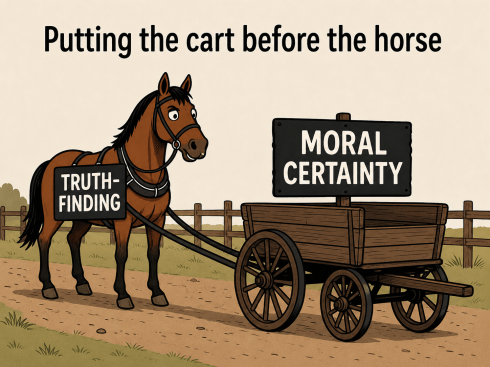
So they accept the conclusion first and hope the facts will catch up later.
They often do not.
Reality has a way of collecting unpaid debts. Bad premises eventually produce visible damage: failed policies, institutional distrust, medical scandals, economic denial, public cowardice, and citizens who no longer believe official language because they have watched it bend too many times.
The answer is not cynicism. Cynicism is often just laziness wearing a smarter jacket. The answer is better truth-finding: slower claims, clearer definitions, stronger evidence, real costs counted on both sides, and a willingness to notice when our preferred story stops matching the world.
That includes me. That includes you. That includes the people whose politics we find irritating, fashionable, smug, or deranged. Nobody gets a permanent exemption from reality because their intentions are good or their enemies are worse.
A decent society needs moral seriousness, but moral seriousness cannot mean protecting our favourite conclusions from examination. It has to mean caring enough about justice to ask whether our account of the world is actually true.
I do not especially care whether someone voted Liberal, Conservative, NDP, or something stranger from the pamphlet table. A democratic country still needs citizens who can look at reality without first asking whether the facts are useful to their team.
Canada is not in a healthy place. The economy has posted two straight quarters of contraction on an annualized basis, which is why the phrase “technical recession” has entered the conversation, even if analysts can argue over how much weight to give that label. Statistics Canada reported unemployment at 6.9% in April 2026, with youth unemployment at 14.3%. Food insecurity is harder to soften: PROOF reported that in 2024, 25.5% of people in the ten provinces lived in food-insecure households, about 10 million people, including 2.5 million children. These are not fringe complaints or partisan vibes. They are indicators of stress in the lives of ordinary people.
The point is not that every bad number belongs neatly to one party. Serious people should avoid that reflex. Some problems are inherited. Some are global. Some are structural. Some are provincial. Some are made worse by federal policy, and some are made worse by years of institutional delay, denial, or misplaced priorities. Canada’s productivity weakness, housing shortage, debt burden, immigration pressures, and affordability crisis did not arrive in one tidy partisan package. That is precisely why citizens need better habits of attention, not better excuses.
This is where media hygiene matters.

A lot of political coverage trains people to process public life through narrative before evidence. The right leader appears calm, credentialed, and respectable, so economic stress becomes “headwinds.” Stagnation becomes “uncertainty.” Failure becomes “transition.” Aggregate growth gets reported without enough attention to per-person decline. A press conference sounds adult and measured, while the household math keeps getting worse.
This problem is not confined to one side. Liberal-friendly media can soften failure when the right institutional language is being used. Conservative-friendly media can turn every bad number into proof that the apocalypse has already been scheduled. Social media rewards panic, resentment, and team loyalty. Legacy media rewards access, tone, and respectable framing. The result is a public conversation where facts often arrive already dressed for the argument someone wanted to make.
Voters participate in this too. Partisans learn to defend their side before checking the claim. Comfortable people mistake their own insulation for national health. Professionals who live inside institutional language can forget that ordinary Canadians live inside rent, groceries, wages, taxes, debt, and renewal notices, none of which become easier because the country’s managerial class found a more reassuring adjective.
A country needs some measure of optimism to function, so the answer is not theatrical despair. But optimism that cannot survive contact with the facts is closer to mood management than civic seriousness. Canadians should be able to say two things at once: yes, a leader may seem more competent than the alternative, and yes, the material indicators are still ugly. One does not cancel the other.
Political maturity begins when people stop treating bad news as betrayal. Reality does not care which party benefits from noticing it, which is precisely why noticing it remains one of the basic duties of citizenship.
Social media is not a neutral information pipeline. It is a distribution system for identity scripts, status incentives, and institutional messaging aimed at children and adolescents.
The internet matters, but the internet is not the first mover. The first mover is often the institution. Child-facing media packages contested identity-adjacent material in a glowing register—creativity, confidence, self-expression, empowerment—then platforms do what platforms do: amplify, repeat, and reward.
That sequence matters. Parents know the internet is porous and chaotic. Institutional children’s programming arrives pre-approved. It signals safety. It signals legitimacy. By the time a clip hits the feed, it is not just content. It is content stamped with adult authority.
Criticism of this pattern is routinely framed as hostility to “queer youth.” That framing is too convenient. The stronger criticism is about frameworks.
Some strands of queer activism are not simply asking for tolerance or protection from abuse. They are explicitly suspicious of norms as such, and in some cases treat norm disruption as a political good. Adults can debate that project in adult spaces. The problem begins when a norm-disruptive framework is repackaged as child guidance and presented as developmental common sense.
Developmental psychology matters here as a guardrail. Piaget’s core point still stands: children do not think like adults; reasoning develops in stages. Erikson likewise treats identity formation as developmental, social, and staged. Children and early adolescents are especially sensitive to imitation, belonging, prestige, and adult cues. That does not mean they lack an inner life. It means adults should not hand them high-status identity templates and call it pure self-discovery.
The question is not whether vulnerable youth exist. They do. The question is whether activist frameworks built to challenge adult social norms should be translated into child-facing institutional messaging as if they were straightforwardly age-appropriate. On that question, skepticism is not cruelty. It is adult judgment.
Public argument usually collapses here. One side calls it moral panic. The other calls it recruitment. Both are lazy.
Children are impressionable. Social learning is real. Status-seeking is real. Identity experimentation is real. None of that requires conspiracy thinking. It also does not justify a cartoon model of causation where one video produces one outcome. The serious concern is cumulative: repeated exposure, emotional framing, peer reinforcement, institutional endorsement, and algorithmic repetition shape what children perceive as admirable, normal, and socially rewarded.
That concern becomes more serious when the surrounding issue can become clinical. Once clinical pathways enter the picture, the adult burden of care rises. “Let kids explore” is not a sufficient standard when the surrounding culture is supplying scripts, rewards, and institutional validation at scale.
The evidence conversation has to stay honest. Research on social media and transgender or gender-diverse youth supports a mixed picture: online spaces can correlate with distress, discrimination, and problematic use, while also providing support, connection, and relief from offline isolation. Used carelessly, that literature gets abused in both directions—either as proof of “brainwashing” or as proof that social influence is irrelevant.
The more useful point is simpler: institutions increasingly present contested identity material to children in the language of celebration before they provide any framework for developmental caution. The sequencing is wrong. The tone is wrong. The confidence is often ahead of the evidence.
A sane standard is still available. Some online spaces help marginalized youth. Some online dynamics intensify confusion, distress, and imitation. Institutions should not present complex identity performance to children as if there are no downstream risks, tradeoffs, or developmental questions.
That is not cruelty. It is adult supervision.
The deeper problem is cultural, not merely digital. We outsource moral formation to feeds, then act surprised when children absorb what the feed rewards. Social media amplifies. Schools legitimize. Media narrates. Government ratifies. Then the shift is described as organic.
It is not fully organic. It is curated.
That does not mean every child in these spaces is inauthentic. It means authenticity itself is now being shaped inside an environment saturated with scripts, incentives, and prestige signals children are poorly equipped to evaluate critically.
If standards do not return, institutions will keep mistaking early exposure for compassion, and children will keep paying for adult vanity dressed up as progress.
References
-
Piaget, Jean, and Bärbel Inhelder. The Psychology of the Child.
-
Erikson, Erik H. Identity: Youth and Crisis.
-
Halperin, David M. Saint Foucault: Towards a Gay Hagiography. Oxford University Press, 1995.
-
Keenan, H., and Lil Miss Hot Mess. “Drag Pedagogy: The Playful Practice of Queer Imagination in Early Childhood.” Curriculum Inquiry (2021). DOI: 10.1080/03626784.2020.1864621.
-
CBC Kids News / Drag Kids segment (2017, resurfaced clip).
The first duty of public journalism after a massacre is simple: name the dead, establish the sequence, and tell the truth about what is known and what is not. That is media hygiene. That is how a public learns. That is how systems get fixed.
Instead, we got a firewall.
In the immediate wake of the Tumbler Ridge killings—home first, then school; five students dead, an education assistant dead; the perpetrator dead by suicide—the national conversation was quickly steered away from forensic clarity and toward reputational triage. In at least one major network segment, the frame was explicit: the story was “anti-trans disinformation” after the shooting. Not the chain of events. Not the failure points. Not the institutional blind spots. The message was prophylactic: watch what you say; the real danger is how people might talk about it.
This is not merely tone-deaf. It’s a form of complicity.
Not complicity in the act, obviously—complicity in what follows: the slow, predictable replacement of accountability with moral theatre. When a newsroom’s first instinct is to manage narrative risk, it begins to treat facts as flammable materials—things to handle with gloves, filter through approved experts, and keep away from ordinary citizens who might draw the “wrong” conclusions.
That is how gatekeepers lose legitimacy. And it is how tragedies become recurring.
The mechanism: switch the object of fear
Watch the pivot closely and it’s always the same move.
- A real event happens in the world—blood, bodies, families blown open.
- The newsroom identifies a second-order risk: public anger, political fallout, reputational damage to a protected consensus.
- The coverage shifts from “What happened?” to “What must we prevent?”
- Prevention is defined as protecting a narrative, not repairing a system.
The object of fear changes. Instead of fearing the next killing, the institutions fear the next argument.
So they tell you the problem is “misinformation.” They tell you the danger is “conflation.” They tell you this is a moment for “community support” and “protecting vulnerable people.” And those may all be decent impulses—in their proper place, at their proper time. But as a lead story? As the framing lens? As the moral of the segment?
That’s not reporting. That’s crisis communications.
“Don’t conflate” becomes a solvent
One line in particular functions like a solvent in the modern media ecosystem:
Don’t conflate an identity with violence.
Fine. True in the general case. But after a massacre, deployed as the first moral reflex, it does more than discourage scapegoating. It quietly discourages inquiry.
Because inquiry is not a vibe. Inquiry is a chain:
- What was the timeline?
- What were the warning signs?
- Who saw what?
- What interventions were tried?
- Where did they fail?
- What policies shaped those failures?
- What is going to change next week because children are dead?
A solvent doesn’t “refute” those questions. It dissolves the social permission to ask them. It turns scrutiny into contamination.
That is why it feels so out of touch to grieving parents: it is journalism behaving as if the central public hazard is discussion rather than risk.
Media complicity looks like this
Complicity, in this context, is not about malice. It’s about habit.
It’s the habitual choice to protect institutions from accountability by rerouting attention:
- From the scene to the discourse.
- From the victims to the community statement.
- From the timeline to the think-piece.
- From “what failed?” to “what mustn’t be said?”
A professional newsroom used to be allergic to this. The old standards—imperfect, often biased, frequently arrogant—still had a core ethic: facts first, advocacy last. If advocacy entered the frame, it was labeled as such. If uncertainty existed, it was named. If a claim couldn’t be verified, it didn’t get aired as settled truth.
Today, too often, we get advocacy laundering: press-release moralizing presented as news, with the added twist that dissent is treated as a moral defect rather than a factual dispute.
That is not neutrality. That is narrative commitment wearing a blazer.
What “media hygiene” used to mean (and must mean again)
A return to old standards isn’t nostalgia. It’s practical survival. Here’s what media hygiene looks like when it’s done properly—especially after mass violence:
1) Victims first.
Name the dead. Describe the community. Make the loss real before you make it useful.
2) Sequence before interpretation.
Timeline, confirmed facts, and clearly separated unknowns. No moral “lesson” until the basic chain is established.
3) Mechanisms over slogans.
If firearms were involved, the mechanism is access and storage—specific failures, not national clichés. If mental health is part of the background, the mechanism is escalation thresholds and follow-up—specific gaps, not hashtags.
4) No prophylactic framing.
Do not lead with “misinformation,” “backlash,” or “what this might fuel.” Those are downstream effects. They are not the event.
5) Don’t pre-label inquiry as bigotry.
Scapegoating is wrong. So is shutting down investigation by treating questions as dangerous.
6) Separation of church and newsroom.
Advocacy voices may be relevant. They must not become the controlling lens. Journalists should interrogate them the way they interrogate police, politicians, and corporations.
7) Corrections that cost you pride.
If you get something wrong, correct it prominently, not performatively. Trust is built when gatekeepers admit error without theatrics.
None of this requires “hating” anyone. It requires doing the job.

The consequence of failing the job
When media behaves like a narrative defense force, the public does not become more compassionate. It becomes more suspicious. It begins to assume that every tragedy will be translated into a pre-approved moral. It begins to look elsewhere for facts—often to sources far less responsible, far more conspiratorial, and far more cynical.
That is the boomerang effect of the firewall: the attempt to prevent “bad interpretations” produces a credibility vacuum, and the vacuum fills with poison.
If journalists want to stop that cycle, they can’t do it by lecturing the public into compliance. They can only do it by earning trust the old way: through sequence, clarity, restraint, and the disciplined refusal to turn atrocity into messaging.
Because if the first move after a massacre is to protect a narrative, the system will not learn.
And if the system does not learn, it will repeat. 🕯️











 bleatmop
 Mystro
 The Arbourist


 Dead Wild Roses
Your opinions…