
You are currently browsing the tag archive for the ‘Reality Testing’ tag.
“Human beings are very good at noticing the stupidity of outsiders and very bad at noticing when our own side has started laundering emotion through principle.”
It is easy to pick apart other people’s bad arguments. Too easy, sometimes. When the subject is gender ideology, the temptation is worse because so much of the public argument really does arrive as slogans, emotional coercion, category confusion, and moral theatre wearing institutional shoes.
But ease is a warning sign.
If an opponent’s weakest argument is the only one I can bear to examine, then I am not truth-seeking. I am harvesting reassurance. That may feel satisfying in the moment, especially when the home team applauds, but it is not the same thing as thinking.
The discipline I keep returning to is simple and unpleasant: prosecute your own argument in the harshest light you can tolerate. Ask what would weaken it. Ask which evidence you are avoiding. Ask whether your conclusion has become part of your identity, because once that happens, correction starts to feel like humiliation.
That is not easy. It cuts against our tribal wiring. Human beings are very good at noticing the stupidity of outsiders and very bad at noticing when our own side has started laundering emotion through principle. The people who agree with us can become dangerous in exactly this way. They reward the sharp line, the fast dunk, the satisfying contempt. They rarely reward the moment when you say, “This part of my own argument may need work.”
 I have had to revise some of my own instincts here. It is too easy to treat the whole phenomenon as ideology, cowardice, and social contagion. Those are real forces, but they do not explain every person caught inside the debate. Some people experience severe and persistent distress around sexed embodiment, and social recognition may reduce suffering in ways that are not trivial. That does not settle women’s spaces, children’s medicine, sports, prisons, or compelled speech. It does mean I have to resist the temptation to collapse every person into the worst activist slogan spoken on their behalf.
The trans debate remains a useful stress test because the public claims are so unstable. If strong evidence showed that cross-sex identification reflected a stable, measurable condition that reliably benefited from social or medical transition under careful safeguards, I would have to revise parts of my view. At present, I do not think that case has been made strongly enough, especially where children, safeguarding, and sex-based boundaries are concerned. Much of what is offered instead is moral pressure: affirmation presented as care, skepticism presented as harm, boundaries presented as hatred.
Still, that cannot become an excuse to write off every person on the other side. The strongest version of their argument is not that slogans are true because activists shout them. It is that some people experience suffering serious enough to deserve humane attention, even if the metaphysics built around that suffering are confused or overstated.
This is where charity matters. Not sentimental charity. Not the kind that asks you to pretend bad arguments are good. Real charity means refusing to make your opponent smaller than they are so you can defeat them more easily.
I do not want to become the mirror image of what I criticize: someone who begins with moral certainty, chooses the facts that flatter it, and treats disagreement as evidence of corruption. If reality matters, then it has to matter when it inconveniences me too.
That is the standard. Not perfection, because nobody gets that. But a willingness to remain revisable. To notice when contempt is doing the work of argument. To ask whether a cherished belief has survived scrutiny or merely avoided it.
A truth-first posture is only worth having if it still applies when the correction costs you something.
The double-slit experiment is one of those scientific ideas people love to borrow badly. It is strange, genuinely humbling, and easy to misuse. That makes it perfect material for people who want reality to be less stubborn than it is.
The basic version is simple enough. Fire particles through two slits without measuring which slit they pass through, and over time they produce an interference pattern, the kind of pattern we associate with waves. Try to measure which slit they go through, and that pattern changes. The system no longer behaves the same way.
That is the part people remember. Unfortunately, they often remember it badly.
The experiment does not show that human consciousness creates reality. It does not show that the universe waits around for a person to notice it before deciding what it is. “Observation” in this context does not mean vibes, attention, social agreement, or someone staring meaningfully at an electron. It means measurement. It means physical interaction with the system. The apparatus matters because the apparatus is part of the situation being tested.
That is weird enough. We do not need to add incense.
There are still serious debates in the foundations of quantum mechanics about how best to interpret what is happening. That is worth admitting. But those debates do not rescue the popular abuse of the experiment. Consciousness is not required, politics does not select the result, and social approval does not decide whether the interference pattern appears.
The real lesson is more disciplined and more interesting. Reality is not always available to common sense. How we investigate can affect what we are able to detect. At quantum scales, measurement is not a passive act, like glancing at a chair from across the room. It changes the conditions under which the result appears.
That should make people humble about truth-finding. It should not make them casual about reality.
This is where social constructivist thinking often slips in through the side door. It does not usually announce itself by saying, “Nothing is real.” That would be too crude, and too easy to reject. Instead, it emphasizes language, framing, power, interpretation, categories, and social meaning until the reader quietly stops treating reality as a constraint and starts treating it as a negotiation.
Reality is real, but not always simple. Because it is not simple, we need better methods, not ideological shortcuts.
Some things really are socially constructed. Money depends on shared agreement. Borders depend on law, force, recognition, and maps. Job titles, academic credentials, citizenship categories, and institutional rituals all rely on human systems to maintain them. That is not a trivial point. Human beings create layers of social meaning that shape how we live, distribute status, enforce rules, and decide what counts inside institutions.
But the fact that some realities are socially maintained does not mean all realities are socially produced. The category “doctor” is socially regulated. The body on the operating table is not. A passport is a legal object. A kidney is not. A government can change language around inflation, housing, crime, or sex, but the material world does not become more cooperative because the terminology became more fashionable.
This is the tell to watch for. A valid insight about interpretation gets stretched until it weakens contact with reality. “Categories have social meaning” becomes “categories are merely imposed.” “Observation matters” becomes “truth depends on standpoint.” “Language shapes perception” becomes “language can rearrange the world.” Each step sounds sophisticated enough in isolation. Put them together, and ordinary reality gets escorted out of the room by people who insist they are only asking questions.
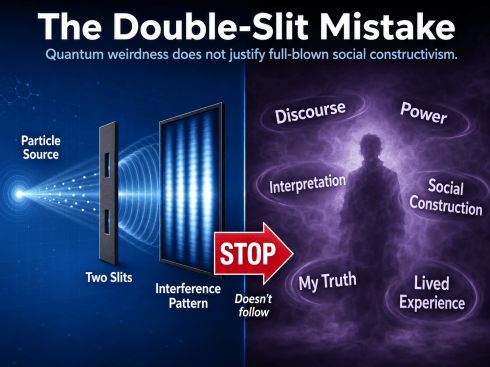
The double-slit experiment does not support that move. If anything, it rebukes it. The experiment is repeatable. The results are disciplined. The mathematics is unforgiving. You do not get a different interference pattern because your politics require one. You do not get to vote on the apparatus. The whole point of the experiment is that reality answers back, though not always in the form our intuitions expected.
That distinction matters far beyond physics. Bad theories of reality do not stay in seminar rooms. They eventually show up in schools, medicine, law, media, and public policy, often wearing the language of compassion or sophistication. If institutions lose the ability to distinguish between social meaning and material constraint, they do not become more humane. They become easier to fool.
Quantum weirdness should not become a permission slip for intellectual fog. It should remind us that careful methods are necessary precisely because reality can be subtle. The world is not always obvious, but it is also not waiting for our preferred theory to grant it permission to exist.
The better response to mystery is not social construction all the way down. It is patience, precision, and less eagerness to turn every difficulty in knowing into an excuse for pretending the thing known has disappeared.
Good intentions are not enough. That should be obvious, but much of our public life now behaves as if noble language can rescue bad thinking.
Before people declare what is compassionate, just, inclusive, hateful, dangerous, or necessary, they need some reliable way of knowing whether their factual claims are true. That order matters. If the tools used to find truth are broken, captured, or designed to protect a preferred belief from contradiction, then the moral conclusions built on top of those tools will inherit the damage.
This is not a left-wing or right-wing problem, though each side prefers noticing it in the other. The progressive version often begins with moral urgency. A policy is called compassionate, inclusive, or protective, and once that moral label is attached, factual objections start to look suspicious. Questions about consequences become “harm.” Questions about definitions become “erasure.” Questions about evidence become proof that the questioner is unsafe.
The conservative version has its own habits. A bad social trend gets folded too quickly into civilizational decline. One ugly example becomes proof of total collapse. A complicated institutional failure becomes evidence that the enemy planned the whole thing. The moral conclusion may contain some truth, but it arrives too early and then starts recruiting facts to serve it.
That is the trap. Once moral certainty arrives first, the mind stops investigating and starts defending.
You can see the pattern wherever institutions are rewarded for sounding virtuous before they are required to be accurate. A school board adopts fashionable language before asking whether the policy helps children. A medical system treats hesitation as cruelty before the long-term evidence is settled. A government describes economic pain in careful managerial terms while households are trying to make rent, groceries, debt, and wages fit inside the same month. The details differ, but the sequence is familiar: the moral frame arrives first, and the facts are invited in later as supporting cast.
A healthier public culture would ask plainer questions before the slogans begin. What is the claim? What evidence would show it is true? What evidence would weaken it? Who pays the cost if we are wrong? Are we counting those costs honestly, including the costs to people we do not like? Are we applying the same standard when the facts embarrass our own side?
Those questions are not glamorous. They do not fit neatly on a protest sign or a campaign graphic. They also do not offer the emotional satisfaction of instant righteousness. But they are the difference between thinking and performing.
This matters because moral language is powerful. It can move people to protect the vulnerable, correct injustice, and resist cruelty. But the same language can also be used to smuggle weak claims past scrutiny. Institutions have incentives to do this. Activists gain status from certainty. Bureaucracies protect themselves with approved vocabulary. Media outlets reward emotional clarity over careful qualification. Ordinary people learn, quickly enough, which questions are safe to ask in public and which ones are better saved for the parking lot.
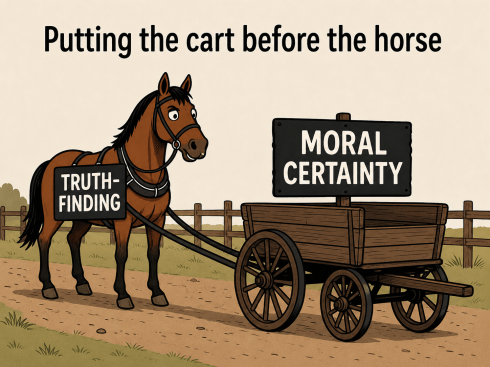
So they accept the conclusion first and hope the facts will catch up later.
They often do not.
Reality has a way of collecting unpaid debts. Bad premises eventually produce visible damage: failed policies, institutional distrust, medical scandals, economic denial, public cowardice, and citizens who no longer believe official language because they have watched it bend too many times.
The answer is not cynicism. Cynicism is often just laziness wearing a smarter jacket. The answer is better truth-finding: slower claims, clearer definitions, stronger evidence, real costs counted on both sides, and a willingness to notice when our preferred story stops matching the world.
That includes me. That includes you. That includes the people whose politics we find irritating, fashionable, smug, or deranged. Nobody gets a permanent exemption from reality because their intentions are good or their enemies are worse.
A decent society needs moral seriousness, but moral seriousness cannot mean protecting our favourite conclusions from examination. It has to mean caring enough about justice to ask whether our account of the world is actually true.











 bleatmop
 Mystro
 The Arbourist


 Dead Wild Roses
Your opinions…