
You are currently browsing the tag archive for the ‘Postmodernism’ tag.
The double-slit experiment is one of those scientific ideas people love to borrow badly. It is strange, genuinely humbling, and easy to misuse. That makes it perfect material for people who want reality to be less stubborn than it is.
The basic version is simple enough. Fire particles through two slits without measuring which slit they pass through, and over time they produce an interference pattern, the kind of pattern we associate with waves. Try to measure which slit they go through, and that pattern changes. The system no longer behaves the same way.
That is the part people remember. Unfortunately, they often remember it badly.
The experiment does not show that human consciousness creates reality. It does not show that the universe waits around for a person to notice it before deciding what it is. “Observation” in this context does not mean vibes, attention, social agreement, or someone staring meaningfully at an electron. It means measurement. It means physical interaction with the system. The apparatus matters because the apparatus is part of the situation being tested.
That is weird enough. We do not need to add incense.
There are still serious debates in the foundations of quantum mechanics about how best to interpret what is happening. That is worth admitting. But those debates do not rescue the popular abuse of the experiment. Consciousness is not required, politics does not select the result, and social approval does not decide whether the interference pattern appears.
The real lesson is more disciplined and more interesting. Reality is not always available to common sense. How we investigate can affect what we are able to detect. At quantum scales, measurement is not a passive act, like glancing at a chair from across the room. It changes the conditions under which the result appears.
That should make people humble about truth-finding. It should not make them casual about reality.
This is where social constructivist thinking often slips in through the side door. It does not usually announce itself by saying, “Nothing is real.” That would be too crude, and too easy to reject. Instead, it emphasizes language, framing, power, interpretation, categories, and social meaning until the reader quietly stops treating reality as a constraint and starts treating it as a negotiation.
Reality is real, but not always simple. Because it is not simple, we need better methods, not ideological shortcuts.
Some things really are socially constructed. Money depends on shared agreement. Borders depend on law, force, recognition, and maps. Job titles, academic credentials, citizenship categories, and institutional rituals all rely on human systems to maintain them. That is not a trivial point. Human beings create layers of social meaning that shape how we live, distribute status, enforce rules, and decide what counts inside institutions.
But the fact that some realities are socially maintained does not mean all realities are socially produced. The category “doctor” is socially regulated. The body on the operating table is not. A passport is a legal object. A kidney is not. A government can change language around inflation, housing, crime, or sex, but the material world does not become more cooperative because the terminology became more fashionable.
This is the tell to watch for. A valid insight about interpretation gets stretched until it weakens contact with reality. “Categories have social meaning” becomes “categories are merely imposed.” “Observation matters” becomes “truth depends on standpoint.” “Language shapes perception” becomes “language can rearrange the world.” Each step sounds sophisticated enough in isolation. Put them together, and ordinary reality gets escorted out of the room by people who insist they are only asking questions.
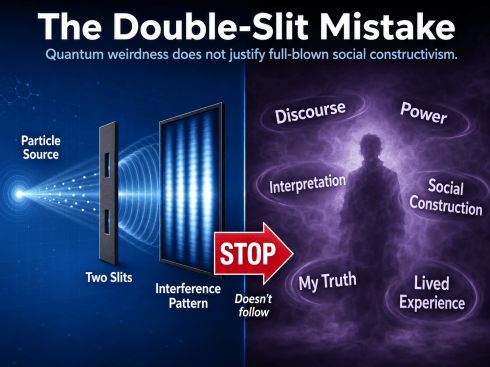
The double-slit experiment does not support that move. If anything, it rebukes it. The experiment is repeatable. The results are disciplined. The mathematics is unforgiving. You do not get a different interference pattern because your politics require one. You do not get to vote on the apparatus. The whole point of the experiment is that reality answers back, though not always in the form our intuitions expected.
That distinction matters far beyond physics. Bad theories of reality do not stay in seminar rooms. They eventually show up in schools, medicine, law, media, and public policy, often wearing the language of compassion or sophistication. If institutions lose the ability to distinguish between social meaning and material constraint, they do not become more humane. They become easier to fool.
Quantum weirdness should not become a permission slip for intellectual fog. It should remind us that careful methods are necessary precisely because reality can be subtle. The world is not always obvious, but it is also not waiting for our preferred theory to grant it permission to exist.
The better response to mystery is not social construction all the way down. It is patience, precision, and less eagerness to turn every difficulty in knowing into an excuse for pretending the thing known has disappeared.
I’m up to Chapter 3 so far and would highly recommend this book to those who want understand the ‘why & how’ of what is happening in our society. Understanding post-modernism is the first step. This is a short summary gleaned from ‘Goodreads’ is a part of what the book is explaining about Postmodern thought.
“The online Encyclopedia Britannica defines postmodernism as: “a late 20th-century movement characterized by broad scepticism, subjectivism, or relativism; a general suspicion of reason; and an acute sensitivity to the role of ideology in asserting and maintaining political and economic power.” The authors of this book mentions the two principles and four themes of postmodernism thus:
1. The postmodern knowledge principle: Radical skepticism about whether objective knowledge or truth is obtainable and a commitment to cultural constructivism.
2. The postmodern political principle: A belief that society is formed of systems of power and hierarchies, which decide what can be known and how.
The Four Major Themes
1. The blurring of boundaries
2. The power of language
3. Cultural relativism
4. The loss of the individual and the universalNow, to translate this to words of one syllable.
The first principle means that we can never know the objective truth: indeed, it is doubtful whether it exists at all. The second principle means that what is known as the truth is decided by the power hierarchy inside the system.
Thus, in one fell swoop, postmodernism dethroned science from its pedestal – because if we are not sure whether there is objective truth at all, why spend time looking for it? And in the colonial world, most of the objective knowledge was based upon colonial viewpoints; so a deconstruction of this was essential, especially as Orientalism was holding sway in the West.
(However, this doesn’t negate the power of science – but the fallout of postmodernism has engendered dangerously unscientific attitudes.)
Now let’s move on to the themes.
The blurring of boundaries means categorisations are no longer trusted. Not only the boundaries between objective and subjective and between truth and belief have been blurred, but also those between science and the arts, the natural and the artificial, high and low culture, man and other animals, and man and machine, and between different understandings of sexuality and gender as well as health and sickness. Everything is a spectrum.
The power of language emphasises that it is through language that we define power structures in a society. Under postmodernism, many ideas that had previously been regarded as objectively true came to be seen as mere constructions of language. In postmodern thought, language is believed to have enormous power to control society and how we think and thus is inherently dangerous. It is also seen as an unreliable way of producing and transmitting knowledge. To summarise: we create reality through language.
In a world where there is no objective truth, no boundaries, and where everything is created through how we speak and think, truth and knowledge are different for each and every culture and no one from outside that culture can comprehend it. This is called cultural relativism.
Consequently, to postmodern theorists, the notion of the autonomous individual is largely a myth. The individual, like everything else, is a product of powerful discourses and culturally constructed knowledge. Equally, the concept of the universal—whether a biological universal about human nature; or an ethical universal, such as equal rights, freedoms, and opportunities for all individuals regardless of class, race, gender, or sexuality —is, at best, naive. At worst, it is merely another exercise in power-knowledge, an attempt to enforce dominant discourses on everybody. This leads to the loss of the individual and the universal.
I totally get this. It’s a very nice intellectual exercise: and I must say that in the field of arts, literature and sociology, it has got valid uses. The only place I take the high road while postmodernists take the low road is when it comes to the concept of the individual and the universal, which I do believe are required as valid concepts if we need an equitable world. And also, for all our subjective perceptions, science has discovered many objective truths through its powerful method, which are not dependent upon language and/ or culture.
But now, the authors started talking about Theory (with a capital T: applied postmodernism) and the concept of Social Justice; and I started getting a bit alarmed – because I could now make sense of how I was annoying all those woke people.
“I do know this: we cannot have this postmodernism and still have a meaningful practice of women’s human rights, far less a women’s movement. Ironically, and how postmodernism loves an irony, just as women have begun to become human, even as we have begun to transform the human so it is something more worth having and might apply to us, we are told by high theory that the human is inherently authoritarian, not worth having, untransformable, and may not even exist-and how hopelessly nineteenth-century of us to want it. (That few of the feminist postmodernists, had it not been for the theory of humanity they criticize, would have been permitted to learn to read and write-this is perhaps a small point.)”
| — | Catharine A. Mackinnon, “Points against Postmodernism“, Chicago-Kent Law Review, Volume 75 Issue 3, Symposium on Unfinished Feminist Business, Article 5 (June 2000) [PDF] |

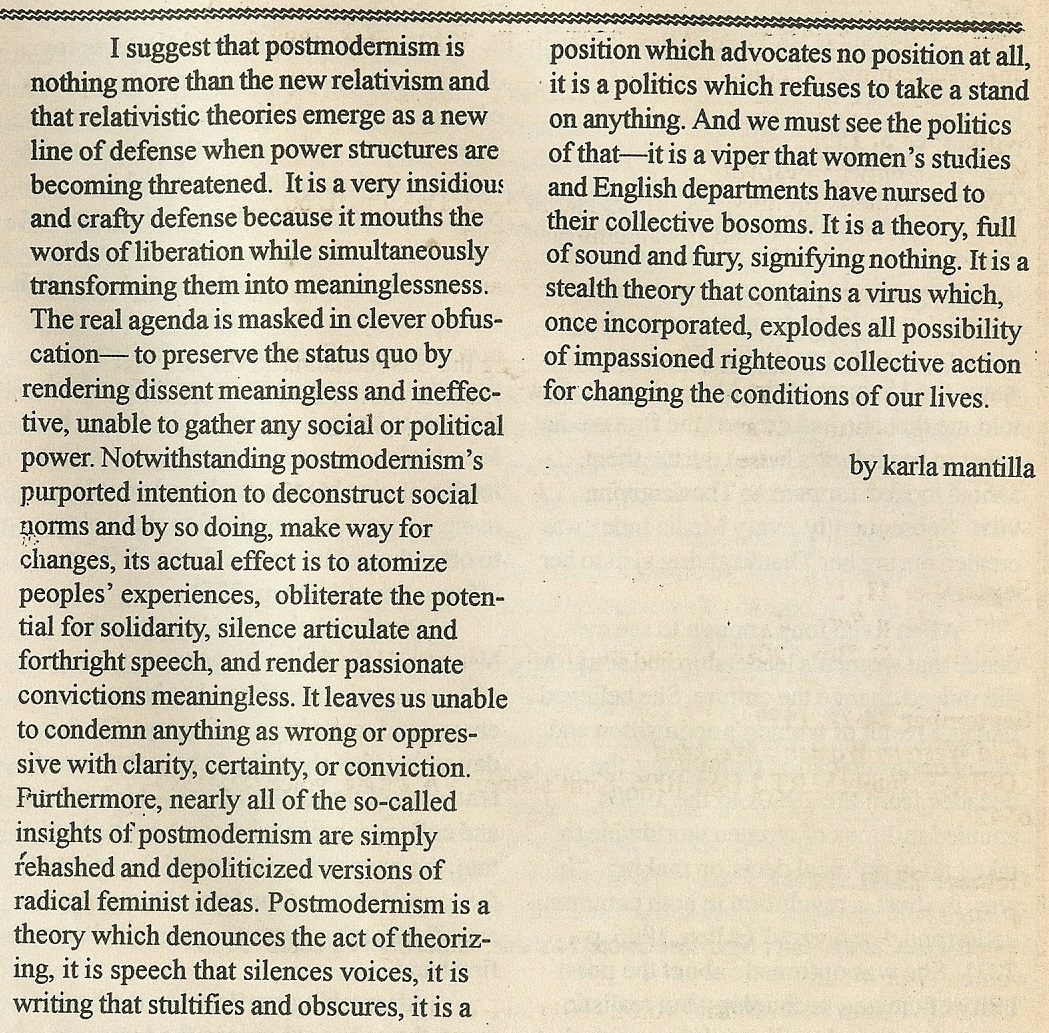
Two views on post modernism and commentary on how it is quite detrimental to society, especially groups that need to band together to affect change in said society.












 bleatmop
 Mystro
 The Arbourist


 Dead Wild Roses
Your opinions…