
You are currently browsing the category archive for the ‘personal’ category.
In 2018, after fifteen years together and six years of marriage, my wife told me that our relationship was no longer working for her and that she wanted to separate. I was left trying to decide what hurt more: the loss of the relationship itself or what felt like the betrayal of the vows we had made. In sickness and in health, for better or worse, until death parted us. Those promises had described the future as I understood it. Suddenly, they did not.
I spent many hours talking with my mother and friends, returning to some version of the same question: How could she do this to me, and how could she do it to us? It was partly a search for an explanation, but it was also an argument with reality. I believed our shared history, the difficult years we had already survived and the commitment we had made to our later years ought to count for more than they apparently did.
She told me that she no longer felt the kind of romantic and physical connection she needed from a marriage. For her, companionship, shared history and the other parts of our covenant could not compensate for what was missing. I did not share her conclusion, but I came to understand it even while experiencing her decision as a betrayal of our vows.
Marriage requires two people to sustain it, but only one to withdraw. I made the case for the life we had built and the future I believed remained possible. A covenant may carry moral obligations, yet it cannot be preserved by one person alone. Eventually, there was nothing left to negotiate except the conditions of the ending.
By 2019, I had lost twenty pounds from stress. The house was sold, and I moved in with my mother to serve as her caretaker. The divorce was amicable in conduct, even when its consequences were devastating. I have seen divorces animated by cruelty, revenge and the deliberate destruction of whatever survives after the marriage has failed. Ours was not like that, and I remain thankful for it. Suffering is not a tournament, however, and perspective does not make an experience painless.
Fiona, our white cat, came with me. She became the finest snuggle companion and love cat a temporarily broken man could have asked for. She offered warmth, routine and uncomplicated affection when all three were badly needed. Fiona died in 2025 and still holds a dear place in my heart. She helped carry me through one loss before I had to grieve hers.

Fiona, who came with me in 2019 and remained a beloved companion until 2025
Divorce is not the same as death, but it breaks many of the same bonds. A familiar person disappears from the role she occupied in my life, taking with her not only the present relationship but an imagined future. The difference is that she remains alive somewhere beyond the boundary of that shared world. The grief therefore carries an additional question: this person did not simply vanish; she chose to leave.
In the final portion of his conversation on TRIGGERnometry, Arthur Brooks presents falling in love as the ultimate example of prudent risk-taking. The phrase initially sounds too calm for the experience it describes. Love exposes us to rejection, grief and the possibility that another person will change in ways we cannot control. Even the happiest relationship eventually exposes someone to loss. Yet the sensible response cannot be to eliminate the risk by refusing to love. A life shielded from every wound would also be cut off from much of what makes life worth living.
This is the difficult territory left after defining happiness and identifying its false substitutes. A happy life is not one in which nothing terrible happens, nor is pain evidence that we have failed to construct one correctly. The more serious question is what pain becomes after it arrives. It can harden into permanent accusation, turn inward as self-punishment or gradually become part of a more honest understanding of ourselves and other people.
Brooks offers a compact formula for the distinction: suffering equals pain multiplied by resistance. It is better read as a heuristic than a clinical equation. Pain is the wound itself; resistance is the mind’s continuing insistence that reality must not be what it already is. One of the hosts describes noise in his home that he could not eliminate. Once he stopped fighting its existence and arranged his life around it, the noise remained but much of his suffering receded.
The stakes of divorce are considerably higher than irritating noise, but I recognized the mechanism. “How could she do this?” was a legitimate moral question, particularly while I was trying to understand what our vows had meant to each of us. Repeating it indefinitely could not restore the marriage. In time, the question stopped uncovering information and became another way of refusing an answer I had already received.
Non-resistance does not mean passivity, and acceptance is not a moral pardon. Some causes of pain can and should be changed. Illness should be treated, injustice opposed and a failing relationship confronted while both people remain willing to repair it. Wisdom lies partly in recognizing which lever is still available. I could ask for honesty and examine my conduct. I could not make another person want the same future.
This raises an apparent tension in Brooks’s account: he speaks of suffering as sacred and part of being fully alive, but also argues that we can reduce it by relinquishing resistance to unavoidable pain. I would put the first claim more cautiously. I did not want my divorce or, years later, Fiona’s death. Pain does not become valuable merely because we survive it, nor does an injury become virtuous through severity. A life fully alive does not go looking for wounds. It accepts vulnerability as the cost of loving others and pursuing goods that can be lost.
The divorce taught me, but it did not teach automatically. Whatever wisdom I gained emerged through conversations, reflection and decisions made after the initial crisis had passed. That process helped me move from blaming her to blaming myself and finally toward a more complicated account of us. It did not divide responsibility into mathematically equal shares. It allowed me to examine the part of the marriage that was mine to understand.
Looking back, I came to see how often I had confused being nice with being kind. Niceness, as I had practised it, tried to preserve the immediate calm. It avoided the difficult conversation, softened the unwelcome observation and plastered over cracks in the foundation in the hope that they would repair themselves. Kindness proved more demanding. It required accepting the discomfort of telling the truth before silence turned a manageable problem into structural damage.
Hard honesty begins with ourselves. We can believe we are being considerate while quietly withholding information another person needs in order to know us. Assumptions fill the resulting gaps, and because they are rarely tested, they can resemble mutual understanding for years. The surface remains pleasant until it can no longer bear the weight placed upon it.
Better communication cannot save every relationship because honest people sometimes want incompatible things. Truth guarantees nothing, but it clarifies the risk they are taking together and replaces unspoken expectations with something less comfortable but more solid.
Gratitude arrived much later. For a long time, acknowledging that the marriage contained real happiness felt dangerously close to excusing the way it ended. Yet the fifteen years were not all bad. Most of them were pretty good. The ending did not retroactively poison every shared meal, private joke, difficult season survived or ordinary day of companionship. Those experiences were real even though the permanence I attached to them was not.
I still qualify that gratitude. The betrayal continues to irk me in the way a scar does not quite feel like the surrounding skin. A scar is not an open wound, but neither is it evidence that nothing happened. Gratitude does not require us to falsify the texture of memory. It is not a final acquittal delivered upon the past; it is the gradual recovery of what was worth having from the pain of how it was lost.
Fiona taught the same truth in a gentler register. Knowing now that I would lose her does not make me wish she had not come with me. Grief should not have exclusive ownership of the memories that preceded it. The pain belongs to the story, but it does not get to claim the entire story as its own.
By 2020, I was ready to try again, though “ready” may grant the process more tidiness than it possessed. I made one commitment to myself: I would be honest about who I was, what I wanted and what I brought to the table. I had no interest in selling someone a polished version of myself and hoping reality would arrive too gradually to cause trouble.
Six years into my current relationship, it is about as good as relationships get. There are still problems and irritations because two imperfect people have not discovered a loophole in the human condition. Marriage may be on the horizon. Would it be a slam dunk? I know better than to claim that. People and their desires change over time, and vows cannot remove the freedom that gives them meaning.
What we can do is communicate, listen and try to understand what the person beside us is feeling before the cracks disappear beneath another coat of plaster. We can tell the truth early enough for kindness to remain possible. None of this guarantees permanence. It creates better conditions for trust and gives both people a fairer understanding of the life they are choosing.
This is what makes love a prudent risk rather than blind optimism. Prudence does not eliminate uncertainty; it asks whether the good being pursued is worthy of the exposure it requires. I entered this relationship without believing I had made myself invulnerable to another loss. I knew more clearly what love asks of me and what avoidance had once allowed me not to say.
A fully alive person is not someone who has learned to enjoy suffering. There is no moral achievement in remaining inside preventable misery, and no virtue in refusing help when pain becomes unmanageable. The choice is not between worshipping suffering and fleeing every discomfort. It is between treating pain as one part of life and allowing the fear of pain to determine the boundaries of living.
Enjoyment, satisfaction and meaning do not form a protective wall around a life lived properly. Faith, family, friendship and meaningful work matter partly because they draw us beyond the small territory we could keep perfectly controlled.
I would not choose the divorce again merely to preserve its lessons. I would not choose Fiona’s death to prove that her companionship mattered. Yet I remain grateful for what was good in my marriage, for the white cat who helped a temporarily broken man find warmth again, and for the relationship that later asked me to risk an uncertain future with greater honesty.
Happiness does not require a painless life. It requires enough openness to keep loving what can be lost, enough judgment to change what can still be changed, and enough humility to carry what cannot. The scar remains different from the surrounding skin, but it belongs to a living body.

“Human beings are very good at noticing the stupidity of outsiders and very bad at noticing when our own side has started laundering emotion through principle.”
It is easy to pick apart other people’s bad arguments. Too easy, sometimes. When the subject is gender ideology, the temptation is worse because so much of the public argument really does arrive as slogans, emotional coercion, category confusion, and moral theatre wearing institutional shoes.
But ease is a warning sign.
If an opponent’s weakest argument is the only one I can bear to examine, then I am not truth-seeking. I am harvesting reassurance. That may feel satisfying in the moment, especially when the home team applauds, but it is not the same thing as thinking.
The discipline I keep returning to is simple and unpleasant: prosecute your own argument in the harshest light you can tolerate. Ask what would weaken it. Ask which evidence you are avoiding. Ask whether your conclusion has become part of your identity, because once that happens, correction starts to feel like humiliation.
That is not easy. It cuts against our tribal wiring. Human beings are very good at noticing the stupidity of outsiders and very bad at noticing when our own side has started laundering emotion through principle. The people who agree with us can become dangerous in exactly this way. They reward the sharp line, the fast dunk, the satisfying contempt. They rarely reward the moment when you say, “This part of my own argument may need work.”
 I have had to revise some of my own instincts here. It is too easy to treat the whole phenomenon as ideology, cowardice, and social contagion. Those are real forces, but they do not explain every person caught inside the debate. Some people experience severe and persistent distress around sexed embodiment, and social recognition may reduce suffering in ways that are not trivial. That does not settle women’s spaces, children’s medicine, sports, prisons, or compelled speech. It does mean I have to resist the temptation to collapse every person into the worst activist slogan spoken on their behalf.
The trans debate remains a useful stress test because the public claims are so unstable. If strong evidence showed that cross-sex identification reflected a stable, measurable condition that reliably benefited from social or medical transition under careful safeguards, I would have to revise parts of my view. At present, I do not think that case has been made strongly enough, especially where children, safeguarding, and sex-based boundaries are concerned. Much of what is offered instead is moral pressure: affirmation presented as care, skepticism presented as harm, boundaries presented as hatred.
Still, that cannot become an excuse to write off every person on the other side. The strongest version of their argument is not that slogans are true because activists shout them. It is that some people experience suffering serious enough to deserve humane attention, even if the metaphysics built around that suffering are confused or overstated.
This is where charity matters. Not sentimental charity. Not the kind that asks you to pretend bad arguments are good. Real charity means refusing to make your opponent smaller than they are so you can defeat them more easily.
I do not want to become the mirror image of what I criticize: someone who begins with moral certainty, chooses the facts that flatter it, and treats disagreement as evidence of corruption. If reality matters, then it has to matter when it inconveniences me too.
That is the standard. Not perfection, because nobody gets that. But a willingness to remain revisable. To notice when contempt is doing the work of argument. To ask whether a cherished belief has survived scrutiny or merely avoided it.
A truth-first posture is only worth having if it still applies when the correction costs you something.
For most of my adult life, I identified as left-of-centre. I supported progressive policies on social issues, the environment, and equality. But over the past few years—especially now, at 51—I’ve found myself increasingly out of step with parts of the contemporary left. Not because my values changed, but because many of the policies being pushed today feel more disruptive than constructive. They often reshape core institutions, family structures, or economic systems without clear evidence that the changes will work long-term.
This isn’t a turn toward extremism. I still care deeply about compassion, fairness, and progress. What has changed is my tolerance for sweeping experimentation without rigorous testing. I want policy that is incremental, evidence-based, and willing to adjust when data shows something isn’t working. That’s not ideology—it’s responsibility.Seeking evidence-driven solutions isn’t inherently “right-wing.” Both sides claim to follow the data, but in practice, good policy should transcend labels. Historically, Canadian conservatism has often embodied this approach: balanced budgets, stable institutions, and pragmatic reforms that build on what already works rather than tearing systems down in pursuit of unproven theories.
Yet critics are quick to slap on labels like “Maple MAGA”—a term meant to equate any Canadian centre-right view with the most polarizing elements of U.S. Trumpism. It’s a lazy shortcut, designed to shut down conversation rather than understand it. Not every conservative is a populist firebrand. Many people—myself included—are simply tired of rapid, ideologically driven changes that risk destabilizing society without demonstrating clear benefits.
I’m not closed off. If strong evidence emerges showing that bold progressive policies genuinely improve stability, opportunity, and quality of life, I’m willing to reconsider. But right now, I see more promise in cautious, proven approaches that respect the complexity of the systems we’re trying to improve.
What about you? Have your views shifted as you’ve gained more life experience? I’m interested in real dialogue: no smears, no lazy labels, and no assumptions that a shift in perspective means abandoning core values.

To all of my friends and followers I wish you the most merry of holiday times. May the long nights be filled with warm blankets, hot chocolate, and holiday cheer. Thank you for your time and engagement here at DWR I appreciate your comments and contributions to the blog.
Bach’s Mass in B minor BWV 232 needs no introduction. It is “The Mass” that stands above all sacred works. I present it here in full realized by the Netherlands Bach Society.
May the Mass take you where you need to go to pause and reflect on this time year.
Happy Holidays, Folks! Take care of yourselves.
The Arbourist
The Humane Society kitty lottery came through in spades for me. Meet Quincy, a energetic yet loving fellow who is quite passionate about food and looking out the window. :)

 A few houses down, there’s this neighbour who’s basically declared his yard a no-maintenance zone, and it’s got the whole block groaning. Every winter, we’re all out shoveling to keep the sidewalks clear, but his place? A snow-drift disaster that forces people to shuffle into the street. Come summer, his lawn’s a chaotic sprawl of overgrown grass and invasive weeds that look ready to invade the rest of the neighborhood. Like, come on—how hard is it to just run a mower over your lawn once a week-ish? It’s not like we’re begging for a botanical masterpiece, just some basic effort.
From where I’m at, I don’t have to deal with his mess directly, but you can’t miss it strolling by—it’s like a black hole sucking the charm out of the street. It’s not just about curb appeal; those weeds don’t respect property lines, creeping into other yards, and the unshoveled snow makes life harder for kids or anyone passing through. Keeping your yard decent shows you’re in it with the rest of us, not thumbing your nose at the neighborhood. A quick mow, a bit of edging, or a few minutes with a shovel isn’t a huge ask—it’s like saying, “Hey, I care about this place too.”
I don’t know what’s up with the guy—maybe he’s got bigger fish to fry—but letting your yard turn into the block’s eyesore feels like a choice. Nobody’s expecting him to sculpt topiaries or build a snow fort; just do the minimum so we’re not all dealing with the fallout. We’re all pitching in to keep the street looking like a community, not a free-for-all. A little sweat with a mower or a weed-puller goes a long way to keeping things neighborly.
An antidote :) –
In Loving Memory of Fiona
Today, we said goodbye to our beloved Fiona, a beautiful white cat whose gentle presence brought warmth and joy to our lives every day. Fiona passed away on April 1, 2025, after a brave battle with diabetes and a urinary tract infection that led to kidney failure. She left this world peacefully, surrounded by love, during her final visit to the vet.
Fiona was the epitome of affection, always eager to snuggle and cuddle. Her favorite place was curled up under the covers, right next to her human, where she would drift off to sleep each night, purring softly. Her fluffy white fur and loving nature made her a constant source of comfort and companionship, and her absence leaves a void that cannot be filled.
Though her time with us was cut short by illness, Fiona’s memory will live on in the countless moments of warmth and love she gave so freely. She was more than a pet—she was family, a loyal friend, and a cherished soul who made every day brighter.
Rest in peace, sweet Fiona. You will forever hold a special place in our hearts.
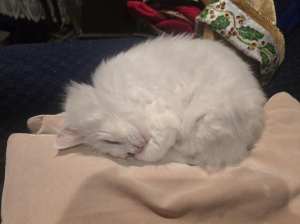





Best nap zone Evar!!
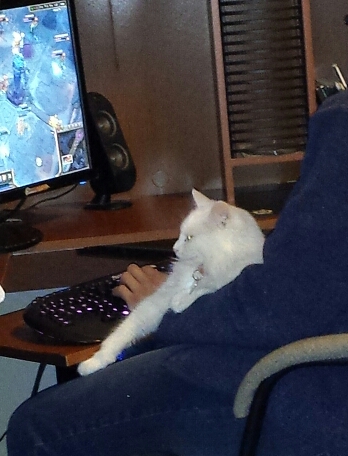
White Cat approves of LoL!
Good Bye Fiona. = Give peace, O Lord, in our days
Da pacem, Domine, in diebus nostris
Give peace, O Lord, in our days











 bleatmop
 Mystro
 The Arbourist


 Dead Wild Roses
Your opinions…