
You are currently browsing the tag archive for the ‘Sunday Religious Disservice’ tag.

I’m an atheist. I do not believe in God, heaven, or some higher intelligence waiting behind the curtain of the universe.
Sometimes that feels like clarity. Sometimes it feels like standing unsheltered in the cold.
Cosmically speaking, we are clinging to an infinitesimal rock circling an ordinary star, drifting through a universe so vast and indifferent that its scale threatens to mock every human urgency. The things that consume us here—war, ideology, political decline, cultural mania, the fate of nations—loom enormous at ground level, yet from any larger vantage they begin to look terribly small, if not absurd.
If you stay in that frame too long, the philosophers are probably right: the line tends toward absurdism, or else toward nihilism. Once the biological imperatives are stripped bare—survive, reproduce, persist—you begin to ask what, exactly, remains, and the answers do not come easily.
Loss is what makes that question hurt.
It is one thing to reject religion in the abstract. It is another to think about the people and creatures you have loved and realize that, if you are right, they are simply gone.
I would love to be wrong about that. I would love there to be a place where what was lost was not really lost, only deferred; a place where I could see again those who were dear to me, where death turned out not to be final after all, where I could hold my cat Fiona again and feel her nose under the covers at bedtime because she had decided, as she often did, that sleep ought to be a shared enterprise. I would love to curl up with her again, give her the scritches she liked, and feel that small, warm, living certainty settle in beside me.
I would fucking love that.
But wanting something to be true does not make it so. Memory is what I have, and memory is not a permanent possession. It erodes. The edges soften. Details lose their fidelity. What once felt immediate recedes, and even love, in that sense, is left to contend with time’s slow vandalism.
So yes, I understand why human beings reached for religion.
A creature capable of love, foresight, memory, and self-consciousness is also capable of a particular kind of suffering. We do not merely lose what we love. We know in advance that we will lose it. We know we will die. We know those we cherish will die. It is not surprising that human beings built systems that promised permanence, reunion, justice, and meaning. Those promises are not arbitrary. They answer real pressures and speak to real wounds.
I do not believe those answers are true.
But I understand the need they answer, and I would be lying if I said I felt no pull from them myself. The appeal is obvious. To be told that love is not finally defeated, that separation is temporary, that the dead are not wholly gone, that all this grief is folded into some larger redeeming order—of course that is appealing. It is appealing because the alternative is so stark.
And yet I cannot make myself believe by force of will. I cannot call a thing true because I find it comforting. That leaves me where many unbelievers eventually find themselves: without eternity, without cosmic reassurance, and still very much in need of something that can be lived on.
When you cannot believe in eternity, you learn to survive on smaller mercies.
You remember what you can, even as memory fades. You invest in people while they are still here. You try to be useful. You try to make or sustain something that matters, however locally, however briefly. You accept that human meaning may not be ultimate and yet refuse, all the same, to treat it as nothing.
For me, a great deal of that has taken the form of music.
I’m a choir junkie. At one point I was singing in five different choirs. I have winnowed it down to four—still more than most people would consider sane—but singing remains one of the few things in life that feels unquestionably real to me. It demands breath, attention, discipline, listening, patience, and a willingness to stop treating your own moods as the center of the universe. You stand among other people and, together, make something that did not exist before. Then, almost as soon as it arrives, it vanishes.
That impermanence is part of the point. Music does not solve death. It does not restore the lost or promise reunion. It offers no metaphysical guarantee at all. What it can do, at its best, is create a moment of such concentrated beauty, order, and shared presence that the void is not answered so much as held at bay. For a little while, meaning is not argued into existence but felt.
The conductor John Eliot Gardiner, writing about Bach, titled his book Music in the Castle of Heaven. I cannot follow him all the way there. I do not believe there is a heaven waiting above or behind the world. But I know the feeling he is trying to name. I know what it is to stand inside a musical moment and feel that another human being, centuries ago, summoned something out of silence that still reaches into the present and gathers us up.
That is heaven enough on earth for me: not eternal life, not divine certainty, but the brief and radiant fact of human beings making something beautiful together in the face of darkness.
I am here at ground level, wanting only to lay a few bricks at the base—to help build, preserve, and share that fleeting experience with others. It is a small pool of light against the void.
And yes, it is small. It does not answer every question. It does not heal every wound. It certainly does not raise the dead. Fiona is still gone. The people we lose do not walk back through the door because a choir sings well enough. The universe does not owe us meaning, and music does not change that. Still, there are moments when a phrase resolves, a harmony opens, or a line of Bach lands with such strange and lucid rightness that one feels, however briefly, less abandoned inside things.
That is not eternity. But it is not nothing.
I criticize religion because it makes unfalsifiable claims about the structure of reality, and I do not think those claims become more credible simply because they are consoling. But my criticism does not cancel the deeper recognition beneath it: religion is trying to answer a question that does not disappear when the answer is rejected.
What do you do with loss?
What do you do with love that has nowhere left to go?
What do you do with the knowledge that everything you build, and everyone you care about, will eventually end?
Memory. Music. Friendship. Work. Service. The quiet dignity of being of some use to other people. The temporary grace of being known, and of knowing others, before the light goes out.
They are not eternity.
And sometimes, for mortal creatures like us, that has to be enough.
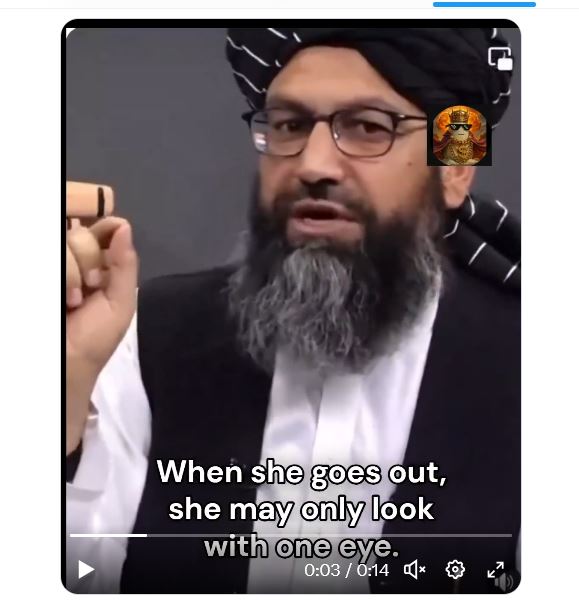
There are sermons that call men to humility, mercy, and repentance. Then there are sermons like this one: small, cruel, and drunk on power.In August 2025, a sermon by Taliban cleric Mahmood Zakeri circulated widely online. In it, he declared that a woman has no right to walk outside with both eyes open, and that if one eye remains uncovered it may be used only to watch the path, not to look around. He also reaffirmed the rule that women must leave home only with a male guardian.
That is not holiness. It is not modesty. It is the religious language of domination.
The point is not simply to cover women. It is to reduce them. A woman may see, but not look. She may move, but not appear. She may exist, but only under supervision. This is what tyranny looks like when it becomes intimate. It does not stop at law or force. It enters the body, the face, the eyes, and the terms of ordinary presence.
The Taliban’s rule over women has followed this logic from the start. Women and girls have been pushed out of school, work, and public life. They have been made dependent, restricted, and vulnerable by design. This sermon matters because it states the regime’s purpose with unusual bluntness. The goal is not public morality. The goal is female submission.
And this is where religion is being degraded along with women.
Islam is being used here not as a path to righteousness, but as a warrant for male control. Scripture and clerical authority are being conscripted to make domination sound sacred. That is one of the oldest abuses of religion: to take what should humble the strong and turn it into a weapon against the weak.
No serious moral society should accept that disguise. A woman is not a source of pollution to be hidden, escorted, monitored, and diminished. She is not male property. She is not a household object under external management. She is a human being. Any system that denies that is evil, whatever language it wraps around itself.
There is something especially repellent in the pettiness of it. Afghanistan has been battered by poverty, war, loss, and instability. Women there have already lost freedom, education, work, and legal protection. Faced with all that suffering, this cleric’s great moral concern is whether a woman may use both eyes.
That is not spiritual seriousness. It is sadism dressed as virtue.
When religion rots into ideology, this is what happens. The faith is no longer used to discipline pride or protect the vulnerable. It is used to flatter male authority and train women into fear. It becomes less a way to honor God than a system for breaking human beings into obedience.
A healthy religion reminds men that they are not God. The Taliban uses religion to tell them they may act like gods over women.
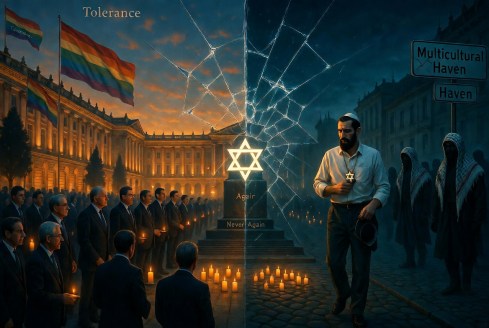
Europe has spent years congratulating itself on becoming too enlightened for its old demons. The old hatreds, we were told, belonged to a darker age: church prejudice, blood-and-soil nationalism, crude ethnic chauvinism, all safely archived in museums and memorial culture. Modern Europe would be different. Liberal. Secular. Therapeutic. Post-tribal. Above all, tolerant.
And yet here we are again, with Jews across Europe reporting that open Jewish life feels risky, visibility feels costly, and public confidence in their safety has eroded badly. The European Union Agency for Fundamental Rights found in its 2024 survey that antisemitism remains a reality for many Jewish people in the EU and that most feel unable to live openly Jewish lives. The agency’s 2026 follow-up stated it even more starkly: Jewish people in the EU face antisemitism on a “nearly constant basis.”
That is the irony. Europe built an entire moral identity around remembering the Jewish catastrophe, and yet in large parts of Europe it has become normal again for Jews to calculate where to wear a kippah, whether to hide a Star of David, and which neighbourhoods are best avoided. The continent has mastered the liturgy of remembrance while struggling with the elementary duty of protection.
The preferred story, of course, is that the danger must still come from the approved villains of European memory: the nationalist brute, the Christian reactionary, the provincial right-wing throwback with too much history and not enough sociology. Sometimes it does. The far right remains real, and in Germany, for example, Reuters reported in June 2025 that the watchdog RIAS recorded 8,627 antisemitic incidents in 2024, nearly double the 4,886 recorded in 2023, and that far-right offenders were responsible for around three times as many incidents as Islamists. That fact matters, and serious people should not airbrush it away for narrative convenience.
But that is not the whole story, and everyone knows it is not the whole story.
“Europe still loves Jews in theory, in memory, in curriculum, in the high-church ceremony of remembrance days. It is the living, visible, inconvenient Jew who keeps committing the unforgivable sin of existing in public.”
What liberal Europe finds harder to admit is that some of the antisemitism now making Jewish life more precarious arrives under the cover of other sacred commitments: multicultural innocence, asylum romanticism, anti-colonial theatre, imported sectarian fury, and elite cowardice dressed up as nuance. The old hatred has not vanished. It has diversified. It now marches under more than one banner. It can wear a bomber jacket, a keffiyeh, or a university lanyard. It can quote medieval slanders or postcolonial jargon. It can shout in the street or whisper in institutional euphemism.
That is what makes the present moment so revealing. Europe did not abolish prejudice. It changed the etiquette around which prejudices could be named plainly. It became exquisitely skilled at denouncing the safe forms of antisemitism, especially the dead ones, while growing clumsy, evasive, or selectively blind toward the live ones.
So the spectacle becomes almost comic in its hypocrisy. Politicians attend Holocaust memorials by day and govern societies by night in which Jews are advised to be discreet. Institutions publish statements about inclusion while Jewish students need security. Commentators deliver lectures on democratic values while treating Jewish fear as awkward, politically inconvenient, or in need of contextualization. Europe still loves Jews in theory, in memory, in curriculum, in the high-church ceremony of remembrance days. It is the living, visible, inconvenient Jew who keeps committing the unforgivable sin of existing in public.
The deepest irony may be this: a civilization that prides itself on tolerance has become so attached to its self-image that it cannot honestly describe the forms of intolerance now flourishing inside its own borders. And when a society cannot name a problem because naming it would embarrass its governing myths, the problem does not disappear. It metastasizes.
A decent society does not prove its virtue by hosting remembrance days, curating moral vocabulary, or posting the correct slogans after each outrage. It proves its virtue when Jews can walk its streets without calculation. Europe remembers what happened. Good. It should. But remembrance that does not cash out in ordinary public safety is beginning to look less like moral seriousness than civilizational vanity.
References
European Union Agency for Fundamental Rights, Jewish People’s Experiences and Perceptions of Antisemitism (11 July 2024). Survey overview and key findings page.
European Union Agency for Fundamental Rights, Monitoring and recording antisemitism in the EU – State of play and ways forward (27 January 2026). Overview and introduction page.
Reuters, “Antisemitic incidents in Germany almost double in 2024, report says” (4 June 2025).
Raymond Ibrahim, “The Irony of Europe’s Antisemitism Problem — Jewish Safety, Migration, and a Failed Narrative,” Hungarian Conservative (21 January 2026). Used here as thematic inspiration rather than as a primary evidentiary source.











 bleatmop
 Mystro


 Dead Wild Roses
Your opinions…