
You are currently browsing the tag archive for the ‘Loss’ tag.

I’m an atheist. I do not believe in God, heaven, or some higher intelligence waiting behind the curtain of the universe.
Sometimes that feels like clarity. Sometimes it feels like standing unsheltered in the cold.
Cosmically speaking, we are clinging to an infinitesimal rock circling an ordinary star, drifting through a universe so vast and indifferent that its scale threatens to mock every human urgency. The things that consume us here—war, ideology, political decline, cultural mania, the fate of nations—loom enormous at ground level, yet from any larger vantage they begin to look terribly small, if not absurd.
If you stay in that frame too long, the philosophers are probably right: the line tends toward absurdism, or else toward nihilism. Once the biological imperatives are stripped bare—survive, reproduce, persist—you begin to ask what, exactly, remains, and the answers do not come easily.
Loss is what makes that question hurt.
It is one thing to reject religion in the abstract. It is another to think about the people and creatures you have loved and realize that, if you are right, they are simply gone.
I would love to be wrong about that. I would love there to be a place where what was lost was not really lost, only deferred; a place where I could see again those who were dear to me, where death turned out not to be final after all, where I could hold my cat Fiona again and feel her nose under the covers at bedtime because she had decided, as she often did, that sleep ought to be a shared enterprise. I would love to curl up with her again, give her the scritches she liked, and feel that small, warm, living certainty settle in beside me.
I would fucking love that.
But wanting something to be true does not make it so. Memory is what I have, and memory is not a permanent possession. It erodes. The edges soften. Details lose their fidelity. What once felt immediate recedes, and even love, in that sense, is left to contend with time’s slow vandalism.
So yes, I understand why human beings reached for religion.
A creature capable of love, foresight, memory, and self-consciousness is also capable of a particular kind of suffering. We do not merely lose what we love. We know in advance that we will lose it. We know we will die. We know those we cherish will die. It is not surprising that human beings built systems that promised permanence, reunion, justice, and meaning. Those promises are not arbitrary. They answer real pressures and speak to real wounds.
I do not believe those answers are true.
But I understand the need they answer, and I would be lying if I said I felt no pull from them myself. The appeal is obvious. To be told that love is not finally defeated, that separation is temporary, that the dead are not wholly gone, that all this grief is folded into some larger redeeming order—of course that is appealing. It is appealing because the alternative is so stark.
And yet I cannot make myself believe by force of will. I cannot call a thing true because I find it comforting. That leaves me where many unbelievers eventually find themselves: without eternity, without cosmic reassurance, and still very much in need of something that can be lived on.
When you cannot believe in eternity, you learn to survive on smaller mercies.
You remember what you can, even as memory fades. You invest in people while they are still here. You try to be useful. You try to make or sustain something that matters, however locally, however briefly. You accept that human meaning may not be ultimate and yet refuse, all the same, to treat it as nothing.
For me, a great deal of that has taken the form of music.
I’m a choir junkie. At one point I was singing in five different choirs. I have winnowed it down to four—still more than most people would consider sane—but singing remains one of the few things in life that feels unquestionably real to me. It demands breath, attention, discipline, listening, patience, and a willingness to stop treating your own moods as the center of the universe. You stand among other people and, together, make something that did not exist before. Then, almost as soon as it arrives, it vanishes.
That impermanence is part of the point. Music does not solve death. It does not restore the lost or promise reunion. It offers no metaphysical guarantee at all. What it can do, at its best, is create a moment of such concentrated beauty, order, and shared presence that the void is not answered so much as held at bay. For a little while, meaning is not argued into existence but felt.
The conductor John Eliot Gardiner, writing about Bach, titled his book Music in the Castle of Heaven. I cannot follow him all the way there. I do not believe there is a heaven waiting above or behind the world. But I know the feeling he is trying to name. I know what it is to stand inside a musical moment and feel that another human being, centuries ago, summoned something out of silence that still reaches into the present and gathers us up.
That is heaven enough on earth for me: not eternal life, not divine certainty, but the brief and radiant fact of human beings making something beautiful together in the face of darkness.
I am here at ground level, wanting only to lay a few bricks at the base—to help build, preserve, and share that fleeting experience with others. It is a small pool of light against the void.
And yes, it is small. It does not answer every question. It does not heal every wound. It certainly does not raise the dead. Fiona is still gone. The people we lose do not walk back through the door because a choir sings well enough. The universe does not owe us meaning, and music does not change that. Still, there are moments when a phrase resolves, a harmony opens, or a line of Bach lands with such strange and lucid rightness that one feels, however briefly, less abandoned inside things.
That is not eternity. But it is not nothing.
I criticize religion because it makes unfalsifiable claims about the structure of reality, and I do not think those claims become more credible simply because they are consoling. But my criticism does not cancel the deeper recognition beneath it: religion is trying to answer a question that does not disappear when the answer is rejected.
What do you do with loss?
What do you do with love that has nowhere left to go?
What do you do with the knowledge that everything you build, and everyone you care about, will eventually end?
Memory. Music. Friendship. Work. Service. The quiet dignity of being of some use to other people. The temporary grace of being known, and of knowing others, before the light goes out.
They are not eternity.
And sometimes, for mortal creatures like us, that has to be enough.
This is my dog, Shadow. We found her at the Alberta Sheltie Rescue society. She had passed through two families before finding her forever home with us.

Shadow passed from this world yesterday and I miss her so very dearly. It was time, she was 15 or 16 years old (didn’t have an exact date of birth),her vision was dim, she was almost deaf and couldn’t make it up the stairs anymore. She loved her humans to the very end, (and they loved her), I stroked her back and held her paw as the vet gave her the injection. She left the world with her family.
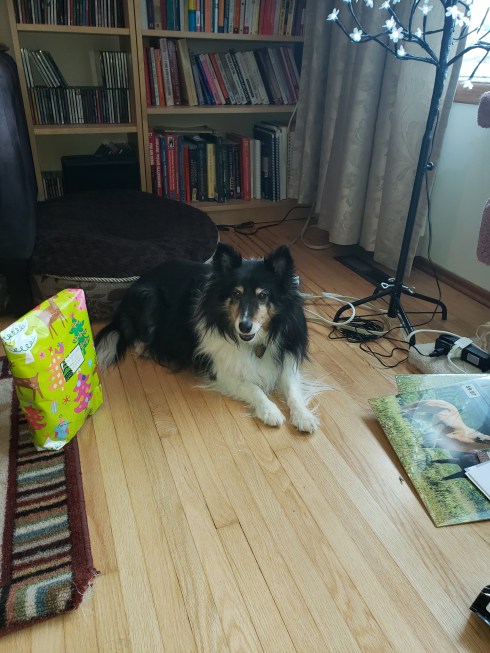
Shadow was a great dog, she was elegant and regal, but also a rambunctious goof at times. Her smiles were always endearing.

She was a shy dog, but could always be counted on for a cold nose *boop* when you really needed it.

She was my special girl, even when we couldn’t go for the long walks any more, we did short slow ones instead. She always tried to be in the same room with me.

Now she’s gone, and I mourn her passing. All I have left of her now are these photos and her collar. It is not even close to being enough. Thank you Shadow for being my bestest dog.

Helena de Bres writes about how Philosophy if you’re doing it right, is an absurd practice. What I found interesting about her essay is the idea of the two perspectives we shift between as hypothesized by Thomas Nagel (“One [perspective] is that of the engaged agent, seeing her life from the inside, with her heart vibrating in her chest. The other is that of the detached spectator, watching human activity coolly, as if from the distance of another planet.”). Us human types bring about so much of our own troubles, often failing to strike a reasonable balance between ‘living in moment’ and the detached ‘from the point of view of the Universe’. Significant life events, whether positive of negative, can also foment imbalance between these two perspectives, in which I think require careful mixing in order to live a more meaningful life.
One of the things I’ve noticed in the literature about grieving and loss is how important it is to realize the ubiquity of the experience that happens to be engulfing you at the moment. Most certainly, this is your own personal trauma, but realizing that others have and are experiencing similar feelings and going through similar motions can help frame your personal struggles in a slightly more hopeful context. For example, people have been grieving the loss of their loved ones for centuries now, and most find a way forward. There is some small solstice to be found (for the grieving person) in fact that others have found the means to go on after traumatic life experiences.
This contextual switching, I think, plays a significant role in the rebuilding of the emotional resilience that is necessary to keep life going and for an individual to continue to grow after a major setback. I see a fair number of parallels in this essay between the notion of dual experiential perspectives and some of the tenets of Buddhism and other Eastern philosophies.
“There’s something especially absurd about philosophers, supine or not. The explanation for this might lie in the best-known philosophical account of absurdity, offered by Thomas Nagel in 1971. Nagel argued that when we sense that something – or everything – in life is absurd, we’re experiencing the clash of two perspectives from which to view the world. One is that of the engaged agent, seeing her life from the inside, with her heart vibrating in her chest. The other is that of the detached spectator, watching human activity coolly, as if from the distance of another planet. Nagel notes that it’s our nature to flip between these points of view. One moment we’re fully caught up in our mushroom-cultivation class, our infatuation with our sister’s husband or our intractable power struggle with Terri in accounting. The next moment, our mental tectonics shift and we see ourselves from an emotional remove, like a spirit hovering over its own body. It becomes evident to us that, ‘from the point of view of the Universe’, to use the 19th-century utilitarian Henry Sidgwick’s phrase, none of these things matter.
Our sense of absurdity kicks in when we snap between these two perspectives rapidly, in a kind of duck-rabbit movement of the soul. The sense of absurdity depends on this instability. If we could retain the internal perspective forever, we’d never experience the shock of doubt about whether what we were doing was ultimately worthwhile or made any kind of sense. If, alternatively, we could permanently view all human affairs, our own included, from the perspective of the Universe, we’d never find ourselves eagerly attempting to adhere fungi to a damp log. We’d be full-time ascetics, to whom nothing human mattered at all, people who couldn’t be caught red-handed caring about something small.
Though Nagel says that we all adopt both the internal and external perspectives on our lives, some people clearly identify more with one than the other. And some of these people cluster in professions where one perspective is disproportionately valued. Academic philosophy is one such profession. When people say: ‘Let’s be philosophical about this,’ they mean: ‘Let’s calm down, step back, detach.’ The philosopher, in the public imagination, is set apart from the mundane concerns and fiery attachments that govern the rest of humanity. He or she takes the external perspective on pretty much everything. When Søren Kierkegaard collapsed at a party and people tried to help him up, he allegedly said: ‘Oh, leave it. Let the maid sweep it up in the morning.’
If this image is accurate, and if Nagel’s account is right, philosophers, parked forever in only one of Nagel’s perspectives, will escape the absurdity of the human condition. We philosophers, however, are among the most absurd people I’ve ever met. The reason for this has a whiff of paradox. Abstraction and detachment might be a philosopher’s stock-in-trade, but philosophers are often fiercely attached to those very things: passionate about impassion, abstract in the most concrete of ways. They spend years working obsessively on papers with titles such as ‘Nonreducible Supervenient Causation’ and then have public brawls about them at conferences. This is part of philosophy’s charm for me. There’s something especially absurd, yes, but also endearing, about people who are so serious about their core life endeavour that they regularly forget its ridiculous aspects, even though the endeavour itself is meant to serve as a perpetual reminder.”
Recent cutbacks have curbed my employment at the school that I teach in. So today was my last day. Some days you feel like a song. Today I feel like this…











 bleatmop
 Mystro


 Dead Wild Roses
Your opinions…