
The government is right about one thing: children are not safe in much of online life. But that does not make every child-safety law wise, limited, or safe for a free society.
Parents have a real responsibility to monitor their children’s welfare, and that includes internet activity. Freedom does not mean abandoning children to whatever social media companies, algorithms, predators, influencers, or peer-status machines decide to push at them next. A free society still expects adults to act like adults.
But parental responsibility is not the same thing as state permissioning. Bill C-34, the federal government’s Safe Social Media Act, should be read with that distinction in mind. The issue is not whether children should be protected from online harm. They should. The issue is whether protecting them requires building the habits, infrastructure, and bureaucracy of identity-gated internet access.
That danger is sharpened by how much the bill leaves to regulation. Many of the most important questions — which services are covered, how age will be verified, what exemptions will exist, and how the new regulator will enforce compliance — are not settled in the public-facing moral language of child safety. They are pushed into future administrative machinery.
That matters. A social media ban for users under sixteen cannot enforce itself. Platforms must know who is under sixteen. To know that, they must verify age. And once age verification becomes normal, adults are pulled into the same machinery because they must prove they are not children.
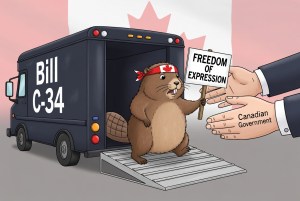
Child safety should not require Canadians to trade the open internet for a permission slip.
This is where the civil-liberties danger begins. The stated aim is child safety. The operating mechanism is identity checking. Once identity checking becomes a normal condition of access, it will not stay politely confined to one narrow category of service forever.
The strongest argument for the bill is not frivolous. Social media companies have profited from addictive design, algorithmic pressure, sexualized content, bullying, and misery dressed up as engagement. Parents are right to be angry. Governments are right to ask whether platforms have been allowed to externalize too much harm onto children and families.
But good intentions do not make a bad tool harmless.
Online anonymity is not just a convenience for trolls. It matters for political dissent, unpopular opinions, whistleblowing, vulnerable people, religious minorities, abuse victims, workers criticizing employers, and ordinary citizens who do not want every thought, search, argument, or association tied back to their legal identity.
For some Canadians, anonymity is not a luxury. It is part of how they remain able to think and speak honestly. Teachers, nurses, public servants, professionals, small-business owners, and employees in ideologically narrow workplaces all understand the problem. A person can hold lawful, serious, defensible opinions and still know that one bad-faith complaint, one screenshot, or one HR process can turn ordinary dissent into a professional liability.
Canadians should not reject child protection simply because the state has chosen a bad tool. If there are unobtrusive ways to reduce children’s exposure to exploitation, addiction loops, algorithmic pressure, and adult content without creating surveillance architecture, we should pursue them. Better parental tools, device-level controls, digital literacy, stronger enforcement against predators, and less addictive platform design are all fair subjects for debate.
“Child safety is real. Identity-gated access is still a dangerous cure.”
But a checkpoint internet is not a small price to pay. It changes the relationship between citizen and screen, reader and state, speaker and regulator. Once access depends on verification, the open internet begins to look less like a public square and more like a permissioned space.
That is too much power to normalize under the language of safety.
Our rights in Canada are unlikely to be taken away all at once. They erode gradually: one safety measure, one administrative convenience, one temporary verification requirement at a time, until the extraordinary becomes ordinary and the ordinary becomes mandatory.
Then, one day, pedestrianly, Canadians may discover that freedoms they thought were secure have become permissions they must ask for.











 bleatmop
 Mystro
 The Arbourist


 Dead Wild Roses
1 comment
Comments feed for this article
June 15, 2026 at 6:55 am
tildeb
No matter the government overreach, just wait for it: “Think of the children and their safety,” follows like night follows day as the go-to blanket excuse for any and all ‘official’ suppressive and intrusive actions, policies, and laws.
LikeLike