
You are currently browsing the daily archive for June 28, 2026.
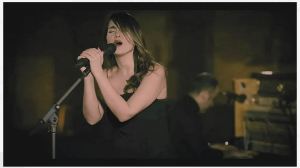 Parastoo Ahmadi sang without a hijab. For that, an Iranian court has reportedly sentenced her to seventy-four lashes, along with a two-year travel ban and a ban on artistic work.
Eight members of her musical and production team reportedly face the same punishment.
The ruling may still be appealed. That matters legally. It does not rescue the moral situation. A state has looked at a woman singing in an online performance and answered with the threat of the lash.
The official language is familiar: public decency, immoral content, religious propriety, social order. There is always a phrase ready when power wants to punish disobedience. But the facts remain plain enough. Ahmadi performed without submitting to Iran’s compulsory hijab laws, accompanied by male musicians, in a concert released online. The court treated the performance not as art, but as contamination.
That is what theocratic rule does. It turns a woman’s hair, voice, clothing, movement, and public presence into political territory.
A hijab freely chosen may be an act of faith, modesty, identity, or personal conviction. A hijab enforced by courts and police is something else. It becomes a sign of state power. Once punishment enters the picture, the language of choice disappears.
Western societies often become nervous when speaking about this. Ordinary Muslims in Canada, Britain, France, or the United States are not responsible for the crimes of the Islamic Republic. Many Muslims reject this kind of rule entirely. Many Iranian women resisting the regime come from Muslim families and communities themselves.
But that distinction cannot become an excuse for silence.
Islam as private belief is one thing. Islam as state power is another. When religious law governs women’s dress, restricts women’s voices, polices women’s bodies, and punishes public disobedience, it stands in direct conflict with the liberal inheritance the West should still be willing to defend: freedom of conscience, freedom of expression, equality before the law, and the right of the individual to live without clerical supervision.
Those values are not always honoured here. The West fails them often enough. But their failures do not make them false. Their absence is visible in places where a woman can be dragged through courts for singing.
Ahmadi’s alleged offence was not violence. It was not theft. It was not corruption. It was a performance. The regime’s response reveals the insecurity beneath the theology. A system confident in its moral authority would not need to threaten artists with flogging. A faith secure in itself would not require police, courts, and punishment to preserve public obedience.
“A hijab freely chosen belongs to the woman. A hijab enforced by courts and police belongs to the state.”
This is where polite multicultural language often fails. Respect for persons does not require respect for the laws that crush them. We can defend the dignity of peaceful Muslims while saying plainly that theocratic rule in Iran is oppressive, anti-liberal, and especially brutal toward women.
Sweeping that conflict under the multicultural rug does nothing for women like Ahmadi. It only protects the comfort of people far away from the consequences. The women living under these laws do not get the luxury of abstraction. They live with patrols, summonses, bans, fear, and the knowledge that a song can become evidence.
The phrase “Women, Life, Freedom” became powerful because it named what the regime fears most: women living as full human beings rather than managed subjects. Ahmadi’s performance belongs to that same moral territory. Under a regime like Iran’s, a woman singing uncovered is not merely performing. She is refusing.
And for that refusal, the state reaches for the lash.
Parastoo Ahmadi should be free to sing. Iranian women should be free to uncover their hair, make art, criticize their rulers, choose their faith, reject faith, and live without being disciplined by men who mistake control for morality.
A society that must threaten to whip women into obedience has already lost the argument.
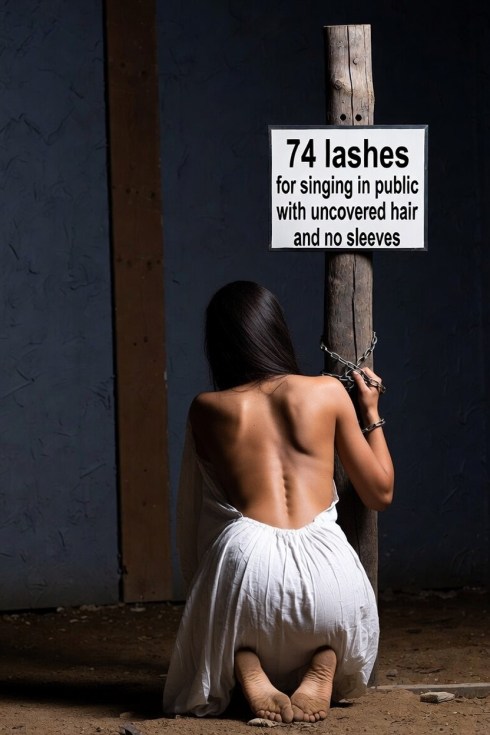
Seventy-four lashes for a song — the price of a woman’s uncovered voice in Iran.”
References
The Guardian. “Iranian star Parastoo Ahmadi reportedly sentenced to 74 lashes for singing without hijab.” June 18, 2026.
https://www.theguardian.com/world/2026/jun/18/iran-parastoo-ahmadi-74-lashes-singing-without-hijab
Radio Free Europe/Radio Liberty. “74 Lashes For A Song: Iranian Artist Sentenced For Virtual Concert.” June 2026.
https://www.rferl.org/a/iran-singer-sentence-flogging-morality-police-ban-women-life-freedom-hijab-concert-youtube/33783873.html
IranWire. “Caravanserai Concert Staff Sentenced to Flogging and Artistic Bans.” June 2026.
https://iranwire.com/en/news/153871-caravanserai-concert-staff-sentenced-to-flogging-and-artistic-bans/
Amnesty International. “Iran: New compulsory veiling law intensifies oppression of women and girls.” December 10, 2024.
https://www.amnesty.org/en/latest/news/2024/12/iran-new-compulsory-veiling-law-intensifies-oppression-of-women-and-girls/











 bleatmop
 Mystro


 Dead Wild Roses
Your opinions…