
You are currently browsing the daily archive for June 4, 2026.
The double-slit experiment is one of those scientific ideas people love to borrow badly. It is strange, genuinely humbling, and easy to misuse. That makes it perfect material for people who want reality to be less stubborn than it is.
The basic version is simple enough. Fire particles through two slits without measuring which slit they pass through, and over time they produce an interference pattern, the kind of pattern we associate with waves. Try to measure which slit they go through, and that pattern changes. The system no longer behaves the same way.
That is the part people remember. Unfortunately, they often remember it badly.
The experiment does not show that human consciousness creates reality. It does not show that the universe waits around for a person to notice it before deciding what it is. “Observation” in this context does not mean vibes, attention, social agreement, or someone staring meaningfully at an electron. It means measurement. It means physical interaction with the system. The apparatus matters because the apparatus is part of the situation being tested.
That is weird enough. We do not need to add incense.
There are still serious debates in the foundations of quantum mechanics about how best to interpret what is happening. That is worth admitting. But those debates do not rescue the popular abuse of the experiment. Consciousness is not required, politics does not select the result, and social approval does not decide whether the interference pattern appears.
The real lesson is more disciplined and more interesting. Reality is not always available to common sense. How we investigate can affect what we are able to detect. At quantum scales, measurement is not a passive act, like glancing at a chair from across the room. It changes the conditions under which the result appears.
That should make people humble about truth-finding. It should not make them casual about reality.
This is where social constructivist thinking often slips in through the side door. It does not usually announce itself by saying, “Nothing is real.” That would be too crude, and too easy to reject. Instead, it emphasizes language, framing, power, interpretation, categories, and social meaning until the reader quietly stops treating reality as a constraint and starts treating it as a negotiation.
Reality is real, but not always simple. Because it is not simple, we need better methods, not ideological shortcuts.
Some things really are socially constructed. Money depends on shared agreement. Borders depend on law, force, recognition, and maps. Job titles, academic credentials, citizenship categories, and institutional rituals all rely on human systems to maintain them. That is not a trivial point. Human beings create layers of social meaning that shape how we live, distribute status, enforce rules, and decide what counts inside institutions.
But the fact that some realities are socially maintained does not mean all realities are socially produced. The category “doctor” is socially regulated. The body on the operating table is not. A passport is a legal object. A kidney is not. A government can change language around inflation, housing, crime, or sex, but the material world does not become more cooperative because the terminology became more fashionable.
This is the tell to watch for. A valid insight about interpretation gets stretched until it weakens contact with reality. “Categories have social meaning” becomes “categories are merely imposed.” “Observation matters” becomes “truth depends on standpoint.” “Language shapes perception” becomes “language can rearrange the world.” Each step sounds sophisticated enough in isolation. Put them together, and ordinary reality gets escorted out of the room by people who insist they are only asking questions.
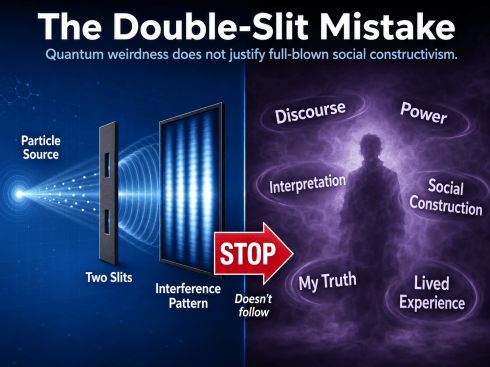
The double-slit experiment does not support that move. If anything, it rebukes it. The experiment is repeatable. The results are disciplined. The mathematics is unforgiving. You do not get a different interference pattern because your politics require one. You do not get to vote on the apparatus. The whole point of the experiment is that reality answers back, though not always in the form our intuitions expected.
That distinction matters far beyond physics. Bad theories of reality do not stay in seminar rooms. They eventually show up in schools, medicine, law, media, and public policy, often wearing the language of compassion or sophistication. If institutions lose the ability to distinguish between social meaning and material constraint, they do not become more humane. They become easier to fool.
Quantum weirdness should not become a permission slip for intellectual fog. It should remind us that careful methods are necessary precisely because reality can be subtle. The world is not always obvious, but it is also not waiting for our preferred theory to grant it permission to exist.
The better response to mystery is not social construction all the way down. It is patience, precision, and less eagerness to turn every difficulty in knowing into an excuse for pretending the thing known has disappeared.











 bleatmop
 Mystro


 Dead Wild Roses
Your opinions…