
You are currently browsing the tag archive for the ‘Free Speech’ tag.
“White people don’t get to decide what’s racist.”
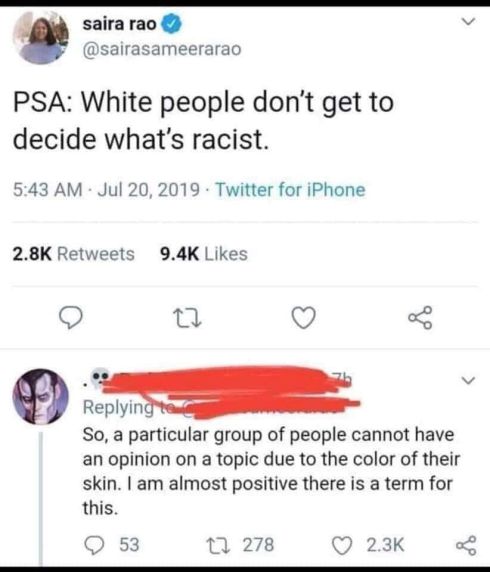
At first glance, this sounds like a demand for humility. And humility is not a bad thing. People can miss harms they do not personally experience. They can mistake comfort for neutrality. They can ignore patterns because those patterns do not touch them directly. Any honest account of racism has to leave room for that.
But the sentence does more than ask for humility. It draws a racial boundary around moral reasoning. It says that one group of people is not merely fallible, not merely prone to blind spots, but disqualified from judgment by birth.
That is where the sentence stops being a plea for listening and becomes something else. It becomes racial gatekeeping presented as moral expertise.
The screenshot is useful because it shows several aspects of critical theory coming into contact with the real world. Not in a seminar room. Not in a carefully footnoted academic paper. In the wild, where theory has been stripped of caveats, flattened into slogans, and handed to people who often have no idea where their fractured knowledge comes from or how badly it is being misused.
Most people who make these arguments are not theorists. They are downstream consumers of theory. They have inherited conclusions without the arguments, moral reflexes without the limits, and social weapons without the instruction manual. What reaches them is not a coherent philosophy but a cluster of habits: centre marginalized voices, listen and learn, impact matters more than intent, racism equals power plus prejudice, disagreement is fragility, demands for evidence are suspect, and dominant groups must defer.
Each of those claims contains a partial truth. That is why the machinery works.
People do have blind spots. Power does matter. Lived experience can reveal things outsiders miss. Social systems can produce unequal outcomes without anyone needing to wear a cartoon villain costume. A liberal society that cannot admit any of that becomes shallow and self-protective.
The problem begins when those partial truths become untouchable rules.
How the Move Works
The first assumption smuggled into the sentence is that racism is not primarily a judgment, action, belief, policy, habit, or pattern of unfair treatment. It is treated as an invisible mechanism operating beneath society. In this case, the mechanism is systemic racism: a hidden structure said to explain disparities, conflicts, speech, institutions, motives, and disagreement before any particular claim has been examined.
Again, systems are real. Institutions can produce patterns. History does not disappear because someone wants the conversation to be more comfortable. But in popular use, the mechanism often becomes unfalsifiable. If a disparity appears, the system explains it. If someone questions the explanation, the questioning becomes further evidence of the system. If a member of the alleged oppressor class objects, the objection is interpreted as fragility, denial, privilege, or complicity.
The claim no longer has to survive ordinary examination. The theory has already decided what resistance means.
“Unfalsifiable: a claim that cannot be proven wrong because every objection is reinterpreted as proof of the claim.”
The second assumption is that this mechanism can only work in one direction. This is where the “racism equals power plus prejudice” formula enters the bloodstream. In ordinary moral language, racism means judging, mistreating, excluding, or degrading people because of race. But under the power-plus-prejudice formula, racism is redefined so that only groups with systemic power can commit it. Members of designated oppressor classes can be mocked, stereotyped, excluded, insulted, or judged by race, but the framework classifies this as something other than racism because they occupy the wrong place in the hierarchy.
That is why “white people don’t get to decide what’s racist” can be treated as anti-racist rather than racial. The rule has already been made unequal.
The third assumption is epistemic. The oppressed are said to possess a kind of dual insight into how the system works. They understand their own experience from below, but they also understand the dominant group because they are forced to navigate its rules. The dominant group, by contrast, is presumed to be trapped inside its own power. It cannot see clearly because its comfort depends on not seeing.
There is a reasonable insight here. People lower in a hierarchy may notice pressures and hypocrisies that people higher up never have to think about. A worker may understand the boss’s rules better than the boss understands the worker’s life. A minority may notice social frictions the majority can glide past without naming.
But once that insight hardens into authority, the conversation changes. Standpoint stops being evidence offered into a common search for truth and becomes a credential. The person assigned to the oppressed position is treated as uniquely insightful. The person assigned to the oppressor position is treated as morally and intellectually compromised. At that point, argument no longer proceeds by shared standards. It proceeds by status.
You are no longer in a discussion. You are in a permission system.
“Permission system: a social rule where some people are allowed to define the issue, while others are expected only to listen, confess, or defer because of identity.”
This is the part ordinary people often sense but struggle to name. They think they are being invited into a moral conversation. In reality, every normal question has already been assigned a guilty interpretation.
They ask, “Isn’t it wrong to judge someone by skin colour?”
The answer comes back: “You do not get to decide that.”
They ask, “Shouldn’t the same rule apply to everyone?”
The answer comes back: “Equality language protects privilege.”
They ask, “Can we examine the evidence?”
The answer comes back: “Your demand for evidence is part of the problem.”
They ask, “How would this claim be proven wrong?”
The answer comes back: “That question itself shows your investment in domination.”
 Once this frame is accepted, the target cannot really answer. Refusal confirms guilt. Confession confirms guilt. Silence confirms guilt. Disagreement confirms guilt. The accusation is insulated from ordinary scrutiny because the mechanism is said to operate invisibly in the background, and only the approved interpreters are permitted to describe it.
That is why these encounters feel so maddening to normal people. They think they are dealing with a claim. Instead, they are dealing with a closed interpretive loop. Every exit has been marked as another entrance.
This is not an honest epistemology. It is a social technology for producing compliance.
The uglier part is that most people using it do not understand the machine they are operating. They have picked up fragments from universities, HR seminars, DEI training, social media, activist language, institutional statements, and moral peer pressure. They know the moves, not the machinery. They know which phrases confer status and which phrases mark someone as suspect. They may sincerely believe they are being compassionate, educated, and morally brave.
But sincerity does not rescue bad reasoning.
How to Recognize the Trap
A liberal society cannot function when moral claims are sorted by identity before they are examined. It depends on the possibility that anyone can ask whether a claim is true, fair, coherent, and consistently applied. It depends on open criticism, equal moral standing, and the right to question even claims made in the name of justice.
That does not mean every speaker is equally informed. It does not mean history is irrelevant. It does not mean racism only exists when someone says an obvious slur. It does not mean people with direct experience have nothing important to teach the rest of us.
It means no person’s race should grant immunity from scrutiny, and no person’s race should disqualify them from moral reasoning.
You do not need a PhD to notice when the rules have stopped applying equally. A few simple questions are often enough.
The first is the reciprocity test: would this rule be acceptable if the races were reversed? If the answer is no, then the rule is not a principle. It is a permission structure.
The second is the individual test: are we judging this person’s actual words and actions, or are we assigning moral status to an entire race? A society that cannot tell the difference between individual responsibility and racial status is not overcoming racism. It is reorganizing it.
The third is the evidence test: what would prove this claim wrong? Honest explanations can be examined. Bad explanations protect themselves by treating examination as aggression.
The fourth is the equal-rule test: does this standard apply to everyone, or only to approved groups? If one race may generalize, accuse, mock, or define the terms while another may only listen and confess, then we are not dealing with fairness.
The fifth is the liberal-society test: does this help people reason together, or does it sort them into racial teams? That question matters because liberal society depends on shared standards. Without them, public life becomes a contest over who gets to define reality and who is expected to submit.
These questions do not solve every hard case. They are not meant to. Racism can be subtle. Power can matter. History can shape the present in ways that are not obvious at first glance. But if a moral framework cannot survive these basic questions, the problem is not the questions.
The problem is the framework.
That is what makes a small sentence like “white people don’t get to decide what’s racist” worth examining. It is not merely rude. It is not merely hypocritical. It is a compressed example of a larger ideological move: convert a universal moral question into an identity-jurisdiction question.
Who may speak? Who must listen? Who is presumed insightful? Who is presumed guilty? Who gets to define the harm? Who is allowed to ask for evidence?
Once those roles are assigned by race, the conversation is no longer about racism in any honest moral sense. It is about power over the terms of reality.
A genuinely anti-racist society should reject that move.
Not because racism is unreal. Not because power is irrelevant. Not because lived experience does not matter. But because the cure for racial injustice cannot be a new racial priesthood deciding who is allowed to reason, who is allowed to question, and who must sit quietly while their moral standing is revoked.
Shared truth has to remain possible. So does shared criticism.
Otherwise, anti-racism becomes just another way to smuggle racial hierarchy back into public life, this time with better slogans and institutional approval.
—–
Glossary
Critical theory
A broad family of ideas that examines society through power, hierarchy, and oppression. It can reveal real blind spots, but in popular use it often turns into a habit of treating every disagreement as proof of hidden domination.
Systemic racism
The idea that racism can operate through institutions, patterns, incentives, and social habits, not only through individual prejudice. The problem comes when “systemic racism” is used as an all-purpose explanation that cannot be questioned or tested.
Power plus prejudice
A redefinition of racism that says racism is not simply racial prejudice or unfair treatment, but prejudice backed by social power. In practice, this often means racism is treated as something only dominant groups can commit.
Standpoint epistemology
The idea that people may notice different truths depending on their social position. Someone lower in a hierarchy may see pressures that someone higher up misses. The danger comes when perspective is treated as automatic authority.
Epistemology
A theory of knowledge: how we know what is true, what counts as evidence, and how claims should be tested.
Epistemic hygiene
The habits that keep our thinking clean: asking for evidence, checking assumptions, allowing disagreement, correcting errors, and refusing to protect favourite ideas from scrutiny.
Unfalsifiable
A claim that cannot be proven wrong because every objection is reinterpreted as proof of the claim. For example: “If you disagree, that only proves you are in denial.”
Lived experience
Knowledge gained from personal experience. It can be important evidence, but it should not become a veto over questions, criticism, or shared standards.
Identity-jurisdiction question
A shift from asking “Is this claim true?” to asking “Who is allowed to speak about this?” The issue becomes identity status rather than evidence or reasoning.
Permission system
A social rule where some people are allowed to define the issue, while others are expected only to listen, confess, or defer because of their identity.
Liberal society
A society built around equal moral standing, open debate, individual rights, shared standards, and the ability to criticize ideas without being treated as morally disqualified.
Racial gatekeeping
Using race to decide who is allowed to speak, judge, question, or define moral terms.
Closed interpretive loop
A pattern where every possible response confirms the accusation. Denial, silence, disagreement, or requests for evidence are all treated as further proof of guilt.
Moral reasoning
The process of deciding what is right or wrong using evidence, consistency, fairness, context, and principles that can be applied beyond one group.
Racial essentialism
Treating people as if their race determines their moral status, knowledge, guilt, innocence, or authority.
There are few modern spectacles more interesting than Richard Dawkins speaking warmly about Christianity.
Not converting. Not recanting The God Delusion. Not wandering into Evensong with a softened heart and a sudden interest in incense. But speaking warmly, nevertheless.
 Dawkins has called himself a “cultural Christian.” He remains an atheist, which is what makes the admission interesting. He is not saying Christianity is true. He is noticing that Christianity helped form a civilization in which he could become Richard Dawkins: skeptical, eloquent, publicly irreverent, protected enough to criticize sacred things, and still culturally at home among the ruins and residues of the faith he rejects.
For a long time, many secular Westerners treated Christianity as something they had outgrown. It was old, morally complicated, often hypocritical, and associated with repression, scolding, and bad Sunday mornings. Keep the music, perhaps. Keep the architecture. Keep Christmas, provided no one gets doctrinal about it. The rest could be packed away.
There were reasons for that impatience. Churches persecuted, censored, lied, protected abusers, cozied up to power, and sometimes confused institutional self-interest with the will of God. No honest appreciation of Christian civilization can skip that part. But there is a difference between remembering the failures of an inheritance and forgetting that we inherited anything worth having.
The West was not built from one source. It is a quarrelsome inheritance: Greek reason, Roman law, Jewish moral seriousness, Christian theology, Germanic custom, common law, Reformation fracture, Enlightenment skepticism, scientific inquiry, and the long institutional habit of limiting power. Christianity did not invent every virtue from nothing, but it became one of the great furnaces in which those virtues were universalized, moralized, preached, contradicted, betrayed, and recovered.
Modern liberalism did not merely inherit Christian assumptions and put them in nicer clothes. It built institutions Christianity often resisted: robust free speech, religious disestablishment, broader suffrage, empirical science protected from clerical authority, and legal equality that went well beyond what most Christian societies were willing to grant. Some of the freedoms Dawkins enjoys were made possible by Christian moral inheritance. Others required sharp breaks from dominant Christian practice.
That tension is the point. The West is the product of argument, correction, rebellion, restraint, and institutional memory.
This is what modern secular people often miss. We imagine ourselves as freestanding moral adults. We believe in human dignity, equality before the law, freedom of conscience, care for the vulnerable, suspicion of tyranny, and the right to criticize authority. Fine. Keep all of that. But those commitments have a history. They were not produced by vibes, nor assembled last Tuesday by a committee with a land acknowledgement and a catering budget.
They came through centuries of conflict, doctrine, reform, law, blood, repentance, philosophy, institutional restraint, and exhaustion after too many people had killed each other over ultimate things.
To appreciate that inheritance is not to baptize every part of it. Christendom was not gentle. Christianity often had to be forced into better conduct by dissidents, reformers, scientists, heretics, abolitionists, and Christians reading their own scriptures more honestly than their institutions did. The West’s moral inheritance was not a clean gift. It was an argument, often conducted under pressure.
“The West is the product of argument, correction, rebellion, restraint, and institutional memory.”
But the argument happened inside a civilization shaped deeply by Christianity.
The freedom to doubt, mock religion, publish irreverent books, leave a faith, criticize clerics, and live without being ruled by priests was not inevitable. Nor was the expectation that women may walk unveiled, educated, employed, politically equal, and legally protected. These are achievements produced by particular histories, institutions, and moral restraints.
That is where Dawkins’ comparison with Islam enters the discussion, though it needs care.
The issue is not Muslim neighbours. Millions of Muslims live peacefully, work hard, raise families, keep faith privately, and want the ordinary goods everyone else wants: safety, dignity, friendship, decent schools, and a stable life. A serious argument begins by refusing collective suspicion.
The harder question is what happens when Islamic doctrine becomes politically confident and expects the wider society to accommodate its rules around blasphemy, apostasy, religious offence, sex roles, homosexuality, and public criticism. Outcomes differ by interpretation, education, migration patterns, and host-society confidence, but liberal societies still cannot survive by pretending every moral and legal order is equally compatible with liberal freedom.
Dawkins seems to understand that cultural Christianity has learned to live with disbelief in a way many religious systems have not. The Anglican church may annoy you. It may bore you. It may produce beige sermons, awkward committees, and hymns sung by twelve people spread across a nave built for three hundred. But it is unlikely to demand the state punish you for mocking it, which is not a small thing.
“But criticism without gratitude curdles into contempt, and contempt is a poor steward of anything worth preserving.”
The Sunday lesson, then, is not “become Christian or die,” nor “atheists secretly know God is real,” nor “all Muslims are enemies.” It is more modest and more useful: know where you are standing.
If you live in the West, you live inside an inheritance. You may criticize it. You should criticize it. The tradition itself contains the tools for doing so. But criticism without gratitude curdles into contempt, and contempt is a poor steward of anything worth preserving.
Secular liberalism has been living partly off inherited moral capital for a long time, even while adding real achievements of its own. Compassion, rights, conscience, equality, dissent, human dignity, forgiveness, reform, and care for the weak remained available, but the story of how they arrived became unfashionable.
A culture can run on inherited habits for a while. Maybe longer than its critics expect. But inheritance is not self-renewing, and gratitude alone is not repayment. If people are taught only to sneer at what formed them, they will not know what to keep, what to reform, what to defend, or what to pass on. If they merely admire the ruins, they become tourists in their own civilization.
Dawkins has not found God. He has noticed a debt.
The harder question is whether a civilization can repay that debt without pretending to believe what many of its citizens no longer believe.
A recent post from a Women’s Liberation Front activist should be read less as a complaint than as a warning about how institutions train dissenters to accept contempt as normal.
She describes years of opposing gender-identity legislation in California: travelling to Sacramento, meeting legislative offices, testifying at hearings, and trying to explain to ordinary people what the policies actually mean. Female locker rooms become mixed-sex spaces by administrative decree. Girls’ sports and girls’ boundaries become conditional. Distressed young women are placed on medical pathways that can permanently alter healthy bodies.
The remarkable part is not merely that lawmakers disagree with her. Disagreement is expected in politics. What stands out is the air of pre-judgment around the process. She writes that legislators’ offices treat these women with “barely contained disdain.” Public hearings fill with activists who regard any defence of female boundaries as proof of bigotry. The women objecting are not received as citizens raising serious concerns about privacy, safeguarding, fairness, or medical ethics. They are treated as a nuisance class: managed, endured, and socially disqualified before the argument begins.
A functioning democracy does not require lawmakers to agree with every citizen. It does require them to hear citizens as citizens. When women raise concerns about intimate spaces, parental knowledge, fair competition, or irreversible interventions on minors, the answer cannot simply be a sneer and a label. “Bigot” is not an argument. “Hate” is not a policy analysis. “Inclusion” does not magically settle every conflict between competing rights.
Institutional capture often works this way. It does not begin by winning every argument in public. It begins by deciding which arguments are permitted to count. After that, the ordinary political process becomes strangely theatrical. Hearings still happen. Citizens still line up to speak. Legislators still nod along with the solemn expressions of people performing democratic patience. But the conclusion has already been filed away. These women are not constituents with claims on representation. They are obstacles to be routed around.
“A functioning democracy does not require lawmakers to agree with every citizen. It does require them to hear citizens as citizens.”
California is an especially sharp example because its political culture is so one-sided on this issue. The institutions are not neutral referees; they have chosen a side, and women who object are expected to absorb that fact politely. Over time, this wears people down. The WoLF activist’s most revealing line is not the one about crazy legislation. It is the moment of recognition: going to Washington, D.C. reminded her how badly she had become accustomed to being treated in California.
That is what contempt does over time. It lowers your expectations. It trains you to think basic respect is a luxury. It teaches you that being ignored is normal, that being caricatured is normal, that being called hateful for stating sex-based concerns is the price of admission.
This is especially perverse when the dissenters are women defending women’s boundaries. Feminism once insisted that female privacy, bodily integrity, and protection from male entitlement mattered. Now women who make those arguments are often treated as embarrassing relics, reactionaries, or moral contaminants. The old feminist vocabulary survives, but the sex class it was built to defend has been quietly replaced by a more fashionable abstraction.
The inversion should be obvious by now. Women are told they must be compassionate while their own concerns are dismissed. Girls are told inclusion matters while fairness and privacy are negotiated away on their behalf. Parents are told to trust institutions that increasingly treat hesitation as a threat. Citizens are told democracy is sacred while lawmakers learn to ignore the public on issues where the public is far less progressive than the activist class.
“The hearings still happen. Citizens still line up to speak. But the conclusion has already been filed away.”
This is why the fight matters even when a particular bill is lost. Public opposition creates a record. It denies consensus. It tells other women they are not alone. It forces legislators to own what they are doing rather than hiding behind bureaucratic language and moral fog.
Eventually, legislators need to pay a political price for treating women this way. Not because disagreement is forbidden. Not because every feminist objection should automatically prevail. But because a political class that can dismiss women’s sex-based concerns with contempt has learned something dangerous about power: the right moral vocabulary can make ordinary citizens disappear.
Women cannot win a fight they are shamed out of entering. They cannot defend boundaries they are not allowed to name. They cannot rely on institutions that have already decided their objections are evidence of guilt.
The point is not that every battle will be won in Sacramento. Some will be lost. Maybe many. But silence is how capture becomes permanent. Visibility is how it starts to crack.

Institutional capture rarely arrives breathing fire. More often, it brings a binder, a microphone, and a schedule.
Truth is the lifeblood of any serious civilization. Not comfort, not ideological harmony, and not the temporary social peace that comes from teaching people to suppress what they can plainly see.
A society can survive mistakes. It can survive corruption. It can survive periods of confusion and even mass foolishness, provided enough people remain willing to describe reality honestly when the pressure arrives to do otherwise. What societies struggle to survive is organized dishonesty.
Reality is the brick wall waiting at the end of every false belief. You can postpone the collision for a while. You can build bureaucracies around the falsehood, invent softer language to cushion it, and punish people for pointing at the wall. The impact still comes.
That is why a recent quote from J. K. Rowling landed with such force:
“The West is currently divided between people who know he is a man and are prepared to say so and those who know this is a man but lie out of obedience to an ideology. There is no third option. Literally nobody on earth thinks ‘Roxanne Tickle’ is actually a woman.”
The quote unsettled people because it named something many Western institutions have spent years trying to blur: the widening gap between public language and private belief.
Large numbers of people now routinely say things in public that they would once have regarded as obviously false, not because the underlying biology changed, but because the social cost of dissent rose dramatically. That distinction matters, because this is not primarily a debate about kindness.
A decent society should discourage cruelty. It should not encourage humiliation, harassment, or needless malice toward people struggling with alienation, identity, or psychological distress. Most ordinary people understand this instinctively. But courtesy is not the same thing as compelled belief.
Calling someone by a preferred name is one thing. Demanding that citizens affirm propositions they do not believe to be true is something else entirely. The first is social grace. The second is ideological obedience.
 Nor is this an argument for replacing one rigid orthodoxy with another. Conservative traditions have their own temptations toward enforced piety, inherited blindness, and social punishment for inconvenient truths. Any worldview, religious or secular, progressive or reactionary, becomes dangerous when it starts protecting sacred assumptions from scrutiny. The standard cannot be nostalgia or novelty. The standard has to be reality itself: when a belief hits the brick wall, the belief must yield.
Modern Western institutions increasingly refuse to yield.
People learn quickly which observations are permitted and which ones carry risk. Teachers self-censor in classrooms. Employees rehearse approved language in HR seminars. Professionals choose silence over scrutiny. Friends whisper obvious opinions privately, then publicly perform uncertainty they do not actually feel. Entire bureaucracies now operate through euphemism, ritual language, and carefully managed ambiguity designed less to clarify reality than to avoid conflict with activist moral frameworks.
The social choreography becomes exhausting to watch because everyone notices the contradiction, while almost nobody wants to be the first person to say so aloud.
That atmosphere corrodes more than speech. It corrodes trust itself.
Once institutions begin demanding verbal loyalty to claims that large numbers of people privately reject, public language starts losing contact with reality. Words stop functioning primarily as descriptive tools and become signals of social compliance. The goal is no longer clarity. The goal is demonstrating moral alignment with the approved consensus.
History offers repeated warnings about where this habit leads. Not always to catastrophe on cinematic scales. Sometimes the damage is quieter and more banal than that. Institutions become incapable of self-correction because honest feedback becomes socially dangerous. Bad ideas survive longer than they should. Obvious failures remain unacknowledged. Citizens retreat into cynicism. Public trust declines because people can feel the gap between official language and observable reality widening in real time.
The lie does not even need to convince everyone to become destructive. It only needs to become socially mandatory.
That is the deeper danger here. A liberal society depends on the ability of ordinary people to speak plainly about reality without fear that disagreement itself will be treated as moral contamination. Once that principle collapses, coercion inevitably expands to fill the space left behind, not always through laws, but often through softer mechanisms: reputational pressure, professional risk, social isolation, algorithmic mobbing, institutional gatekeeping. The effect is similar either way. Silence becomes safer than honesty, and so more people stay silent.
The defenders of this system often insist they are merely asking for compassion. In many cases, I suspect some genuinely believe that. But compassion detached from truth eventually mutates into something harsher. If reality itself becomes negotiable, then social power determines what may be spoken. At that point the argument is no longer about tolerance. It becomes a struggle over who has authority to define reality for everyone else.
That is not progress. It is regression wrapped in therapeutic language.
None of this requires cruelty toward individuals or hatred. It requires only the willingness to say that observable reality still matters, even when saying so becomes socially uncomfortable. Reality does not disappear when institutions stop acknowledging it.
The brick wall remains where it always was, and civilizations that train themselves to look away rarely avoid the collision forever.
The CBC’s problem is not that it experimented with satire, hidden cameras, or uncomfortable encounters. Those tools have existed for decades. Political comedy often works by creating discomfort. The issue exposed by the CBC/APTN controversy is narrower and more revealing: the apparent belief that some Canadians are legitimate targets for deception and public humiliation, while others must be protected from the same treatment.
Reports surrounding the proposed CBC/APTN production describe critics of prevailing narratives being approached under false pretences for staged ideological confrontations. The defence offered afterward was familiar: this was entertainment, satire, social experimentation, democratic conversation. Not journalism. Not activism. Just provocative television.
So apply the format evenly.
Imagine CBC producers creating fake donor dinners for Egale Canada representatives, only to surprise them with hidden-camera confrontations involving worried parents asking difficult questions about youth medical transitions.
Imagine prominent Indigenous advocates invited to reconciliation forums before being confronted with unscripted questions about land acknowledgements, pipeline development, corruption scandals, or reserve governance.
Imagine supervised-consumption advocates calmly informed during a fake consultation that a new injection site will open beside an elementary school and a seniors’ residence, while cameras capture their reactions for national entertainment.
Everyone knows what would happen next. The country would not describe these productions as brave satire. They would be denounced as targeted harassment. Editorials would appear within hours condemning the emotional manipulation. Activists would speak about institutional retraumatization. Media panels would debate whether public funding had enabled abuse against marginalized communities. Sensitivity consultants would materialize at lightspeed.
“Nobody seriously believes CBC would approve the same hidden-camera tactics against officially protected activist groups.”
That predictable reversal is the whole problem.
The CBC controversy matters because it exposes two moral rulebooks operating inside many modern institutions. Protected groups receive the full vocabulary of care: context, power dynamics, emotional safety, harm, trauma, dignity. Dissidents, skeptics, unfashionable critics, and anyone outside the approved coalition structure receive a different treatment. Their discomfort becomes democracy in action. Deception becomes “conversation.” Public ridicule becomes “holding people accountable.”
Public broadcasters occupy a different category from private partisan outlets because they are funded by citizens across ideological lines. The expectation is not perfect neutrality. Nobody serious believes that producers have no assumptions, sympathies, or editorial instincts. The expectation is procedural fairness and basic consistency. What corrodes legitimacy is the growing perception that public institutions now distinguish between citizens whose dignity must be protected and citizens whose dignity can be safely spent for entertainment, activism, or moral theatre.
That perception does not emerge from nowhere. It emerges from asymmetry repeated often enough that people begin noticing the pattern.
The most revealing part of the whole affair is how easy the hypothetical reversal is to predict. Nobody seriously believes CBC would approve a hidden-camera “social experiment” targeting officially protected activist constituencies in the same way it appears willing to target dissident academics or politically inconvenient critics. The cancellation would arrive before lunch. Internal investigations would begin by dinner.
The issue is not whether satire is allowed. Satire should be allowed. Democratic societies need irreverence, criticism, and uncomfortable mockery. But institutions do not get to claim moral consistency while operating two different ethical systems depending on who happens to be in the chair.
“Protected groups receive the language of care. Dissidents receive the language of accountability.”
Once people notice the asymmetry, the lecture circuit stops sounding principled and starts sounding managerial. The language of compassion begins to feel less universal and more tribal. Trust decays accordingly.
Institutions that spend years preaching equity should be careful about teaching the public that equal treatment ends the moment the targets change.

Women do not need permission to define themselves.
The word woman already has a meaning. It is not hateful to say so, and it is not extremist to defend female boundaries, female privacy, female sports, or female-only spaces. Women are adult human females. That definition is not a slur. It is the basis on which women’s rights were built.
The public silence around this issue is starting to crack because too many people can now see where the trajectory leads. A society that cannot define women cannot reliably protect them. Rights tied to sex become fragile once sex itself is treated as optional language.
Enough of the intimidation. Enough of the compelled speech. Enough of the social blackmail that brands ordinary women as bigots for wanting boundaries previous generations understood as normal, necessary, and humane.
The next step is not private agreement. It is public resistance, steady enough that institutions can no longer pretend the objection belongs only to cranks and extremists.
Write to elected officials and demand that sex-based protections be clarified in law as applying to biological sex. Support groups defending women’s sports, shelters, prisons, and female-only services. Push back in schools, workplaces, unions, professional associations, and public consultations when policies dissolve female boundaries into identity claims. Refuse the language games that make reality harder to discuss. Speak plainly, calmly, and repeatedly.
Support the journalists, writers, academics, whistleblowers, parents, athletes, and ordinary women who are absorbing the punishment for saying what millions still believe. Do not leave them standing alone while quietly agreeing with them afterward in private.
That private agreement is one of the main things keeping this machine alive. Institutions interpret silence as consent. Bureaucracies advance until they meet resistance, and too many citizens have been trained to mistake politeness for surrender.
This resistance does not require rage or cruelty. It requires steadiness, numbers, and the willingness to stop pretending obvious things are unsayable.
The backlash already underway across the Western world is not driven by hatred. It is driven by exhaustion with the claim that female boundaries are negotiable, that biology is taboo, and that dissent itself is immoral.
Women have the right to their own spaces, language, associations, and political interests. No court ruling or policy document can erase that reality.

The recent Tickle v Giggle ruling exposes a widening gap between legal language and ordinary reality.
The court held that a female-only app unlawfully discriminated against a ‘transgender woman’ by excluding him from the platform. The legal mechanism matters: this was framed through gender-identity discrimination protections. But the practical result is hard to miss. A space created for women was told it could not draw its boundary around being female.
That has consequences beyond one app.
Women’s sex-based protections exist because sex is real. Pregnancy is real. Male-pattern violence is real. Privacy concerns in shelters, prisons, changing rooms, sports, and intimate female spaces are not imaginary. They are not bigotry dressed up as discomfort. They arise from material differences that law once had enough common sense to recognize.
A humane society can treat transgender people with dignity and still preserve female-only spaces. Those two duties are not enemies unless ideology makes them so.
The problem with this ruling is that it pushes women into the old subordinate role again: accommodate first, object later, and expect punishment if the objection sounds too firm. Female boundaries become negotiable. Female discomfort becomes suspect. Meanwhile, identity claims are treated as moral imperatives that everyone else must organize around.
That is not equality. It is a new hierarchy with better manners.
Ordinary people notice the coercion. They notice the pressure to say things publicly that they do not believe privately. They notice that everyone still understands what sex is when the issue is medical care, crime statistics, pregnancy, or athletics, but suddenly becomes confused when women try to maintain a boundary.
This is why the issue refuses to disappear. Reality keeps returning through the side door.
The law should protect every citizen from harassment and mistreatment. But it should not compel society to pretend that sex is meaningless. If women cannot define female-only spaces around biological sex, then “woman” has lost the legal coherence that made women’s rights possible in the first place.
This decision should be overturned, and the law should be clarified: sex means biological sex where single-sex spaces, services, sports, and protections are concerned.
Without that correction, women are being told to move aside in the name of inclusion.
They have heard that instruction before.












 bleatmop
 Mystro


 Dead Wild Roses
Your opinions…