
You are currently browsing the tag archive for the ‘Free Speech’ tag.
One of the most effective moves in contemporary progressive argumentation, especially inside institutions that trade in moral prestige, is also one of the least truth-seeking: take an ordinary policy dispute, attach a moral charge to one side of it, and then treat resistance as evidence of personal defect.
The argument does not proceed by persuasion. It proceeds by contamination.
You are not merely skeptical of a DEI policy. You are hostile to inclusion. You are not asking whether a school lesson is age-appropriate. You are endangering vulnerable children. You are not questioning whether a land acknowledgement has become empty ritual. You are denying history. You are not concerned about due process, compelled speech, medical evidence, or institutional overreach. You are “unsafe.”
“The moral valence trap raises the social cost of dissent until silence looks like prudence.”
The mechanism is simple. First, the issue is moved from the realm of judgment into the realm of moral identity. Then the person asking questions is dragged with it. The disputed policy becomes kindness, justice, safety, inclusion, or harm reduction. Opposition becomes cruelty, hatred, danger, exclusion, or complicity. Once that happens, the argument is no longer about the thing itself. It is about whether you are the sort of person decent people should listen to.
This is dirty pool, but it works because most people do not want to be seen as cruel. They also do not want a meeting, classroom, workplace, choir rehearsal, staff room, or family dinner to become a tribunal. So they soften, retreat, or say nothing. The moral valence does its job. It raises the social cost of dissent until silence looks like prudence.
The tactic is not unique to progressives. Conservatives have used their own versions: dissent from a war becomes hatred of the troops; concern about state power becomes softness on crime; criticism of national myth becomes contempt for the country. The mechanism is the same. Policy disagreement is converted into a character flaw. The reason the progressive version deserves special attention now is not that it is uniquely wicked, but that it has become unusually powerful inside the institutions that shape respectable opinion: schools, universities, HR departments, media, charities, public agencies, and professional regulators.
The first defence is definitional clarity.
Do not accept suitcase words without unpacking them. Harm, safety, inclusion, dignity, equity, violence, erasure, and belonging are often used as if everyone already knows what they mean. Usually they do not. These words carry emotional force precisely because they remain blurry. A claim like “this policy protects safety” sounds serious, but it may mean physical safety, emotional comfort, reputational protection, ideological conformity, bureaucratic risk management, or the absence of disagreement.
Those are not the same thing.
The useful question is not “Do you care about safety?” That question has already been rigged. The useful question is: what kind of safety, for whom, from what, by what mechanism, and at what cost to others?
That last clause matters. Every moral claim has tradeoffs. A school policy that makes one child feel affirmed may require another child to lie. A workplace policy designed to create inclusion may create compelled speech. A public ritual meant to acknowledge one group may quietly pressure others into participation. A speech code meant to prevent harm may give administrators broad discretion to punish unpopular views.
Definitions bring the argument back to earth. They force slogans to become claims. Once a slogan becomes a claim, it can be examined.
The second defence is fairness in a liberal democratic society.
Progressive moral framing often assumes that once a group is described as vulnerable, its preferred policy should win by default. But liberal democracy cannot work that way. Vulnerability matters, but it does not abolish fairness. A decent society does not settle conflict by asking which side has the most emotionally powerful identity claim and then handing that side the institutional lever.
Fairness requires reciprocal rules. If one group may decline participation in a ritual that violates its conscience, others must be allowed the same freedom. If one group may describe its experience honestly, others must be allowed to describe theirs. If dignity matters for minorities, it also matters for dissenters. If safety matters for the anxious student, it also matters for the girl in the changing room, the employee pressured to say words he does not believe, the parent cut out of a consequential decision, or the teacher expected to enforce doctrine while pretending it is merely kindness.
The point is not that all claims are equal. Some are stronger than others. Some deserve accommodation. Some deserve rejection. But in a liberal society, moral concern cannot become a one-way ratchet where one side receives rights and the other receives obligations.
A fair question cuts through the fog: would this rule be acceptable if used by people you distrust?
If the answer is no, then the principle is not a principle. It is a weapon waiting for a friendly hand.

The third defence is free speech.
Not free speech as a bumper sticker. Not free speech as “I should be able to say anything without consequence.” Free speech as the basic operating condition of a truth-seeking society.
The moral valence trap depends on making certain questions unsayable. It does not always censor directly. Often it works through etiquette, professional risk, peer pressure, institutional language, and the quiet fear of being labelled. That is enough. You do not need formal censorship when people learn to pre-edit themselves before the room turns cold.
Free speech is not merely a personal liberty. It is a safeguard against institutional self-deception. Bad policies survive when people cannot question the assumptions underneath them. Medical scandals survive that way. Educational fads survive that way. Bureaucratic rituals survive that way. Ideologies survive that way. The organization tells itself that dissent is harm, then congratulates itself on the absence of dissent. An institution can call that consensus if it wants, but what it has really produced is managed silence.
This is also where the dissenter has to resist the forced confession. The moral valence trap often tries to make you prove your innocence before you are allowed to discuss the issue: “Do you support inclusion?” “Do you understand how harmful that is?” “Why are you uncomfortable with marginalized people being seen?” Sometimes these are sincere questions. Often they are attempts to move the conversation from the policy to your character. A useful response is calm redirection: I’m happy to discuss the rule. I’m not going to litigate my soul as a precondition for speaking.
The point is not to become rude or combative; it is to keep the discussion on the rule, the evidence, and the tradeoffs instead of letting it drift into a trial of your character.
Progressive argumentation wins when it turns politics into moral theatre. The trick is to refuse the theatre without refusing morality. There are real harms, real injustices, and real people who deserve protection, accommodation, and dignity. But moral language should clarify reality, not smother it. Once moral vocabulary becomes a substitute for evidence, mechanism, fairness, and speech, it stops being ethics and becomes discipline.
The answer is not counter-shaming, which only reproduces the same bad habit with different slogans, but steadiness: define the terms, ask who pays the cost, test the rule for reciprocity, and defend the right to question. A liberal society does not need citizens who agree about everything. It needs citizens who can disagree without turning every dispute into a loyalty test.
June is coming, which means the machinery will start again.
The flags. The emails. The school bulletin boards. The corporate logos. The municipal proclamations. The HR language. The social media badges. The rainbow email signatures. The familiar little suggestion that anyone who declines the ritual must be hiding some moral defect.
That is exactly why Pride needs civic proportion.
Not abolition. Not cruelty. Not some bitter campaign to drive gay and lesbian citizens back into silence. That would be wrong, and it would also miss the point. The question is not whether gay people should be treated with dignity. Of course they should. The question is whether equal citizenship requires a month of institutional performance, followed in Canada by what the federal government now openly calls Pride Season, running from June to September.
At some point, recognition became saturation.
That distinction matters. Visibility can have value. There are still young people who feel isolated, families that struggle to accept them, and countries where homosexuality remains criminalized. None of that is trivial. But a liberal society still has to distinguish between civic recognition and compulsory enthusiasm. It can protect minorities without turning public institutions into ideological billboards. It can permit parades, private celebration, voluntary corporate sponsorship, and public respect without making every workplace, school, and government office participate in a rolling moral pageant.
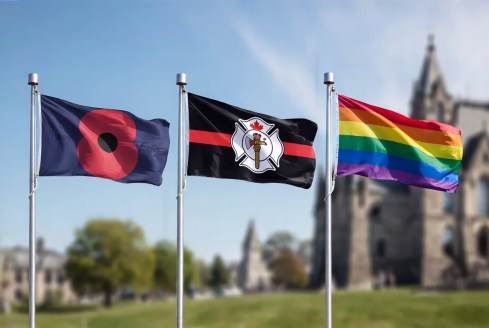
Veterans have Remembrance Day, with Veterans’ Week as a focused period of solemn national memory. Fallen firefighters are honoured through Firefighters’ National Memorial Day. Canadian peacekeepers are recognized on National Peacekeepers’ Day. These are not minor observances. They include people who served in wars, ran toward fire, responded to disaster, watched friends die, and carried burdens most citizens will never see.
Yet their recognition is bounded and it is not disrespect, but rather it is a demonstration of civic restraint.
Pride has not been restrained. It has expanded from a protest, to a celebration, to a month, to a season, to a branding cycle, to a school-calendar fixture, to a test of institutional obedience. The expansion is now so familiar that many people barely notice it. They only notice the consequences of objecting.
Decline the flag, and suspicion arrives. Question the school display, and someone starts measuring your moral temperature. Object to compelled language, and the labels come quickly: hateful, unsafe, bigoted, backward, not fit for polite company. This is how a movement that once asked for tolerance drifts into reputational discipline. Not by sending police to your door, but by making ordinary dissent socially expensive enough that most people decide silence is easier.
Surprisingly(?)this isn’t healthy pluralism or even good advocacy on a societal scale.
Every cause eventually faces a choice. It can keep expanding its demands forever, or it can settle into the ordinary dignity of citizenship. The first option keeps activists, consultants, committees, and bureaucracies busy. The second allows citizens to live together without every institution becoming a stage for moral performance.
And this critique does not apply only to one letter in the ever-expanding acronym. The problem is the machinery itself: the institutional expectation that citizens must affirm not only dignity and legal equality, but the whole ideological package attached to the celebration. That is where reasonable accommodation gives way to soft coercion.
The smarter move would be if the Pride organizations themselves stepped up and acknowledged their overreach.
“The better settlement is simple enough: one day of recognition, freely observed, and then the ordinary dignity of living together without a seasonal loyalty test.”
They could say: we have made our point. Gay and lesbian Canadians are not going anywhere. We are neighbours, friends, co-workers, artists, teachers, soldiers, parents, and citizens. We do not need four months of official reinforcement to prove we belong. Let Pride return to civic scale: a bounded public recognition, private celebration for those who want it, and no expectation that every institution must join the ritual.
That would be a sign of confidence, not retreat. A movement secure in its place does not need every bank logo recoloured, every school hallway decorated, or every employee nudged into public agreement. If the goal is equal citizenship, then the endgame cannot be permanent mobilization. It has to be ordinary civic life, with room for celebration, indifference, criticism, and refusal.
Let communities hold parades. Let businesses support Pride if they choose. Let citizens attend, ignore, criticize, or enjoy the day as free people. But public institutions should stop behaving as though full civic membership requires annual submission to a political liturgy.
The better settlement is simple enough: one day of recognition, freely observed, and then the ordinary dignity of living together without a seasonal loyalty test.
Alberta Premier Danielle Smith used her address at the Canada Strong and Free Network conference to frame her government’s recent legislative agenda as a direct challenge to what she called the “era of wokeism.”
The speech was not about one bill. It was a political inventory: professional regulation, classroom neutrality, parental rights, gender medicine for minors, female sport, and sexually explicit material in libraries. The through-line was institutional restraint. Schools, regulators, medical systems, and libraries should not become vehicles for ideological enforcement.
Smith pointed first to what supporters have called the “Jordan Peterson Law,” Alberta’s legislation aimed at professional regulators. The basic idea is that professional bodies should regulate competence and misconduct, not punish members for off-duty political or personal views unless those views clearly bear on professional conduct. Whatever one thinks of Peterson himself, the principle is larger than one man: licensing bodies are not supposed to become political conformity boards.
Education took up much of the speech. Alberta’s Bill 25, introduced March 31, 2026, is formally titled An Act to Remove Politics and Ideology from Classrooms and Amend the Education Act. The province says the bill is meant to keep classrooms neutral, impartial, and respectful of diverse viewpoints. It would require school authorities to avoid taking official positions on political, social, or ideological matters outside their education mandate, and would direct teachers to remain objective and present balanced perspectives.
That is the political nerve centre of the speech. For years, progressive activists have argued that schools cannot be neutral and must instead be actively “inclusive,” “anti-oppressive,” or “affirming.” Smith’s answer is that this logic has turned too many classrooms into ideological delivery systems. Her government’s position is that schools should teach students how to think, not quietly steer them toward approved political conclusions.
Smith also returned to Alberta’s laws on gender-related interventions for minors. The province’s Protecting Alberta’s Children Statutes Amendment Act invokes the notwithstanding clause to shield several measures from being struck down by courts. These include prohibitions on gender reassignment surgery for children under 18, restrictions on puberty blockers and hormone treatments for gender reassignment for children under 16, parental notice and consent rules around gender-related name and pronoun changes in schools, opt-in consent for teaching on gender identity, sexual orientation, or human sexuality, and rules limiting women’s and girls’ amateur competitive sports to those born female.
Supporters will call this child protection, parental rights, and fairness in female sport. Critics will call it state interference in the lives of transgender youth. That fight will not be settled by changing labels. It turns on deeper questions: what children can consent to, what parents are entitled to know, how strong the medical evidence is, and whether schools may keep consequential identity-related information from families.
Smith also addressed sexually explicit material in libraries. Alberta has proposed public-library measures aimed at limiting minors’ access to materials containing explicit visual depictions of sexual acts, while saying adults would retain access and that materials would not be removed from libraries. The government describes this as age-appropriate access control, not a book ban. Critics see it as censorship, especially given previous fights over school-library materials and LGBTQ-themed books.
The speech’s political purpose was obvious. Smith was not merely listing policies. She was tying them into a governing thesis: Alberta’s public institutions have drifted from their proper roles, and her government intends to pull them back.

That is the real argument underneath the “wokeism” language. Are schools, professional regulators, medical bodies, and libraries limited institutions with defined purposes? Or are they now expected to act as engines of progressive moral instruction?
Smith’s answer is blunt: no.
The word “wokeism” is not especially precise. It is a bucket term, and bucket terms can get sloppy fast. But in this case, it is pointing at something real: the steady conversion of public institutions into ideological enforcement systems, usually under softer language about safety, inclusion, equity, care, or professional standards.
Alberta’s new posture is simple: public institutions should serve the public under defined rules, not quietly reshape the public under activist supervision. That is the line Smith is trying to draw. The coming fight will be over whether Alberta is allowed to draw it.
The scandal around the Southern Poverty Law Center matters for one reason above all: it exposes a mechanism.
If the allegations now before a U.S. court are borne out, the charge is stark: an organization built to fight extremism may have been financially entangled with the very actors it claims to oppose. The SPLC says this was an informant program. The Department of Justice says it was something else.
That distinction matters legally. But analytically, the incentive structure is already visible.
Create the threat. Amplify the threat. Position yourself as the authority on the threat. Then monetize the response.
That loop is the story.
And once you see it, you can’t unsee it.
Because the real danger isn’t confined to one American organization. It’s the export model.
“When institutions depend on a problem for their legitimacy, they do not simply respond to it.
They begin—slowly, rationally—to ensure it never goes away.”
In Canada, the same structural incentives are in play. Groups like the Canadian Anti-Hate Network operate within a system where funding, relevance, and authority are tied to the persistence of “hate” as a visible social problem. They do not need to fund extremists to reproduce the same dynamic. They only need to expand the boundary of what counts as extremism.
That is the quieter version of the same loop.
If your mandate depends on the persistence of a threat, then ambiguity becomes an asset. Lines blur. Categories stretch. Dissent edges toward designation. Over time, the distance between “wrong” and “dangerous” collapses.
You don’t need burning crosses if you can redefine disagreement as harm.
This is where the SPLC story stops being scandal and starts becoming signal.
Because the underlying logic is identical:
- The problem must persist
- The threat must remain legible
- The institution must remain necessary
And if reality doesn’t supply enough fuel, the system has incentives to… supplement.
That doesn’t always mean fabrication. More often, it means selection, amplification, and framing. The worst examples are elevated. Edge cases become representative. Boundaries widen quietly.
Until the label “hate” no longer describes a phenomenon—it polices a conversation.
That’s the iceberg.
The visible scandal is shocking because it’s crude. Funding extremists while fundraising against extremism is a contradiction people can grasp immediately. But the more sophisticated version—the one that operates through classification, narrative control, and institutional trust—is harder to detect and far more durable.
And once embedded, it reshapes discourse itself.
People self-censor and institutions defer. Then the obsequious journalists haphazardly cite.
With no regard for truth the designation becomes the argument.
At that point, the system no longer needs to prove anything. It only needs to point.
The SPLC case, if proven, is the blunt instrument version of the problem. The more durable form operates without headlines, through incentives that reward threat maintenance over problem resolution.
That is the real risk.
Because when institutions depend on a problem for their legitimacy, they do not simply respond to it.
They begin, slowly and rationally, to ensure it never goes away.

Sources for readers
- US Department of Justice: https://www.justice.gov/opa/pr/federal-grand-jury-charges-southern-poverty-law-center-wire-fraud-false-statements-and
- CNBC report on the federal indictment of the SPLC:
https://www.cnbc.com/2026/04/21/splc-indicted-doj-extremism-funding.html - The Guardian coverage including SPLC’s response and defense:
https://www.theguardian.com/us-news/2026/apr/21/splc-indictment-doj-response - Juno News reporting on Canadian Anti-Hate Network funding and criticism: https://junonews.com/2025/03/15/canadian-anti-hate-network-government-funding-controversy/
Much of the current conflict around gender identity is framed as a debate about compassion, recognition, and inclusion. At a more basic level, it is also a conflict about language—specifically, whether individuals can be expected to adopt terms that do not align with their understanding of reality.
Pronouns seem like a small thing. In practice, they are not.
They are not simply polite conventions. They function as statements about a person. To use a pronoun is to make a claim, and when that claim is contested, the disagreement is not about tone but about what is being asserted.
For a time, the direction of that disagreement appeared settled. In many settings, declining to use requested pronouns was treated not as a difference of view, but as a form of harm. Social and professional consequences followed—sometimes quickly, sometimes quietly, but with enough consistency to shape behaviour.
That shift matters because it changes the role language plays. It moves from something negotiated between individuals to something that, in certain contexts, is expected and enforced.
There is a difference between courtesy and agreement.
Courtesy is voluntary. It allows for discretion, context, and mutual recognition. Agreement operates differently. It narrows the range of acceptable responses and attaches consequences to deviation. The two can overlap, but they are not the same thing, and treating them as interchangeable obscures the boundary where disagreement becomes difficult to express.
The argument for using preferred pronouns is often framed as a matter of basic dignity—a small concession that reduces friction in everyday life. At that level, it has real force. Most people are willing to extend minor courtesies to make social interactions smoother, especially when the cost appears low.
The difficulty is that this framing does not remain stable.
“Once language is tied to required affirmation, refusal is no longer treated as disagreement, but as harm.”
What begins as a request for courtesy has, in many contexts, become an expectation of agreement. The distinction matters. Courtesy allows for discretion; agreement does not. Once language is tied to a required affirmation, refusal is no longer interpreted as indifference or disagreement, but as harm.
That shift changes the nature of the interaction. It moves from a voluntary accommodation between individuals to a norm that carries social or professional consequences. At that point, the question is no longer whether one is willing to be polite. It is whether one can be required to make a claim one does not believe to be true.
This is why pronouns became a point of pressure.
They are easy to enforce, highly visible, and symbolically loaded. Agreeing to their use is often treated as a minimal concession. Refusing them is treated as a line crossed. That asymmetry is not accidental. It makes pronouns an effective entry point for broader expectations about how language should function.
There is also a boundary question that is harder to avoid than it first appears.
Individuals are free to describe themselves as they choose. That freedom, however, does not automatically extend to requiring others to adopt the same description. At some point, a shared language is still needed, and that language cannot function if its basic terms are entirely detached from common reference points.
For many people, this is where the conflict becomes unavoidable.
Refusing to adopt certain pronouns is not always an act of hostility. In some cases, it is an attempt to preserve a distinction between what one believes to be true and what one is being asked to say. Whether that distinction is respected or overridden has implications that extend beyond the immediate interaction.
Once language becomes a site of compelled agreement, the scope of that agreement rarely remains fixed.
That is why this feels, to some, like an early point of decision. Not because the issue is small, but because it establishes what can be asked—and what must be said.

I woke this morning to the sort of silence one usually associates with miracles or the CBC losing funding. It was not the usual Canadian silence of people muttering “well, that’s concerning” while being mugged by ideology in a Lululemon hoodie. No. It was the silence that comes after a fever breaks.
By breakfast, the first signs were impossible to miss. Gender ideology had finally been moved to its proper shelf: comparative religion. It now sat comfortably beside crystal healing, Gnostic sects, and the more enthusiastic forms of astrology. Canadians, with characteristic politeness, agreed that adults were free to believe in innate gender spirits if they wished. They were simply no longer allowed to drag those beliefs into schools, prisons, women’s shelters, human rights tribunals, or sports governing bodies and demand that everybody else call it science.
Female spaces reverted, almost overnight, to the radical old principle that women are female. Women’s prisons once again housed women. Women’s shelters once again served women. Women’s hospital wards, changing rooms, crisis centres, rape relief services, and athletic categories all quietly recovered their original function. The country did not collapse. No one burst into flames. The sun rose, the buses ran late, and Canadian women experienced the deeply unfamiliar sensation of not having to explain why privacy, fairness, and physical safety were not hate crimes.
“They were replaced by the revolutionary practice of getting on with things.”
Even the sports pages improved. Men were removed from women’s competitions with so little fuss one wondered why the insanity had been allowed to continue so long. Records began to mean something again. Girls stopped being told that getting flattened by male bodies was a teachable moment in inclusion.
Meanwhile, Canada seemed to have recovered from a long and embarrassing binge. DEI offices vanished like travelling carnivals after a municipal scandal. Land acknowledgements were quietly retired from every meeting and kindergarten graduation after the public noticed they had not, in fact, altered land title or improved anyone’s life. They were replaced by the revolutionary practice of getting on with things.
Freedom of speech also made an unexpected return. Not the decorative kind. The real kind. The kind where one could say true or unpopular things without being marched through a moral struggle session by people whose entire personality is a lanyard.
For several glorious hours, the country seemed almost curable.
Then I remembered the date.

Happy April Fool’s Day.
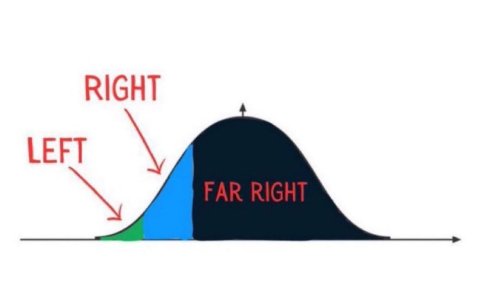
One of the most corrosive habits in current political discourse is the way plain factual claims get assigned a partisan label. Not arguments. Not policies. Facts. Or, more precisely, statements that point back to material reality, institutional limits, or ordinary human constraints. In theory, facts are supposed to discipline ideology. In practice, they are often treated as ideological aggression when they obstruct a preferred moral script.
That is what people are reaching for when they say facts are now treated as right-wing. The phrase is blunt, but it points to something real. In a growing number of disputes, especially around sex, gender, speech, and institutional policy, a person can say something materially true and be treated not as a participant in debate but as a moral suspect. The point is not answered on its merits. It is recoded as a signal of contamination. The speaker is no longer heard as describing reality. He is heard as choosing a tribe.
That shift matters because it changes the structure of argument. Once a factual claim is socially coded as “right-wing,” the burden quietly moves. The question is no longer whether the claim is true. The question becomes why you said it, what kind of person says such things, and who might feel endangered by hearing it. Motive replaces mechanism. Stigma replaces rebuttal. The claim is not refuted so much as quarantined.
You can see this clearly in disputes over sex and pronouns. For many people, saying that sex is real, binary in the ordinary human sense, and not altered by self-declaration is not an act of hostility. It is a claim about reality and a claim about language. “He” and “she” historically track male and female persons. Refusing to detach those words from sex is not, on its face, a partisan performance. It is an attempt to keep public language tethered to the material world rather than to inward identity claims.
“The disagreement is not mainly about politeness. It is about which reality gets public authority.”
That is exactly why the issue generates so much heat. The disagreement is not mainly about politeness. It is about which reality gets public authority. Does language track bodies, or does it track self-declared identity? Does a school treat sex as a stable feature of the world, or does it treat identity assertion as the governing fact? Those are not small etiquette disputes inflated by the internet. They are conflicts about ontology, law, and institutional power.
Canada now offers several live examples. Alberta’s Education Amendment Act requires parental notification when a student requests a gender identity-related preferred name or pronouns, and parental consent for students under 16 before staff may use them. The province says these changes are part of supporting families and setting clear school rules, with the remaining education amendments anticipated to take effect on September 1, 2025. Then, in late 2025, Alberta escalated further. Bill 9 invoked the notwithstanding clause to shield not only this school policy but other contested sex-and-gender measures from being struck down by the courts. That bundling matters. It shows this is no longer being treated as a narrow administrative disagreement, but as a foundational conflict over parental authority, child development, and the public meaning of sex.
Quebec presents the same fracture from the opposite direction, and it is ongoing now. Current reporting says a Montreal teacher is challenging the provincial policy that allows students 14 and older to change the name and pronouns used at school without parental consent. The teacher alleges she was required to use male pronouns at school while using female pronouns with the student’s parents. A preliminary hearing on anonymity and confidentiality was held on March 6, 2026, with the broader merits challenge still to come. Strip away the activist packaging and the conflict becomes plain: can institutional professionals be required to maintain two vocabularies of reality depending on the audience, and if they object, are they making an ethical argument or committing a moral offense?
The Barry Neufeld case in British Columbia shows the institutional end point of this logic. On February 18, 2026, the B.C. Human Rights Tribunal issued its decision and ordered substantial damages after finding that multiple publications were discriminatory, while some crossed the threshold into hate speech. That does not prove that every factual objection to gender ideology is punishable. It does show how readily dissent can be processed through systems that move from moral condemnation to formal classification. Once that line is crossed, everyone watching understands the lesson. The risk is no longer simply that you will be called wrong. The risk is that you will be treated as a public contaminant.
This is why the familiar “both sides are just choosing different facts” formula goes soft in exactly the wrong place. The conflict is not symmetrical. One side is generally making claims about bodies, language, legal authority, and institutional procedure. The other is often demanding that those things yield to identity-based recognition norms. Dignity is real and relevant. But dignity does not erase biological category, dissolve observable sex, or transmute factual disagreement into literal violence.
So when people say facts are treated as right-wing, the point is not that truth literally belongs to one side of the spectrum. The point is that in a culture saturated with moral performance, inconvenient facts are often recoded as partisan because it is easier to stigmatize them than to answer them. A factual claim that disrupts the script is no longer processed as description. It is processed as dissent. And dissent, under current conditions, is increasingly treated as a character defect.
Facts do not have a party. But when facts obstruct an ideological narrative, that narrative will often brand them right-wing and move straight to motive-policing. That is not a sign that the facts have changed. It is a sign that too much of public discourse has become allergic to reality when reality refuses to flatter the creed.
References
Government of Alberta. “Supporting Alberta students and families.”
https://www.alberta.ca/supporting-alberta-students-and-families
Government of Alberta. “Protecting youth, supporting parents, and safeguarding female sport.”
https://www.alberta.ca/protecting-youth-supporting-parents-and-safeguarding-female-sport
Global News. “Montreal teacher challenges policy for trans students to hide identity from parents.” March 6, 2026.
https://globalnews.ca/news/11719392/montreal-teacher-trans-students-challenge/
British Columbia Human Rights Tribunal. Chilliwack Teachers’ Association v. Neufeld (No. 10), 2026 BCHRT 49. February 18, 2026.
https://www.bctf.ca/docs/default-source/for-news-and-stories/49_chilliwack_teachers-_association_v_neufeld_no_10_2026_bchrt_49.pdf?sfvrsn=2d847803_1











 bleatmop
 Mystro
 The Arbourist


 Dead Wild Roses
Your opinions…