
Canada did not need less concern for possible graves at former residential schools. It needed more truth, earlier. The residential school record contains real wrongs: family separation, cultural suppression, abuse, neglect, disease, and documented deaths. But when the Kamloops announcement broke in 2021, the public story moved very quickly from ground-penetrating radar findings to language of “discovered remains” and “mass graves.” That distinction mattered. Ground-penetrating radar does not find bodies. It identifies disturbances, anomalies, and possible grave-like features that require verification.
The mechanism is familiar: narrative hardened faster than evidence. Grief became certainty. Certainty became accusation. Accusation became permission. A country already primed to view churches as historical villains suddenly had a simple moral script: children had been found, churches were responsible, rage was righteous. After that, Canada saw a wave of church fires and vandalism. A CBC investigation later reported that at least 33 Canadian churches had burned to the ground since May 2021; 24 were confirmed arsons, two were ruled accidental, and the remaining cases were suspicious or under investigation.
That caveat matters. We should not replace one sloppy narrative with another. Not every burned church was necessarily revenge for residential schools. Not every vandal was acting from the same motive. Some Indigenous leaders condemned the arsons, and some churches destroyed or damaged were themselves part of Indigenous communities. But it is also dishonest to pretend the atmosphere had nothing to do with it. The grave announcements were absorbed into a wider moral panic, and churches became symbols onto which anger could be poured.
This is the disservice. Public institutions, media, and political leaders helped sanctify a narrative before the evidence was ready to carry it. Then, when churches burned, the response was often strangely muted, hedged, or morally embarrassed. The same society that had no trouble speaking in grand certainties about historical guilt suddenly discovered nuance when actual churches were being attacked.
The answer is not denial of residential-school harms. It is truth over narrative, regardless of whose narrative is being protected. Children suffered. Families were broken. Some children died. Some claims also outran the evidence. A serious country should be able to say all of that at once. If Canada wants reconciliation rather than ritualized accusation, it has to stop treating careful factual distinctions as blasphemy. Truth does not become less necessary because the cause is emotionally powerful.
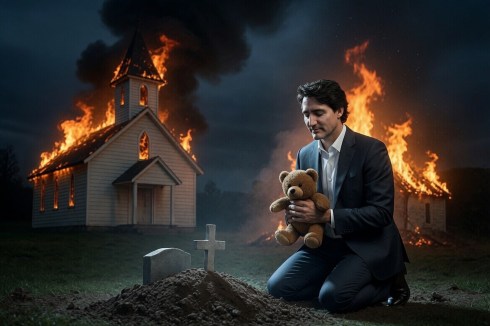
Canada needed truth, not ritual certainty. When narrative outran evidence, churches became symbols for rage.
Works Referenced
Tk’emlúps te Secwépemc. “Remains of Children of Kamloops Indian Residential School Discovered.” May 27, 2021.
https://tkemlups.ca/wp-content/uploads/05-May-27-2021-TteS-MEDIA-RELEASE.pdf
Sarah Beaulieu. “Ground-Penetrating Radar Preliminary Survey: Kamloops Indian Residential School.” Canadian Archaeological Association PDF.
https://canadianarchaeology.com/sites/default/files/page/gpr_at_kamloops_irs_sarah_beaulieu.pdf
Tk’emlúps te Secwépemc. “Media Release.” July 15, 2021.
https://tkemlups.ca/wp-content/uploads/July15_Media-Release_Final.pdf
Terry Reith, CBC News. “At least 33 Canadian churches have burned to the ground since May 2021. So far, 24 are confirmed arsons.” January 10, 2024.
https://www.cbc.ca/news/canada/edmonton/church-fires-canada-1.7055838
Angelus News. “Report: 33 churches in Canada destroyed since May 2021.” January 17, 2024.
https://angelusnews.com/news/nation/canada-churches-destroyed/
CBC News. “‘Unacceptable and wrong’: Trudeau condemns attacks on churches.” July 2, 2021.
https://www.cbc.ca/news/politics/trudeau-churches-arson-attacks-1.6088237











 bleatmop
 Mystro


 Dead Wild Roses
2 comments
Comments feed for this article
June 14, 2026 at 8:04 am
tildeb
“The residential school record contains real wrongs: family separation, cultural suppression, abuse, neglect, disease, and documented deaths.”
There you go again, doubling down on this ridiculous narrative as if it describes a system. That belief is based on an absolute fiction. In every case of this list, what you say here was extraordinarily rare and exactly the reverse to the typical and daily Indian Residential School experience. Zero balance.
For example, 150,000 students over 130 years attended. The ‘documented deaths’ were exactly that: well documented for cause and the vast majority were related to tuberculosis at a rate that was a FRACTION of what children from reserves suffered, not by some governmental malfeasance but by a very real killer of all children in the country. Zero ‘missing’ bodies. The total was about 3300, which works out to – grab your socks – 3 a year for a national schooling program, which was well BELOW comparison to the reserves themselves. IRS were a step UP for the health and welfare of children. Not down. Where is that made clear in any of this writing?
When it comes to “family separation,” think ‘English Boarding School’ to which the Indians – like British parents throughout the Empire – had to APPLY. Not children tripped out of the arms of wailing mothers by RCMP officers as modern ‘culture’ likes to pretend but by the almost equally horrendous bureaucratic nightmare of paperwork and organizing transportation. Oh, that evil British government and those evil British parents. Genocide, I tell you. English school survivors one and all.
When it comes to “cultural suppression”, remember that the purpose was to meet an indigenous request, to provide schooling and training for indigenous children (to fit and succeed in the modern world as tens of thousands of graduates DID rather than try to live in the past) and NOT the other way around. When Alberta residential schools were closed early in the 20th century, over 50 chiefs went to Ottawa to plead their cases and reopen them. Remember, none of these tribes would have a written language without this institution, without staff dedicated to keeping these cultures alive in the youth. Mandatory attendance was for on site reserve schools (where numbers warranted) and not the often displayed and endlessly repeated IRS writ large, where ‘enforcement’ was simply not practiced (hence, why only 1/3 of ALL eligible indigenous children ever attended). The supposed ‘suppression’ of culture repeated in the OP as if fact when it is a fiction was staffed where possible by tribe members and where English or French was implemented inside the classroom tom prepare the students for the real world but not outside on the playground, not in the hallways, not in the residences. Just read the accounts. The most evil and infamous school in Kamloops sent dancers, musicians, artists, and sports teams on European and central American tours, the money raised from local fundraisers in Kamloops by those evil colonizers who held yearly public parades, events, and venues to enable the cultural celebrations of the local indigenous population. When a young girl in her first year of residence at the Kamloops school died in the very cold waters of the nearby river, an Olympic sized swimming pool was installed. These are not the actions, investments, expressions, and daily life consistent with the above listed narrative. Read the account of worldwide success of people like Thompson Highway. He’s one of thousands. All these accounts are easily available to those who actually want to know more about the Indian Residential School system than the religious chanting about its horrors. But you will find neither hide nor hair of such from the TRC.
Those who continue to double down on the negative narrative unsupported by compelling evidence but bought and paid for by taxpayers and skewed so very badly by the agenda brought into the Truth and Reconciliation Commission’s final report (the original Commissioners replaced by activists), without understanding the difference between outliers and norms, unwilling or unable to compare and contrast like with like, for those who seek no appreciation between the highly selective, often imaginary, and negative ‘testimonials’ they put on display (again, the worse the reported ‘abuse’ the greater the financial reward in the tens and hundreds of thousands of dollars in ‘compensation without any require of ANY evidence to support these, ‘testimonials’ that today are continued to be used to supposedly ‘prove’ malignant intent by Canadians and their elected governments through the institution of the IRS. It’s a narrative that does not link to truth but empowers an entire multibillion dollar a year grievance industry and calls it ‘reconciliation’ rather than graft. More easily digested by the ignorant population paying for it, donchaknow.
I could go on and on and on about the fictions raised because I have real world access to many who attended and laugh at the gullibility of ‘white’ Canadians who think no having a clue is a sign of virtue, and have read widely the work done by those who stand by what’s true. And that sure as hell isn’t Artificial Intelligence based on large language models filled to the brim with false accusations, very little evidence in its favour, and overwhelming evidence contrary to it… for those willing to LOOK.
LikeLike
June 14, 2026 at 8:50 am
The Arbourist
Tildeb,
I think there are two different errors here, and I am trying not to commit either one.
The first error is the maximalist popular narrative: every child was physically seized, every school was a death camp, every grave claim has been proven, and every residential-school experience can be reduced to horror. I do not believe that. I agree that parental applications existed, that some Indigenous leaders wanted schooling, that enforcement varied by period and region, that many students survived and succeeded, and that the Kamloops “mass graves” story outran the evidence.
That was the point of the article.
But the second error is your counter-narrative: because the maximalist version is false, the whole record of family separation, cultural suppression, neglect, disease, abuse, and documented deaths is supposedly fiction. That does not follow.
“Not every child was forced” does not mean coercion was absent. “Some parents applied” does not mean all attendance was ordinary voluntary boarding school. “Some students had good experiences” does not erase those who did not. “Tuberculosis was widespread” does not erase school conditions that worsened disease spread. “Kamloops has not produced confirmed bodies” does not mean the residential-school death record disappears.
Your death arithmetic is also wrong. If we use roughly 3,300 documented deaths over 130 years, that is about 25 deaths per year, not 3. And the more important question is not the annual average across the whole life of the system, but death rates by period, age, school, and comparison group. The TRC’s Missing Children volume found that residential-school death rates were significantly higher than general Canadian school-aged death rates until the 1950s. That does not prove murder. It does not prove every claim. But it does defeat the breezy claim that there was nothing institutionally serious to answer for.
I am perfectly willing to grant the dissident/revisionist point where it is strongest: the public narrative after Kamloops became sloppy, moralized, and factually premature. “GPR anomalies” became “discovered remains.” “Possible graves” became “mass graves.” That distinction mattered, and the churches paid a real price in vandalism and arson.
But I will not correct exaggeration by adopting denial. The honest position is more difficult: residential schools were not the cartoon horror sometimes presented in activist rhetoric; they were also not benign boarding schools cruelly maligned by modern grievance politics. They were state-funded, church-run institutions embedded in an assimilationist policy framework, and their record includes real harms alongside complexity, variation, and some positive testimony.
That is the distinction I am trying to preserve: truth over narrative, including narratives I find emotionally or politically convenient.
LikeLike